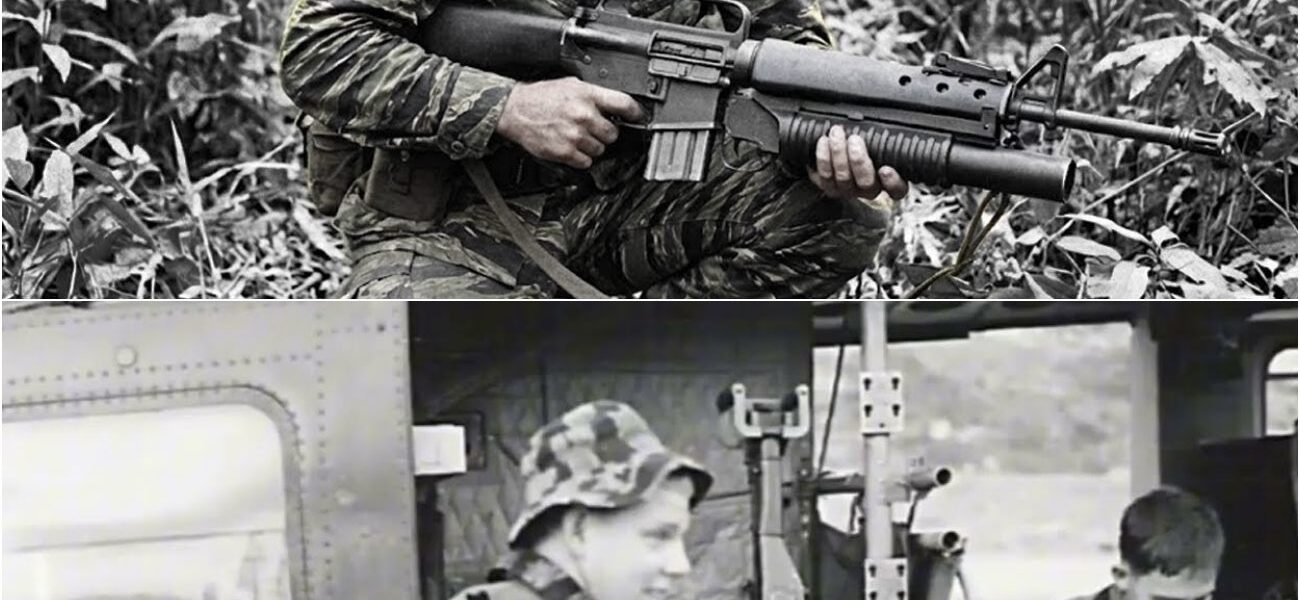

Why LRRPs Wore Tiger Stripe Camouflage (And Why It Worked)
May 4th, 1967. 1400 hours. Quantum Province, Central Highlands. The heat stands at 98 degrees with humidity pushing the air density into something that feels like wet wool. Five men lie motionless in a thicket of elephant grass and bamboo. They have not moved a muscle for 4 hours. They are Americans, but they do not look like the soldiers seen on the evening news back in Ohio or California.
There are no steel helmets, no flack jackets, no heavy rucks sacks burdened with creature comforts. Their faces are painted in erratic patterns of lom and green grease. But the most striking detail is their skin, or rather what covers it. They are not wearing the standard issue olive drab fatigues that define the United States Army.
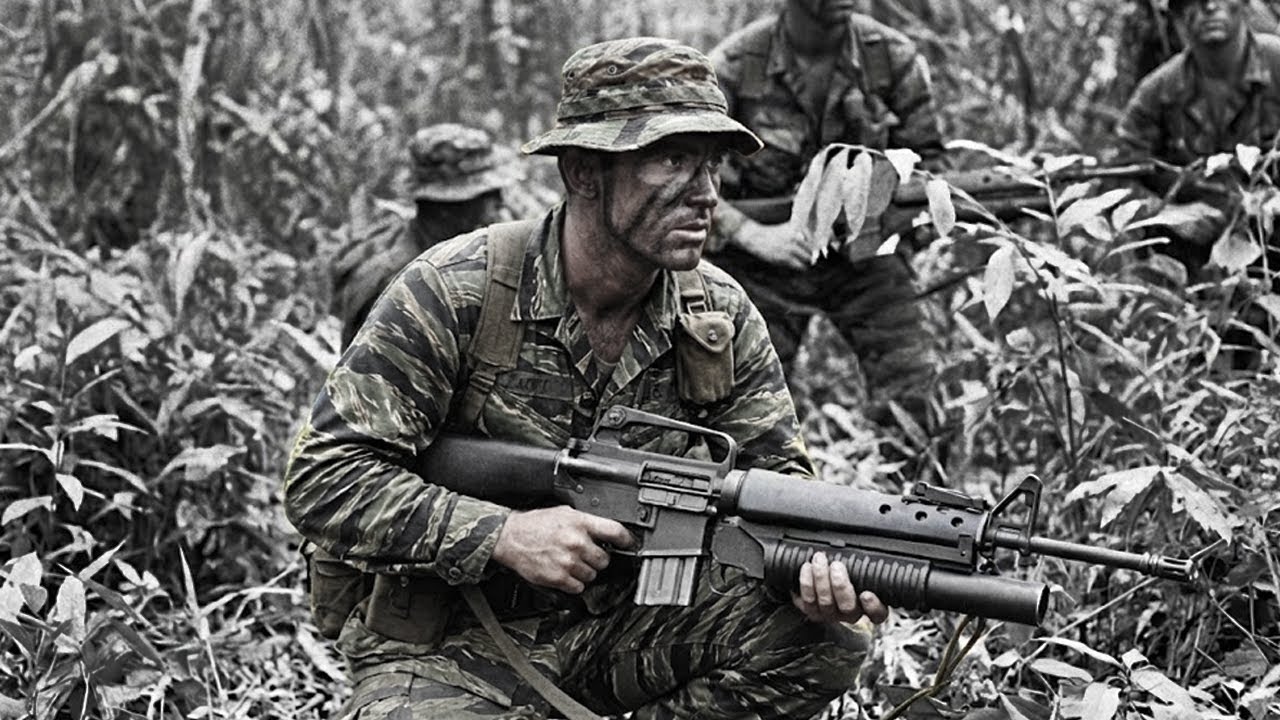
They are draped in a chaotic jagged pattern of black, green, and brown brush strokes. Horizontal stripes that mimic the interplay of shadow and light filtering through the triple canopy. 10 meters away, a North Vietnamese Army squad moves down a game trail. They are looking for Americans. They are looking for the silhouettes of steel pots and the solid blocky shapes of green uniforms that turn black when soaked in sweat.
The NVA point man scans the bamboo. His eyes pass directly over the five men. He sees nothing. He sees vines. He sees shadows. He sees the chaotic texture of the jungle floor. He does not see team 22 of the first cavalry division’s long range reconnaissance patrol. The enemy squad passes. The Americans begin to breathe again.
This invisibility was not standard issue. It was not authorized by the Pentagon. It was not in the supply manuals. It was scavenged, bought, and modified by men who realized a terrifying truth about modern warfare. In the jungle, the standard uniform was a death sentence. To survive the reconnaissance war, you had to become the jungle. You had to wear the tiger.
This is the story of how a piece of cloth became the most coveted, controversial, and effective tool in the arsenal of the Vietnam Wars elite. It is a story of logistics, physics, and the psychology of survival. This is why they wore the stripe. To understand the revolution of the tiger stripe, we must first understand the massive rigid machine it rebelled against.
1965, the United States ramps up its commitment. The logistical footprint is staggering. Millions of tons of supplies are shipping from San Francisco and San Diego to Cameran Bay. The United States Army is an institution built on uniformity. It is in the name, the uniform. The goal of the quartermaster corps is to provide a standardized, durable, and mass-producible set of clothing for millions of men.
The result was the OG 107, the olive green shade 107. It was a simple, utilitarian combat uniform made of heavy cotton satine. In the pine forests of Georgia or the plains of Germany, the OG 107 was adequate. It was green. Nature was green. The logic held up in the Pentagon. But Vietnam is not a pine forest.
Vietnam is a kaleidoscope of contrast. It is not a solid wall of green. It is a chaotic mix of brown rot, black shadows, bright green leaves, yellow bamboo stalks, and gray limestone. When a soldier wearing solid olive green enters this environment, a phenomenon known as blobbing occurs. The human eye is a predator’s tool. It is designed to detect anomalies.
It looks for solid blocks of color that do not exist in nature. When the OG 107 gets wet, and in Vietnam you are always wet, either from the monsoon or from sweat, the cotton satine darkens. It turns a deep solid forest green, almost black against a background of vibrating sundappled foliage. A wet American soldier looks like a solid black hole, a silhouette.
You can see a soldier in OG 107s from 300 m away if the light is right. For a regular infantry battalion maneuvering with 500 men, relying on firepower and artillery, camouflage is secondary. They are not hiding. They are searching and destroying. But for the long range reconnaissance patrol or LRP, the equation is inverted.
A LRP team consists of four to six men. They are dropped by helicopter deep into enemy territory far beyond the umbrella of friendly artillery. They are outgunned 100 to1. Their mission is not to fight. It is to watch, to count trucks, to locate base camps, to snatch a prisoner. If they are seen, they die.
In 1965 and 1966, the early LRP detachments realized that the standard issue uniform was getting them spotted. They needed to break up the human outline. They needed something that mimicked the horizontal chaos of the bamboo thicket. They looked at their allies. They looked at the South Vietnamese Marines and they saw the Tiger.
The origins of the tiger stripe pattern are not found in American research labs but in the desperate colonial rear guard actions of the 1950s. The French fought in Vietnam for nearly a decade before the Americans arrived. The French paratroopers the paras wore a camouflage pattern called tenu du leopard or lizard pattern.
It was a chaotic mix of brushstrokes designed for the scrubland of Algeria and the jungles of Indochina. When the French left in 1954, the South Vietnamese Army, the ARVN, inherited the stocks. They also inherited the manufacturing capabilities. Local Vietnamese tailor and textile factories began to modify the French lizard pattern.
They tightened the stripes. They added more black. They tweaked the greens to match the brighter foliage of the Highlands. The result was a pattern that looked like a tiger’s coat viewed through a prism. black stripes, brown undertones, bright green traces. It was aggressive. It was distinct. And for the early American advisers who arrived in the early 60s, it was the mark of a veteran.
But the US Army did not issue it. If a LRP wanted tiger stripes, he had to go outside the wire. This created a unique microeconomy within the war. A newly minted LRP member fresh from the Rondo school in Natrang would not go to the supply sergeant for his gear. He would go to the local market.
He would go to the tailor shops in Saigon, Daang or outside the gates of Camp Holloway. He would pay for his uniform with his own money. The price varied. In 1966, a set of tiger stripes might cost $10. By 1969, as inflation hit the South Vietnamese economy, it could cost 20 or 30. This transaction changed the relationship between the soldier and his gear.
The OG 107 was government property. You turned it in when it ripped. You didn’t care about it. The Tiger Stripe was personal property. Because they were custommade, the LRRPs began to modify them. This is where the uniform ceased to be clothing and became a survival system. A standard US Army shirt had two chest pockets, flat, hard to access if you were wearing a harness.
The LRPS instructed the Vietnamese tailor to move the pockets. They put small pockets on the upper sleeves to hold cigarettes, morphine cigarettes, or a signal mirror. They added a pocket on the lower leg for a bandage. They reinforced the knees and elbows. They had the shirts taken in to prevent loose fabric from snagging on the wait a minute vines.
This was gear evolution happening in real time, driven by the consumer, not the manufacturer. But the most critical aspect was the pattern itself. Let us look at the visual physics of why tiger stripe worked where olive drab failed. Camouflage works on two principles, blending and disrupting. Blending is matching the colors of the background.
If the wall is beige, you wear beige. Disrupting is breaking up the outline of the object so the brain cannot recognize it as a human. The human brain relies on edge detection to identify objects. It looks for the curve of a shoulder, the straight line of a leg, the oval of a helmet. The tiger stripe pattern utilizes a concept called disruptive coloration with high frequency noise.
The broad black stripes break up the macro shape of the body. At 50 m, the black stripes look like deep shadows between trees. The lighter green and brown shapes look like foliage. The result is that the human form dissolves. When a LRP in tigers lies prone in a bamboo thicket, the horizontal stripes of the uniform align with the horizontal shadows of the bamboo nodes.
The soldier disappears into the visual frequency of the environment. There is a famous photograph from 1968. A LRP team from the 101st Airborne is moving through tall grass. The man in the front is wearing tiger stripes. The man in the back is wearing standard OG 107s. The man in the back is a dark, distinct blob.
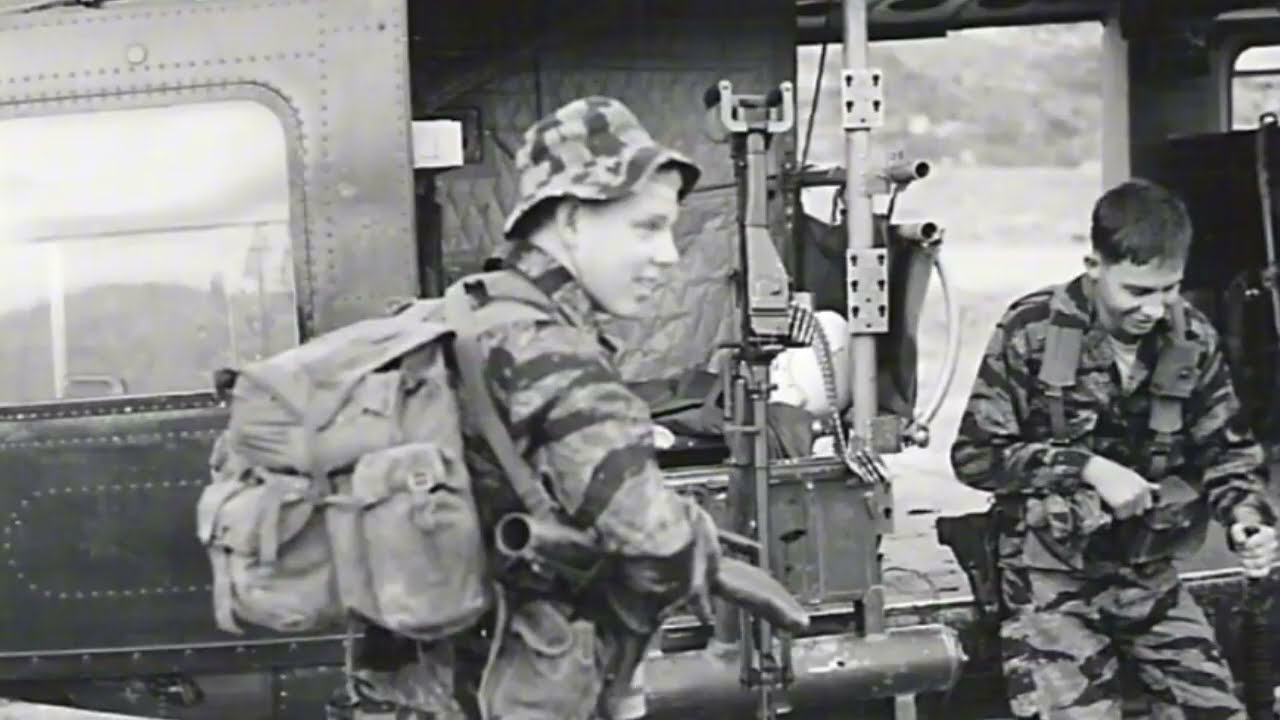
The man in the front is a ghost. You have to squint to see where his arm ends and the grass begins. That split second of hesitation, the enemy looking and not recognizing, was the difference between a successful ambush and a compromise. But there was another layer to the Tiger Stripe. A layer that had nothing to do with physics and everything to do with psychology.
It was the look of the hunter. By 1967, the US Army in Vietnam was divided into two distinct casts. There were the legs, the grunt infantry, the men who humped the boonies in large battalions, ate sea rations, and wore the standard green uniforms. And then there were the elites, the special forces, the seals, and the LRPS.
Wearing tiger stripes became a status symbol. It was a visual shortorthhand that said, “I go where you do not go. I fight alone.” The North Vietnamese Army knew this, too. Intelligence reports from captured enemy officers revealed that NVA units were instructed to look for the men in the spotted uniforms. They knew these were not drafties.
They knew these were the reconnaissance specialists who brought the air strikes. NVA snipers were often told to prioritize the men in tigers. This created a strange paradox. The camouflage made you invisible to the eye, but highly visible to the culture. In the rear areas at the base camps, a man walking in tiger stripes drew stairs.
He walked with a different swagger. The command hated it. To the highranking officers in Saigon, who obsessed over discipline and uniformity, the Tiger Stripe was an eyesore. It was nonregulation. It looked paradical. General West Morland and later General Abrams issued periodic directives trying to ban non-standard uniforms. They wanted everyone in the OG 107 or the later jungle fatigues, but the LRPS ignored them.
Or their immediate commanders, the captains and majors who relied on their intelligence, looked the other way. You don’t tell a man who is going to crawl into an NVA base camp armed only with a rifle and a radio that his shirt is the wrong shade of green. So, the tiger stripe stayed. Let’s zoom in on the specific timeline of the pattern’s evolution, because not all tigers were created equal.
Collectors and historians today identify over a dozen distinct variations of the tiger stripe pattern made in Vietnam between 1964 and 1975. There was the John Wayne dense, a pattern where the stripes were thick and crowded together. There was the tadpole sparse, a pattern where the shapes looked like swimming tadpoles and there was more open green space.
There was the golden tiger, a late war variation where the fabric faded to a distinct golden yellow hue, which surprisingly worked incredibly well in the drying bamboo of the dry season. These variations happened because there was no central factory. There were dozens of small textile mills in Cholon and Daang printing these fabrics on cheap cotton.
The dots were inconsistent. The printing rollers were hand cut. This inconsistency actually helped. In nature, nothing is perfectly repeated. A mass-produced US Army camouflage pattern like the ERDL pattern introduced later in the war repeated its pattern every vertical 18 in. The eye can subconsciously pick up that repetition.
The Tiger stripes were chaotic. They were messy. And that messiness mimicked the anarchy of the jungle floor. However, there was a flaw. The material. The US Army OG 107s were tested for durability. They were roted. They were designed to survive the rot of the tropics. The cheap cotton used by the Vietnamese tailor was not.
A LRP might buy a set of Tigers, wear them on two patrols, and find them disintegrating. The crotch would blow out, the seams would rot, the fabric would tear on the sharp elephant grass. This led to the sterile uniform phenomenon. LRPS would often take their tiger stripes and have them reinforced with canvas or even pieces of US parachutes.
They would sew shut the pockets they didn’t use. But the most dangerous aspect of the cheap fabric was the noise. Cheap starched cotton makes a swish swish sound when wet legs rub together. In the silence of the jungle, that sound is as loud as a shout. Veterans speak of spending hours washing their new tiger stripes, weighing them down with rocks in a stream, trying to break down the fibers to make them silent.
They would rub them with sand. They had to age the uniform before they could wear it to war. Let’s go back to the field. November 1968, the AA Valley. A six-man LRP team from the 100 First Airborne is inserted into one of the most hostile valleys in the country. The AHA is the NVA’s highway. The team leader is Sergeant Ken Miller.
He is wearing a set of tadpole dense tiger stripes he bought in hue. He has modified them, removing the lower pockets and sewing a signal panel into the inside of the hat. The team is moving up a ridge line. The vegetation is thick. Wait a minute. Vines and sharp bamboo. They stop. The pointman signals movement.
30 meters away, an NVA porter column is moving supplies. They are carrying rice bags and RPG rounds. The LRP team freezes. They melt into the ground. The tiger stripe pattern breaks up the outline of Miller’s shoulder as he leans against a teak tree. The black stripes on his sleeve merge with the dark bark of the tree.
The green matches the moss. He is in plain sight technically, but he is optically absent. The porters pass. They are talking, smoking cigarettes. They are confident they are alone. Miller counts them 12, 15, 20. He whispers into the handset of his PRC 25 radio. He is calling for blue max aerial rocket artillery. If Miller had been wearing solid green, that first porter might have seen the dark block of color.
The firefight would have started at 30 m, six men against 20. The Americans would likely be overrun before the choppers could crank their engines. But the camouflage buys time. And in the recon game, time is the only currency that matters. Time to count, time to call, time to kill. This effectiveness created a feedback loop. The more the LRPS returned alive, the more the legend of the Tiger Stripe grew.
It began to bleed out of the recon community. Infantry officers started buying them for their rear echelon wear. CIA field officers wore them. Even the US Air Force par rescue jumpers, the PJs, adopted them. It became the symbol of the indigenous warrior. The American who had adapted to Vietnam rather than trying to pave it.
But as the war dragged on, the US military-industrial complex tried to catch up. They saw the effectiveness of the Tiger Stripe and they tried to standardize it. They developed the ERDL pattern, the engineering research and development laboratories pattern. It was a good pattern. It was a mix of lime green, forest green, brown, and black.
It was printed on highquality riptop popppllin. It was durable. It held its color. The army began issuing erdl to the Marines and the special forces in 1967 and 1968. Technically, on paper, erdl was a better fabric. It didn’t rot. It dried faster. But many LRPS refused to switch. Why? Because erdl was still too green.
It lacked the aggressive black striping of the tiger. In the deep, deep triple canopy where the sun barely reaches the floor, the world is not green. It is black and gray and brown. The tiger stripe with its bold artificial black brush strokes match the deep jungle shadow better than the scientifically designed American pattern. And there was the cool factor.
You couldn’t issue cool. Erdloo like a uniform. Tiger stripe look like a predator’s skin. There is a psychological component to camouflage that goes beyond optics. It is about how the soldier feels. When a man puts on a suit and tie, he feels civilized. When a LRP put on his paint and his tigers, he felt dangerous.
He felt separate from the rules of civilization. This separation was necessary. They were asked to do things that civilized men do not do. They were asked to hunt men at close range, often using knives or silenced weapons to avoid compromising the team. The Tiger Stripe became the uniform of that grim reality. Let’s look at the numbers of supply.
By 1969, there were approximately 500,000 American troops in Vietnam. The vast majority, 95%, never wore tiger stripes. The Tigers were a minority. Maybe 10,000 to 20,000 men at any given time across the entire theater were wearing non-regulation camouflage. Yet if you look at the cultural memory of the war, if you look at the movies, the books, the tiger stripe is everywhere.
It punched above its weight class in memory just as it did in the field. We have established the what and the how. Now we need to look at the who in more detail and the specific mechanics of a patrol that relied on this camouflage. We need to understand the visual game of cat and mouse played in the Asha Valley in the war zone C. We need to see what happens when the camouflage fails and what happens when it works too well.
In the deep jungle, distance is a lie. On a map, a kilometer is a thousand m. In the central highlands, a kilometer is 4 hours of chopping through bamboo thicket so dense they block out the sun at noon. But the most important distance in the Vietnam War was not measured in kilome. It was measured in feet.
The average engagement distance for a regular infantry unit was roughly 30 to 50 m. For a LRP team, the desired engagement distance was zero. They wanted to be close enough to touch the enemy without being seen. If they were shooting, they had already failed the primary mission. To understand why the Tiger Stripe pattern was not just a fashion statement, but a piece of survival engineering, we have to look at the optics of the 5 War.
June 14th, 1969. War Zone D. A six-man team from Company F1st Infantry Longrange Patrol is set up in a linear ambush position. They are not there to ambush. They are there to observe a trail intersection. They have been static for 6 hours. When a human being remains perfectly still for 6 hours, the mind plays tricks.
The jungle floor seems to breathe. Shadows detach themselves from trees. But then the shadows sharpen. An NVA reinforced platoon, roughly 40 men, appears on the trail. They are moving fast. They are confident. They are wearing their standard khaki uniforms, pith helmets, and carrying AK-47s slung over their shoulders.
They walk right into the kill zone. The LRP team leader, a 21-year-old sergeant named Martinez, is lying in the prone position behind a fallen teak log. He is wearing a faded set of John Wayne dense tiger stripes. The point man of the NVA column stops. He is 5 ft away from Martinez. The NVA soldier looks down. He is looking for a trip wire.
He is looking for the unnatural shine of a claymore mine’s plastic casing. He looks directly at Martinez, but he does not see a man. He sees a pile of rotting leaves. He sees the dark striations of the log. The tiger stripe uniform covered in the red dust of the zone and the sweat of the day has completely disrupted Martinez’s outline.
The black stripes on Martinez’s shoulder link up visually with the dark bark of the teak log. The brain of the NVA soldier connects the two and categorizes them as one object, log. He steps over Martinez. The boot of the North Vietnamese soldier lands inches from the American’s face. The rest of the column follows.
40 men walk past six Americans. Not a shot is fired. This is the negative space theory of camouflage. standard military camouflage of the era and even today often focuses on positive space. It tries to look like a leaf. It tries to look like a branch. Tiger stripe focused on the space between the leaves. It mimicked the shadow.
It mimicked the void. In the high contrast lighting of the jungle, where sunlight punches through holes in the canopy like a spotlight, the world is defined by these hard shadows. A solid green uniform reflects light. It glows. The tiger stripe absorbs it. The black dye used in the cheap Vietnamese manufacturing process was often carbon-based.
It sucked in light. But this invisibility came with a terrifying cost. The blue on blue. The jungle did not just hide the LRPS from the enemy. It hid them from their friends. And in a war dominated by air power, looking different was dangerous. To a Cobra gunship pilot flying at 100 knots and 1500 ft, the jungle is a green blur.
He is looking for friendlies to protect and enemies to kill. He is trained to look for friendlies as defined by the US Army manual. Steel helmets, large rucks sacks, olive drab uniforms. When he looks down and sees men in strange spotted pajamas, moving stealthily, not wearing helmets, and carrying non-standard weapons, his brain signals enemy.
There are documented incidents of LRP teams frantically popping colored smoke grenades to wave off American gunships that were rolling in on a strafing run. The pilots thought they were Vietkong. This fear led to a specific modification that became iconic to the LRRP look, the signal panel. Because they knew their camouflage worked too well, LRPS would sew a square of bright orange or pink silk into the lining of their tiger stripe boonie hats.
When the team heard the wump wump of an inbound Huey or the wine of a cobra, they would snatch off their hats and wave the bright orange lining at the sky. It was a frantic toggle switch. Hat on, invisible to the NVA. Hat off, visible to the US Air Force. This duality defined their existence. They were operating in the gray zone between friendly and enemy lines, and their appearance reflected that. Let’s analyze the boon hat itself.
The steel M1 helmet was the symbol of the American GI. It stopped shrapnel. It was heavy. It was hot and it was noisy. If a branch hit a steel helmet, it made a clack sound that traveled for 200 m. LRPS discarded the helmet. They wore the soft cover, the boon hat, almost exclusively in tiger stripe.
The boon hat did not stop bullets, but it broke up the most recognizable shape in nature, the human head and shoulders. The brim of the boon hat created an irregular shadow over the face. It distorted the silhouette, but more importantly, it allowed for better hearing. The steel helmet created an echo chamber.
The wind rushed over the steel pot. The soft hat allowed the jungle sounds to filter in, and sound in the deep bush was more important than sight. You often heard the enemy long before you saw them. The clinking of a canteen, the cough of a smoker, the slap of a sandal on mud. The Tigerstripe uniform was designed to be quiet. As mentioned, the fabric was often sourced locally, but the LRPS took it further.
They would remove all metal from the uniform. The zippers on the fly removed and replaced with buttons. A zipper makes a distinct zip sound that does not exist in nature. The metal snaps on the pockets, taped over or removed. They were stripping the machine out of their appearance. Now, we must look at the weapons.
A man in full tiger striped camouflage, face painted green and black, is still holding a distinct object, the M16 rifle. The M16 is black. It has hard, straight lines. It has a distinct silhouette that screams rifle. The LRPS realized that the weapon was a dead giveaway, so they extended the camouflage to the gun. They used green duct tape, 100 mph tape.
They wrapped the handguards. They wrapped the stock. They painted tiger stripes on the tape with black marker. This was strictly against regulations. Tampering with the weapon was a court marshal offense in a line unit. In the LRPS, it was standard operating procedure. They were breaking the visual signature of the barrel.
When you point a black rifle at someone, the eye is drawn to it. When you point a modeled green and black object, the eye hesitates. That hesitation is the kill window. But the tiger stripe was not just for the Americans. It is a detail often missed in the history books. But the enemy respected the stripe and they coveted it.
There were instances of NVA Dak Kong, the highly trained sapper units wearing captured Tiger stripes. Imagine the confusion in a firefight. 1970 Cambodia border. A US platoon is hit by a probe. They see muzzle flashes. They see figures running in the wire. The figures are wearing tiger stripes. Cease fire. cease fire. Friendlies in the wire. The lieutenant hesitates.
He thinks it might be a LRP team coming back in. That hesitation allows the sappers to blow the bunker line. The NVA used the Americans elite status against them. If you saw Tiger Stripes, you assumed it was one of us, or at least one of the special ones. This led to a counter tactic. LRP teams began using challenge and passwords that were strictly visual.
If a team was coming in, they would roll their sleeves up or they would wear their boon hat backwards. Visual encryption. The tiger stripe uniform was the base layer of this code. Let’s zoom out to the logistics of the look. How did a LRP actually acquire his gear? We touched on the tailor, but let’s look at the kit. A standard LRP loadout in 1968 was a study in customized lethality.
The base was the Tiger Stripe uniform. Over that they wore the stabo rig, stabilized body or a modified M1956 web gear. They carried 20 magazines of ammunition that is 400 rounds. They carried two court cantens. They carried grenades, claymores, and morphine, but they carried almost no food. Maybe one long range patrol ration, a freeze-dried meal that was the precursor to the modern MRE.
They prioritized ammunition over calories. They prioritized camouflage over comfort. The tiger stripe uniform was often worn without underwear. In the constant wet of the jungle, cotton underwear caused chafing and jungle rot, fungal infections that could take a man out of the war. Going commando in tigers allowed the skin to breathe and dry faster. It was a primal existence.
There is a psychological shift that happens when you strip away the regulation gear. When a soldier is inspected, told his boots must be shined, his shirt tucked in, he is a cog in a machine, he is obeying. When LRP put on his customtailored tigers, untucked, sleeves rolled, he was making a choice. He was asserting agency.
I am wearing this because it works, not because I was told to. This created a fiercely independent culture, the Tiger Stripe Mafia. It annoyed the brass to no end. There are stories of generals landing at fire bases. Seeing a LRP team waiting for extraction and exploding in rage at their unmilitary appearance. The team exhausted, covered in leeches and mud, wearing shredded tiger stripes, would just stare back.
They knew something the general didn’t. They knew that the shiny boots and starched fatigues of the general would last about 45 minutes in the Asia Valley. The tiger stripe was the uniform of the reality of the war versus the theory of the war. And the reality was brutal. Let’s look at the wet season factor. During the monsoon, the rain does not stop for weeks.
The temperature drops. The standard issue poncho was heavy rubberized nylon. It was noisy. It trapped heat. The LRPS often took their tiger stripe whoopies, the poncho liners, and had the tailor sew zippers into them. A lightweight camouflage sleeping bag that dried in minutes. They wrapped themselves in the stripe to sleep. They wore it to fight.
It became their second skin. But by 1970, the war was changing. Vietnamization was in full swing. American units were withdrawing. The golden age of the tiger stripe was ending. The US Army was introducing the jungle fatigue. The slant pocket popplin green uniform. It was excellent. It was comfortable.
And they were pushing the erdl camouflage pattern harder. The supply of authentic tiger stripe fabric began to dry up as the local economy crashed and the American dollars left. The quality of the prints dropped. The late war lightweight pattern appeared. Printed on fabric so thin it ripped if you looked at it wrong. But the legend was already cemented.
The Navy Seals operating in the rungs special zone, the forest of assassins, adopted the tiger stripe. They liked the blue tiger variant where the black was inkier and the greens had a cooler tone fitting the mangrove swamps. The pattern had transcended the army. It had become the universal signifier of special operations in Southeast Asia.
Even the CIA’s Air America pilots wore flight suits made of tiger stripe. It was a brand. But let’s return to the ground to the physics of why it worked one last time. We talked about the blobbing effect of green. There is another effect, the motion parallax. When a solid object moves against a textured background, the eye tracks the solid object easily.
When a textured object moves against a textured background, the eye struggles to isolate the movement. The chaotic stripes of the tiger pattern created a stroboscopic effect. When a soldier moved quickly, it made it hard to track the center of mass. If an enemy soldier raised his AK-47 to shoot a running LRP, he aimed for the center of the torso.
With a solid green target, that center is obvious. With a tiger stripe target, the center is visually broken up by a jagged black slash. The aim point drifts. A miss by 2 in is the difference between a punctured lung and a bullet hitting a rucksack frame. We have anecdotes of LRPS finding bullet holes in the loose fabric of their tiger stripes after a firefight.
The enemy had shot at the edge of the pattern, which was just flapping cloth, missing the body entirely. The uniform acted as a visual decoy. We have established the mastery of the environment. The way the LRPS used the stripe to hack the visual cortex of the enemy, but the war was not static. The enemy adapts.
As the war entered its final violent years, the NVA changed their tactics to counter the invisible men. They stopped looking with their eyes and they started using other senses and they started using dogs. A tiger stripe uniform can hide you from a man. It cannot hide you from a tracker dog.
This forced the LRPS to evolve again. September 12th, 1970. Kum province near the Cambodian border. The visual war is over. The olfactory war has begun. The North Vietnamese army has realized that they cannot see the Americans in the tiger stripes. The pattern is too effective. The shadows are too deep. So they stop looking. They start sniffing.
The NVA begins deploying tracker teams with dogs. Alsations. Mongrels. Dogs do not see patterns. They smell molecules. To a dog, LRP team smells like a chemical spill in a flower shop. Americans smell of processed sugar. They smell of tobacco. They smell of the harsh industrial laundry detergent used on the base.
They smell of the bug juice, the deep insect repellent that burns the nostrils. The tiger stripe uniform could hide a man from a sniper at 20 m. It could not hide him from a dog at 200. This forced the LRPS to alter the chemistry of their camouflage. They stopped washing their uniforms with soap. When a team was prepping for a mission, they would take their tiger stripes crusted with the red clay of the last patrol and wash them in a local stream. No detergent, no bleach.
They wanted the uniform to smell like the water, like the mud. Some teams went further. They would hang their uniforms in the smoke of a woodfire. The carbon smell of wood smoke was natural in the jungle. It masked the ammonia scent of human sweat. They stopped eating American rations 3 days before a patrol. No chocolate, no gum. They ate rice.
They ate fish sauce. They tried to alter their biological output to match the enemies. The tiger stripe uniform became a sponge for the environment. But even with these counter measures, the dogs were a lethal threat. If a team heard the baying of a tracker dog, the mission was aborted. You cannot ambush a nose that has 300 million oldactory receptors.
The tactics shifted from hide to evade. And here the Tiger Stripe played a different role, not as a cloak, but as a confusion multiplier during the escape. When a LRP team makes contact, they do not fight a pitched battle. They execute an immediate action drill. It is a choreographed explosion of violence designed to buy seconds.
The point man fires a full magazine on automatic. The second man throws a white phosphorus grenade. The team peels back, leapfrogging rearward. In this chaotic, high-speed movement, the tiger stripe pattern proves its worth again. As the team runs through the flickering light of the jungle, the chaotic stripes create a visual stutter.
To the pursuing NVA soldiers trying to aim their AK-47s at the fleeing shapes, the Americans look like flickering shadows. The white phosphorous smoke mixes with the black stripes of the uniform. The target dissolves. It is harder to hit a blur than a block. This optical friction saved hundreds of lives during the break contact drills of 1970 and 1971.
But while the LRPS were perfecting the art of the primitive, the US Army was trying to solve the problem with high technology. This contrast defines the schizophrenia of the Vietnam War. In the sky, the Americans were flying F4 Phantoms, dropping laserg guided bombs. They were dropping acoustic sensors.
Operation Igloo White, trying to listen to the jungle electronically. On the ground, the best soldiers in the army were wearing pajamas made by local tailor and rubbing garlic on their boots to confuse dogs. The people sniffer, the XM2 personnel detector. It was a machine mounted on a helicopter that detected the ammonia in human urine.
The army flew it over the jungle to find the NVA. It was the technological equivalent of the tracker dog. But the LRPS hated it because it didn’t work. It detected monkeys. It detected water buffalo. And it gave away their position because the helicopter was loud. The LRPS trusted the cloth. They trusted the stripes. They trusted the silence.
Let’s look at the psychology of the stripe. In the late war period, by 1971, the morale of the US Army in Vietnam was collapsing. Drug use was up. fragging. The murder of officers was up. Combat refusal was real. The army was fracturing. But the LRP units, now redesated as rangers in many divisions, maintained their discipline.
Why? Identity. The tiger stripe uniform was the flag of their tribe. In a sea of demoralized drafties wearing peace signs on their helmets, the Rangers and their faded tigers stood apart. They maintained a cult of professionalism. You earned the stripes. You didn’t get drafted into them. You had to volunteer. You had to pass the Ricondo school.
This exclusivity kept them fighting when the rest of the war was winding down. There is a famous psychological concept in clothe cognition. It states that the clothes you wear influence your psychological processes. When a 19-year-old kid from Detroit put on that tiger strip shirt, he wasn’t a drafty anymore. He was a hunter.
He stood straighter. He moved quieter. He became the role he was dressed for. The uniform did not just camouflage the body, it armored the mind. But the machine was running out of steam. As the Americans withdrew, the supply of tiger stripes vanished. The local economy of South Vietnam was collapsing. The textile mills that printed the fabrics were shutting down or running out of dye.
The late war patterns became erratic. The blacks turned purple. The greens turned into a weird neon shade. The fabric became paper thin. Veterans speak of hoarding their good sets from 1968, stitching and restitching them until they were more thread than cloth. They refused to wear the standard issue jungle fatigues.
To wear the green was to be regular. To be regular was to be a target. Let’s examine a specific operation where the tiger stripe played a crucial role in a massive intelligence coup. May 1970, the Cambodian incursion. The US Army invades Cambodia to destroy the NVA sanctuaries. A LRP team from the First Cavalry Division is dropped ahead of the armored columns.
Their job is to find the city, the mythical NVA logistics hub. The team is wearing heavy tadpole patterned tigers. They move through a bamboo forest that has been bombed by B-52s. The terrain is a nightmare of shattered trees and craters. The tiger stripe pattern with its jagged broken lines matches the shattered landscape perfectly.
They find it the city. It is a massive complex of bunkers, training centers, and mess. It is empty. The NVA have fled. The team moves into the enemy base. They are walking through the NVA messaul. There is rice still cooking in the pots. Suddenly, a rear guard NVA squad returns to retrieve documents. The LRP team freezes in the shadows of the bunker entrance.
The NVA soldiers walk within 10 ft of them. The gloom of the bunker combined with the black dominant tiger stripes turns the Americans into part of the wall. The NVA grab the papers and leave. The team calls in the coordinates. The resulting air strikes and capture of supplies set the NVA back 6 months. They survived because they blended into the enemy’s architecture.
The Tiger Stripe was not just for the jungle. It worked in the ruins. It worked in the bunkers. It worked wherever there was chaos and shadow. But there is a darker side to the story. The impostor threat. As the US pulled out, the ARVN, South Vietnamese Army, took over the fight. Many ARVN units, particularly their Rangers, wore tiger stripes.
The NVA began to use this confusion aggressively. During the Easter offensive of 1972, NVA sappers dressed in captured ARVN Tiger Stripes to infiltrate fire bases. The uniform that had identified the elite American was now being used to kill his allies. The symbol had become a weapon of deception. Let’s analyze the data of survival. There are no official army studies comparing casualty rates of LRPS in Tiger Stripes versus OG 107s.
The Army didn’t study what it didn’t officially issue. However, we can look at the compromise rates. Anecdotal data from Raondo school after action reports suggests that teams wearing tiger stripes were detected later in the engagement sequence than teams wearing green. In an ambush, seconds equal survival.
If the enemy sees you at 2 seconds, you might die. If they see you at 5 seconds, you might live. The Tiger Stripe bought those 3 seconds. It bought the time to raise the rifle. It bought the time to click the transmitter. It was a piece of cloth that manipulated time. But by 1973, the Americans were gone. The Tiger Stripe remained.
It was left behind in the warehouses of Saigon. It was worn by the ARVN soldiers fighting their final desperate stand in 1975. When the tanks rolled into the presidential palace in April 1975, the Tiger Stripe didn’t disappear. It went underground. It traveled back to America in the duffel bags of the returning veterans.
And this brings us to the strange afterlife of the pattern. Usually when a war ends, the uniforms are burned or surplused. They are forgotten. The tiger stripe was different because it was never official. It never had the stigma of the government issue. It was cool. It started appearing in pop culture. It appeared in movies like Apocalypse Now.
The character of Captain Willard doesn’t wear standard fatings. He wears tiger stripes. Why? Because the director Copa knew what it signaled. It signaled that this man was outside the system. The pattern entered the civilian consciousness. It ceased to be camouflage and became an icon of the warrior soul.
But for the men who wore it in the AA in the iron triangle in war zone C, it was never fashion. It was the only thing standing between them and the void. Let’s pause and zoom in on the specific construction of the Golden Tiger variant, the last evolution of the war. By 1972, the war had moved out of the deep triple canopy and into the scrub and the dried rice patties as the fronts shifted.
The golden tiger had a dominant fade of yellow ochre. It looked ugly in the garrison. It looked like a mistake. But in the elephant grass during the dry season, it was absolute magic. It proved that the Vietnamese tailor were still innovating even as their country fell apart. They were matching the fabric to the season. The US Army with its massive R&D budget was still issuing the same green jungle fatigues for all seasons.
The guerilla market beat the industrial complex. The Tiger Stripe was the ultimate example of bottomup innovation. The soldiers identified the problem. Green doesn’t work. The soldiers identified the solution. French lizard pattern modified. The soldiers executed the logistics, buying it themselves. The soldiers refined the product, moving pockets, adding paint.
It was the pure free market of survival. Now we approach the end of the line, the legacy. Today, if you look at modern digital camouflage, the marad of the Marines, the multicam of the army, you see the DNA of the tiger, you see the disruption, you see the pixelated chaos. Science finally caught up to what the LRPS knew in 1966.
But the modern patterns lack the soul of the tiger. They are computerenerated. They are perfect. The tiger stripe was imperfect. It was handdrawn. It was bled in. It was a human pattern for an inhuman war. There is a final bitter irony to the story of the tiger stripe. The US Army spent the entire war trying to ban it. They called it nonregulation.
They called it undisiplined. They wanted every soldier to look exactly the same, like interchangeable parts of a welloiled machine. But the jungle does not tolerate uniformity. The jungle eats machines. The climax of the Tiger Stripe story is not found in a specific firefight in 1969. It is found in the failure of the system that tried to replace it. Fast forward to 2004.
The United States Army introduces the universal camouflage pattern UCP. The pixelated gray green uniform designed to work everywhere, desert, woodland, urban. It cost 5 billion to develop an issue. It failed everywhere. It was too bright for the night. It was too gray for the forest. It was a universal failure.
It turned soldiers into targets. The lesson that the LRPS learned in 1966 that you must match the specific chaos of your specific environment was ignored by the Pentagon for 40 years. The LRPS didn’t have a billion dollar research budget. They had $10 and a Vietnamese tailor named Mama in a shack outside Da Nang. And they produced a better camouflage system than the entire US military industrial complex.
This is the central thesis of the tiger stripe. It represents the triumph of user experience over system theory. The men on the ground knew the truth. The men in the Pentagon knew the regulations. The tiger stripe was the flag of the men on the ground. It was an organic solution to a lethal problem. Let’s look at the after image of the war. 1975, the fall of Saigon.
The NVA tanks roll through the gates. The war is over. Thousands of sets of tiger stripe uniforms are left behind. They are worn by the victors. They are worn by the farmers. They are bleached by the sun until they turn white. But in the United States, the pattern begins a second life.
The veterans brought them home, a single shirt, a boon hat. They didn’t wear them to VFW halls. They didn’t wear them to parades. They put them in cedar chests. They hung them in the back of closets. Why? Because the tiger stripe was not a dress uniform. It wasn’t for showing off medals. It was a tool of the trade.
Seeing it brought back the smell of the wet bamboo, the tension of the ambush, the adrenaline of the extraction. It was a relic of the secret war. But the principles of the pattern did not die. In the 1980s, the US Army switched to the woodland pattern M81. Big blocky shapes of black, brown, and green. If you look closely at the M81 woodland, it is essentially a zoomedin, slowed down version of the tiger stripe logic.
High contrast, disruptive black blobs. Then came the digital revolution, Marat, CADPAT, and finally multicam. Look at a modern special forces operator. Today in 2024, he is wearing multicam. What is multicam? It is a complex mix of horizontal bias, gradient fades, and sharp disruptive elements. It is the spiritual grandson of the golden tiger stripe.
The science finally caught up to the instinct. Modern optical engineers now use algorithms to generate fractal camouflage that mimics the mathematical chaos of nature. The Vietnamese tailor did it with hand cut stencils. They understood intuitively that nature is not random. It is chaotically ordered. The Tiger Stripe captured that order.
Let’s close the loop on the survival statistics. We know that LRP companies had the highest kill ratios of the war. Some units claimed 100 to1. We know they initiated contact on their terms over 80% of the time. How much of that was the training? Most of it. How much was the air support? A lot of it.
But how much was the fact that for the first 3 seconds of an encounter, the enemy didn’t know what they were looking at? That hesitation was the margin of victory. If you ask a surviving LRP member today what saved his life, he might mention the Cobra gunships. He might mention his team leader. But if you ask him about his tigers, his eyes will change.
He will talk about them with a reverence usually reserved for a holy relic. I felt safe in them, they say. In a war where nowhere was safe, where the front line was everywhere, that feeling of safety was a weapon in itself. If you feel hidden, you act with confidence. If you feel exposed, you act with fear.
The Tiger Stripe eliminated the fear of being seen. May 4th, 1967. 1405 hours. We return to our five men in the elephant grass. The NVA squad has passed. The sound of their footsteps fades into the jungle hum. The LRP team leader signals a subtle hand movement. They do not rise. They do not high-five. They simply begin to crawl inch by inch deeper into the green.
They are not soldiers in the traditional sense. They are something else. They have shed the green skin of the army and adopted the striped skin of the predator. They are the tiger. And for 90 minutes in the most dangerous place on earth, they were the kings of the jungle. Not because they had more bullets, but because they understood the first rule of the wild.
If you want to survive the tiger, you must become the tiger.
Note: Some content was generated using AI tools (ChatGPT) and edited by the author for creativity and suitability for historical illustration purposes.