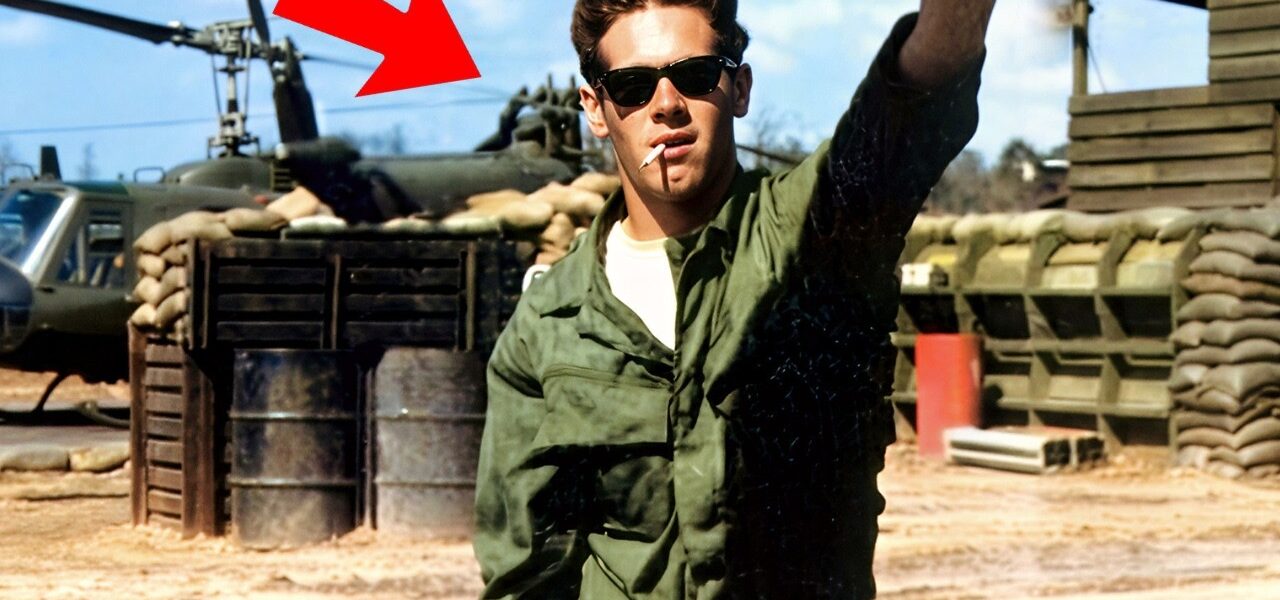

January 8th, 1968. Vietnam mud rotor wash. The smell of jet fuel and copper. Something burning. A helicopter is broken open in the middle of a rice patty. And a 20-year-old soldier is trying to pull himself back inside it. His right hand finds the edge of the gun well. His legs push through kneedeep water. His chest is full of shrapnel.
He reaches for the M60 with his left hand. His left hand isn’t there. His arm is gone. Destroyed at the shoulder, hanging by tissue, blood pouring from a severed artery into the brown water. He looks at it for maybe two seconds. Then he tucks what’s left of the limb into his waistband, pins it against his body with his hip, and keeps climbing.
Uh, the M60 weighs 23 lbs. It was designed for two hands. He has one. He wedges the stock against the airframe, racks the bolt with his right hand, and opens fire on the enemy machine gun that’s been killing Americans across this landing zone for the last several minutes. His gun is the only American weapon still shooting. He kills the imp placement.
Then his body shuts down and he falls unconscious into the gunwell. That’s not the end. That’s not even the middle. Gary Wetszel is going to wake up three more times the next 12 hours. Each time with less blood, each time with more damage. Each time he’s going to get up and go back for his crew.
What kind of person crawls back into a wrecked helicopter with one arm? Gary Wetszel grew up the second oldest of nine children uh in South Milwaukee, Wisconsin. Workingclass family. His father had fought in World War II. Wetszel spent his childhood watching John Wayne films and waiting to be old enough to enlist.
School didn’t hold him. The military was always the plan. He joined the army in 1965 at 18. They gave him a safe job. He requested Vietnam denied. He requested again. Approved. They deployed him to an ordinance unit, maintenance supply, still safe. Wetszel reinlisted while overseas specifically to transfer to an aviation unit.
Door gunner on a Huey, the most exposed seat in the American military. No armor, no doors. You sat behind an M60 in the open cargo bay, leaned into the rotor wash, and presented your entire upper body to whatever was shooting from below. The enemy knew this. Their doctrine prioritized killing door gunners first. Over the course of the war, nearly 5,000 helicopter crew members were killed in Vietnam.
One in 10 American combat deaths. Wetszel volunteered for it. By January 68, he’d been shot down four times. Walked away every time. Most men who survive one helicopter crash count themselves lucky and start calculating how many missions they have left. Wetszel volunteered for more flights. Um, this wasn’t bad luck. This was a man who kept putting himself exactly where the dying happened and kept not dying.
That pattern was about to break. Uh, Wetzel’s crew that morning, warrant officer Timothy Artman, 23, out of Halia, Florida, aircraft commander, specialist Bart Jarvis, crew chief on the opposite gun. Their mission was troop insertion near Abdong An. Uh what intelligence hadn’t grasped was that the enemy dug into those tree lines wasn’t gerillas.
They were main force battalions with RPGs and heavy machine guns protecting weapons caches for an offensive 22 days away. The Tet offensive, the biggest coordinated attack of the entire war. The soldiers hiding in that tree line weren’t running. They were waiting. The Hueies came in low over flat patty land. Dry season, water catches the light from the air.
The landing zone looked open and safe. The kind of place you could set a helicopter down and have troops fanning out in 30 seconds. Uh, but the Vietkong had studied American landing patterns for years. They knew where the helicopters flared. They knew the exact moment the airframe was slowest, heaviest, most committed. They’d turned this LZ into a killbox with interlocking fields of fire and RPG teams sighted on the touchdown point.
They let the helicopters come all the way in, held their fire through the approach, through the flare, through the final seconds when the aircraft was heaviest and slowest. Wetzel felt the skids touch patty water. Half a second of silence. Then the crossfire was tremendous. The first RPG tore into the airframe. The cockpit plexiglass blew inward.
Shrapnel hit Artman in the legs. The Huey shuttered, lurched sideways and died in the mud. Rotors winding down. No lift, no power. A stationary target in the center of a kill zone with its crew still inside. Artman was slumped in the cockpit, couldn’t move. Wetzel and Jarvis kicked out and went for him. They never got there.
Two more rockets detonated inches from Wetzel. The blast destroyed his left arm at the shoulder, drove shrapnel through his right arm, his chest, and his left leg and threw him out of the aircraft into the mud. He should have died in the water. The arteries at the shoulder, bleed fast enough to kill in minutes. He had four open wounds.
He was face down in a rice patty. Every variable pointed at death. He lifted his head. He looked down at his left arm. It was still attached by a strip of tissue, but the bone was shattered. The muscles shredded. The hand and forearm hanging at an angle that made no anatomical sense. He was watching himself bleed out. He had seconds to make a decision.
and no training for the decision he was about to make. He grabbed the destroyed limb with his right hand, folded it against his body, tucked it into his waistband, and cinched it tight against his hip. The pressure partially compressed the artery. Not enough to stop the bleeding, enough to slow it.
A solution no field manual covers. Invented by a 20-year-old kid in the mud with one working arm and an enemy machine gun still firing 50 meters away. Then he saw a VC soldier closing on the crash site with a grenade. Wetszel raised his right arm and shot him. Then he turned toward the helicopter. The M60 was still mounted. The imp placement was still killing Americans. He started crawling.
One arm is pulling through the mud, legs pushing, blood trailing behind him in the patty water. He reached the gun well, pulled himself up, pinned the weapon against the airframe with his body, and grabbed the pistol grip. The citation says his machine gun was the only weapon placing effective fire on the enemy at that time.
Every other American gun in that LZ was silenced or couldn’t reach the target. Wetszel, uh, one armed, bleeding from four wounds, was the only thing between the enemy and the rest of his crew. He held the trigger until the imp placement went quiet. Then his body quit for the first time. Everything Wetzel does uh, from this point forward is a choice.
The rational thing, the survivable thing is to lie still, conserve blood, wait for rescue. That is what his body is telling him to do. Every time it shuts down and every time he wakes up, he chooses something else. He came to in the mud. Uh the imp placement was dead, but enemy fire still crackled from the tree lines.
No medivvac could land. He didn’t check his wounds. He went for Artman. He dragged himself across the patty on one arm and his legs heading for the cockpit. Made it part way. His body quit for the second time. This time when he woke, it wasn’t adrenaline that moved him. Adrenaline was gone. He’d bled too much for that.
What pulled him forward was something harder to explain and harder to stop. Artman was still out there. Artman was 23 years old and had flown him into 100 LZ’s and was bleeding out in a cockpit 50 ft away. A helicopter crew is four men in a metal box over a country that wants them all dead. You eat together, sleep 20 ft apart.
Fly together every day knowing one of those days will be the wrong one. You don’t leave your crew. Something deeper than training won’t let you. He found Jarvis, who’d gotten Artman out of the cockpit and was trying to pull him toward a rice patty dyke, the only hard cover in reach. Wetszel grabbed Artman with his one working arm and helped drag him toward it.
His body quit for the third time. Three collapses, three awakenings. A man running on less than half his blood volume, one arm destroyed, shrapnel in his chest, kept regaining consciousness and kept choosing to move. There is no clinical explanation that accounts for it. The human body doesn’t do this. His did. All three times he moved toward the same man.
They lay behind that dyke for hours. The firing thinned. The light went. Cold patty water soaked into blast wounds and a severed limb. Septic mud. The kind of exposure that kills through infection, even when the bleeding stops. Sometime around midnight, the firing had moved south. The patty was quiet for the first time in hours.
Behind the dyke in the dark, warrant officer Timothy Harold Artman stopped breathing. 23 years old Hleia, Florida. He had woken up that morning and pre-flighted a helicopter and flown it into a landing zone that nobody knew was a trap. He never flew out. He bled out in the mud 6 hours after the crash while his crew lay beside him and couldn’t stop it.
The patty was still. Wetzel lay next to Artman’s body for the rest of that night. He’d crawled to him three times. It wasn’t enough. When extraction finally came, Wetszel was barely alive. Surgeons completed the amputation and started counting everything else. Shrapnel across his right arm, chest, and left leg.
Spine damage they wouldn’t fully understand for years. They gave him 18 units of blood. The human body holds 10 to 12. His entire blood volume was nearly replaced twice over. His heart stopped once during surgery. They brought him back again. A week on the critical list, surgery in Tokyo, 5 months of skin grafts and rehabilitation in Denver, discharged in June 68, 20 years old.
Uh medically, he said later, “I should have been dead.” On November 19th, 1968, President Lyndon Johnson placed the Medal of Honor around Gary Wetzel’s neck at the White House. His fianceé Kathy stood in the audience. He went home to Wisconsin, married Kathy, had a son, got a job as a welder, two-handed trade, hot metal inches from your face, steady nerves, steady grip.
He figured out how to do it with one arm the same way he’d figured out the M60. He just did it until it worked. Nobody taught him. Nobody could have. Even though I thought I was dying, Wetzel said once, I didn’t want to die in a rice patty. He didn’t. Timothy Artman did. And 30 years later, when Wetzel stood before the United States Senate to testify about the American flag, he didn’t talk about politics or constitutional law.
He talked about the men under the flag. He talked about Timothy Artman. He called the flag the shroud of the dead. The cloth that covers the caskets of 23-year-old warrant officers from Hyia, Florida, who die in rice patties because their crew couldn’t drag them far enough or fast enough. He still rides with rolling thunder to Washington.
He still wears the metal. Every time I have the privilege of wearing that blue ribbon around my neck, he said, I am in awe. I try to live up to it for the guys who aren’t here. His left arm is still in a rice patty near Abdongan. The rest of him never stopped fighting.