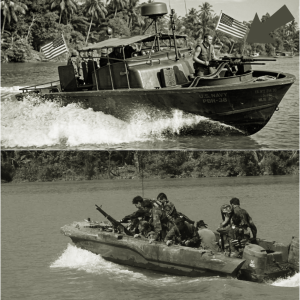

The HORRORS of the PBR Patrol Boats in Vietnam
The most powerful navy in the history of the world arrived in Vietnam and discovered it could not enter the war. Not because the enemy was stronger, because the water was too shallow. So they sent four men in a plastic boat to do what a destroyer could not. May 24th, 1967. Hamong River before dawn.
Two patrol boats drifted with the current. Engines cut four men per boat. The tree line on both banks pressed close enough that a man could reach out and touch the leaves. Then both banks opened up at once. Fire came from positions the crew could not count or see the end of. A recoilless rifle round hit the lead boat’s forward position in the opening seconds.
The patrol commander was dead before the echo crossed the river. The boat began circling at full throttle, the helmsman’s hands locked on the controls, the remaining crew firing into a tree line they could not fully see at distances close enough to hear the men killing them. One and three. That is the casualty figure for PBR sailors in Vietnam. Not over a career per tour.
This is the story of what the Navy built when it had no other choice. What it cost the boys they put inside it. and what the institution did with everything those boys learned after the war ended. Speed is armor until it isn’t. The Meong Delta is not geography. It is a trap built by 10,000 years of river water carving channels through flat earth, roughly 15,000 square miles of southern Vietnam.
Approximately 3,000 nautical miles of rivers, canals, and streams, natural channels rarely deeper than 10 ft. secondary canals shallower still. During the wet season, flood water expanded the network into the rice patties themselves, creating routes that appeared on no military map. During the dry season, those routes contracted and left vessels grounded in the open.
The terrain breathed. The men who had been fighting on it for decades understood its rhythm. Nearly 40% of South Vietnam’s entire population lived here. The Delta was the country’s food supply, its commerce, its circulatory system. Everything moved by water, fish, rice, medicine, families, and embedded invisibly inside 50,000 registered civilian craft.
The weapons, the money, and the men of an insurgency that had been operating on these waterways since before the first American adviser landed in country. The US Navy arrived in 1965 with destroyers and cruisers. Destroyers draw 20 to 30 ft of water. The Delta offered 10 ft on a good day. The warships anchored offshore and watched a war happening in water they could not touch.
What would you build if your fleet drew 30 ft and the enemy was fighting in nine? On December 18th, 1965, the Navy formally acknowledged what the geography had already decided. Task Force 116, Operation Game Warden. Mission: Deny the enemy the use of South Vietnam’s inland waterways. A direct order, an impossible environment, and nothing in the inventory is capable of executing either.
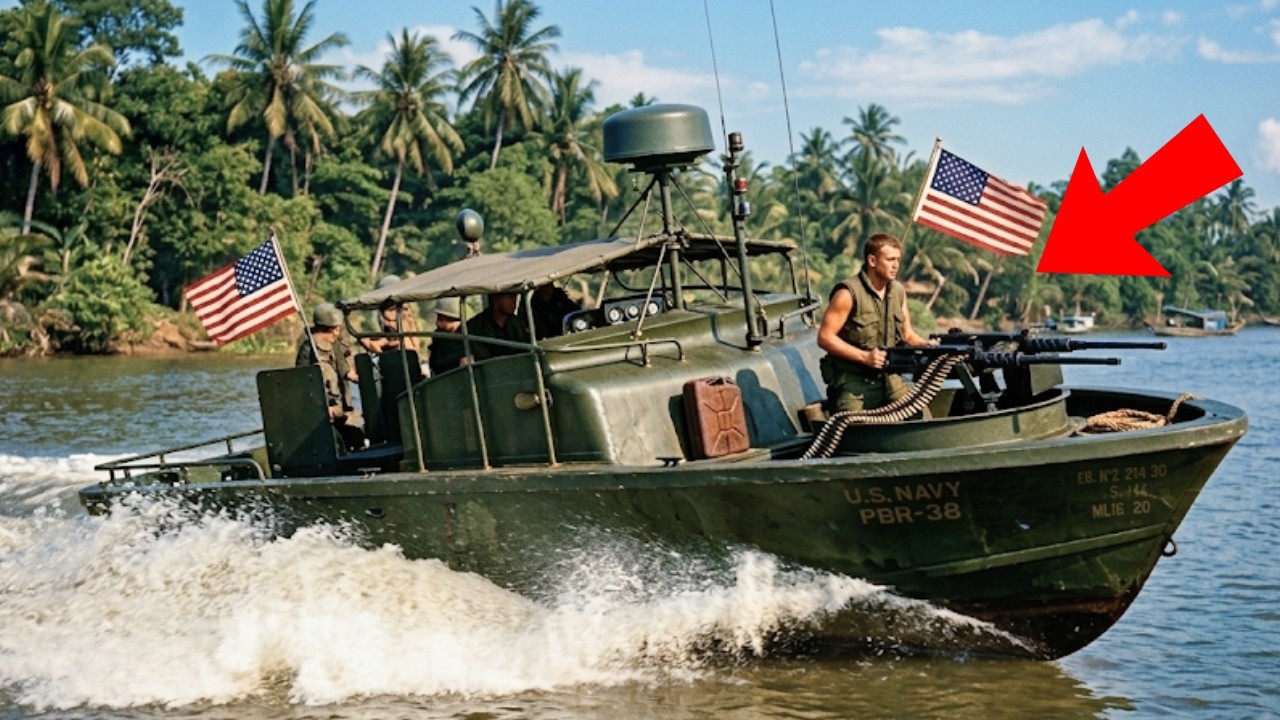
The contract went to United Boat Builders of Bellingham, Washington. The designers produced a working prototype in seven days, basing the hole on an existing civilian pleasure craft. The patrol boat river 31 ft long fiberglass. Twin Detroit diesel engines driving jacuzzi water jet pumps. No propellers to fowl in the weeds and sediment of the canals.
Just twin jets pushing 6,000 gall per minute through stern nozzles. A skilled helmsman could execute a full reversal within the boat’s own length. He could crash stop from speed. He could crab the hole sideways against a current holding position alongside a suspect Sampan while the forward gun tracked both banks. The first boats began operating in the Delta in March 1966.
Around 250 were eventually built. The Navy called it a breakthrough. The men who wrote it called it something else. Speed is armor until it isn’t. Here is what the PBR could do. Twin Browning M250 caliber. Machine guns forward. A single 50 or M60 aft. M60 machine guns and midshipips. Grenade launchers.
Four men who also carried M16s, shotguns, and pistols. For a boat smaller than most suburban living rooms, it could generate a volume of fire that vessels three times its size could not match. Here is what it could not do. Survive a hit. Fiberglass was chosen because it was light enough to meet the draft requirement and fast enough to field, not because it was safe.
The hull provided no meaningful protection against anything heavier than small arms. A B40 rocket, the insurgency’s standard shoulder fired weapon, available in enormous quantities, punched through fiberglass without meaningful resistance. When it detonated inside the hole, the boat itself became the weapon. Fiberglass does not fragment like steel.
It shatters. Thousands of microscopic splinters moving at high velocity through the interior of the boat, through clothing, through skin. Those splinters were non-raopaque. Surgeons could not see them on X-rays. Men carried pieces of their own boat inside their bodies for decades after the war. Some still do.
Sit with that for a moment. The designers knew all of this before the first boat shipped. They built it anyway because the alternative was not a better boat. The alternative was sending nothing into the Delta at all and the war happening there without any American presence capable of contesting it. This is not negligence.
This is the logic of an impossible problem where every option costs someone everything. Mine detonations beneath the hull were different. A command detonated mine transmitted full blast energy vertically through the deck with nothing to absorb it. The characteristic injuries were traumatic amputation, spinal compression, and pelvic fractures.
The river mud packed into those wounds, contaminated, biological, carrying everything that drained off 15,000 square miles of agricultural delta, turned survivable injuries into infections. Sepsis became a leading cause of death in wounds sustained in this environment. In cases where the initial blast alone had not been enough to kill the narrow canals removed every option the designers had built in.
They narrowed to 30 ft in operational areas, some to 15. At that width, both banks are within hand grenade range. The tree line pressed to within feet of a passing boat. The PBR’s engines produced a distinctive acoustic signature. Fighters who knew this river could identify an approaching patrol by sound alone with time to prepare and position before the boat even came into view.
You could not outrun an ambush when the walls were 30 ft apart. River Division 531 lost seven of its 10 assigned boats to rocket hits in a 40-day span. Speed is armor until it isn’t. His name was James Elliot Williams, Boatson’s mate, first class, Darlington, South Carolina. He’d been on the river long enough to know what a motorized sandpan sounds like at 400 yd in the dark and what it sounds like at 200, and what the difference between those two sounds means for the next 60 seconds of his life. He knew the number.
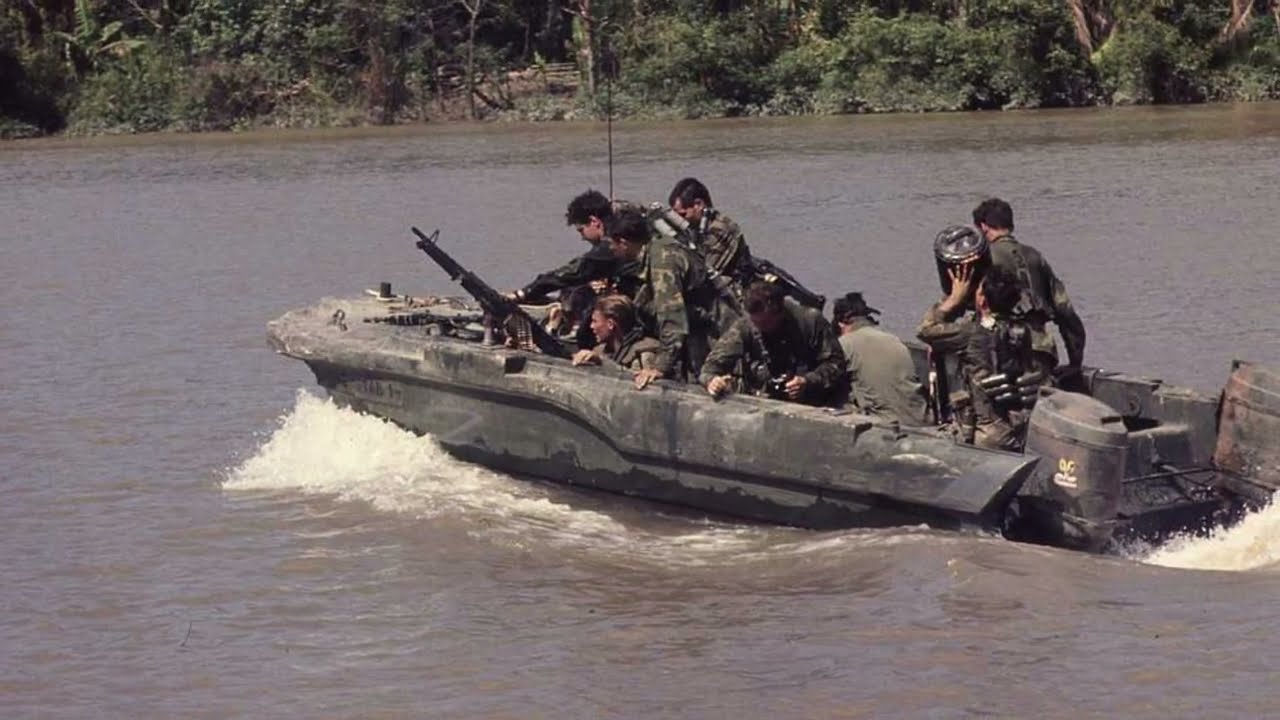
Every man on that boat knew the number, one and three. A standard patrol ran 12 hours, sometimes 24. Patrols operated in pairs. One boat conducting the inspection, the second circling with guns covering both banks. The task force logged approximately 70,000 patrol hours per month at operational peak.
Roughly 80 firefights on average every month. Those numbers describe the shape of a war from the outside. From the inside, a patrol was this. You cut the engines and let the current carry you forward. The jungle closes overhead where the canal narrows. The water is brown, warm, and smells like something agricultural and something biological and something you stop trying to name after the first week.
The only sounds are the current, the insects, and the low note of the coverboat 200 yards behind. You scan the banks and the banks watch you back. And the difference between a fisherman checking nets before dawn and a sapper waiting for your hull to cross a command wire is not always visible until the moment it stops mattering.
Then a sand pane emerges from the dark. You close fast. You decelerate alongside. A crewman crosses over. He has roughly 12 seconds. Not because a rule says 12 seconds. Because 12 seconds is the geometry of two boats in a current in the moment when holding position stops being possible without telling everyone on both banks exactly where you are.
12 seconds to read a hole that might be carrying fish or might be carrying weapons or might detonate the moment a hand goes below the surface. 12 seconds to search through ceramic jars of nukemam. Fermented fish sauce, a staple on every Vietnamese table. smells like something that drowned and was never recovered.
Knowing that the B40 rocket round packed inside that smell, surrounded by rice and dried fish, is physically indistinguishable from storage until your knuckles hit metal. What would you do in those 12 seconds? In November 1966, Game Warden forces boarded more than 16,000 SAMP pans in a single month, detained nearly 600 suspects, recorded 76 firefights, multiply 12 seconds by 16,000 every month.
For years, men averaging 19 to 21 years old, 6 to8 weeks out of training, whose entire tactical education was a river that kept changing the exam. the sustained vigilance this required the acoustic monitoring, the 12-second assessment windows, uh the inability to ever fully stand down across a 12-hour patrol, followed immediately by another 12-hour patrol, does not switch off when a man crosses back into American territory.
The nervous system that learned to read threat from an engine note in the dark does not unlearn it at the gate of a naval air station in California. That is not a metaphor. That is a documented mechanism that researchers spent decades tracing in Vietnam. Veterans bodies and sleep records and nightmares. Williams knew this. Every man on that river knew this.
They started the engines the next morning. Anyway, when the Ted offensive began in January 1968, game warden forces held. By the time concentrated fighting subsided, task force 116 had recorded 40 killed and more than 400 wounded since operations began. During the peak 40 days of tetalone, eight killed, more than 130 wounded, hundreds of confirmed enemy dead.
The strategic math said those numbers were favorable. The human math said three men came back to a bunk that used to have four, one, and three. They held it. The waterways around provincial capital stayed open. Vietkong defectors later reported that interdiction pressure had been severe enough that units in the Delta sometimes went multiple days without food and weapon shipments were delayed for weeks at a time. The mission worked.
The Navy officially ended Operation Game Warden in March 1973. Then it did something with everything those men had paid for. It forgot the riverine force was demobilized, the crews dispersed. The operational doctrine filed and not retrieved. The institutional memory of everything learned in blood on the Hamlong and the Bassac.
And the quaveat was allowed to evaporate because the Cold War was repositioning the Navy toward deep ocean. And a lesson about 30-foot canals and fiberglass holes did not fit the force structure anyone was building for. This was not a conspiracy. It was something more ordinary and in its way more damaging. Bureaucratic amnesia. The assumption that a war that had ended was a problem that had been solved.
In 2004, American soldiers in Iraq were welding scrap steel to vehicle doors and calling it hillbilly armor because nothing purpose-built existed. The improvisation was identical in principle and execution to what the Brownwater Navy had done in 1966. Nobody in the procure procurement chain appeared to remember why.
In 2006, the Navy stood up a new riverine squadron essentially from scratch because it no longer had the doctrine, the training programs, or the organizational structure to operate in shallow contested waterways. Rebuilt from first principles. 40 years of hard-bought knowledge reconstructed from archival visits and veteran consultations because the institution had let the men who originally held that knowledge scatter and age and die without writing any of it down where it could be found.
The special operations craft riverine in use today carries waterjet propulsion, shallow draft, heavy armament and a small crew. It is a direct conceptual descendant of the PBR. Better sensors, better medicine, better materials. The same trade-off the designers accepted in 1965.
The same canal geometry, the same fundamental truth about what happens when speed is your only armor and the walls are 30 ft apart. James Elliot Williams received the Medal of Honor for his actions on October 31st, 1966 on the Mikong River. His patrol boat took fire from both banks. He engaged a concentration of enemy watercraft in a running fight that lasted hours.
His crew fighting forces that outnumbered them by a margin he could not count from where he was standing. The citation is a matter of public record. He survived the war. He came home to South Carolina. He died in 1999. The river he fought on is still there. The PBR solved the problem it was built to solve.
The Delta’s major waterways came under Allied control. Vietkong logistics were disrupted. The supply lines held. Task Force 116 suffered 272 killed and missing across all components. 137 of them PBR sailors, the most decorated naval command of the Vietnam War. Two Medal of Honor recipients, 14 Navy crosses. The Navy took that knowledge and that cost and filed it in a cabinet.
And 30 years later, other men bled while the institution went looking for what it had already paid for. He knew the hole was fiberglass. He knew the canal was 30 ft wide. He knew the number, the one that said one in every three men who did this job came home wounded or came home in a box. He knew all of it.
He started the engines the next morning. One in three. That was the price of the
Note: Some content was generated using AI tools (ChatGPT) and edited by the author for creativity and suitability for historical illustration purposes.