Surrounded by fire and left for dead, one pilot risked everything to save 15 men no one could reach. NU

Surrounded by fire and left for dead, one pilot risked everything to save 15 men no one could reach
The air over Kavieng Harbor on February 15, 1944, was a tapestry of violence. To the north, the northern tip of New Ireland was a bristling fortress of Japanese anti-aircraft batteries that had been reinforced for over two years. Below, the Bismarck Sea churned with 18-foot swells—massive walls of water that could snap a ship’s back, let alone a plane’s hull.
At 07:40, Lieutenant Junior Grade Nathan Gordon, a 27-year-old pilot from Arkansas, sat in the cockpit of his PBY-5A Catalina, aptly named the Arkansas Traveler. He was part of Patrol Squadron 34—the “Black Cats.” His mission was the most dangerous kind in the Pacific: a “Dumbo” flight. His job was to orbit the combat zone and, if an American bomber went down, go into the killing zone to pull the survivors out.

By 08:15, the “brutal mathematics” of the Pacific war began to unfold. American A-20 Havocs and B-25 Mitchells were strafing Japanese positions at suicidal altitudes of 50 feet. They were being shredded.
THE FIRST LANDING: A SUICIDE RUN
The first distress call crackled over the radio: an A-20 Havoc was down. Gordon didn’t hesitate. He turned the Arkansas Traveler toward the rising columns of black smoke.
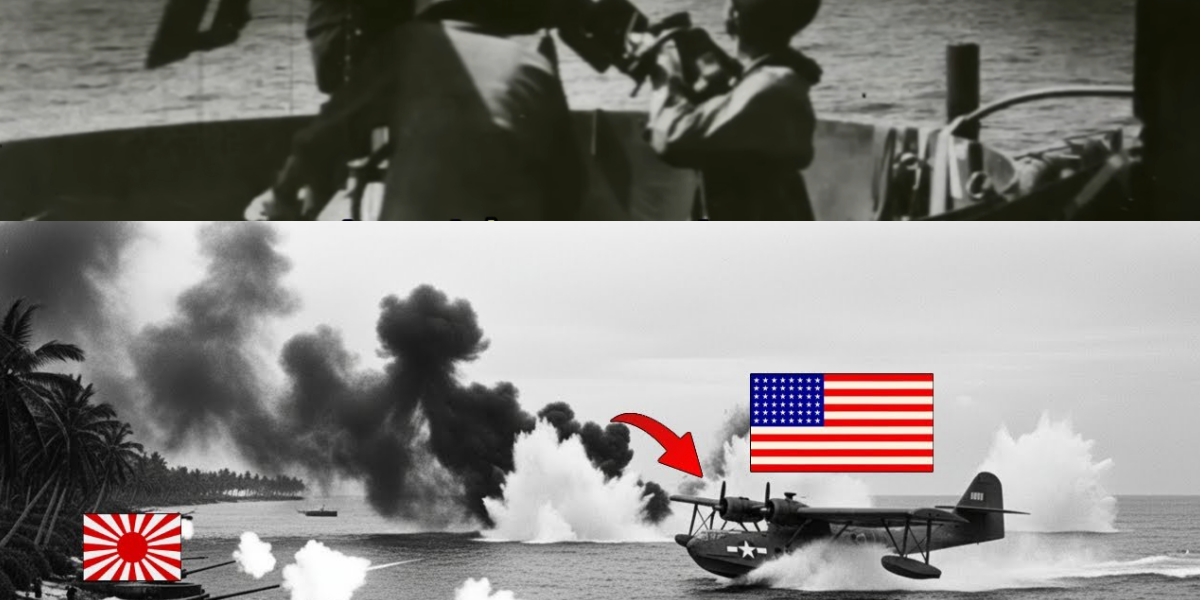
A PBY Catalina was never meant for this. It was a slow, 65-foot flying boat with a massive 104-foot wingspan. Against shore batteries, it was essentially a flying building moving at a sluggish 120 mph. Worse, the sea state was far beyond the Catalina’s safety parameters. The 18-foot swells were erratic and violent.
Gordon lined up his approach, trying to time the “step” between the wave crests. He missed. The hull struck a wave at 80 mph with the force of a car crash. Rivets sheared. Seams in the aluminum skin burst open. Water began geysering into the fuselage.
The crew searched frantically, but the A-20 crew was gone—swallowed by the impact or the sea. Gordon had a damaged, leaking aircraft and no survivors to show for it. Standard procedure dictated he return to base. Then, a second call came: a B-25 Mitchell was down. Five men were alive in the water, bobbing less than a mile from Japanese guns.
THE SECOND AND THIRD LANDINGS: UNDER THE GUNS
Gordon fought the Arkansas Traveler back into the sky. Because there was no wind, he had to “claw” the heavy, water-logged plane off the swells, a process that took nearly a full minute of screaming engines.
He descended again, this time directly into the Japanese kill zone. His four P-47 Thunderbolt escorts dove ahead of him, eight .50 caliber machine guns each, trying to suppress the shore batteries. But there were too many guns.
Gordon set the plane down and—most terrifyingly—shut off the engines. To pull men from the water, the propellers had to stop, or they would mince the survivors. For minutes that felt like hours, the Catalina drifted as a sitting duck. Japanese shells bracketed the plane, sending 50-foot water spouts into the air.
His crew hauled five bleeding airmen through the observation blisters. Gordon restarted the engines and staggered back into the air just as the next salvo hit the spot where they had been floating.
Minutes later, a third call. Another B-25 down. Four more men. Gordon turned back a third time. By now, the hull was a sieve. The bilge pumps were losing the battle against the Bismarck Sea. Every landing added hundreds of pounds of seawater to the plane’s weight. Yet, he pulled those four men in and escaped again.
THE FOURTH LANDING: 600 YARDS FROM HELL
As Gordon turned toward home with nine rescued men, the final transmission arrived. A third B-25 had been shot down directly in front of the heaviest Japanese defenses. Six men were in a life raft, drifting toward the beach. They were only 600 yards from the shore.
At 600 yards, the Japanese didn’t need anti-aircraft guns. they could use rifles. They could see the faces of the Americans.
Gordon’s P-47 escorts signaled they were out of fuel and had to leave. He was now alone. A leaking, overloaded aircraft with 18 men aboard, heading into a wall of lead. Gordon looked at his crew. They didn’t blink. He turned the Arkansas Traveler back toward Kavieng for the fourth and final time.
As he descended, the Japanese opened up with everything—machine guns, field artillery, rifles. The aluminum skin of the Catalina was being peppered with holes. Gordon didn’t shut down the engines this time; he kept them at a low idle, taxiing through the fire.
The crew worked with a “brutal efficiency born of desperation.” They hauled the six unconscious and wounded men aboard.
The final takeoff was a miracle of physics. With 24 men aboard and a hull filled with seawater, the Arkansas Traveler refused to lift. For two miles, Gordon held the throttles at “War Emergency Power,” the hull pounding against wave after wave, rivets popping like popcorn. The Japanese gunners methodically “walked” their shells toward the plane.
At 82 knots—just barely above stall speed—the plane finally broke the suction of the water and clawed into the air.
THE SINKING OF THE TRAVELER
The two-hour flight back to base was a nightmare of vibration and shifting weight. The water sloshing in the hull made the plane nearly impossible to trim.
When Gordon finally touched down at the seaplane base at Milne Bay, the Arkansas Traveler had nothing left to give. As the last man was pulled onto the dock, the aircraft that had survived four impossible combat landings finally surrendered. The seams gave way completely, and the hero of Kavieng sank into the shallow waters of the bay.
The Mission Statistics: | Metric | Number | | :— | :— | | Total Landings under Fire | 4 | | Total Lives Saved | 15 airmen | | Total Souls Aboard on Final Flight | 24 | | Distance from Enemy Guns | 600 Yards | | Medal of Honor Awarded | Nathan Gordon (Sept 1944) |
EPILOGUE: THE ARKANSAS STATESMAN
Nathan Gordon became the only PBY Catalina pilot in history to receive the Medal of Honor. His entire crew received the Silver Star.
But Gordon’s service didn’t end in 1945. He returned to Arkansas and entered public service, eventually being elected Lieutenant Governor. He served in that role for 20 years—the longest tenure in the state’s history. Until his death in 2008 at the age of 92, he remained humble, always insisting that the “real heroes” were the eight men who stood in the back of his plane hauling survivors out of the water while the world exploded around them.
The Arkansas Traveler is gone, but the story remains as a testament to a simple truth: The most valuable weapon in any war is the man who refuses to leave another behind.
Note: Some content was generated using AI tools (ChatGPT) and edited by the author for creativity and suitability for historical illustration purposes.