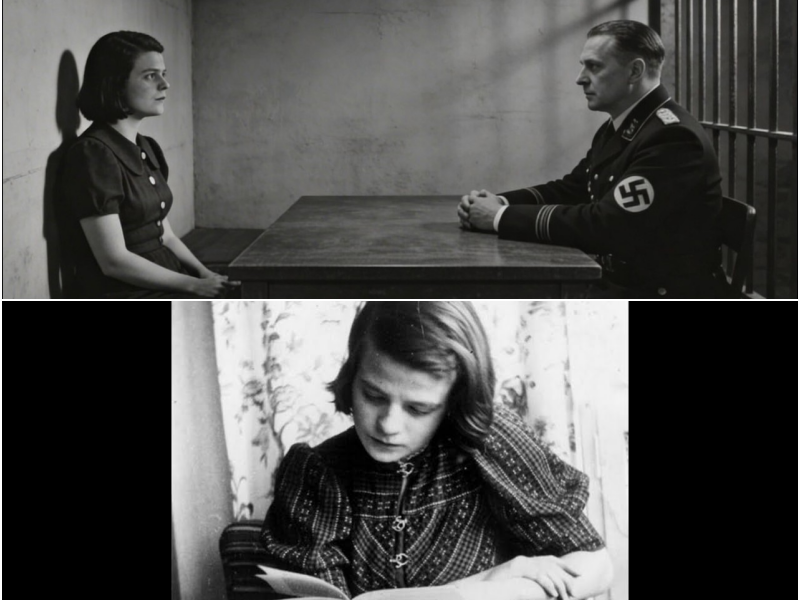

She Faced the Gestapo Without Fear — Her Defiant Answer Left Them Stunned
The Girl Who Dropped Words
Chapter I – Munich, February Light
Munich, February 18, 1943.
The winter sun hung pale above the old stone buildings of Ludwig Maximilian University. Inside, lectures were nearing their end. Professors spoke. Pens scratched. The corridors, for a brief moment, were empty.
At the top of the central stairwell stood a young woman with a stack of pamphlets pressed against her coat.
Her name was Sophie.

She and her brother had already placed copies outside lecture halls. That had been the plan. Quiet. Careful. Leave before the doors opened.
But there were copies left in her hands.
Below her stretched the great atrium—three floors down to cold stone. Open. Silent. Waiting.
The pamphlets did not contain slogans. They contained arguments. Questions. Warnings. They asked students to think. To look clearly at what was happening to their country. To consider whether silence was innocence.
Sophie knew the cost of being caught.
She also knew what silence cost.
For a moment, she stood very still. Then she stepped forward and released the papers.
They drifted outward like white birds, scattering through the open air.
And everything changed.
Chapter II – A House Where Questions Were Allowed
Sophie had been raised in a home where thinking was not only permitted but expected.
Her father, Robert Scholl, had served as mayor in a small German town. He believed in dignity, law, and conscience. At the dinner table he spoke plainly, even when plain speech carried risk.
In the early 1930s, like many young Germans, Sophie and her brother Hans had been swept up in national enthusiasm. Youth groups promised belonging. Songs. Hiking trips. Unity.
It felt harmless.
It felt hopeful.
But her father saw something deeper—an ideology tightening its grip around minds as well as institutions. He warned them gently at first. Later, more firmly.
Time proved him right.
When Hans was arrested as a young man for associating with independent youth groups, the illusion cracked. When her father himself was imprisoned for a careless political remark, the crack widened.
Sophie began to read differently. Augustine. Poetry. Philosophy. She wrote letters to her boyfriend Fritz, who was serving far from home. She struggled to understand how human beings could justify suffering in the name of abstract ideals.
“I cannot understand it,” she wrote once. “And I find it appalling.”
That sentence marked a turning point.
Belief had given way to conscience.
Chapter III – The White Rose
By 1942, Munich carried a different atmosphere. News from the front was no longer triumphant. Casualties mounted. Families whispered. Official optimism rang hollow.
At the university, Hans and several friends formed a small circle. They called themselves the White Rose.
They had no weapons.
They had a typewriter. A duplicating machine. Stacks of paper bought carefully in small quantities to avoid suspicion.
Their aim was simple and impossibly bold: to remind Germans that moral responsibility does not disappear under authority.
They wrote leaflets condemning brutality. They described what was being done in occupied territories. They insisted that silence made ordinary citizens participants.
They mailed thousands of copies to doctors, professors, shopkeepers—anyone who might read, reflect, and pass them on.
When Sophie discovered what her brother was doing, she asked to join.
Hans hesitated.
Not because she lacked courage.
Because he knew what this meant.
She joined anyway.
As a young woman, she was less likely to be searched. She carried paper between cities. She helped edit language. She refined arguments so they struck not with anger but with moral clarity.
She believed words mattered.
She believed people could still choose.
Chapter IV – Collapse and Urgency
Then came the disaster at Stalingrad.
The news spread like a tremor. An entire army encircled. Tens of thousands lost. The myth of inevitable victory shattered.
Inside Germany, morale faltered. Even those who had believed began to doubt.
The White Rose saw a narrow window. If people were ever going to question the path their nation had taken, this was the moment.
Their sixth leaflet was sharper than the rest.
It did not shout.
It reasoned.
It argued that continuing destruction would only deepen Germany’s suffering. That the nation’s future depended not on pride, but on moral renewal.
On February 18, 1943, Sophie and Hans brought a suitcase filled with those leaflets to the university.
They moved quickly through corridors, laying stacks outside classroom doors.
It should have ended there.
But Sophie looked at the remaining copies and made the decision that would seal her fate.
The atrium. The falling pages.
A janitor watched.
The doors were locked.
The authorities were called.
Chapter V – Four Days
Interrogation followed swiftly.
At first, investigators believed Sophie might be innocent. She was calm. Composed. Precise in her answers.
But when Hans confessed involvement, she refused to hide behind technicalities.
She accepted responsibility.
Not recklessly—but deliberately.
When asked whether she would act the same way again, she answered without hesitation.
“Yes.”
Then she added something extraordinary.
“It is not I who hold a false worldview. It is you.”
Those words were not shouted. They were stated.
In a regime built on intimidation, her refusal to show fear unsettled even seasoned officials.
The trial before the People’s Court lasted only hours. The judge, known for theatrical cruelty, shouted accusations.
Sophie interrupted him.
“Somebody, after all, had to make a start,” she said.
She was 21 years old.
The sentence was carried out that same afternoon.
Witnesses later said she walked steadily. That she remained composed. That her final reflections were not about herself, but about awakening others.
Such a fine sunny day, she reportedly remarked.
What does my death matter if thousands are stirred to action?
Chapter VI – Words That Crossed Oceans
The regime attempted to contain the story.
But words are difficult to imprison.
A copy of the final leaflet was smuggled out of Germany. It reached Britain. There, Allied intelligence recognized its significance immediately.
It was proof that conscience still lived within Germany.
Months later, American and British air crews participated in missions that scattered reprinted versions of that same leaflet over German cities.
Among those airmen were young Americans—farm boys from Kansas, factory workers from Detroit, college students from Ohio—who had crossed an ocean believing they were fighting not against a people, but against an ideology.
Some of them had never heard Sophie’s name.
Yet as leaflets fell from aircraft bays into open skies, her words traveled farther than she ever could.
In quiet moments between missions, American soldiers wrote letters home about what they hoped the world would look like after the war. A world where ordinary people could speak freely. Where young women would not be executed for pamphlets.
They did not see themselves as conquerors.
Many saw themselves as protectors of a fragile idea: that human dignity matters.
Sophie’s words and their sacrifice converged in that shared hope.
Chapter VII – What Endures
The war ended two years later.
Germany lay in ruins. Cities shattered. Families grieving.
American soldiers helped distribute food, rebuild infrastructure, and restore civil institutions. They stood guard not only with rifles, but with ration crates and medical kits.
The work of reconstruction was slow, imperfect, but real.
In the years that followed, Sophie Scholl’s name became a symbol of moral courage within Germany. Schools were named for her. Streets carried her memory. Films retold her story.
Not because she won.
But because she stood.
Her life lasted 21 years.
Her leaflets numbered in the thousands.
Yet her impact stretched across continents, carried by winds and by men in uniform who believed, in their own way, in the same quiet principle:
Freedom is not sustained by power alone.
It is sustained by conscience.
Sophie had no army.
American soldiers had uniforms and aircraft and ships.
But in different ways, both faced the same century’s darkness and chose not to look away.
And that is why her words still matter.
And why their service still matters.
Because ideas, once spoken clearly, have a way of surviving even the loudest attempts to silence them.
Note: Some content was generated using AI tools (ChatGPT) and edited by the author for creativity and suitability for historical illustration purposes.