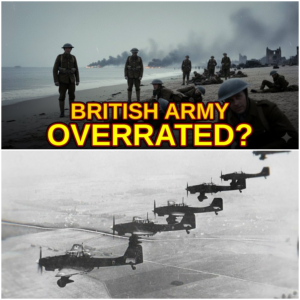

How Capable Was the British Army in WWII? A Closer Look
The British army in the Second World War has often been overshadowed by the Soviet Union’s immense sacrifices on the Eastern Front and by America’s staggering industrial output. Yet, British soldiers fought across nearly every theater of the war, from the frozen fjords of Norway to the sweltering jungles of Burma, from the ancient sands of North Africa to the shattered hedge of Normandy and all the way into the heart of Germany itself.
But how capable was the British army really? Did it possess the tactical skill, the leadership, and the spirit to overcome Hitler’s Vermach? Or was Britain simply carried across the finish line by its more powerful allies? The answer is far more complex than you might expect. When Britain declared war on Germany in September 1939, its army was primarily a small professional force designed for colonial policing rather than continental warfare.
The British Expeditionary Force sent to France numbered just under 400,000 men, a fraction of what France or Germany could field. When the Germans launched their Western offensive on the 10th of May, 1940, the British Expeditionary Force found itself facing the most revolutionary military machine in history.
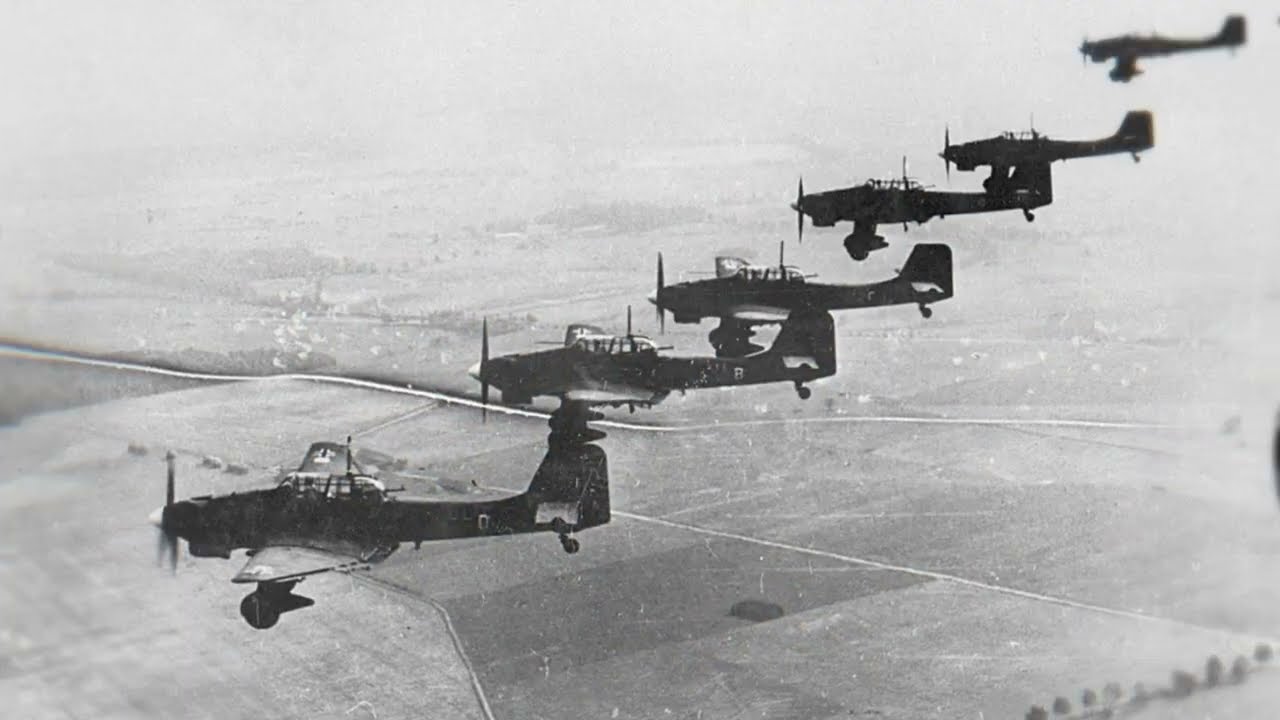
The Vermath’s combined arms tactics, blending armor, infantry, and close air support with devastating coordination, simply overwhelmed Allied defenses within days. There were moments of genuine British competence amid the chaos. At Ars on the 21st of May, the British First Army Tank Brigade counterattacked with 74 Matilda tanks, their thick armor shrugging off German anti-tank rounds that had proved lethal against French vehicles.
For a few terrifying hours, Irwin RML’s seventh Panza division genuinely believed they faced five full divisions rather than a single brigade. German soldiers fled in panic. RML himself reportedly manned an anti-aircraft gun in desperation, firing at the advancing British tanks point blank, but Aris was a tactical pin prick, not a strategic solution.
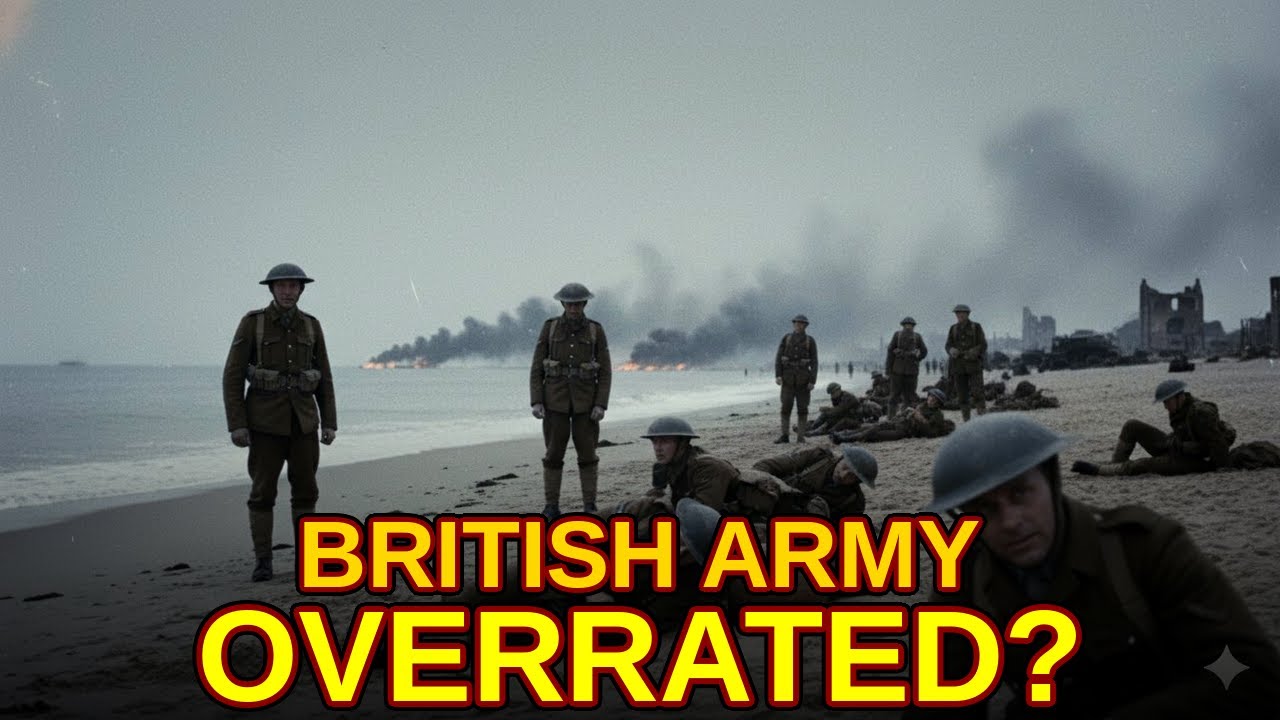
Within days, the British Expeditionary Force was streaming toward the beaches of Dunkirk. Operation Dynamo lifted 338,000 Allied soldiers from those beaches between the 26th of May and the 4th of June 1940. Nearly 200,000 were British. Winston Churchill called it a miracle of deliverance, but he also reminded Parliament that wars are not won by evacuations.
The army that returned to Britain had lost virtually everything. Over 2,400 guns, more than 84,000 vehicles, and 650,000 tons of supplies >> [music] >> lay abandoned on French soil. If Germany had invaded that summer, Britain would have struggled to equip even a handful of divisions for home defense.
In 1940, the British army was simply not capable of taking on the Vermacked head-to-head. It could well be argued that the British were only saved by Hitler’s controversial decision to halt his Panza units advancing toward Dunkirk on the night of the 23rd of May, giving the British Expeditionary Force just enough time to escape across the channel.
The transformation of this battered force began in the most unlikely classroom imaginable, the western desert of North Africa. In December 1940, General Richard Okconor launched Operation Compass with just 36,000 men against 150,000 Italians entrenched in fortified camps along the Egyptian border.
What followed was one of the most lopsided victories in military history. In barely 2 months, Okconor’s Western Desert Force advanced 500 m along the coast, destroyed 10 Italian divisions, captured 130,000 prisoners, 400 tanks, and nearly 1,300 guns. British casualties totaled fewer than 2,000 men. This stunning campaign demonstrated exactly what the British army could achieve with aggressive leadership, audacious maneuver, and careful logistical planning.
Then RML arrived in North Africa with his Africa cores and everything changed. The Germans pushed the British back to the Egyptian frontier. For 18 grueling months, the desert war seesared back and forth across the same baron ground. Tobuk endured a legendary siege. Commanders were sacked with alarming regularity.
The eighth army developed an unfortunate habit of snatching defeat from the jaws of victory. What went wrong? British armored doctrine was fundamentally flawed during this period. Tank commanders charged at German positions with the enthusiasm of cavalry at Balaclava. The Vermacht’s deadly 88 mm guns waited in carefully prepared positions.
The results were predictable [music] and devastating. Infantry and armor rarely coordinated effectively, fighting what sometimes seemed like separate battles on the same battlefield. >> [music] >> Stuff work was often amateur-ish compared to the professional German system. But the British army did something unexpected during these difficult months.
It learned from its failures and adapted. When Bernard Montgomery took command of the 8th Army in August 1942, he inherited a force that had been defeated repeatedly and whose morale had suffered accordingly. He gave them something they desperately needed, a clear plan they could understand and believe in. along with the confidence that they would not be thrown into battle until properly prepared.
At Elmagne, Montgomery masked 195,000 men and over 1,000 tanks against RML’s 116,000 troops and 547 tanks. The 12-day battle that began on the 23rd of October, 1942 was not elegant or particularly innovative, but it was methodical and ultimately effective. British artillery fired over 1 million shells during the battle, maintaining a weight of fire that German veterans compared unfavorably to the worst bargages of the First World War.
When RML’s fuel ran critically low and his ammunition supplies dwindled to almost nothing, there was nothing left for the Africa Corps but retreat. Elmagne proved conclusively that the British army could defeat German forces in open battle when properly led and adequately supplied. It would never lose that hard one capability again.
The next test came quickly. Italy was supposed to be what Churchill called the soft underbelly of Europe. It proved to be anything but soft. When British forces landed in Sicily in July 1943 and then crossed to the Italian mainland that September, they encountered terrain that favored the defender at every possible turn.
Mountain ridges offered perfect observation posts. River valleys channeled attackers into killing grounds. Medieval towns built of thick stone became natural fortresses. The Germans, masters of defensive warfare, made the Allies pay for every mile in blood. The Anzio landings in January 1944 exemplified everything that could go wrong with an amphibious operation.
The British First Infantry Division along with elements of the Guards Brigade and Royal Marine Commandos splashed ashore against minimal initial opposition. The beaches were secured with surprising ease. Then the advance inexplicably stalled. For four agonizing months, over 100,000 Allied soldiers clung to a shallow beach head just 15 mi deep, enduring relentless artillery bombardment, fierce German counterattacks, and waterlogged trenches grimly reminiscent of the SO.
When the breakout finally came in May 1944, some British battalions had been reduced to mere company strength through casualties, exhaustion, and disease. The Italian campaign would grind on until May 1945, successfully tying down German divisions that might otherwise have reinforced France, but at a terrible cost in lives and suffering.
Then came the moment Britain had waited four long years to see the return to France. On the 6th of June 1944, British and Canadian forces stormed Gold, Juno, and Sword beaches along the Normandy coast. The 50th North Umbrean Division attacked Gold Beach. The third infantry division assaulted Sword Beach.
Meanwhile, the Sixth Airborne Division had already landed by glider and parachute during the night, seizing vital bridges over the Orn River and Khn Canal in daring raids that secured the eastern flank of the entire invasion. By nightfall, on that longest day, the Allies had established a foothold in France that the Germans would never dislodge.
But the fighting around the city of Kong became a brutal meat grinder that would test British forces to their limits. The second army under General Miles Dempsey found itself facing seven German Panza divisions, including elite Waffan SS units like the 12th SS Panza Division Hitler Yugand. Young soldiers indoctrinated from childhood who fought with fanatical determination.
Operations Epsom, Charwood, and Goodwood gained ground measured in hundreds of yards at costs measured in thousands of casualties. During Operation Goodwood alone, the British lost over 400 tanks in 3 days, more armor than the entire Africa Corps possessed at Elamagne. The Boage country around K swallowed men and tanks with grim efficiency.
Critics accuse Montgomery of being too cautious, too methodical, too slow to break out. But there was strategic method in these grinding attritional battles that was not always apparent to frustrated observers by drawing the bulk of German armored reserves onto British positions around Carl. Montgomery enabled the American breakout at Slow that broke the German defensive line in late July.
When the Phalet’s pocket finally closed in August 1944, 50,000 Germans surrendered and another 10,000 laid dead amid the wreckage of their equipment. The Vermacht in France was shattered as a coherent military organization. While the war in Europe dominated newspaper headlines, another British force was waging a campaign that many people back home barely knew existed.
Operating in conditions that would have broken lesser armies, the British 14th Army in Burma, commanded by General William Slim, faced challenges of almost unimaginable difficulty. The Japanese were skilled in jungle warfare, thinking nothing of infiltrating behind British lines to strike from unexpected directions.
The terrain was absolutely murderous. Thick jungle alternating with steep mountains and malarial swamps. The monsoon season turned everything to clinging mud that could swallow vehicles whole. Disease, particularly malaria and dentry, killed and incapacitated more men than enemy bullets. In 1944, the Japanese launched their last great offensive toward India, hoping to trigger an uprising against British rule.
At Ifal and Kohima, British, Indian, Gura, and African troops held defensive positions against overwhelming odds in battles that would determine the fate of the subcontinent. At Kohima, the fighting became so close that opposing trenches were separated by nothing more than the width of a tennis court. the garrison’s tennis court to be precise, which became quite possibly the most intensely fought over piece of ground in the entire Burma campaign.
The Japanese offensive ultimately collapsed from starvation, disease, and British firepower. Slim then launched his own advance south beginning in late 1944. A masterpiece of logistics, deception, and calculated aggression that carried the 14th Army over 600 m through supposedly impossible terrain into the heart of Burma.
By the time Japan surrendered in August 1945, British and Commonwealth forces had inflicted well over 300,000 casualties on the Japanese army in one of the most comprehensive victories of the entire war. Slim is now widely regarded by military historians as Britain’s finest general of the Second World War, perhaps the finest British general since Wellington.
His soldiers called themselves the forgotten army because their achievements received so little recognition at home while the nation focused on events in Europe. Even today, how many Britons could name a single battle of the Burma campaign? [music] Imfal and Kohima deserve a place alongside Elamagne and D-Day in our national memory.
The men who fought there certainly earned it. So how capable was the British army in the Second World War? In 1940, it was comprehensively outclassed, obsolete equipment, outdated doctrine, commanders unprepared for modern mechanized warfare. By 1945, it had transformed into a formidable military machine that overcame both German and Japanese armies in sustained combat.
That transformation did not happen by accident. German commanders left telling assessments. Field marshal Irvin RML respected British tenacity in the desert, though he considered their early armored tactics clumsy. Hines Scodderion, the architect of Blitz Creek, acknowledged after the war that while British tanks were usually inferior, British soldiers showed exceptional steadiness under fire and their artillery coordination was superb.
SS General Sep Dietrich complained bitterly that British artillery and air power in Normandy made movement nearly impossible during daylight hours. When your enemies praise your artillery, you know you have done something right. The weaknesses were real. British tank crews paid for poor design with their lives.
Tactical rigidity cost opportunities. Manpower shortages meant the army could never trade casualties the way the Soviets or Americans could. But consider what the British army actually accomplished. It won the first major Allied land victory against Germany at Elmagne. It destroyed an entire Japanese army in Burma.
It stormed three beaches on D-Day alongside Canada and held them against determined counterattacks. Over 144,000 British soldiers gave their lives. Another 240,000 came home wounded. These men were not passengers carried to victory by stronger allies. They were soldiers who learned their trade the hard way in defeat after defeat until they mastered it.
Now I want to hear from you. Montgomery gets the glory, but Slim delivered arguably the more complete victory in Burma. Who do you think was Britain’s finest general of the war? Make your case in the comments. And if this video gave you a new perspective on the British army, hit that subscribe button.
I have plenty more stories to
Note: Some content was generated using AI tools (ChatGPT) and edited by the author for creativity and suitability for historical illustration purposes.