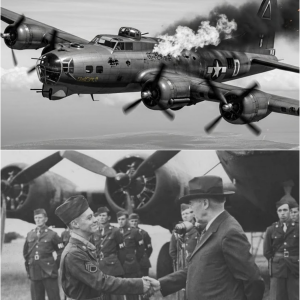

His B-17 Was on Fire at 20,000 Feet — He Put It Out with His Bare Hands
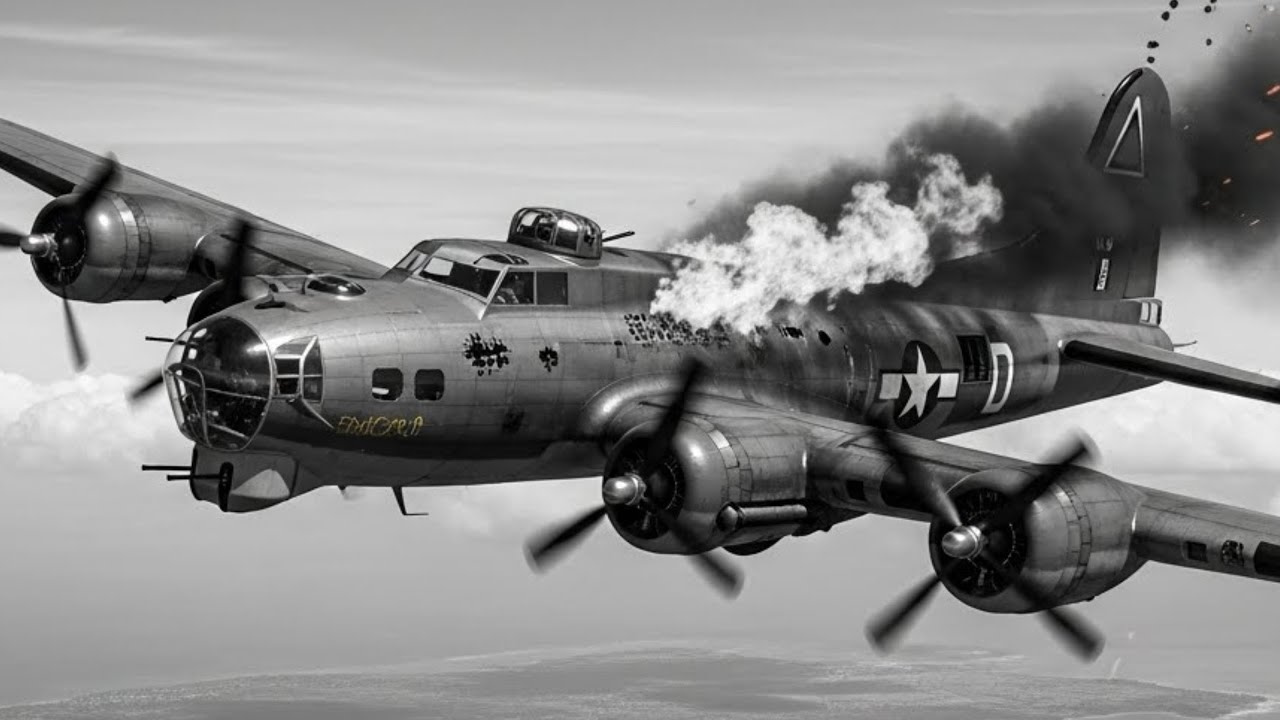
May 1st, 1943. Somewhere over the English Channel. A B17 flying fortress is on fire. Flames are ripping through the fuselage. The radio compartment is an inferno. Ammunition is cooking off, exploding in all directions. Three crewmen have already bailed out. Two others are bleeding out from their wounds.
And the only man left standing is a 5’6 staff sergeant that nobody wanted to fly with. His name is Maynard Smith. His nickname is Snuffy. He’s been in England for 6 weeks, and this is his first combat mission. He has 90 minutes to save this aircraft, and everyone’s still on it. The pilots can’t help him. They’re trapped in the cockpit, cut off by a wall of fire.
The gunners can’t help him. They’re either wounded, dead, or floating somewhere in the channel. It’s just Snuffy alone in a burning airplane. 20,000 ft above the ocean and German fighters are still shooting at him. What happens next will make Maynard Smith the first enlisted airman in history to receive the Medal of Honor.
But here’s the thing about Snuffy Smith. When the Secretary of War flew to England to personally present him with that medal, they couldn’t find him. He was in the kitchen peeling potatoes. Punishment for showing up late to a briefing. This is the story of the hero. Nobody liked Maynard Harrison Smith was born on May 19th, 1911 in Caro, Michigan.
His father was a successful attorney. His mother was a school teacher. By smalltown Michigan standards, the Smiths were wealthy and Maynard knew it. From an early age, he developed a reputation as a spoiled, entitled troublemaker. The kind of kid who believed rules applied to everyone except him. His parents tried to fix him.
They sent him to how military academy in Indiana, a boarding school designed to instill discipline in difficult boys. It didn’t work. Maynard graduated, but his personality remained unchanged. He bounced between jobs, the US Treasury Department, the Michigan Banking Commission. Nothing stuck. In 1929, he got married.
By 1932, he was divorced. Then his father died in 1934 and Maynard Smith made a decision that defined the next several years of his life. He quit his job and lived off his inheritance. No work, no responsibility, just a 30-something man coasting on his dead father’s money, convinced he was smarter than everyone around him.
Eventually, the money started running out. And then came the court case. By 1942, Maynard Smith had a problem. He’d failed to pay child support. The court wasn’t happy. A judge looked at this 31-year-old man, unemployed, arrogant, and completely unwilling to meet his obligations and made him an offer, jail, or the military.
Maynard chose the military. He enlisted in the US Army Air Forces on August 31st, 1942. Not because he wanted to serve his country, not because he felt called to fight the Nazis, because it was better than prison. But here’s the thing about the Army Air Forces. They needed aerial gunners. The bombing campaign over Europe was chewing through air crews at a horrific rate.
And aerial gunners, the men who man the machine guns on B7 bombers, had one of the most dangerous jobs in the entire war. They also got automatic promotions to non-commissioned officer rank. Better pay, better status. Maynard Smith volunteered for aerial gunnery school, not for glory, for the paycheck. After completing gunnery school, Staff Sergeant Maynard Smith was shipped to England and assigned to the 423rd Bombardment Squadron, 306th Bomb Group, based at RAF Thurley in Bedfordshire.
His reputation preceded him. Within days of arriving, Smith had managed to alienate almost everyone on the base. He was obnoxious, insubordinate, convinced of his own superiority despite having zero combat experience. He was 5’6 and 130 lb, small, gay-haired at 32, redeyed, flat-footed, and absolutely insufferable.
The other airmen started calling him Snuffy after Snuffy Smith, a character from a popular comic strip called Barney Google and Snuffy Smith. The comic character was shiftless, badteered, and had no ambition other than to live life on his own terms. The nickname fit perfectly. Here’s how bad it was. In the Eighth Air Force, replacement gunners were usually assigned to crews within days of arriving.
Combat losses were so high that experienced crews were constantly looking for new men. Nobody wanted Snuffy Smith. For 6 weeks, he sat at Thoroughly while other airmen flew mission after mission. Cruz would rather fly short-handed than take him along. But war doesn’t care about popularity. Eventually, someone had to fly with him. On the last day of April, the mission board went up.
Target the German submarine pens at St. Nazair, France. St. Nazair was one of the most heavily defended targets in occupied Europe. The Yubot pens there were built from reinforced concrete virtually impervious to bombing. American air crews called it Flax City because of the sheer volume of anti-aircraft fire they encountered over the target.
Staff Sergeant Maynard Smith was assigned to fly as ball turret gunner on B7F. The pilot was First Lieutenant Lewis P. Johnson. This was Johnson’s 25th and final mission, the last flight of his combat tour. After this, he was going home. The rest of the crew were also veterans. They knew what they were doing. Smith was the only rookie.
At 0300 hours on May 1st, the crews were awakened for the morning briefing. Despite overcast skies and drizzle, the mission was a go. 78 B17 flying fortresses would cross the English Channel, bomb the submarine pens, and return home. At least that was the plan. The Sperry Ball turret was the most claustrophobic position on a B7.
It was a glass and metal sphere mounted on the belly of the aircraft. The gunner sat inside with his knees pulled up to his chest, rotating the turret to aim two 50 caliber machine guns at attacking fighters. The view was spectacular. You could see everything beneath the aircraft. The experience was terrifying. You were completely exposed, hanging in space with nothing but thin plexiglass between you and 20,000 ft of empty air.
Most ball turret gunners were chosen for their small size. At 5’6 and 130 lb, Snuffy Smith fit the profile perfectly. He climbed into the turret as Lieutenant Johnson’s B17 lifted off from Thorly and headed south toward France. The mission to Saint Nazair went smoothly. The formation encountered minimal resistance over the target.
They dropped their bombs and turned for home. 2 hours later, they were approaching what they believed was the southern coast of England. They were wrong. The lead navigator made a catastrophic mistake. In the heavy cloud cover, he misidentified the coastline below. He thought they were over England. They were still over France.
Specifically, they were over Breast, another heavily fortified German position on the northwestern tip of the Breton Peninsula. The formation descended to 2,000 ft. Thinking they were almost home, that’s when the flack opened up. German anti-aircraft batteries hammered the American bombers. Fighters scrambled to intercept.
Within minutes, the formation was fighting for its life. Lieutenant Johnson’s B17 took the worst of it. 20 mm cannon shells ripped through the fuselage. The fuel tanks were punctured. A massive fire erupted in the radio compartment and quickly spread to the waist section. The aircraft’s oxygen system was destroyed. Vital control cables were severed.
In the ball turret, Snuffy Smith’s position lost power. The turret wouldn’t rotate. He was trapped in a useless glass bubble underneath a burning airplane. He had to get out. Smith cranked open the ball turret hatch and pulled himself up into the fuselage. What he saw was chaos. Fire everywhere.

Smoke so thick he could barely see. The radio compartment was an inferno. The waist section was burning. Three crewmen, technical sergeant Henry Bean, Staff Sergeant Robert Foliard, and Staff Sergeant Joseph Bukachek, made a decision. They bailed out. They jumped into the English Channel hoping to be rescued. They were never seen again.
The tail gunner, Sergeant Roy Gibson, was badly wounded. He couldn’t move. Up front, Lieutenant Johnson and his co-pilot, Lieutenant Robert Macallum, were trapped in the cockpit. The fire had cut them off from the rest of the aircraft. They couldn’t communicate with anyone behind them. They didn’t even know who was still alive.
In the middle section of the B7, surrounded by fire and smoke and exploding ammunition, stood one man, Maynard Snuffy Smith, the soldier nobody wanted. What Snuffy Smith did over the next 90 minutes is almost impossible to believe. He didn’t panic. He didn’t bail out. He didn’t freeze. He went to work.
First, he checked on the wounded tail gunner. Gibson was bleeding badly. Smith administered first aid bandaging wounds, stopping bleeding, doing whatever he could to keep the man alive. Then he turned his attention to the fire. The flames were spreading toward the fuel tanks. If they reached them, the entire aircraft would explode.
Smith grabbed a fire extinguisher and attacked the blaze. When that extinguisher ran empty, he found another one. When that one ran out, he started looking for anything else that might work. Then the German fighters arrived. FW190s spotted the crippled B17, and moved in for the kill. Smith was the only crewman capable of fighting back.
He ran to the left waist gun, a 50 caliber Browning machine gun, mounted in an open window, and opened fire on the attacking fighters. Then he ran to the right waist gun and fired from that position. Then he ran back to fight the fire. Then back to the guns. For 90 minutes, Maynard Smith fought a three-front war.
Flames on one side, German fighters on the other, and a wounded crewman who needed constant attention. The heat inside the fuselage became unbearable. The spare ammunition started cooking off, rounds exploding randomly, shrapnel flying everywhere. Smith grabbed the exploding ammunition boxes and threw them out through holes that the fire had burned in the fuselage.
Anything that wasn’t bolted down went overboard. Every pound he threw out made the aircraft lighter, easier to fly, more likely to make it home. When the fire extinguishers were empty, Smith wrapped himself in protective clothing and attacked the flames with his bare hands.
He beat at the fire with whatever he could find. clothing, blankets, anything. And when nothing else worked, he urinated on the flames, whatever it took. Lieutenant Johnson didn’t know what was happening behind him. He just knew his aircraft was still flying. Somehow, despite the damage, despite the fire, the B7 was still airborne. He nursed the crippled bomber across the English Channel.
Every minute felt like an hour. The controls were sluggish. Cables had been severed. Hydraulics were failing. But the aircraft kept flying. Finally, they crossed the English coastline. Johnson spotted an airfield Prainac on the southwestern tip of Cornwall and lined up for an emergency landing. The B17 touched down and then it broke in half.
The fuselage, weakened by fire and riddled with holes, simply gave way. The aircraft split into two pieces on the runway. When rescue crews reached the wreckage, they found Staff Sergeant Maynard Smith standing in the debris. He was exhausted, covered in soot and burns, but alive. So was the tail gunner he’d been treating for 90 minutes.
So were the pilots who’d been trapped in the cockpit. The B17 had over 3500 bullet holes and shrapnel impacts. It would never fly again. Lieutenant Johnson, the pilot, was direct in his assessment. Maynard Smith was solely responsible for the return of the aircraft and lives of everyone aboard. The story of Snuffy Smith spread quickly.
Here was a first mission gunner, a man nobody wanted to fly with, who had single-handedly saved a burning aircraft and its crew while fighting off German fighters for an hour and a half. The Army Air Forces saw a propaganda opportunity. America needed heroes, and Snuffy Smith’s story was perfect. An ordinary man rising to extraordinary courage when it mattered most.
On July 15th, 1943, Secretary of War Henry Lewis Stimson flew to England to personally present the Medal of Honor to Staff Sergeant Maynard Harrison Smith. It would be the first Medal of Honor awarded to an enlisted airman, the first awarded to a living recipient in the European theater. A ceremony was arranged at Thorly. Press was invited.
Cameras were ready. There was just one problem. They couldn’t find Snuffy Smith. A frantic search began. Officers checked his barracks, the messaul, the flight line. Nobody had seen him. Finally, someone thought to check the kitchen. There he was. Staff Sergeant Maynard Harrison Smith, Medal of Honor recipient, standing over a pile of potatoes with a peeler in his hand. KP duty.
Kitchen patrol. the classic military punishment. Smith had been late returning from a pass. His commanding officer had assigned him to potato duty as punishment. He’d completely forgotten about the metal ceremony. That was Snuffy Smith in a nutshell. He’d just performed one of the most heroic acts in the history of aerial combat.
And two months later, he was still getting in trouble for the same petty infractions that had defined his entire military career. They pulled him out of the kitchen, cleaned him up, and rushed him to the ceremony. Secretary Stimson hung the Medal of Honor around his neck, and Maynard Smith became a legend.
The press loved the story. Andy Rooney, yes, that Andy Rooney, who would later become famous on 60 Minutes, was a young reporter for Stars and Stripes at the time. He wrote a front page story about Snuffy Smith’s heroism. The Office of War Information turned Smith into a symbol of American courage. He was interviewed, photographed, celebrated.
Back at Thurley, the reality was more complicated. Smith flew four more combat missions after receiving the Medal of Honor, but the stress had taken its toll. He was diagnosed with what they called operational exhaustion, what we would now recognize as combat stress, or PTSD. That’s the story of Maynard Snuffy Smith, the hero nobody liked.
He was permanently grounded and then his behavior problems resumed. Smith started signing his letters, Sergeant Maynard Smith, CH, putting the initials of his medal after his name like British officers did with their decorations. He used his hero status to skip duties, sleep late, and avoid work. He wore out his welcome quickly. Sergeant.
On December 17th, 1944, Maynard Smith was reduced in rank from staff sergeant to private for poor job performance. A Medal of Honor recipient, demoted, that almost never happens. Smith was sent home in February 1945 and discharged in May. Despite everything, the demotion, the disciplinary problems, the difficult personality, he received a hero’s welcome when he returned to his hometown.
There was a parade, speeches, celebrations. America wanted heroes, and Snuffy Smith was one. His post-war life was turbulent. He had legal troubles, business failures. Another marriage, this time to a British woman named Mary Rener, a USO volunteer. he’d met in England. They had four children together. Smith worked for the Treasury Department again.
He founded a magazine called Police Officers Journal. He bounced from one venture to another. He never quite found his footing in civilian life, but he never denied what he’d done on May 1st, 1943. If anything, he embraced it, sometimes embellishing the story over the years, adding details that may or may not have been accurate.
That was Snuffy. Until the end, he remained exactly who he’d always been. Let’s put Snuffy Smith’s actions in perspective. For 90 minutes, he fought a fuel-fed fire that threatened to destroy the aircraft, administered first aid to a critically wounded crewman, manned both waste guns to fight off attacking German fighters, threw exploding ammunition out of the burning fuselage, stripped away burning debris to prevent the fire from spreading, extinguished the flames using fire extinguishers, clothing, blankets, and when nothing
else worked, his own urine. He did all of this on his first combat mission with no experience while three of his crew mates were bailing out and two others were too wounded to help. The B7 had over 3,500 holes in it when it landed. It broke in half on the runway and everyone still aboard survived. Snuffy Smith was the first enlisted airman to receive the Medal of Honor.
Only four others would receive it during the entire war. Maynard Snuffy Smith died on May 11th, 1984 in St. Petersburg, Florida. He was 72 years old. He’s buried in Arlington National Cemetery, the same place where presidents and generals rest. His story is complicated. He wasn’t a noble hero from Central Casting.
He was difficult, arrogant, often his own worst enemy. But on May 1st, 1943, when his aircraft was on fire and his crew mates were dying and German fighters were trying to finish them off, Maynard Smith became something more than the sum of his flaws. He became exactly what was needed at exactly the right moment. That’s the thing about heroism.
It doesn’t care about your personality. It doesn’t care if people like you. It doesn’t care about your past mistakes or your character flaws. It only cares about what you do when everything is falling apart. For 90 minutes over the English Channel, Snuffy Smith fought fire, fought Germans, and fought to keep his crew mates alive.
The soldier nobody wanted to fly with saved everyone who flew with him. And when the Secretary of War came to give him the highest honor his country could bestow, he was in the kitchen peeling potatoes. That’s the story of Maynard Snuffy Smith, the hero nobody liked.
May 1, 1943. High above the frigid, choppy waters of the English Channel, a B-17 Flying Fortress was transformed from a weapon of war into a screaming metal coffin. At 20,000 feet, the aircraft was a chaos of orange flames and suffocating black smoke. The radio compartment had become a roaring furnace, and the waist section was an inferno. Inside, the unthinkable was happening: machine-gun ammunition, heated by the blaze, was “cooking off”—exploding in every direction like deadly, unpredictable popcorn.
In the cockpit, the pilots were cut off by a wall of fire, unable to communicate with their crew. In the back, the situation was even grimmer. Three men, paralyzed by the terror of a mid-air explosion, had already made the desperate choice to bail out into the clouds below—they would never be seen again. The tail gunner lay slumped over his weapon, bleeding out from grievous wounds.
And then there was the only man left standing in the middle of that flying bonfire: a 5’6” staff sergeant with a reputation so foul that almost no one in the 306th Bomb Group wanted to fly with him. His name was Maynard Harrison Smith, but to the men of the Eighth Air Force, he was simply “Snuffy.” This was his very first combat mission. He had been in England for exactly six weeks, and now, he had 90 minutes to do the impossible: save a disintegrating airplane, fight off a swarm of German fighters, and keep a dying comrade alive.
What happened over the next hour and a half would cement Maynard Smith’s place in history as the first enlisted airman to receive the Medal of Honor. But the story of Snuffy Smith isn’t a polished Hollywood tale of a square-jawed patriot. It is a messy, complicated, and deeply human account of a man who was, by almost all accounts, a complete “jerk”—and yet, in the moment the world asked for a hero, he was the only one who answered.
The Man Nobody Wanted
To understand why Maynard Smith was so intensely disliked, you have to look at where he came from. Born in 1911 in Caro, Michigan, Maynard was the son of a successful attorney and a schoolteacher. By the standards of a small Midwestern town during the Great Depression, the Smiths were wealthy. Maynard grew up with a silver spoon and a massive chip on his shoulder. He was entitled, arrogant, and possessed a talent for making people want to punch him within five minutes of meeting him.
His parents, desperate to instill some discipline in their rebellious son, sent him to Howe Military Academy. It didn’t take. Maynard graduated, but he remained a man who believed that rules were things that applied only to “lesser” people. He drifted through government jobs, got married, got divorced, and when his father died in 1934, he simply quit working altogether. He spent years living off his inheritance, convinced he was the smartest person in any room he entered.
By 1942, however, the money had run out, and the law had caught up with him. Facing a judge for failing to pay child support, the 31-year-old Smith was given a choice that many “difficult” men faced during the war: go to jail or join the military. Maynard chose the Army Air Forces—not out of a burning desire to defeat the Axis, but because it was marginally better than a prison cell.
He volunteered for aerial gunnery school for the simplest of reasons: the pay was better. In the air crews of the B-17s, gunners were automatically promoted to non-commissioned officer ranks. To Maynard, the stripes on his arm were just a bigger paycheck.
When he arrived at RAF Thurleigh in Bedfordshire, England, his personality immediately clashed with the high-stress, brotherhood-focused environment of a bomber base. He was 32 years old—nearly a decade older than most of the “boys” flying these missions—and he treated them with condescension. He was insubordinate to officers and obnoxious to his peers. They nicknamed him “Snuffy” after a lazy, shiftless comic strip character. For six weeks, combat crews actually flew short-handed rather than take Smith along. They simply didn’t trust him.
90 Minutes in the Inferno
The mission on May 1st was supposed to be a “milk run”—or at least as close to one as you could get when flying toward the U-boat pens at St. Nazaire, France. Known as “Flak City,” St. Nazaire was protected by some of the densest anti-aircraft fire in Europe.
Maynard Smith was assigned as the ball turret gunner on a B-17 nicknamed Mayl. The ball turret was a claustrophobic plexiglass sphere hanging from the belly of the plane. You sat in a fetal position, suspended over the abyss. It was a job for the small and the brave.
The mission went well until the return leg. Due to a catastrophic navigational error in heavy cloud cover, the formation descended thinking they were over England. In reality, they were directly over the heavily fortified German base at Brest. The sky erupted. Flak tore through the fuselage, and 20mm cannon shells from German fighters began shredding the Mayl.
When the fire broke out, the ball turret lost power. Smith, trapped in his glass bubble, had to manually crank the hatch open and pull himself up into the waist of the plane. He emerged into a nightmare. The midsection was a roaring tunnel of flame. The heat was so intense it was melting the aluminum skin of the aircraft.
This was the moment where Maynard Smith’s life changed. Faced with a burning plane and certain death, the “spoiled” man from Michigan didn’t panic.
First, he found the tail gunner, who had been peppered with shrapnel and was bleeding profusely. Smith dragged him to safety and administered first aid, wrapping his wounds while the plane bucked and heaved.
Then, he saw the German Focke-Wulf 190s closing in for the kill, sensing a crippled bird. Smith realized that if he didn’t fight back, they were all dead. For the next hour, he performed a frantic, heroic dance. He would run to the left waist gun and fire a burst at an attacking fighter, then sprint through the smoke to the right waist gun to repel a different attack.
Between bursts of gunfire, he fought the fire. When the extinguishers ran out, he used water from the crew’s water bottles. When that was gone, he used his own urine to douse the flames. When the fire began to reach the heavy crates of ammunition, Smith realized the plane would explode if they stayed on board. With his bare hands, he grabbed the scorching, exploding ammo boxes and threw them out of the jagged holes the fire had burned in the side of the plane.
For 90 minutes, he was a one-man army: medic, gunner, and firefighter.
The Miracle on the Runway
Against all odds, the pilot, Lieutenant Lewis Johnson, managed to keep the Mayl in the air. He spotted an emergency airfield in Cornwall and brought the shattered bomber down. The moment the wheels touched the runway, the aircraft—held together by little more than hope and Smith’s frantic efforts—snapped in half.
The rescue crews who rushed to the scene were horrified. The B-17 was riddled with over 3,500 bullet and shrapnel holes. The midsection was a charred skeleton. But as they approached the wreckage, out stepped a small, soot-covered man, still clutching a first-aid kit. Maynard Smith had saved the lives of every man left on that plane.
The Potato Peeler Incident
The Army Air Forces knew they had a legendary story on their hands. They needed heroes to bolster morale, and Smith’s actions were undeniably spectacular. On July 15, 1943, the Secretary of War, Henry Stimson, flew to England to personally award Smith the Medal of Honor. It was the first time the medal would be given to an enlisted airman in the European theater.
The brass organized a massive ceremony. The press was there. The cameras were rolling. The band was ready. There was just one problem: no one could find Maynard Smith.
After a frantic search of the base, an officer finally burst into the mess hall kitchen. There, standing over a massive pile of potatoes with a peeler in his hand, was the man of the hour. Staff Sergeant Maynard Smith, the soon-to-be Medal of Honor recipient, was on KP (Kitchen Patrol) duty. He had been given the detail as punishment for showing up late to a briefing the week before. He had “forgotten” to mention the Medal of Honor ceremony to his commanding officer.
They dragged him out of the kitchen, cleaned the potato starch off his uniform, and pushed him onto the stage. Secretary Stimson hung the medal around his neck, and a legend was born.
A Complicated Legacy
If this were a movie, Maynard Smith would have become a changed man, a humble hero. But Snuffy Smith was a real person, and real people are messy.
After receiving the medal, he flew a few more missions, but the trauma of that first flight had broken something in him. He was diagnosed with “operational exhaustion” (PTSD) and grounded. Without the adrenaline of combat, his old personality returned with a vengeance. He became even more arrogant, signing his name “Maynard Smith, CMH” (Congressional Medal of Honor) and using his status to skip duties and sleep in.
By late 1944, the Air Force had had enough. In a move that is almost unheard of in military history, they reduced the Medal of Honor recipient in rank from Staff Sergeant all the way down to Private for poor job performance.
He returned to Michigan a hero to the public but a pariah to many who knew him. His post-war life was a string of failed businesses, legal battles, and turbulent relationships. He never quite found the peace or the success he felt he was “owed.”
The Meaning of a Hero
Maynard “Snuffy” Smith died in 1984 and was buried in Arlington National Cemetery. He remains one of the most polarizing figures in military history.
But his story offers a profound lesson. Heroism is not a personality trait. It is not something reserved for the “nice guys,” the easy-to-like, or the perfectly disciplined. Sometimes, the man you wouldn’t want to grab a beer with is the only man with the sheer, stubborn audacity to stay on a burning plane when everyone else is jumping.
For 90 minutes in 1943, Maynard Smith was the greatest soldier in the world. He didn’t do it because he loved his country, and he didn’t do it because he liked his crew. He did it because he refused to quit. He was a difficult man who did a difficult thing, and in the end, that was enough.