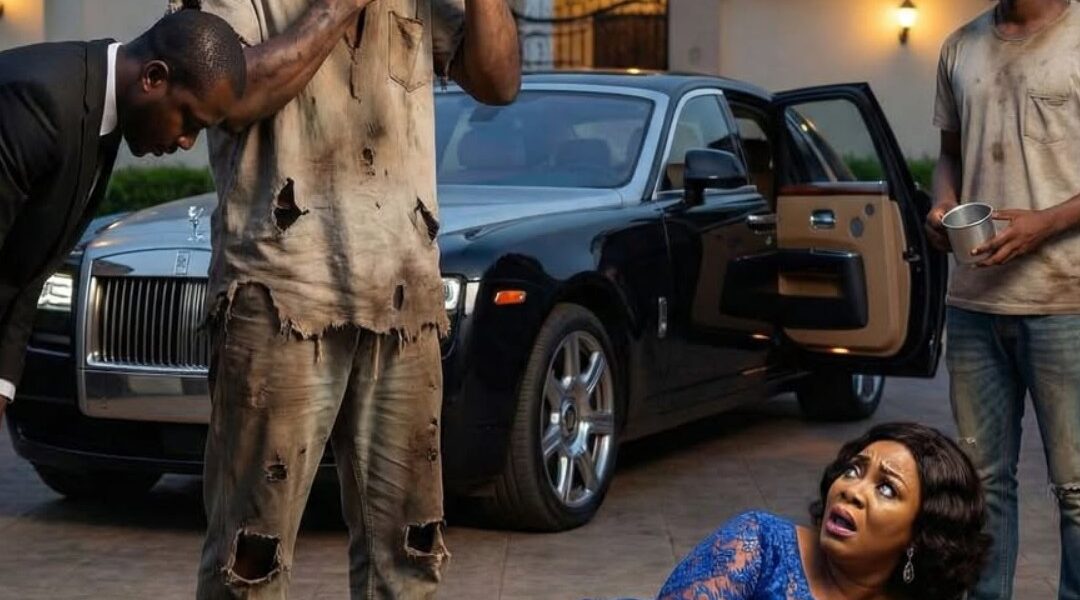
“Don’t give him water! Let him die of thirst! How can a mad man enter my compound on the day my rich brother is returning from America? N1

“Don’t give him water! Let him die of thirst! How can a mad man enter my compound on the day my rich brother is returning from America?
“Don’t give him water! Let him die of thirst! How can a mad man enter my compound on the day my rich brother is returning from America?” Chief Mrs. Uche screamed, kicking the dirty man lying beside her gate harshly.

The man groaned weakly. Flies circled his cracked lips and wounded skin. His beard was tangled, his clothes torn beyond recognition. He looked abandoned by life itself, barely breathing under the scorching afternoon sun.
“Water… please… just water,” he whispered, voice trembling like dry leaves in harmattan wind. His lips were white from dehydration, and his eyes searched desperately for mercy among hostile faces surrounding him.
“Water? Do you know how much a bottle costs?” Uche shouted angrily. “This is not a charity house! Leave before I release the dogs!” She raised her wrapper dramatically, ensuring neighbors witnessed her authority.
Seventeen-year-old Obi ran out from the boys’ quarters carrying a cup of cold water and leftover Jollof rice. His heart pounded, but compassion overpowered fear as he knelt beside the suffering stranger.
“Aunty, please,” Obi begged softly. “He is human. Let him drink and go. He looks like he won’t survive another hour.” His voice shook, yet his hands remained steady offering relief.
Uche slapped him loudly. The sound echoed across the compound like a gunshot. “You want to waste my food on a mad man? Is that why you look thin? Because you give strangers my property?”
Obi’s cheeks burned, but tears rolled silently. He ignored her command and helped the man sit upright gently. He lifted the cup to his cracked lips, supporting his trembling shoulders carefully.
The man drank slowly, every gulp like a blessing. Obi wiped dirt from his face using his own worn shirt. Compassion shone brighter than fear in his young eyes that afternoon.
“Thank you, my son,” the stranger whispered deeply, staring intensely into Obi’s soul. “Kindness never dies unnoticed. God sees everything.” His tone suddenly carried unusual strength that startled Obi briefly.
Obi stepped back respectfully. Something about the man’s gaze felt powerful, almost regal beneath the filth. But he dismissed the thought quickly. Hunger and poverty distort appearances, he reminded himself.
Meanwhile, Uche returned inside angrily. Preparations for her brother’s arrival consumed the mansion. Two cows had been slaughtered. Musicians tuned instruments. Decorations covered every wall in gold and white.
Her husband strutted proudly, boasting to guests about their American connection. “My brother-in-law is a dollar billionaire,” he declared repeatedly. “He will transform this entire family’s destiny permanently.”
Uche’s three children rehearsed fake accents nervously. “Remember your phonetics,” she instructed her eldest son Junior. “Your uncle must see we are polished, not villagers from forgotten corners.”
Obi silently swept the compound corners, overhearing conversations. He had lived under his aunt’s roof since his mother died. She treated him like unpaid labor rather than family.
He slept on a thin mat behind the kitchen. He ate leftovers when available. Yet he never complained. His late mother had taught him dignity survives even inside hardship.
As hours passed, the sun drifted westward. Guests murmured restlessly. The expensive dishes cooled untouched. Uche paced anxiously, adjusting her gele repeatedly, checking her phone every minute.
“Maybe his flight delayed,” her husband suggested nervously. “America traffic is different.” Sweat formed on his forehead despite evening breeze. Their pride depended on this grand arrival.
Suddenly, the large gate creaked open. A black Rolls Royce glided inside silently, engine humming like controlled power. Conversations stopped instantly. Even the live band froze mid-note.
“He is here!” Uche screamed joyfully. She rushed toward the vehicle with exaggerated excitement. Her husband followed. The children arranged themselves strategically, ready to impress the billionaire uncle.
The driver stepped out gracefully, dressed sharply in black suit and gloves. He circled to open the rear door respectfully. Cameras from curious neighbors’ phones flashed eagerly.
But no one emerged.
Instead, the driver closed the door gently and walked past the waiting family. His polished shoes clicked confidently across the tiled driveway toward the compound gate.
He stopped before the “mad man,” who was still seated finishing Obi’s rice. The driver bowed deeply, almost touching the ground. “Sir, the car is ready. Have you seen enough?”
A stunned silence swallowed the compound whole.
Uche’s laughter died instantly. “Driver, what nonsense is this? Why bow to a mad man? Where is my brother?” Her voice trembled between anger and confusion.
The filthy stranger slowly stood up. He straightened his back. Suddenly, his posture radiated authority. He removed the dirty wig covering his hair, then peeled off fake scars attached carefully.
Underneath the grime emerged a striking, dignified man. His skin glowed healthy beneath fading makeup. A familiar birthmark rested clearly on his forehead.
“Hello, Sister Uche,” he said calmly.
The voice was unmistakable.
Uche collapsed immediately.
Her husband staggered backward. “Zubby? Is this some kind of joke?”
The former “mad man” dusted his torn clothes casually. “I arrived four hours ago,” he explained evenly. “I wanted to know who would recognize my humanity without recognizing my wealth.”
His gaze hardened slightly.
“Sister, you kicked me. You denied me water. You threatened dogs on your own blood because I appeared poor.” His words carried disappointment heavier than anger.
Uche struggled upright, tears streaming. “Brother, I didn’t know! I thought—”
“You thought poverty deserved cruelty,” Zubby interrupted gently.
He turned toward Obi, who stood frozen like stone.
“But you,” Zubby continued softly, placing a steady hand on the boy’s shoulder. “You did not know who I was. Yet you gave what little you had. You chose kindness over fear.”
Obi’s heart pounded loudly.
Zubby reached into his pocket and pulled out a red passport. “I came to take one person to America to manage my investments and learn leadership. I needed character, not bloodline.”
Uche crawled forward desperately. “We are your blood! Junior is your nephew!”
“Blood is not by birth alone,” Zubby replied firmly. “Blood is proven by behavior.”
The neighbors, who had gathered quietly beyond the gate, whispered in awe. The live band remained motionless, instruments hanging awkwardly.
“Obi,” Zubby said clearly, “go pack your things. You are coming with me.”
Obi blinked repeatedly, unsure whether this was dream or reality. “Sir… me?”
“Yes, my son.”
Uche wailed loudly, clutching her brother’s legs. “Forgive me! I was protecting my dignity!”
Zubby looked down calmly. “True dignity is how you treat the weakest person at your gate.”
He gently freed his leg from her grip and entered the Rolls Royce. Obi, trembling, rushed inside briefly and returned carrying his small worn bag.
He hesitated briefly, glancing at his aunt. Despite her cruelty, she was still family. But opportunity and destiny stood waiting inside the luxury vehicle.
He entered the car.
The Rolls Royce glided out quietly, leaving dust swirling behind. Neighbors erupted into claps and murmurs of astonishment.
Uche remained kneeling in the driveway, makeup smudged by tears and shame. The feast prepared for glory turned into silent humiliation.
That night, as the mansion emptied of guests and music, she sat alone in the large dining hall staring at untouched food.
Her husband avoided eye contact. Junior locked himself in his room, embarrassed beyond measure.
In the moving car, Zubby observed Obi carefully.
“Tell me,” he asked gently, “why did you help me?”
Obi swallowed nervously. “Because hunger feels the same whether you are rich or mad. My mother taught me that.”
Zubby smiled slowly.
“Good answer.”
As city lights flickered outside the tinted windows, Obi realized something powerful: kindness is currency more valuable than dollars.
Back at the mansion, Uche replayed every word she had spoken. The echoes of her cruelty felt louder than the band’s music earlier.
She remembered her own childhood struggles before Zubby traveled abroad. Had wealth hardened her heart so completely?
Meanwhile, in the airport lounge later that night, Zubby handed Obi a new set of clothes.
“You will study finance and leadership. But remember, power without compassion becomes poison.”
Obi nodded solemnly.
“I won’t forget, sir.”
Weeks passed. News spread across the town about Uche’s disgrace. Invitations to her club reduced. Whispers followed her at markets and church services.
She tried to justify herself repeatedly, but guilt followed closely behind every explanation.
In America, Obi adjusted gradually. Culture shocked him, but Zubby mentored him patiently. Boardrooms replaced muddy compounds. English improved daily.
Yet Obi never forgot the afternoon he offered water to a stranger.
One evening, Zubby asked him quietly, “If I had not been your uncle, would you still have helped?”
“Yes,” Obi answered without hesitation.
Zubby leaned back thoughtfully. “Then you deserve everything coming your way.”
Months later, Zubby transferred ownership shares gradually into Obi’s name, grooming him responsibly rather than spoiling him suddenly.
Meanwhile, Uche visited church weekly, praying for forgiveness and reconciliation.
She finally understood something wealth had hidden from her: pride isolates, but humility restores.
Two years later, a sleek jet landed back home carrying Zubby and Obi, now confident and educated.
The same compound looked smaller to Obi, but memories remained vivid.
Uche approached nervously, no longer adorned in heavy lace or gold.
“Obi,” she whispered, “forgive me.”
Obi embraced her gently. “Aunty, I forgave you the day I left.”
Zubby watched silently, satisfied.
Destiny had not only elevated a boy but reshaped a hardened heart.
The compound that once echoed with insults now carried laughter again.
Kindness had rewritten the family story entirely.
And somewhere deep inside, Uche finally understood: sometimes the person you push away at your gate is the blessing sent to test your soul.
The moral remained carved into memory forever: treat every stranger as possibility, because destiny often arrives disguised in dust and rags.
As for Zubby, harsh or wise?
Perhaps he simply chose justice wrapped inside lesson.
And perhaps, without that painful lesson, none of them would have truly changed.