Why Patton Forced the “Rich & Famous” German Citizens to Walk Through Buchenwald_NU

Why Patton Forced the “Rich & Famous” German Citizens to Walk Through Buchenwald

On April 16th, 1945, the road leading out of Weimar looked, at first glance, like the beginning of a celebration.
It was a bright spring morning—the kind that makes a city’s stone buildings look cleaner than they are, the kind that invites people to open windows and pretend the last years had been only a bad dream. And down that road moved a column of civilians who looked as if they belonged to a different Germany than the one the world had just defeated.
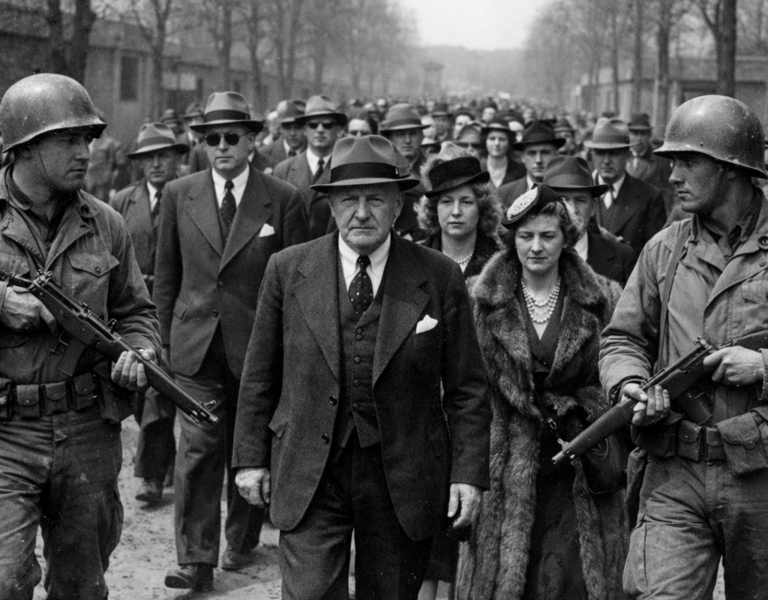
Men in expensive suits and pressed coats walked with the careful posture of people who were used to being respected. Some wore fedora hats tilted at an angle that suggested confidence rather than warmth. Women followed in fur coats and lipstick, their shoes too fine for muddy roads, their hair arranged as if they were headed for the opera rather than anywhere unpleasant. They chatted as they walked. Some of them smiled at each other. A few even laughed—quick, brittle laughs, the kind people use when they want to turn discomfort into a joke.
If you didn’t know better, you might have thought it was a parade of elites on their way to a garden party.
But there was a detail that ruined the illusion.
On both sides of the column marched American soldiers, grim-faced, dirty, exhausted from weeks of fighting. Their uniforms were stained with mud. Their eyes carried the hard flatness of men who had seen too much. Their fingers rested on the triggers of M1 Garands in a way that made the message unmistakable: this was not a social event.
This was an escort.
And the well-dressed citizens were not guests.
They were marching at gunpoint.
The civilians complained as they walked. Not with fear at first, but with irritation, as if the world had committed a personal offense against them.
“Why are we doing this?”
“This is outrageous.”
“My shoes are getting dusty.”
They treated it like an inconvenience—an absurd American stunt. Some told themselves it was propaganda, a theatrical display to humiliate good Germans. Others assumed it would end quickly, perhaps with a lecture and a few photographs, then a return to their homes where they could once again pretend they had been untouched by what had happened.
They were wrong.
The Americans were escorting them up a hill called the Ettersberg, five miles away, toward a place the civilians kept insisting they knew nothing about. A place they claimed was a rumor, a military site, a factory, anything except what it truly was.
The name of that place—spoken now by American soldiers, by liberated prisoners, by the stunned survivors who could barely form words—was Buchenwald.
Two days earlier, General George S. Patton had walked through that camp.
He had seen things that did not fit into his understanding of war—things that made battlefields look almost rational by comparison. He had already been to Ohrdruf. He believed he was prepared for anything.
He wasn’t.
And when the people of Weimar said the same four words—“We knew nothing”—Patton decided those words were not ignorance.
They were a lie.
Or at least a choice.
A choice to look away.
And Patton, who had spent a lifetime believing that reality must be faced head-on, decided to shatter that choice like glass.
He wanted to take the most educated, sophisticated people in Germany—the cultural aristocracy who prided themselves on refinement—and force them to see what had been operating five miles from their theaters, their libraries, their parks, their cafés.
He wanted to rub their faces in the raw sewage of their own history.
They say they didn’t know.
Fine.
Then they would know.
This was the story of what the transcript calls the parade of shame—the moment when the smiles were wiped off the faces of Weimar’s elite and never fully returned.
To understand why Patton did it, you have to understand what Weimar believed it was.
The city of culture beside the hill of death
Weimar was not just another German city. It was, in the German imagination, the soul of the nation. It was the city associated with Goethe and Schiller, the birthplace of ideas Germans spoke of with reverence. It was tied to libraries and philosophy, to theaters and music, to parks where people took long walks and told themselves that civilization was something you could build with art.
Weimar’s citizens prided themselves on being civilized.
They listened to Beethoven. They read philosophy. They spoke about culture as if culture were a shield that made them morally superior to the rest of the world. In their minds, they were not merely Germans. They were the best kind of Germans—educated, refined, sophisticated.
And five miles away, up a scenic tree-lined road on the Ettersberg, a factory of death operated for eight years.
Buchenwald was established in 1937. For eight years, it ran within breathing distance of Weimar’s respectability. SS officers lived in nice houses nearby. Their wives shopped in Weimar boutiques. They attended the same concerts. They walked the same streets. They existed within the same social space—and everyone pretended this meant nothing.
The smoke from cremation drifted over the city. Ash settled—quietly, invisibly—on windowsills. The camp was not a secret in the way a hidden basement is a secret. It was a presence. It was known as a place you did not talk about. A place you explained away because explaining it was easier than confronting it.
And when the Americans arrived, Weimar’s elites said the same words again and again, as if repetition could transform them into truth:
“We knew nothing.”
They claimed the smoke was from a factory.
They claimed the skeletal men seen on work details were volunteers.
They lived inside a bubble of denial because denial is comfortable and because comfort was, for them, a kind of entitlement.
Then April 11th, 1945, arrived, and the bubble burst.
The U.S. Third Army came into the area. American tanks rolled forward. The SS fled. In Buchenwald, prisoners who were still alive took control of the camp in the chaos left behind. The gates that had held them did not protect the SS anymore.
Patton arrived a few days later.
He was a man built for war. “Old Blood and Guts,” they called him. He had a hard reputation and a soldier’s stomach for violence. But what he saw at Buchenwald did not fit into the category of war.
Buchenwald was massive.
Twenty thousand prisoners were still there—walking skeletons, men reduced to bones inside skin. Some weighed barely sixty pounds. There were children whose faces looked too old, children who had forgotten how to smile.
Patton walked through the gate and saw the courtyard.
Bodies lay stacked—hundreds of them—piled like firewood. Naked, yellow-skinned, eyes open. A kind of death that wasn’t honorable, wasn’t sudden, wasn’t even the result of combat. It was industrial. Administrative. Routine.
The smell of death was so strong American soldiers were vomiting.
Patton, the famously tough general, felt himself break in a way he didn’t expect.
He wrote in his diary words that sounded like a man trying to protect his sanity by naming the truth.
“I have never felt so sick in my life,” he wrote. “This is not war. This is madness.”
And then he saw something else.
Not inside the camp.
Outside it.
In the nearby fields, German civilians were going about their lives. Plowing land. Hanging laundry. Existing beside the stench of mass death as if it were merely an unpleasant wind.
Patton turned to the camp commander and asked a question that was less inquiry than accusation.
“Do the people in that town know about this?”
The answer came the way it always did.
“They say they don’t, General.”
Patton’s face turned red. He slammed his riding crop against his boot.
“They are lying,” he said. “And I am going to prove it.”
Patton’s order
Patton called the Provost Marshal. What he demanded next was unusual—so unusual it lodged itself into history as something more than a military action. It was moral theater, meant to force a reckoning.
He didn’t ask for the mayor alone.
He didn’t ask for a handful of bureaucrats.
He wanted the cream of the crop.
“Go into Weimar,” he ordered. “Find the richest people. Find the professors, the lawyers, the businessmen, the wives of politicians. Round up one thousand of them.”
The MPs went into the city.
They knocked on the doors of grand villas. They entered shops. They interrupted breakfast tables and living rooms decorated with the last illusions of normality. They told the civilians, “You are going for a walk. Put on your coats. General Patton invites you to visit your neighbors.”
The German civilians were confused. Many were indignant.
“I am a doctor!” one man shouted. “You cannot order me around!”
The MP pointed his rifle.
“Start walking.”
And so the parade formed—about one thousand well-dressed civilians marching up the hill. Jeeps rolled alongside them to prevent escape. American soldiers flanked them with hard, unsmiling faces.
And the mood among the Germans, at first, remained absurdly light.
They chatted. Women fixed their hair. Men adjusted their hats. They smiled at cameras. They treated it like an inconvenience, like a foolish American game.
They did not know what was waiting at the top of the hill.
The march took about two hours.
And then the wind changed.
As they approached the Ettersberg, the smell hit them—not just rotting flesh, not simply decay, but something older and heavier. Stale, greasy, clinging. A smell that lodged in the throat and refused to leave. A smell that made perfume seem childish and handkerchiefs useless.
The chatter stopped.
Women who had been laughing now pressed scarves to their noses. Some used perfume, desperately, as if scent could build a wall between them and reality.
The American MPs pushed them forward.
“Keep moving. No stopping.”
They reached the main gate—the iron gate of Buchenwald. The inscription, a cruel Nazi joke, read: “Jedem das Seine”—“To each his own.”
The civilians walked through.
And stepped into hell.
The stare
The first thing they saw was not a building. Not a sign. Not an American soldier.
It was the prisoners.
Thousands of them, standing behind barbed wire, silent, watching.
The civilians had claimed these men didn’t exist. That the rumors were exaggerations. That the camp was work, not death.
Now the prisoners stared at fur coats and expensive suits with eyes that looked emptied out. They did not scream. They did not attack. They did not beg.
They simply stared.
And that stare was more terrifying than any weapon.
American soldiers formed a cordon, guiding the civilians like unwilling tourists. The first stop was the crematorium area. In the courtyard near it was a trailer piled high with bodies—emaciated bodies, tangled together in a way that made them look less like individuals and more like evidence.
The civilians stopped as if their feet refused to move.
Color drained from faces. One woman in a fur coat put her hand to her mouth, shaking. Then she screamed and fainted, collapsing into mud.
An American MP stepped forward.
He did not comfort her.
He nudged her.
“Get up,” he said. “You haven’t seen anything yet.”
This was the moment the lie of the “good German” began to crack. Not because every civilian had committed murder—but because the distance between their cultured lives and this machinery of death was no longer abstract. It was five miles. It was smoke on windowsills. It was silence.
The Americans forced them to walk past the bodies. Forced them to look.
If someone turned away, a soldier grabbed their chin and turned it back.
“Look,” they shouted. “Look at what you did.”
Some of the civilians began to weep openly. Others vomited. Men who had carried themselves like aristocrats now stood trembling, hands shaking, eyes wide and helpless.
The tour moved to a building described as the pathology lab—another place where the SS obsession with record-keeping and “souvenirs” had collided with monstrous cruelty. On a table, displayed like items in a shop window, were objects the civilians could not fit into language without their minds resisting.
The transcript describes shrunken heads. Pieces of tattooed skin. Evidence of a perverse collecting habit dressed up as “science.” It names the commandant’s wife, Ilse Koch, and the rumor—widely repeated—that she liked tattoos and ordered prisoners with “interesting” tattoos to be killed so their skin could be used for grotesque crafts.
Whether every specific artifact described in stories was exactly as repeated or not, the essential truth was undeniable: the SS had turned human beings into raw material. Into objects. Into proof that civilization can be hollowed out from within.
An American officer stood by the table and spoke perfect German.
“You say you didn’t know?” he said. “These were made here in your backyard while you went to the theater, while you drank your coffee.”
The civilians had no answer.
Denial was stripped away. They stood naked in their guilt—not guilt for every act committed, but guilt for the comfort that had required blindness.
The tour continued through sections of the camp: the “little camp,” quarantine areas where disease and neglect finished off those already broken. The smell grew worse. American soldiers wore masks in some places.
The civilians were not allowed masks.
They had to breathe it.
One former prisoner—a skeletal man—approached a well-dressed German banker and pointed a shaking finger.
“I remember you,” he said. “I worked at the train station. I saw you. You saw me. You looked away.”
The banker collapsed, falling to his knees.
“I didn’t know,” he sobbed. “I didn’t know.”
But nobody believed him.
Not even himself.
Because even if he truly did not know every detail, he knew enough to look away.
By the time the tour ended, the thousand citizens of Weimar were transformed. Destroyed, in a way no weapon could have done. They walked out of the gate in silence.
No chatting.
No smiling.
Women’s makeup streaked with tears. Men’s suits dusty with the road and with something heavier than dirt.
They walked back down the hill toward their city of poets.
But Weimar would never look the same to them again.
Every time they looked toward that hill, they would see bodies. Smell smoke. Hear silence.
And the ghost of Buchenwald followed them home.
Eisenhower’s expansion: witnesses on purpose
When Eisenhower heard about Patton’s forced tour, he did not reprimand him.
He expanded the idea.
He understood something that went beyond revenge or humiliation. He understood the future.
He sent a cable—send the press, he ordered. Send congressmen. Send members of parliament. Send newspaper editors.
He wanted witnesses.
Eisenhower famously said (as the transcript paraphrases) that what he saw “beggared description,” and that he made his visit deliberately so he could provide firsthand evidence if, in the future, anyone tried to dismiss these reports as propaganda.
He knew denial would come.
He knew decades later people would claim it never happened.
So he wanted proof that could not be waved away by saying “victors exaggerate.”
He wanted Germans—and the world—to be witnesses against themselves.
The impact of Patton’s tour was immediate. Shame did what bombs could not do: it turned inward. In the days that followed, several prominent citizens who had been forced through Buchenwald committed suicide. The transcript frames it as guilt claiming lives—the unbearable realization that culture and education had not prevented them from becoming neighbors to hell.
Patton was told.
He didn’t celebrate.
He didn’t mourn.
He said only, “Good. Maybe the rest of them will learn.”
The question that survives history
The forced tour of Buchenwald raises a question that refuses to die, because it is not limited to 1945.
How much does the average citizen know about the crimes of their government?
The people of Weimar were not the ones turning on the gas. They were not, in most cases, the ones pulling triggers.
But they were the ones who lived nearby, who heard rumors, who saw smoke, who saw skeletal workers, who watched SS families shop in their boutiques and told themselves it meant nothing.
They were the ones who looked away.
They were the ones who stayed silent.
Patton understood that silence can be complicity—not because every silent person is a murderer, but because systems of atrocity rely on the comfort of those who do not ask questions, who accept explanations, who prioritize their own normal life over the suffering they can smell on the wind.
On that day in April 1945, Patton forced them to open their eyes.
And by doing so, he forced the world to open its eyes too.Set featured image
The citizens of Weimar walked up the hill as arrogant aristocrats.
They walked down as broken accomplices—haunted not by American guns, but by the stare of the people they had pretended did not exist.
And the excuse “we didn’t know” followed them like a shadow, just as it follows humanity whenever comfort meets cruelty and someone decides it is safer not to see.