
When Himmler Realized His Crimes Were Exposed
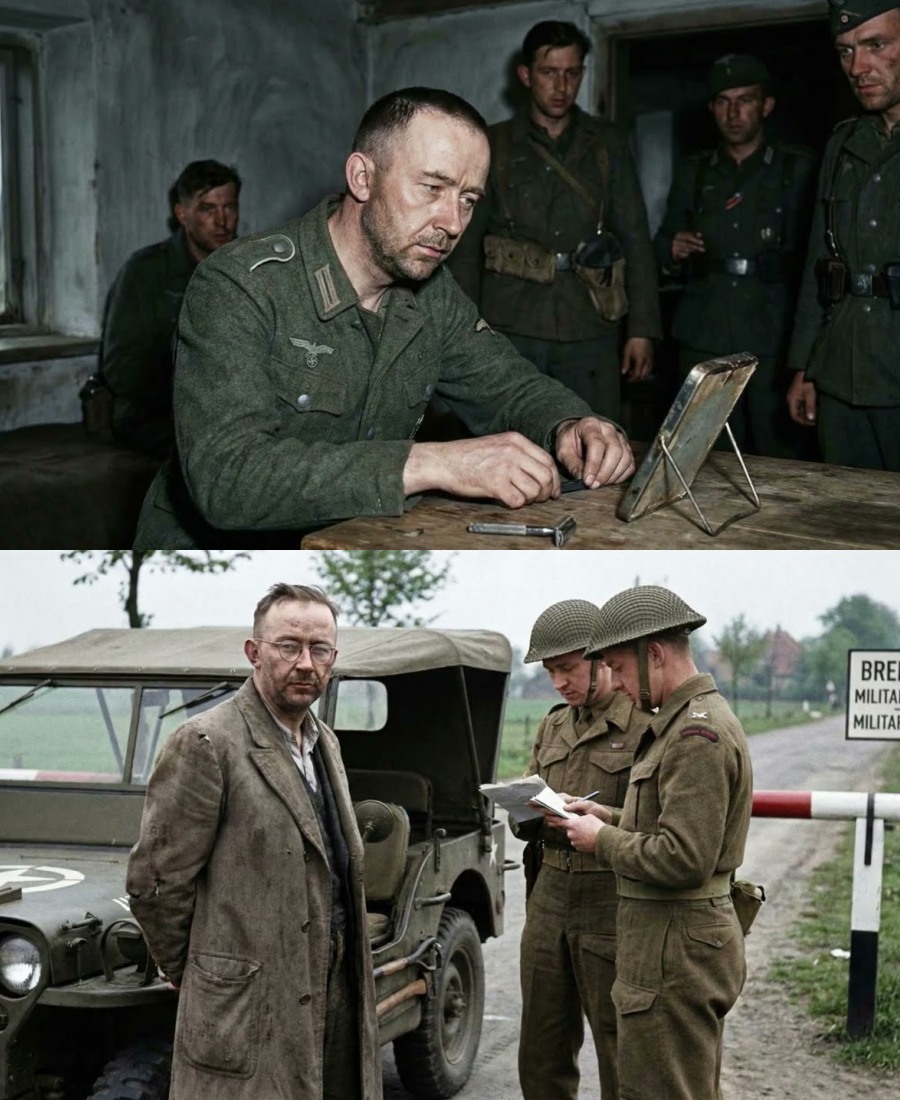
When Himmler Realized His Crimes Were Exposed
The spring of 1945 brought no renewal to Hinrich Himmler. While nature burst forth with life across the German countryside, the Reich’s Furer SS found himself intombed in a shrinking world of ash and ruin. The man who had once commanded the most feared apparatus of terror in modern history now shuffled through the corridors of power like a ghost haunting his own moraleum.
The bunker in northern Germany, where he had established his temporary headquarters, smelled of damp concrete and desperation. Outside, the sounds of distant artillery rumbled like an approaching thunderstorm that would never break, never bring relief, only destruction. Himmler sat at his desk, surrounded by reports he could no longer bear to read in their entirety.
Each page whispered the same truth. The game was over. He had always been meticulous, a bureaucrat of death, who filed genocide with the same precision other men applied to tax records. Every train schedule, every requisition form, every carefully typed memorandum, they had all served the grand machinery of extermination he had constructed.
But now those very documents scattered across Europe in abandoned offices and burning buildings had become testimonies against him. The first crack in his carefully constructed reality came not from enemy armies, but from photographs. British and American forces had liberated Bergen Bellson in midappril, and within days had begun circulating that Himmler’s propaganda machine could no longer suppress.
He had seen them smuggled in by an aid who thought the Reichs furer should know what the world was seeing. Mountains of corpses, living skeletons staring at cameras with eyes that had witnessed hell. Mass graves being bulldozed by grim-faced Allied soldiers wearing masks against the stench. Himmler had stared at those photographs for a long time, not with horror at what they depicted, but with the dawning realization that his grand vision had been reduced to this evidence.
Not the triumph of a superior race, not the cleansing of Europe, not any of the mystical nonsense he had filled his head with for over a decade. Just bodies, just death on an industrial scale, stripped of ideology, revealed as simple mass murder. He had tried to convince himself otherwise. Sitting alone in his office, he composed mental defenses as if preparing for a trial that had not yet begun.
They were enemies of the Reich. The Jews had declared war on Germany. The measures had been necessary, however harsh they appeared to the uninitiated. Someone had to make the difficult decisions, had to have the strength to do what softer men could not. But the photographs kept appearing.
Dao fell at the end of April and then came more images. Then reports from the east where the Soviets had found Maidanek and Ashvitz months earlier. The sheer scale of it documented by enemy cameras and witnessed by thousands of Allied soldiers made his previous rationalizations seem pathetic even to himself.
Himmler remembered the moment with perfect clarity, the instant when the carefully constructed edifice of justification crumbled. It was May 1st, and news of Hitler’s death had just reached him. He was standing in a room lit by a single lamp holding a decoded message. The furer was dead. The man who had given him purpose, who had elevated him from a failed chicken farmer to the second most powerful man in Germany, was gone.
And with Hitler’s death came a terrible clarity. Without the Furer’s gravitational pull, without the shared delusion of the thousand-year Reich, Himmler was forced to see himself as he actually was, not a visionary, not a necessary guardian of racial purity, just a mass murderer whose crimes had been committed in full view of history. He thought of the Vanzi conference in January 1942 where the final solution had been formalized over coffee and pastries.
15 men in a villa by a lake discussing the logistics of genocide as if planning a construction project. How confident they had all been, how certain of their righteousness. The minutes of that meeting still existed somewhere. He knew another piece of evidence in a growing mountain of documentation that would outlive them all.
The camps had been his particular pride once. He had visited them, inspected them with the eye of a quality control manager, reviewing a factory floor. He had made suggestions for improving efficiency. He had commended guards for their dedication. He had watched executions and convinced himself he was witnessing history being made, the hard work of building a better world.
Now in the dying light of the Third Reich, he understood that every visit, every signature, every order had been another link in a chain that would drag him down. The world would not remember him as a visionary. They would remember him as the architect of industrialized murder. His name would become synonymous with evil itself, spoken with the same revulsion as the worst monsters in human history.
Himmler began to burndocuments, a futile gesture he recognized even as he performed it. What did it matter? There were thousands of copies, millions of pages scattered across a continent. His subordinates had been as meticulous as he had taught them to be. Every death had been counted. every transport logged, every execution recorded.
The very efficiency he had demanded had created an irrefutable record of his crimes. He attempted to contact the Western Allies through various intermediaries, offering deals that revealed how completely he had miscalculated everything. He proposed that he could help them fight the Soviets. He suggested that he might be useful in maintaining order in a postwar Europe.
He seemed to genuinely believe that the British and Americans might overlook the murder of millions if he could make himself strategically valuable. The rejection when it came was absolute and contemptuous. The allies wanted nothing from him except unconditional surrender. There would be no negotiations, no special arrangements, no recognition of him as anything other than a common criminal awaiting justice.
In his more lucid moments, Himmler recognized the absurdity of his situation. He had once commanded the SS, the Gestapo, the concentration camp system, an empire of terror that had made Europe tremble. Now he was reduced to fleeing like a common fugitive dependent on the loyalty of a dwindling band of followers who themselves were contemplating betrayal.
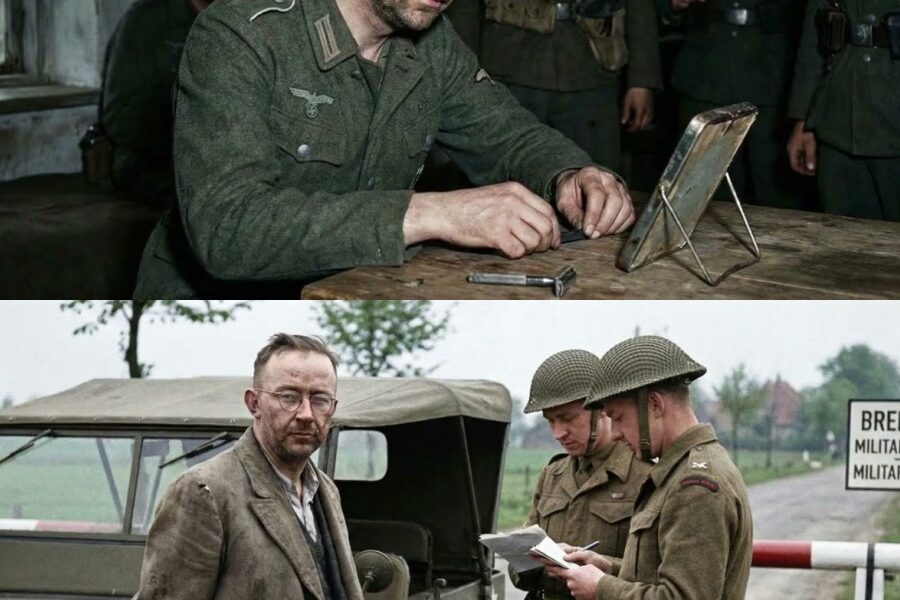
He shaved his mustache and dawned the uniform of a common soldier, as if such a transparent disguise could hide him from the judgment that was coming. The man who had obsessed over racial identification documents and fingerprints now hoped that a change of clothes might make him invisible. It was pathetic, and some part of him knew it.
As he moved through the chaos of a collapsing Germany, Himmler encountered the human debris of his policies. Refugees stream past him on the roads, displaced persons, concentration camp survivors, former slave laborers, all searching for home or safety or revenge. Sometimes they would look at him, this nondescript man in an ill-fitting uniform, and he would wonder if they somehow knew.
Could they see the blood on his hands? Could they sense that they were passing the man responsible for so much of their suffering? The weight of it pressed down on him with physical force. 6 million Jews murdered in gas chambers and shooting pits and through starvation and disease. Millions more Poles, Soviets, Roma, political prisoners, homosexuals, the disabled, all swept up in the machinery of death he had administered.
The numbers were incomprehensible. Yet each one had been a person with a name, a family, dreams that would never be realized. He tried not to think about the children. That was where his carefully constructed rationalizations always fell apart completely. The adults could be cast as enemies, threats, necessary sacrifices to a greater goal.
But the children, what threat did they pose? What war had they declared? They had simply been born into the wrong category in his insane taxonomy of human worth and for that they had been murdered. Himmler remembered visiting a camp early in the war where he had witnessed an execution of Jewish women and children.
He had nearly vomited, had felt his legs go weak. An officer had noticed and offered him brandy. It’s difficult, the officer had said, but necessary. And Himmler had seized on that word necessary and made it his mantra, necessary. Difficult but necessary. Someone had to have the strength to do what was necessary. But it hadn’t been necessary.
That was the truth that gnored him. Now it had been monstrous. It had been evil. And no amount of pseudocientific racial theory or mystical nationalism could change that fundamental fact. The allies were closing in from all sides. Every day the area under German control shrank further. Every day brought new revelations as more camps were liberated, as more witnesses came forward, as more documentation was discovered.
The world was learning the full scope of what had been done, and the reaction was one of universal horror and revulsion. Himmler found himself unable to sleep for more than brief periods. When he closed his eyes, he saw the faces of the dead, not abstract millions, but individuals. The woman he had watched being shot, who had held her child, and whispered something, a prayer, a lullaby in the final moment.
The man who had looked directly at him during a camp inspection, eyes full of a dignity that should have been impossible under such circumstances. the mountains of personal possessions, shoes, suitcases, eyeglasses, children’s toys that he had authorized to be collected and cataloged and distributed. He carried a cyanide capsule, his final escape route.
It nestled in his pocket like a malignant seed, ready to germinate into oblivion whenever he decided he could not face what was coming. Part of him wanted to use it immediately to vanish before thefull accounting could be made. But another part, perhaps the last remnant of his pride, insisted he should face his accusers, should defend his actions, should try to make the world understand.
Understand what? That was the question he could no longer answer. What defense could possibly justify what he had done? What argument could make sense of the deliberate, systematic murder of millions? He had no words that would not sound hollow and monstrous. His entire worldview had collapsed into moral rubble, and he stood alone among the ruins.
On May 21st, British troops stopped him at a checkpoint near Brema. He was traveling with false papers, calling himself Hinrich Hitzinger. For a brief moment, he thought he might pass through unrecognized. Then an officer looked at him more closely, suspicious of something, perhaps the quality of his disguise, perhaps some unconscious mannerism that betrayed his true identity. They questioned him.
He maintained his false identity at first, but the charade felt increasingly pointless. What was he accomplishing? A few more hours of freedom, the postponement of an inevitable reckoning. The British knew who they were looking for. Every checkpoint had descriptions, photographs from before the war, when Himmler had posed proudly in his SS uniform, chest decorated with medals that now seemed obscene.
Finally, he admitted his identity. The words felt strange in his mouth. I am Heinrich Himmler. as if saying it made it real in a new way, transformed him from a fleeing fugitive playing dress up into the actual architect of genocide, present in the flesh, ready to answer for his crimes. The British soldiers reactions ranged from shock to disgust to a kind of horrified fascination.
They had captured one of the most wanted men in the world, one of the principal authors of the greatest crime in human history. They treated him correctly, following their protocols. But he could see the revulsion in their eyes. He was not a prisoner of war deserving of respect. He was something other, something worse.
They brought him to an interrogation center. He would be questioned, processed, eventually handed over for trial. The Nuremberg trials were already being planned. He had heard the major Nazi leaders would be tried before the world, their crimes laid bare in a court of law. He would sit in the dock alongside Guring and the others, and the full documentation of the Holocaust would be presented as evidence.
The world would see the orders he had signed, the camps he had inspected, the systems he had refined, and then conviction was certain was the evidence was overwhelming. irrefutable. Death would follow, either by hanging or whatever method the Allied powers decided was appropriate for crimes of such magnitude. His name would be recorded in history books, but not as he had once imagined.
He would be studied not as a leader or visionary, but as a cautionary tale, an example of how ordinary human beings could commit extraordinary evil when they surrendered their conscience to ideology. Sitting in the detention room waiting to be called for interrogation, Hinrich Himmler finally understood the full weight of what he had done.
Not in abstract terms, not filtered through propaganda or rationalization, but in its simple terrible reality. He had been responsible for the murder of millions of innocent people. He had destroyed families, erased entire communities, caused suffering on a scale almost beyond comprehension. And for what? For a delusional vision of racial purity that had brought nothing but death and destruction.
The world would never forgive him. History would never forgive him. And he could not forgive himself, though forgiveness was a concept that seemed obscenely inadequate in the face of such crimes. What words could express remorse for genocide? What penance could possibly balance the scales? There was only one certainty left.
He would not give them the satisfaction of a trial. He would not sit in a courtroom while survivors testified about the horrors of the camps. He would not hear the evidence read aloud, the numbers tallied, the full scope of his crimes laid bare for the world to judge. He would not give them the opportunity to execute him, to punish him according to their laws.
When the guards turned away for a moment, Hinrich Himmler bit down on the cyanide capsule concealed in his mouth. The poison acted quickly and within minutes the architect of the final solution was dead. He escaped earthly justice, but he could not escape history’s judgment. His crimes would be remembered and studied and mourned for generations to come.
A permanent stain on human history, a reminder of what happens when ordinary men commit themselves to extraordinary evil. In his final moments, as the poison coursed through his veins and consciousness began to fade, Hinrich Himmler finally understood what he had always refused to acknowledge, that he had not been a visionary or a necessaryguardian of civilization, but simply a murderer on a massive scale, and that this truth would outlive him, indelible and eternal, long after his body had turned to dust.
Note: Some content was generated using AI tools (ChatGPT) and edited by the author for creativity and suitability for historical illustration purposes.