The Boys Who Wouldn’t Go Home: How Two German Child Soldiers Found an Oklahoma Family and Challenged America’s Promise After Victory. NU

The Boys Who Wouldn’t Go Home: How Two German Child Soldiers Found an Oklahoma Family and Challenged America’s Promise After Victory
The first thing Klaus Adler noticed about Oklahoma was the sky.
It wasn’t the pale, cautious ceiling of clouds that hung over the ruins of his city back home. It wasn’t the smoky lid that pressed down after the sirens, after the running, after the nights when the only stars were sparks from burning rooftops. This sky was wide enough to make a person feel small in a new way—small not from fear, but from space. It arched over the land like an open hand.
He stood on the wooden platform of a rural train stop with a canvas duffel at his feet and a number stitched to his jacket that didn’t belong to him. A thin line of heat shimmered over the red dirt. Somewhere beyond the tracks, a windmill turned slowly, squeaking with every stubborn rotation.
Emil, two years younger and half a head shorter, squinted up at the sun like it had personally insulted him.
“You said America would be cold,” Emil muttered in German.
“I said it might be,” Klaus corrected. “Also I didn’t say it. The man on the ship said it.”
“The man on the ship was wrong,” Emil concluded, and wiped sweat off his upper lip with a sleeve that was too long.
They had been wrong about other things too.
The war had ended months ago. That fact was supposed to be a door you walked through, like stepping from a dark hallway into a bright room. But Klaus had learned that endings didn’t always end. Sometimes they stayed in the bones, and you carried them into every new place.
A truck waited on the gravel road beside the tracks. An American soldier leaned on the hood, one boot crossed over the other, a cigarette held between two fingers as if it were part of his uniform. He was young—only a few years older than Klaus—yet the way he watched the horizon made him seem ancient.
“Adler,” the soldier called. His accent turned the name into something else. “Klaus and Emil. You boys ready?”
Klaus nodded. Emil nodded after him, because Emil always let Klaus go first when the world changed.
They climbed into the back of the truck. The soldier climbed in front and turned the engine over with a cough of smoke. As they bounced down the road, the land unfolded in long, flat strokes. Fence posts, scattered cattle, the occasional farmhouse with a porch that seemed to face the world without flinching.
It didn’t look like a battlefield.
That was the strangest part.
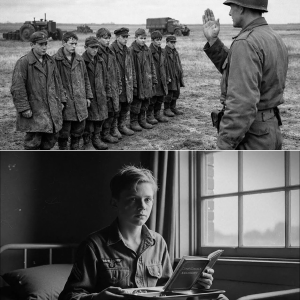
Klaus pressed his forehead against the warm metal slat and tried to picture what the Americans saw when they looked at him. A German teenager with hollow cheeks and too-sharp shoulders. A former child soldier. A prisoner, technically, though the guards had stopped treating him like one when they realized he was young enough to still have a voice crack.
He thought about his last day in Germany—the last day before capture, before the long transport, before the ship—when he had been handed a rifle that weighed more than his certainty.
He had held it with hands that still remembered pencils.
He had marched with boys who still remembered marbles.
He had been told it was honor.
He had learned it was simply hunger dressed in slogans.
The truck turned onto a narrower road, and a cluster of low buildings appeared—simple barracks, a tall fence, a watchtower that looked half-asleep. Fort Reno, someone had called it. A place where the war’s leftovers were stored until someone decided what to do with them.
The truck rolled through a gate. A few men in faded uniforms watched from behind the fence. Some waved. Some didn’t.
Klaus felt Emil shift beside him.
“Are we staying here?” Emil asked quietly.
“No,” Klaus said, though he wasn’t sure. “They said… a farm.”
Emil stared at the watchtower. “A farm is better than a fence.”
Klaus had learned not to promise what he couldn’t control. Still, he said, “Yes. It is.”
They were led into an office where a man with a clipboard asked questions that Klaus answered in stiff, careful English.
Name. Age. Place of birth.
“Were you a member of any military organization?” the man asked, eyes not unkind but practiced.
Klaus swallowed. He could lie. He could try. But the Americans had papers, lists, stamp marks, and the truth had a way of showing up anyway, like a bruise beneath skin.
“Yes,” Klaus said. “Hitler Youth. Then… Volkssturm.”
The pen paused. The man’s mouth tightened slightly—not disgust, not anger, something like sadness squeezed into a professional shape.
“And your brother?”
Emil looked at Klaus with wide eyes. Emil had been dragged into the last months of chaos, handed messages, told to run, told to hide, told to carry things that boys shouldn’t carry. He hadn’t fired a rifle, but he had stood close enough to war that it had left soot on his eyelashes.
“No,” Klaus said quickly. “He was… too young.”
The pen moved again. “You understand you’re here as enemy nationals, yes?”
Klaus nodded. Emil nodded late.
“Work detail,” the man continued, flipping a page. “Local farm. You’ll be supervised. You’ll be fed. You’ll be returned to camp at the end of the season.”
Klaus heard the last part like a rock hitting water.
Returned.
He was given a slip of paper with a name printed on it in bold: HENSLEY, SAMUEL R.
The soldier with the cigarette drove them out again, past the fence, back into the open.
An hour later, the road curved toward a farmhouse that looked like it had grown out of the land the way trees did—plain, sturdy, unpretentious. A row of corn stood in one field. In another, wheat shimmered like a sea under the wind.
A woman stood on the porch with her hands on her hips, watching the truck approach. Beside her, a teenage girl leaned against a post, arms folded, curiosity in her posture. A small boy sat on the porch steps, chewing on something and kicking his heels against the wood.
The truck stopped.
The soldier hopped out and called up to the porch, “Mrs. Hensley!”
The woman came down the steps with brisk purpose. She was not young, but not old either—mid-thirties maybe, with sun in her hair and lines at the corners of her eyes that looked earned.
“Where’s Sam?” she asked the soldier immediately.
“He’s delayed,” the soldier said. “Still clearing out of California. He’ll be home soon, ma’am.”
The woman’s shoulders dropped a fraction, then lifted again like a person refusing to be pulled under by disappointment.
“And these are—” She looked past the soldier, eyes landing on Klaus and Emil, and something unreadable passed through her expression. Not fear. Not hatred. Calculation, maybe, the kind mothers do when the universe hands them a problem and expects them to solve it with dinner and laundry.
“These are the boys,” the soldier said. “Klaus and Emil Adler. From Fort Reno. Work detail.”
The teenage girl straightened slightly, as if she’d been waiting for something like this without knowing it.
The small boy stopped chewing.
Mrs. Hensley walked closer until she stood a few feet from Klaus. He could smell soap on her hands, and something like flour.
“You speak English?” she asked.
“A little,” Klaus answered. His tongue felt heavy.
She studied him, then Emil. “You’re both thin as fence rails.”
Emil bristled. Klaus put a hand on Emil’s shoulder to steady him. “We eat,” Klaus said quickly. “In camp.”
“Well,” she said, as if deciding a matter. “You’ll eat here too.”
She turned and called toward the porch. “June! Get them some water.”
The girl—June—hesitated, then went inside. The small boy hopped down the steps and came closer, looking at Klaus and Emil like they were animals from a traveling show.
“Are you Nazis?” the boy asked, loud and plain.
Mrs. Hensley snapped, “Billy, hush.”
Klaus felt heat crawl up his neck. He didn’t know how to answer in English without sounding guilty in every syllable.
June came back with two glasses of water. She held them out, eyes flicking between the brothers.
Emil took his and drank too fast, coughing. Klaus drank slower, letting the water cool the dust in his throat.
Mrs. Hensley nodded toward the barn. “You’ll sleep in the loft. It’s clean enough. You’ll help with the fields and repairs. No wandering off. No trouble.”
Klaus nodded, grateful for the simplicity of rules. War had been rules too, but rules shaped like knives.
“I’m Ruth,” she added. “Ruth Hensley.”
“Klaus,” he said. “Emil.”
June’s voice came quiet, almost reluctant. “Welcome to Oklahoma.”
The words felt strange in Klaus’s ears, like a door opening to a room he wasn’t sure he deserved.
The days settled into a rhythm that didn’t ask Klaus to be brave.
He woke before the sun because that’s what his body did now. He and Emil climbed down from the loft and washed at the pump, water cold enough to hurt in the early morning. Ruth fed them eggs and biscuits and something called gravy that Emil eyed suspiciously but ate anyway because hunger didn’t care about politics.
June worked too—gathering eggs, hanging laundry, helping Ruth with meals—and she watched Klaus the way someone watches a storm on the horizon: curious, wary, half-expecting damage.
Billy followed them everywhere, endless questions tumbling out of him like rocks from a pocket.
“Did you ever shoot a man?” Billy asked one morning as they repaired a fence.
Ruth barked from the porch, “Billy!”
Billy shrugged. “I’m just asking.”
Klaus didn’t know how to explain to a child that you could fire a rifle and still not know if you’d hit anything, that the sound alone could haunt you, that the recoil could bruise more than flesh.
“No,” Klaus said finally, because “I don’t know” was too complicated.
Billy seemed disappointed, as if Klaus had failed to be interesting.
Emil, however, looked relieved, like a knot in his chest had loosened.
In the afternoons, when the sun grew heavy and the insects buzzed like small engines, Klaus found himself listening to the land. The wind in the wheat. The creak of barn wood. The distant bark of a dog. Sounds that did not mean danger.
Sometimes, though, sounds betrayed him.
A car backfiring on the road made him flinch so hard he dropped a bucket. A sudden clap of thunder made Emil dive behind the woodpile, shaking with a fear he couldn’t name aloud.
Ruth noticed. She didn’t pity them. She didn’t pry. She simply adjusted—closing doors gently, warning them when storms rolled in, leaving extra blankets in the loft without comment.
Once, she caught Klaus staring at a kitchen knife as if it were a memory. She said quietly, “It’s just for bread, honey.”
Honey.
The word struck him harder than an insult would have.
He wasn’t sure what to do with kindness that didn’t demand anything in return.
June taught him small American things without making a show of it—how to pronounce “th” without turning it into “z,” how to use a wrench properly, how to drive a nail straight. In exchange, Klaus taught her German words, though she only seemed to like the softer ones.
“Schmetterling,” he told her once, pointing at a butterfly in the yard.
June tried it and laughed when it came out wrong. “That sounds like something you’d say after stubbing your toe.”
Klaus surprised himself by laughing too, and the sound felt unused in his throat, like a tool pulled from rust.
One evening, Ruth sat at the table with a stack of letters. Her face was tight in a way that made the room feel smaller.
June noticed. “No word?”
Ruth shook her head. “Last I heard, Sam was on his way. They keep saying ‘soon.’”
Klaus lowered his eyes. He knew what “soon” could mean in war. It could mean never. It could mean ashes in a letter.
Billy climbed into Ruth’s lap, too big for it but insistent. “Daddy’s coming,” he said with child certainty.
Ruth kissed the top of his head and stared past Klaus, past Emil, as if looking through walls into the distance.
Klaus felt a strange, guilty tenderness. He knew what it was to wait for someone who might not return.
He wondered if Sam Hensley would hate him when he arrived. A man who had fought for America. A man who would see German faces in his own kitchen.
The idea sat in Klaus’s stomach like a stone.
The first time Klaus spoke about the war, it was an accident.
A neighbor came by—Mr. Cobb, a wide man with a hat that seemed permanently welded to his head. He shook hands with Ruth on the porch, nodded at June, tousled Billy’s hair, then looked at Klaus and Emil like they were stray dogs Ruth had decided to keep.
“Those the Germans?” he asked Ruth, not bothering to lower his voice.
Ruth’s jaw tightened. “Yes. They’re working for us. Government says it’s allowed.”
Mr. Cobb spat into the dirt. “My cousin got killed in France. You watch your back, Ruth.”
Klaus understood enough English to catch the word killed.
Something in him—something raw and exhausted—pushed up like bile.
“I’m sorry,” Klaus said, voice rough.
Mr. Cobb blinked, surprised Klaus had spoken at all. “Sorry don’t raise the dead.”
Klaus swallowed. “No.”
Mr. Cobb leaned closer, eyes sharp. “You one of them Hitler boys?”
Klaus’s vision narrowed. He could feel the old reflex—lie, defend, survive—scratching at his ribs.
“Yes,” Klaus said anyway. “But… I was a boy.”
Mr. Cobb snorted. “A boy with a gun is still a gun.”
June stepped forward before Ruth could. “He’s working,” she said. “He hasn’t caused trouble.”
Mr. Cobb’s eyes flicked to June, and for a moment his expression softened, as if he remembered she was still nearly a child too.
He tipped his hat at Ruth and walked away.
That night, Klaus sat in the loft with Emil while crickets sang outside.
Emil whispered, “Do you think they’ll send us back?”
Klaus stared at the boards above him. “They said they would.”
Emil’s voice trembled. “There’s nothing there.”
Klaus pictured his street—bombed out, the bakery gone, the neighbor’s house a hollow mouth. Their mother’s last look as she shoved them into the cellar and told them to stay quiet, the sound of boots above, then silence that lasted too long.
He didn’t know if she was alive. He didn’t know if “home” still existed.
“We’ll find out,” Klaus said, because what else could he say?
Emil’s breath hitched. “I don’t want to go back.”
Klaus’s chest tightened. He didn’t either, though saying it felt like betrayal—betrayal of soil, language, graves.
But perhaps the war had already betrayed them first.
Sam Hensley came home on a Sunday.
It was the kind of day that looked like a postcard—blue sky, white clouds, the smell of cut grass. Ruth had baked bread. June had washed her hair and tied it back with a ribbon. Billy had been impossible since dawn, bouncing like a spring.
Klaus and Emil had been repairing a gate when they heard the car on the road, the tires crunching gravel.
Ruth stepped onto the porch so fast her apron strings flew. June grabbed Billy before he could fling himself into the yard and get run over.
The car stopped, and a man climbed out.
Sam was taller than Klaus expected, with shoulders that seemed too broad for the car. His uniform looked worn, not like the crisp pictures in American newspapers. His face was sun-browned, and his eyes carried something far away.
Billy tore free and ran. “Daddy!”
Sam caught him, lifted him, buried his face in Billy’s hair. Ruth walked down the steps slower, as if afraid the moment might dissolve.
Sam set Billy down and took Ruth in his arms. For a second, Ruth’s toughness cracked, and Klaus saw how much she had been holding up alone.
Then Sam’s gaze drifted past Ruth.
To Klaus. To Emil.
The air changed.
Sam’s posture stiffened, like someone had set a weight on his spine. His eyes narrowed—not in anger exactly, but in a kind of guarded assessment Klaus recognized from soldiers everywhere.
Ruth stepped slightly in front of Klaus, as if shielding without meaning to.
“Sam,” Ruth said carefully, “these are the boys I told you about.”
Sam’s jaw moved. “The Germans.”
June spoke quickly. “They’ve been helping. They’ve been—fine.”
Sam walked closer. Klaus forced himself not to step back.
Sam stopped a few feet away. He looked Klaus up and down—thin body, worn boots, the way Klaus’s hands were calloused now from farm work rather than weapon grips.
“How old?” Sam asked.
“Seventeen,” Klaus said.
Sam’s eyes flicked to Emil. “And him?”
“Fifteen,” Emil said, voice small.
Sam let out a slow breath. “Kids.”
Ruth’s voice sharpened. “They’re not here to hurt anyone. They’re here because the government sent them.”
Sam’s gaze returned to Klaus. “You fight?”
Klaus felt June watching, felt Ruth tense, felt Emil’s fear like a physical presence beside him.
He could lie. He could say no and let the moment pass.
But he was tired of carrying lies like sandbags.
“Yes,” Klaus said. “At the end. Not by choice.”
Sam’s nostrils flared. “Nobody’s ever by choice, son. They just tell themselves that so they can sleep.”
Klaus didn’t have an answer for that.
Sam’s eyes softened a fraction—just enough for Klaus to see something human there, something wounded.
Sam looked at Emil. “You?”
Emil shook his head so hard his hair fell into his eyes. “No.”
Sam stared for another long second, then turned toward Ruth. “Inside,” he said, voice rough. “I need to sit down.”
They ate dinner that night like people performing normalcy. Ruth talked about the crops. June talked about school. Billy talked about everything.
Sam barely spoke.
Klaus and Emil ate quietly, careful not to take too much, careful not to make noise. Klaus felt every clink of fork against plate as if it were a test.
After dinner, Sam stepped onto the porch alone. Klaus went to the barn, pretending to check the animals, but really just needing air.
He heard footsteps behind him.
Sam stood in the doorway, silhouetted against the dusk.
Klaus straightened. “Sir—”
“Don’t,” Sam said. “Don’t call me that.”
Klaus blinked. “Mr. Hensley.”
Sam walked inside, leaning against a post. He looked tired in a way Klaus had seen in men who had been asked to be unbreakable.
“They tell us the war’s over,” Sam said, staring at the ground. “But it’s like… my head didn’t get the message.”
Klaus swallowed. “Mine too.”
Sam’s eyes lifted sharply, as if he’d forgotten Klaus could be a person.
“What’d you do?” Sam asked, voice low. “Over there.”
Klaus’s heart pounded. Words in English felt too small to hold the truth.
“I carried messages,” Klaus said. “I dug… trenches. I stood with a rifle. I fired, but I don’t know if… if I hit.”
Sam’s mouth tightened. “You were a kid.”
Klaus’s voice cracked despite himself. “They told us we were men.”
Silence sat between them.
Then Sam said something Klaus didn’t expect.
“I was in the Pacific,” Sam said. “Different war, same nightmare. They trained us to hate, too. To turn people into targets in our minds so we wouldn’t hesitate.”
Klaus looked at him, confused. “You… hate me?”
Sam’s laugh was short and bitter. “I don’t even know you. I hate the whole mess that made boys like you pick up guns. I hate what it did to my friends. I hate what it did to me.”
His hand lifted, then dropped, as if he’d almost reached for a cigarette that wasn’t there.
Ruth’s voice called from the house, gentle but firm. “Sam? Come in.”
Sam pushed off the post. At the doorway, he paused and looked back at Klaus.
“You work hard,” he said grudgingly. “You don’t cause trouble. You follow Ruth’s rules.”
Klaus nodded, unsure.
Sam’s eyes held Klaus’s for a moment longer, then he turned and went inside.
Klaus exhaled shakily.
It wasn’t forgiveness.
But it wasn’t war either.
Two weeks later, the letter came.
It arrived folded and official, with stamps and crisp edges that made Ruth’s hands look rough by comparison. She read it once standing by the sink, then read it again sitting at the table like her legs had forgotten how to hold her.
June watched her mother’s face drain. “What is it?”
Ruth swallowed hard. “They’re sending them back.”
Klaus felt the words hit him like cold water.
Emil’s fork fell from his hand and clattered against the plate. Billy looked up, confused.
“Back where?” Billy asked.
Ruth’s eyes flicked to Billy, then away. “Back to Germany.”
Billy’s mouth fell open. “But they live here.”
June’s voice rose. “When?”
Ruth looked at the paper again, as if hoping the date would change under her stare. “End of the month. They’ll be collected from Fort Reno. All remaining prisoners.”
Klaus heard his own heartbeat. His mind flashed to images he didn’t want—ruins, hunger, men with hard eyes, the cold uncertainty of a homeland that might reject him as a traitor for leaving or as a fool for staying alive.
Emil’s voice came out thin. “We can’t.”
Sam had been quiet. Now he spoke, voice steady but strained. “The government made rules, Ruth.”
Ruth slammed her palm on the table so hard the dishes jumped. “The government didn’t tuck them in at night when storms scared them. The government didn’t watch Emil shake in his sleep. The government didn’t see Klaus flinch at a car backfiring like he’d been shot.”
Sam’s jaw clenched. “I know.”
June looked at Klaus, something fierce in her expression. “They can’t make you,” she said abruptly.
Klaus stared at her. “They can.”
June shook her head like the world could be argued into compliance. “You could… hide.”
Sam’s eyes snapped to June. “No.”
Ruth looked torn—her instinct to protect wrestling with her knowledge of consequences.
Klaus stood slowly. His chair scraped the floor, loud in the tense room.
“We will go,” Klaus said, though every cell in his body screamed against it.
Emil looked at him like Klaus had just abandoned him.
Klaus forced himself to breathe. “If we run, they punish Ruth. They punish Sam. They punish June. We cannot.”
Ruth’s eyes shone. “Klaus—”
Klaus swallowed hard. “Thank you,” he said, voice breaking. “For… for everything. But we cannot bring war to your door.”
Sam’s gaze softened, and Klaus saw something like respect there, painful and reluctant.
June looked like she might cry, which startled Klaus more than anger would have.
That night, Emil cried in the loft, quiet so no one would hear. Klaus held him like he used to when Emil was smaller, whispering words that tasted like lies.
“It will be fine,” Klaus murmured.
Emil shook his head violently. “You don’t know that.”
Klaus stared into the dark. “No,” he admitted. “I don’t.”
He lay awake long after Emil’s sobs quieted, listening to the wind outside, imagining it carrying him back across an ocean he didn’t want to cross.
In the morning, Ruth brought them breakfast and then said, in a voice too calm, “Put on your clean shirts. We’re going to town.”
“Why?” Emil asked, wiping his eyes.
Ruth’s chin lifted. “Because I’m not letting the world decide everything for us without a fight.”
Sam looked at her like he wanted to argue, then sighed like a man surrendering to a force stronger than him.
“What’s the plan?” Sam asked.
Ruth folded the letter neatly. “We’re going to see Reverend Collins. Then we’re going to see Mr. Hartman.”
June’s eyebrows lifted. “The lawyer?”
Ruth nodded. “Yes.”
Sam muttered, “Lord help us.”
Ruth shot him a look. “He already has. Now it’s our turn.”
Town smelled like dust and coffee and something fried. People stared when Ruth stepped out of the car with two German boys trailing behind her like shadows.
Some looks were curious. Some were sharp. Some were flat with old grief.
Reverend Collins was a thin man with kind eyes who listened quietly as Ruth explained. He didn’t interrupt, didn’t judge. When she finished, he clasped his hands.
“They’re children,” he said softly. “Even if the world tried to make them otherwise.”
Sam’s mouth tightened. “They’re also enemy nationals.”
The reverend looked at Sam. “So was Paul on the road to Damascus, in his own way.”
Sam blinked, caught off guard.
Reverend Collins turned back to Ruth. “I’ll speak to whoever I can. I’ll write letters. But the law…”
Ruth nodded. “I know.”
Mr. Hartman, the lawyer, was older, with spectacles and a habit of rubbing his temples like every problem gave him a headache.
He read the order twice, then sighed. “Repatriation is standard. Especially with prisoners.”
“They’re not men,” Ruth snapped. “They’re boys.”
Hartman glanced at Klaus. “How old were you when you were… conscripted?”
Klaus swallowed. “Sixteen.”
Hartman’s eyes softened. “And you’ve been working here?”
“Yes.”
“Any trouble?”
“No.”
Hartman leaned back. “There’s no easy path. The war ended, but immigration laws don’t suddenly become kind because your heart wants them to. However…”
Ruth leaned forward. “However?”
Hartman tapped the letter. “There are categories. Juvenile cases. Sponsorship. Claims of hardship. You’d need affidavits. Community support. Proof they have nowhere safe to return to.”
Emil’s voice shook. “Our mother… we don’t know.”
Hartman looked at him. “That may matter.”
Sam’s jaw clenched. “And if the government says no?”
Hartman’s mouth tightened. “Then no means no.”
Ruth’s eyes flashed. “I didn’t ask what happens if we lose. I asked what we can do to win.”
Hartman stared at her a moment, then nodded slowly, as if recognizing a familiar stubbornness.
“All right,” he said. “We’ll try.”
The next two weeks felt like living inside a storm.
Letters were written. Neighbors were approached. Some refused, doors closing in Ruth’s face.
Mr. Cobb laughed and said, “No.”
Others surprised them.
Mrs. Alvarez from down the road, who had lost a brother in the war, signed anyway. Her hands shook as she wrote, but she met Klaus’s eyes.
“My brother died,” she said quietly. “But if I turn you away, then war wins again. I’m tired of war winning.”
Klaus didn’t know what to say. He bowed his head, and she touched his shoulder briefly, like a blessing.
Reverend Collins spoke from the pulpit one Sunday about mercy and rebuilding, about how victory without compassion was just another kind of ruin. Some people walked out. Some stayed.
Sam, to Klaus’s shock, stood in town meetings and spoke.
“I fought,” Sam said, voice steady. “And I lost friends. But these boys didn’t start this war. They got swallowed by it. If we send them back to rubble and hunger because it’s easier than seeing their faces, then what did we fight for?”
Klaus watched from the back of the room, chest aching, and felt something inside him shift. Sam didn’t have to do this. Sam could have chosen comfort. Instead, Sam chose a harder thing.
June spent evenings teaching Klaus and Emil more English, drilling them on questions Hartman said the officials might ask.
“What do you want?” June demanded one night, pencil tapping her notebook.
Klaus looked at the page, then up at June. “To stay.”
“Why?”
Klaus’s throat tightened. “Because here… I can breathe.”
June’s eyes softened. “Good. Say that.”
Emil stared at his hands. “Because I don’t want to be hungry again,” he whispered.
June nodded, fierce. “Say that too.”
On the day they drove back to Fort Reno for the hearing, the sky was bruised with clouds. Wind whipped Ruth’s hair loose. Billy clung to Klaus’s sleeve, eyes wide.
“Don’t go,” Billy pleaded.
Klaus knelt. “I have to go,” he said softly. “But I will try to come back.”
Billy’s lip trembled. “Promise?”
Klaus hesitated—because promises had been broken too often.
Then he said, “I promise I will try with everything I have.”
Billy nodded, accepting that like it was enough.
Inside the camp office, a man in a suit asked questions while another man typed. The soldier with the cigarette from the first day stood in the corner, watching with quiet interest.
Klaus answered as best he could. He spoke about being forced into uniforms, about fear, about the farm, about waking up without sirens.
Emil spoke haltingly about nightmares, about not knowing if his mother was alive, about how Ruth had given him a blanket and not demanded anything in return.
Ruth spoke like a mother defending her own blood. Sam spoke like a man trying to build something better than what he’d seen.
The official listened, face unreadable, and then said, “We’ll take it under review.”
Under review felt like a cliff edge.
They drove home in silence while thunder rumbled in the distance.
That night, a storm hit.
Rain slammed the roof. Lightning flashed bright enough to turn the yard white.
Emil shook so hard Klaus thought his teeth would break. Klaus held him. June came up to the loft with a lamp, face pale, and sat nearby without speaking, just present.
Ruth stood at the bottom of the ladder and called up, “You boys okay?”
Klaus’s voice came out hoarse. “Yes.”
Ruth hesitated, then said, “You’re safe here.”
Klaus believed her.
He wasn’t sure the world would agree.
The answer came three days before the end of the month.
Hartman drove up in a cloud of dust, his car bouncing like it wanted to fall apart. He climbed out with an envelope in his hand.
Ruth met him halfway, wiping flour off her palms on her apron.
“Well?” she demanded.
Hartman looked tired, but there was a spark in his eyes.
“They approved a delay,” he said. “Temporary. Sponsorship review. You boys are not going on the transport—yet.”
Ruth let out a sound that was half laugh, half sob. She covered her mouth with her hand. June grabbed Ruth’s arm, eyes wide.
Emil stepped forward, voice shaking. “Not going?”
Hartman nodded. “Not now. It’s not permanent. But it’s a door cracked open.”
Sam exhaled like he’d been holding his breath for months. He rubbed his face hard, then looked at Klaus.
“You hear that?” Sam said roughly. “You’re staying. For now.”
Klaus’s knees felt weak. Relief rushed through him so fast it almost hurt. He didn’t realize he was crying until June’s hand touched his shoulder.
Emil made a choking noise and then laughed—laughed like a boy, sudden and wild, like the sound had been buried under rubble and finally dug out.
Ruth walked up to Emil and hugged him. Emil froze, then slowly hugged back, his arms thin around her waist.
Klaus watched, heart aching, and then Ruth turned to him too.
“Klaus Adler,” she said fiercely, “you’re going to eat enough to put some muscle on those bones if it kills me.”
Klaus laughed through tears. “Yes, ma’am.”
Ruth glared. “Don’t ‘ma’am’ me. I’m Ruth.”
Klaus nodded, overwhelmed. “Yes. Ruth.”
Hartman cleared his throat. “There’s paperwork. More hearings. This isn’t a fairy tale.”
Ruth wiped her face. “No,” she said. “It’s a fight. And we’re good at fighting.”
Sam’s gaze met Klaus’s, and in it Klaus saw something that felt like a bridge.
Not forgiveness handed down like a gift.
But forgiveness built, plank by plank, by people deciding to be more than their worst history.
Years passed the way seasons do—sometimes gentle, sometimes violent.
Klaus learned English until he could joke in it. He learned the land until he could predict weather by the smell of the wind. Emil grew taller, broader, laughing easier. June finished school. Billy lost his baby teeth and gained a stubbornness that matched Ruth’s.
The war stayed in Klaus like an old scar—sometimes numb, sometimes aching—but it no longer owned every breath.
In 1948, when new laws opened more doors, Hartman pushed papers until his hands cramped, and Ruth pushed everyone to sign everything, and Sam stood in court in his best suit like a man daring the world to argue.
One crisp fall morning, the official letter arrived again—this time with different words.
Approved.
Klaus held the paper with hands that had once held a rifle and now held plow handles and dinner plates and, sometimes, Billy’s hand when they crossed the road.
Emil whooped so loud the chickens scattered.
Ruth sat down hard in a chair and laughed until she cried.
Sam stepped outside, stared at the wide Oklahoma sky, and whispered something Klaus didn’t catch.
June leaned against the doorframe, watching Klaus with a quiet smile.
“You stayed,” she said.
Klaus looked at her, then at the fields, then at the house that had become more than shelter.
“Yes,” he said simply. “We stayed.”
Later that night, after supper, Ruth brought out a pie. Billy insisted on cutting it, making a mess. Sam told a story about California that made June roll her eyes. Emil argued with Billy about baseball rules like they’d been brothers all along.
Klaus sat at the table and listened to the sounds—forks, laughter, voices overlapping. Normal noises. Safe noises.
He thought about the boys he’d left behind, the ones who never got a second chance, the ones whose names were swallowed by rubble and time. He thought about his mother, still unknown, a question mark that would always live in him.
He also thought about Ruth’s hands kneading dough, about Sam’s tired eyes softening, about June’s fierce loyalty, about Billy’s blunt questions and unconditional attachment.
War had made him a child soldier.
But this family—this stubborn Oklahoma family—had insisted on making him something else.
Not a symbol. Not an enemy. Not a story to whisper about.
Just a person.
Klaus lifted his glass of water—because Ruth didn’t allow alcohol at the table on a weeknight—and said, voice steady, “To home.”
Ruth blinked fast, then lifted her own glass. “To home,” she echoed.
Sam lifted his too. “To home.”
June’s voice came softer. “To home.”
Billy grinned and shouted, “To home!”
Emil laughed and added, “And to pie!”
Everyone laughed, and even that—especially that—felt like victory.
Outside, the Oklahoma sky stretched on, endless and open, holding their small farmhouse like it was worth protecting.
Klaus looked up through the window and thought, for the first time in a long time, that maybe refusing to leave wasn’t stubbornness.
Maybe it was courage of a different kind.
The kind that didn’t destroy.
The kind that built.
Note: Some content was generated using AI tools (ChatGPT) and edited by the author for creativity and suitability for historical illustration purposes.