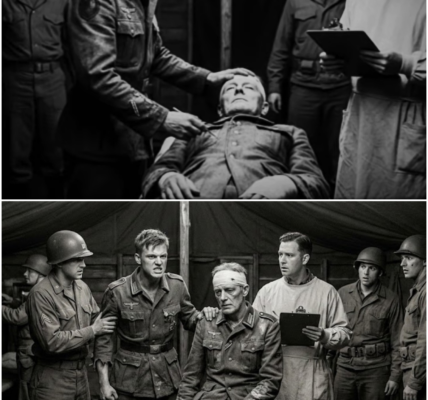

We Get Medicine for Infections?
The Question That Slipped Out Before Fear Could Stop It
He didn’t mean to say it out loud.
The words escaped him the moment he saw the medic’s hand move toward the small metal box. It wasn’t anger or disbelief that pushed them out—it was confusion, pure and unfiltered, the kind that hits before the mind has time to protect itself.
“We get medicine… for infections?”
The question hung in the air longer than anyone expected.
The eighteen-year-old German prisoner of war had learned quickly that asking questions was rarely useful. Questions often invited impatience, sometimes punishment, and almost never comfort. But this moment felt unreal enough to break his own rules.
Medicine was not what he had prepared himself for.
Life at Eighteen Inside a World Built for Endurance

At eighteen, he should have been worrying about ordinary things. Instead, his life had collapsed into routines designed to keep people functional rather than whole.
He was young even by POW standards. His face still carried traces of softness that didn’t belong in a place defined by restraint and repetition. Older prisoners sometimes looked at him with a mix of protectiveness and resignation, as if they already knew how quickly youth would be stripped away.
The camp was orderly, controlled, and predictable. It was not chaotic—but it was unforgiving. Injuries happened often. Infections followed quietly. Treatment, when available, focused on preventing collapse rather than restoring comfort.
You learned to live with discomfort.
You learned not to expect more.
The Infection He Tried to Ignore
It began the way these things usually did.
A small cut. A task done too quickly. A moment of carelessness followed by the familiar sting of regret. He cleaned it the best he could and wrapped it tightly, hoping it would disappear on its own.
It didn’t.
Instead, the skin grew warm. Then tight. Then painful in a way that refused to fade. He said nothing at first. Complaining felt pointless. The infection was uncomfortable, but not dramatic enough to demand attention.
At least, that’s what he told himself.
By the time he finally reported it, the cut had become impossible to hide. The redness had spread. Movement hurt. The fear crept in quietly, late at night, when the camp grew still and thoughts grew loud.
Fear not of pain—but of outcomes.
What He Expected to Happen
The expectations were simple, shaped by observation rather than rumor.
He expected the medic to examine the wound briefly, clean it, perhaps wrap it tighter, and send him away with instructions to “watch it.” He expected time to be the solution—or the problem.
He did not expect urgency.
He certainly did not expect medication.
In his mind, medicine was scarce. Reserved. Prioritized for others. Not something handed to a teenage prisoner with a problem that hadn’t yet turned catastrophic.
That assumption had shaped his fear.
The Small Box That Changed the Room
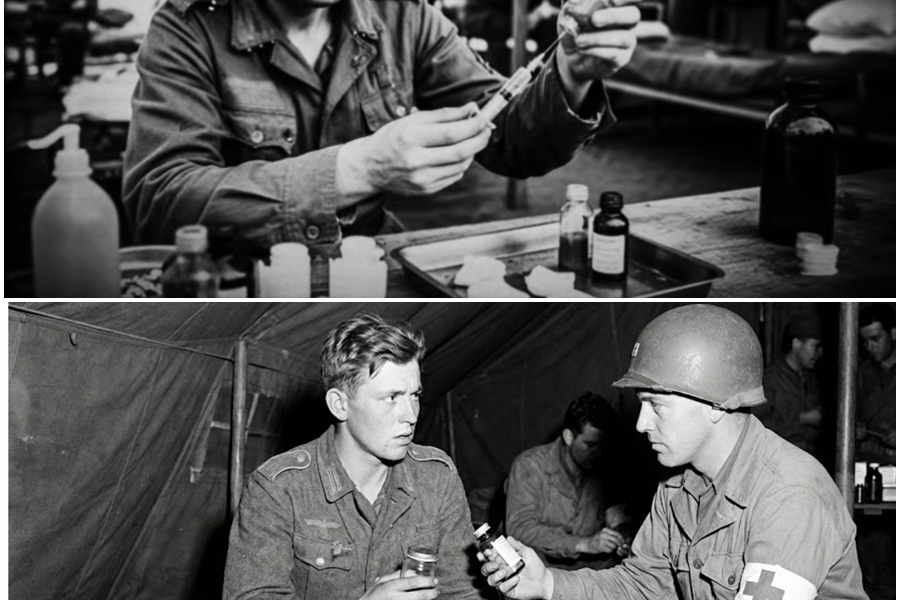
When the U.S. medic reached for the metal box, the young prisoner’s attention sharpened instantly.
Boxes in medical spaces mean decisions.
The medic opened it calmly, revealing small, carefully arranged containers. The movements were practiced, efficient, almost casual. There was no drama in his expression, no sense that something unusual was happening.
That contrast—the normalcy of it—was unsettling.
The medic checked the wound again, nodded slightly, and selected a course of antibiotics as if this were the most natural next step in the world.
That was when the question slipped out.
“We get medicine for infections?”
The Medic’s Answer Was Simpler Than Expected
The medic didn’t react the way the young prisoner feared.
He didn’t sigh.
He didn’t lecture.
He didn’t question why the infection had gone untreated so long.
He simply looked up and answered.
“Yes.”
One word. No explanation.
As if there had never been any doubt.
Shock Has a Physical Feeling
The teenager felt it immediately—an unfamiliar sensation spreading through his chest and shoulders. It wasn’t relief yet. It wasn’t trust.
It was disorientation.
For weeks, his mind had rehearsed outcomes that involved worsening pain, long recovery, or permanent damage. None of those mental rehearsals had included pills measured carefully into his hand.
The world he thought he understood had just shifted, slightly but unmistakably.
He stared at the medication longer than necessary, half-expecting it to be taken back.
It wasn’t.
Why This Moment Felt So Unreal
The shock wasn’t about the medicine itself.
It was about what the medicine represented.
Antibiotics meant prevention, not reaction. They meant effort spent before disaster, not after. They meant someone had decided that stopping the infection early mattered.
That decision carried weight.
In environments defined by limits, every act of care feels intentional. And intentional care feels personal, even when it isn’t meant to be.
The Silent Reactions of Other Prisoners
The room was not empty.
Other prisoners watched quietly from their places, careful not to stare too openly. They noticed the exchange. They noticed the pills. They noticed the medic’s calm.
No one spoke.
But the silence was different now.
It carried curiosity instead of dread.
The eighteen-year-old wasn’t the only one recalculating expectations in that moment.
Taking the First Dose
When instructed to take the first dose immediately, the teenager hesitated for a fraction of a second. Not out of fear of the medicine—but out of disbelief that it was meant for him.
He swallowed carefully.
The act felt ceremonial in a strange way. A simple motion layered with meaning.
Nothing dramatic happened. No immediate relief. No sudden clarity.
Just the knowledge that something had changed.
The Long Night Afterward
That night, sleep came differently.
Pain still lingered, but it no longer carried the same weight. The teenager found himself thinking less about worst-case scenarios and more about ordinary things—how long healing might take, whether the swelling would go down, whether he’d be able to work comfortably again.
Those were normal thoughts.
He hadn’t had normal thoughts in a long time.
Healing That Was Steady, Not Miraculous
Over the next few days, the infection responded the way infections are supposed to respond when treated properly.
The redness faded.
The heat diminished.
Movement became easier.
There was no dramatic turnaround. No sudden victory.
But improvement itself felt extraordinary.
Each small sign of healing reinforced the reality that the medicine was real, that the care was intentional, and that the outcome he feared was no longer inevitable.
Conversations That Changed Quietly
Other prisoners began asking questions.
Not loudly. Not confrontationally.
Just quietly, when the opportunity arose.
“Did it help?”
“How fast?”
“They gave you pills?”
The teenager answered honestly, without embellishment. He didn’t want to oversell it. He didn’t need to.
The evidence was visible.
Why This Surprised Everyone
The camp had rules. It had systems. It had structure.
But it also had assumptions—unspoken beliefs about who received what level of care and when.
This moment disrupted those assumptions.
The teenager had not been favored. He had not been special. He had simply been treated.
And that simplicity was the shock.
The Medic’s Perspective, Brief and Unspoken
The medic never explained his decision because, to him, it didn’t require explanation.
An infection was an infection. Treating it early prevented larger problems later. That was the logic.
But logic doesn’t always account for emotional impact.
What was routine for the medic was transformative for the patient.
How One Interaction Changed the Camp’s Mood
The camp did not suddenly become gentle.
Hardship remained. Rules remained. Confinement remained.
But something subtle shifted.
Illness felt less like a silent threat. Reporting symptoms felt less risky. The fear of being ignored eased slightly, replaced by cautious trust.
That trust didn’t make life easy—but it made it survivable.
Memory Years Later
Years later, when the teenager—no longer a teenager—looked back on his time in captivity, this moment stayed with him.
Not because it was dramatic.
But because it contradicted everything he thought he knew.
He remembered the box.
The pills.
The question he hadn’t planned to ask.
And the answer that came without hesitation.
Why This Story Matters
This is not a story about generosity or heroism in the grand sense.
It is a story about expectations—and what happens when they are quietly overturned.
About how a single, ordinary act of medical care can feel extraordinary in the right context. About how dignity can return in small doses, measured carefully and handed over without ceremony.
The Question That Became a Memory of Relief
“We get medicine for infections?”
The question wasn’t foolish.
It was honest.
And the answer—simple, calm, unquestioned—did more than treat a wound. It treated a belief that had hardened under fear.
Sometimes, the most shocking part of survival isn’t the pain you endure.
It’s the moment you realize someone is trying to prevent it.
Note: Some content was generated using AI tools (ChatGPT) and edited by the author for creativity and suitability for historical illustration purposes.