
She Stole Nothing, Broke No Law, and Still Faced Starvation.
The winter came early, without warning, and with a silence that felt heavier than any sound.
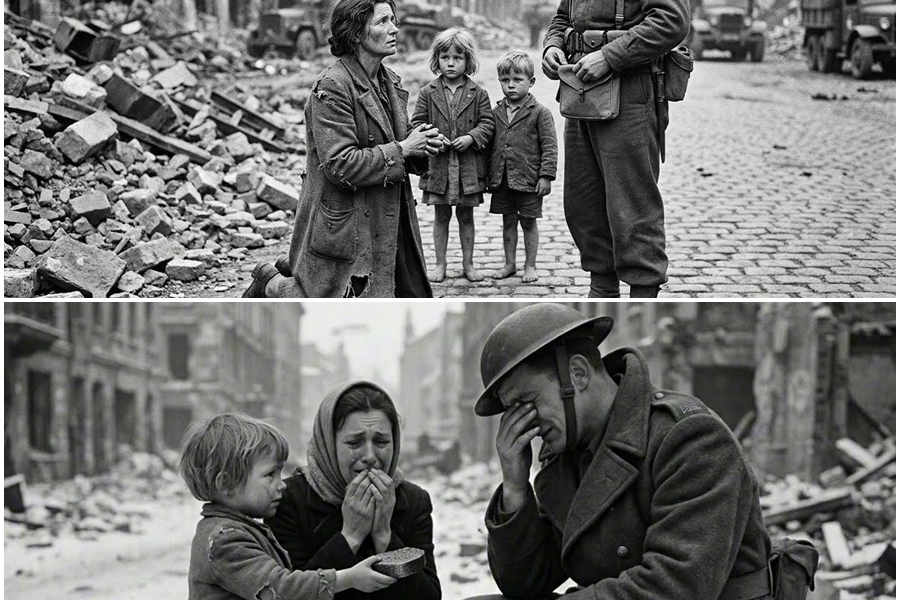
Snow settled over broken streets, collapsed roofs, and homes that no longer felt like shelter. It filled the cracks of a country still trying to understand what had happened to it. For many families in Germany, this winter would not be remembered by a single date or battle, but by a feeling: the slow realization that survival itself had become uncertain.
For Anna Weber, that realization came when she opened her kitchen cupboard and found nothing left to give her children.
No bread.
No potatoes.
No hidden jar.
Only cold air and the sound of her youngest child asking when they would eat again.
A Mother Before Anything Else
Anna Weber was not a public figure. She did not leave behind famous letters or dramatic speeches. She was one of millions of women whose lives were reshaped not by choice, but by circumstance.
Before the war ended, Anna’s world had been small and predictable. She lived in a modest apartment, raised her children, and managed a household with routines passed down through generations. Food was never abundant, but it was reliable. There was always something to stretch into a meal.

That certainty vanished as supply systems collapsed.
By the time winter arrived, ration cards were little more than paper promises. Distribution centers were overwhelmed. Transportation barely functioned. What little food entered cities disappeared almost instantly.
And children still needed to eat.
Hunger Without Drama
Hunger does not always announce itself loudly.
It creeps in quietly—through dizziness, through fatigue, through the way children stop playing and start watching their parents instead. Anna noticed the changes before her children spoke about them.
They moved slower.
They slept longer.
They stopped asking questions.
For Anna, that silence was more frightening than tears.
Each morning became a calculation. Each evening became a negotiation between reality and hope. She watered down soups until they were barely soups at all. She saved crumbs as if they were valuables. She lied gently, telling her children that tomorrow would be better.
She did not know if that was true.
The Unspoken Rules of Survival
The winter revealed a new set of rules—ones that were never written down.
People traded possessions for food. A scarf for a loaf. A family heirloom for a sack of grain. Neighbors watched each other closely, not out of cruelty, but out of shared desperation.
Anna joined long lines before sunrise, waiting hours for distributions that sometimes never arrived. She learned which streets were safer to walk. Which rumors were worth listening to. Which were not.
Every decision carried weight. Every choice felt permanent.
Yet despite everything, she refused to do what some suggested.
She refused to steal.
Why She Drew the Line There
Later, when asked why, Anna struggled to explain.
“It wasn’t about rules,” she said quietly. “It was about my children.”
She believed that how they survived mattered just as much as whether they survived. She wanted them to remember resilience, not fear. Dignity, not shame.
But dignity did not fill stomachs.
As temperatures dropped and fuel ran out, Anna faced a truth she could no longer avoid: her principles would not protect her children from the cold.
Something had to change.
A Choice Made in the Dark
One night, after her children had fallen asleep wrapped in every piece of clothing they owned, Anna sat alone at the kitchen table.
The apartment was silent except for the wind pushing against the windows.
She did not cry.
She planned.
At dawn, she would walk beyond her usual routes. She would knock on doors she had never approached before. She would ask questions she had never asked.
Not for herself.
For them.
The Hidden Economy of Winter
What Anna discovered was a shadow system that operated alongside official channels.
Small exchanges. Quiet agreements. Unspoken understandings between people who had nothing left to lose.
A woman with extra flour.
A farmer willing to trade quietly.
A man who repaired shoes in exchange for dried beans.
None of this appeared in records. None of it followed formal structure. But it kept families alive.
Anna offered what she could: labor, time, skills. She cleaned. She carried water. She mended clothing late into the night.
Sometimes she came home with food.
Sometimes she came home empty-handed.
The Children Knew More Than She Thought
Children sense more than adults often realize.
Anna’s eldest began insisting on smaller portions. Her youngest stopped complaining altogether. They learned, without being taught, how to endure.
That knowledge broke Anna’s heart.
She wanted to protect them from this world, not train them for it.
But the winter did not care about intentions.
A Moment That Almost Broke Her
One evening, after days without success, Anna returned home carrying nothing.
Her children looked at her, waiting.
For the first time, she had no words left.
She sat down on the floor and felt something inside her finally give way—not into despair, but into a fierce clarity.
She would keep going.
No matter how many doors closed.
Why This Story Was Almost Lost
Stories like Anna’s rarely survive intact.
They are not dramatic enough for headlines. There is no single event to point to, no clear resolution. Survival is slow, repetitive, and exhausting.
When the winter ended and conditions slowly improved, people moved on. They focused on rebuilding, on progress, on the future.
Quiet endurance was left behind.
Anna never considered her actions heroic. She considered them necessary.
Historians Still Struggle With This Period
Decades later, historians reviewing this era face a challenge.
Records are incomplete. Testimonies are fragmented. Official documents fail to capture the daily reality of families living at the edge of survival.
Anna Weber’s story exists not because it was extraordinary, but because it was typical.
And that is precisely what makes it unsettling.
What This Winter Reveals About Humanity
Anna’s fight was not against an enemy or an ideology.
It was against time, cold, and hunger.
Her victory was not abundance.
It was survival without surrendering her sense of self.
In the quiet spaces between history’s louder moments, women like Anna held families together with nothing but determination and resolve.
The Legacy of an Ordinary Woman
Anna Weber lived the rest of her life without recognition.
Her children grew up. They remembered the winter not for what they lacked, but for how their mother never stopped trying.
That, perhaps, is the most shocking part of the story.
Not that people suffered.
But that so many endured—silently, stubbornly, and without losing their humanity.
Note: Some content was generated using AI tools (ChatGPT) and edited by the author for creativity and suitability for historical illustration purposes.