
D Day From The German Perspective
June 6th, 1944 00015 hours. Strongpoint WN62 Omaha Beach. Gerright Hinrich Seau carefully cleaned the barrel of his MG42 machine gun in the concrete bunker overlooking the channel. In his pocket, he carried a letter from his girlfriend in Metsingan, promising to wait for him until the war’s victorious end. The invasion will be their grave.

We will throw them back into the sea within hours. He had written these words to her just 3 days earlier after Feld Marshall RML himself had inspected their positions. The desert fox had looked through Seel<unk>’s gun aperture, studied the overlapping fields of fire, and nodded with satisfaction. When they come, RML had said, this beach will be their cemetery.
Through the embracer, Seo could see nothing but peaceful darkness over the channel. The night was calm, almost serene. In 12 hours, this same young man would be found weeping uncontrollably in his bunker, surrounded by 13,500 empty shell casings, his gun barrel warped from heat, watching an invasion force so vast that his mind would simply refuse to process what his eyes were seeing.
Though Seo would later claim to have inflicted 1,000 to 2,000 casualties, historians consider this impossible given that total American casualties at Omaha Beach from all causes were approximately 2,400. The mathematics of German defeat were about to be written not in strategic assessments or intelligence reports, but in the shocked testimonies of soldiers who would witness the largest amphibious invasion in human history from the wrong side of the gun site.
The Atlantic Wall stretched 2,400 m from Norway to the Spanish border, what German propaganda called the most formidable defensive line in military history. Along the Normandy coast, 58 divisions of varying quality manned positions that had consumed 17 million cub m of concrete and 1.2 million tons of steel. Hitler himself had declared it impregnable.
The defensive preparations at Omaha Beach alone seemed to justify such confidence. The US Army Center of Military History records that the Germans had constructed eight concrete bunkers, 35 pill boxes, four artillery positions, 18 anti-tank gun positions, 45 rocket launcher sites, 85 machine gun nests, and six mortar pits.
The beach itself had been turned into a killing field. 3,700 obstacles had been planted in the tidal zone, including Belgian gates, Czech hedgehogs, and wooden stakes, many topped with teller mines. Behind the beaches, 6.5 million mines had been laid, though RML had wanted 60 million. Colonel Ernst Goth, commanding the 916th Grenadier Regiment near Bayur, had calculated the defensive firepower in his sector.
His four batteries could theoretically deliver 120 rounds per minute into the beach sectors. Combined with other batteries, the Germans could concentrate massive firepower on any landing attempt. These calculations, however, assumed unlimited ammunition, an assumption that would prove fatally flawed. June 5th had brought weather that Luftvafa meteorologist Walter Stuba in Paris had declared impossible for invasion.
Wind speeds reached 20 to 25 knots. Waves climbed to six feet and low clouds hung at 500 ft. Stuba using data from Ubot and weather stations had assured the high command that conditions would remain poor for at least 2 weeks. Based on this forecast, many senior officers had left their posts. RML himself had departed for Germany on June 5th to celebrate his wife’s birthday, carrying a pair of gray suede shoes he had purchased in Paris.
General Friedrich Dolman, commanding the seventh army, had ordered division commanders to attend war games at Ren. Even the naval patrols that normally swept the channel had been cancelled due to rough seas. This meteorological confidence would prove to be the first German miscalculation. Unknown to Stuba, the Allies possessed weather stations in Greenland and weather flights over the Atlantic that detected a brief break in the storm.
A 36-hour window that group Captain James Stag had identified and Eisenhower had seized. At 2315 hours on June 5th, radar stations along the Norman coast began detecting unusual activity. Freya and Wsburg radar sets picked up massive aerial formations approaching from the north.
The operators, however, had seen this before. Allied deception raids designed to keep German forces on alert. By 00030 hours on June 6th, reports began flooding in that challenged all assumptions. Full Sher Jagger paratroopers were landing across Normandy. But the reports made no sense. Some units reported paratroopers to the east, others to the west.
Some claimed they were British, others American. Dummy paratroopers with firecrackers attached, part of operations Titanic and Rupert, added to the confusion. Major Hans von Lluck, commanding the 125th Panza Grenadier Regiment of the 21st Panza Division, was one of the first to grasp the situation’s gravity. Awakened by reports of paratroopers landing near his positions, he immediately requestedpermission to attack.
The response from division headquarters, “Do not move until the situation clarifies.” VonLuck would later write in his memoir, “Panza commander, I knew at that moment we were lost. The paratroopers were clearly marking flanks for a landing. Every minute we waited gave them time to consolidate. Yet we sat paralyzed by our own command structure.
” June 6th, 0530 hours. As the first gray light began to illuminate the channel, German observers in forward positions began reporting something that their training had never prepared them for. Verluskart, whose presence at the coast remains disputed by some historians, including Hinrich Seau himself, was credited in some accounts with being among the first to report the Armada.
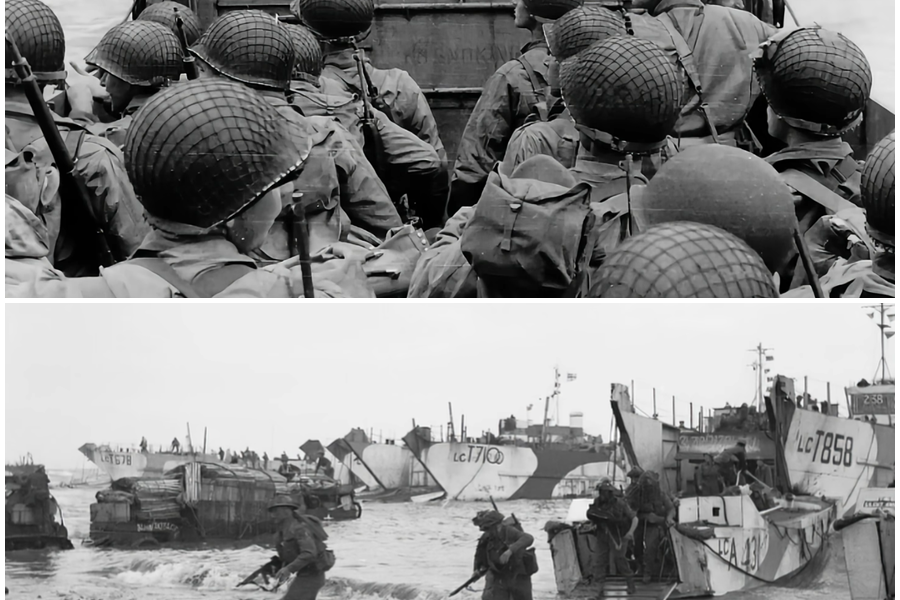
What is certain is that German observers across the Normandy coast witnessed from horizon to horizon a sea covered with vessels. Not dozens, not hundreds, but thousands. Ships of every size and description, from massive battleships to tiny landing craft spreading across the channel like a gray carpet. The invasion fleet consisted of 6,939 vessels, according to official Allied records.
1,213 warships, 4,126 landing craft, 736 ancillary vessels, and 864 merchant ships. It was the largest naval armada ever assembled in human history. To the German defenders raised on propaganda about Allied weakness and division, the site was psychologically devastating. Bernhard Furking, an artillery officer at WN62 who would be killed later that day, reportedly told his men that they were witnessing the whole world arriving on their doorstep.
At 0535 hours, the naval bombardment commenced. Nothing in the German defenders experience, not the Eastern Front, not the heaviest RAF raids, had prepared them for what followed. The battleship USS Texas alone fired 25514in shells at Point Duh Hawk in 34 minutes, according to Naval History and Heritage Command records.
HMS Wars Bite, the first ship to open fire on D-Day at approximately 0500 hours, would deliver over 315in shells in the first 2 days, including 96 rounds fired at German positions on June 9th. The cumulative bombardment from the naval force exceeded anything the Vermacht had previously encountered. According to German veterans accounts collected by the German Federal Archives, concrete bunkers designed to withstand any bombardment cracked under the naval gunfire.
Men were buried alive, dug out, and buried again as shells continued to rain down. The psychological impact was as devastating as the physical destruction. These fortifications in which they had placed absolute confidence were crumbling like sand castles. As the naval bombardment continued, the Luftvafer’s response revealed the true desperation of the German position.
Obus Ysef Pips Prill commanding Yagkashvada 26 received orders to attack the invasion fleet with his entire force. His response recorded in the wings war diary. What entire force? I have two planes. The Luftwaffer, which had promised air superiority over any invasion, could muster only 319 sorties on D-Day against 14,674 allied sorties.
According to US Navy Office of Naval Intelligence Records, Priller and his wingman Unafitzia Hines Vodachic made the only Luftvafer attack on the beaches during the morning of June 6th, strafing Sword Beach once in their FW190A-8 fighters before fleeing from overwhelming Allied fighter cover. This single strafing run by two planes against an invasion force of thousands became a symbol of German impotence.
The promised knights of the air who would darken the skies over any invasion had been reduced to a futile gesture. At 0630 hours, the first assault waves hit the beaches. German defenders, despite the bombardment, manned their positions and opened fire. What followed was carnage that shocked even hardened veterans.
Heinrich Seo, the machine gunner at WN62, began firing at 0635 hours. His position, one of the few undamaged by the bombardment, commanded perfect fields of fire across Omaha Beach. In his 2005 memoir WN62 Irinarungan and Omaha Beach, he stated he fired 13,500 rounds over 9 hours. While Seo claimed massive casualties, military historians note that his position, though deadly, was one of many factors in the Omaha Beach casualties, and specific numbers cannot be verified.
What is certain is that his MG42, firing at a rate of 1,200 rounds per minute in short bursts, contributed significantly to what became known as bloody Omaha. The German defenders began experiencing what military historians would later term material shock, the mental breakdown caused by confronting overwhelming force.
No matter how many Americans, British, or Canadians fell, more appeared. Every destroyed landing craft was replaced by three more. Every silenced machine gun position was suppressed by naval gunfire that seemed unlimited. By midday, German positions began reporting critical ammunition shortages. The defensive plans had calculated ammunition expenditure basedon repelling a limited assault.
Nobody had planned for this scale of attack. According to vermarked supply records, positions that had ammunition calculated for a three-day battle exhausted their supplies within hours. Artillery batteries, the backbone of the defense, faced similar crises. The carefully husbanded ammunition supplies vanished under the intensity of combat.
Attempts to bring forward reserve stocks failed. Every road was under constant Allied fighter bomber attack. The contrast with Allied firepower was stark. German observers noted that American destroyers would fire hundreds of shells at single targets, while German artillery was rationed to four shells per gun per day by the afternoon of D-Day.
The German armor reserve, the force that RML had insisted must defeat any invasion on the beaches, remained paralyzed through the critical morning hours. The 21st Panza Division, the only armored unit close to the beaches, did not receive orders to attack until 1000 hours, 4 hours after the landings began. When the 21st Panza finally attacked at 1620 hours, they advanced between British airborne landing zones toward the coast.
According to divisional records, they reached the shore between Leonare and Luke Sumere around 1900 hours. the only German armored unit to reach the coast on D-Day. However, at 2100 hours, they witnessed the arrival of Operation Malard. 250 gliders bringing reinforcements to the British Sixth Airborne Division. Interpreting this massive air armada as a threat to their flanks, they withdrew.
The division lost 54 tanks and armored vehicles on D-Day, approximately 25% of their strength in a single day. The counterattack also encountered specialized allied armor they had never seen before. Hobart’s funnies, modified tanks with flails for mine clearing, flamethrowers, and bridging equipment, seemed to belong to a different era of warfare entirely.
Throughout D-Day, German units faced a threat they had never encountered at this scale. Massive airborne forces operating behind their lines. The sixth airborne division, British, and the 82nd and 101st Airborne Divisions, American, created chaos that multiplied their actual strength. Oust Friedrich Vonditer, Germany’s most experienced paratrooper commander serving with the sixth falga regiment, was in Normandy during the invasion.
His professional assessment, recorded in post-war interviews, was damning. The Allied airborne operation was everything ours had never been. Massive, coordinated, and supplied. We dropped battalions. They dropped divisions. We were supplied by single aircraft. They had endless streams of gliders and transport planes.
The psychological impact of paratroopers appearing everywhere paralyzed German responses. Units refused to move, fearing ambush. Others fired at shadows, sometimes at their own men. The confusion multiplied German problems exponentially. As D-Day progressed, German command and control disintegrated. Allied aircraft systematically destroyed communication lines.
French resistance activated by coded BBC messages cut telephone cables and destroyed relay stations. Radio communications were jammed by Allied electronic warfare units. General Litnant Max Pemil, Chief of Staff of the Seventh Army, attempted to coordinate the defense from his headquarters at Lamar.
His war diary records increasing frustration as contact with forward units disappeared. By noon, entire divisions had vanished from the communication network. Individual unit commanders made decisions in isolation without knowledge of the larger picture. As darkness fell on June 6th, surviving German defenders took stock of their situation.
The impregnable Atlantic Wall had been breached in multiple places. The Luftvafa had essentially ceased to exist over Normandy. The creeks marine had managed to sink one destroyer USS Cory while losing 15 eboats and numerous smaller craft. General Oitant Wilhelm Richa commanding the 716th division which had borne the brunt of the British assault reported to 7th Army headquarters.
Division combat strength 35%. All coastal strong points lost. Artillery 90% destroyed. enemy advancing inland. The statistics told a story of complete tactical failure despite individual acts of heroism. In a single day, the German forces had suffered casualties equivalent to those of a major battle, while the Allies continued landing fresh troops as if D-Day was merely the beginning, not the climax.
Throughout the night of June 6th to 7th, German units attempted to regroup and counterattack. These efforts revealed the full extent of Allied superiority. Every German movement was detected by radar, illuminated by flares, and destroyed by artillery or naval gunfire. Hans vonLux Panza grenaders, finally released to counterattack, advanced towards Sword Beach in darkness.
According to his memoir, they were immediately illuminated by parachute flares and subjected to devastating fire from destroyers offshore. It was likedaylight. Every vehicle, every soldier was visible. The shells came from the sea with perfect accuracy. We lost half our strength without seeing a single enemy soldier.
Meanwhile, Allied reinforcements continued landing. The artificial Malbury harbors were already being assembled. Supply ships anchored in organized rows. The invasion wasn’t just succeeding, it was transforming into a permanent presence. As German reinforcements attempted to reach Normandy, they encountered complete interdiction of movement.
Every road, railway, and bridge was under constant attack. According to Vermacht transportation records, units that should have reached the front in one day took up to two weeks. The second SS Panza division, Das Reich, stationed near Tulus, took 17 days to reach Normandy, a journey that should have taken 3 days.
They arrived having lost 30% of their vehicles to air attack without firing a shot at ground forces. The psychological impact was devastating. If they couldn’t even reach the battlefield intact, how could they hope to influence it? Meanwhile, Allied logistics operated with stunning efficiency. LSTs, landing ship, tank, discharged entire armored regiments in hours.
Within days of D-Day, the Allies were landing 15,000 tons of supplies daily, more than the entire German army in Normandy consumed in a week. By June 12th, German forces in Normandy were approaching psychological collapse. They had lost 26,000 men killed, wounded, or missing, roughly equivalent to two full divisions. Replacements were minimal.
Meanwhile, Allied strength grew hourly. Carantan fell on June 12th, linking Utah and Omaha beaches. The German paratroopers of the sixth Falsher Jagger regiment, elite troops who had never previously retreated, withdrew in disorder. Their commander, Friedrich Fonder, reported to higher headquarters, “My regiment no longer exists as a combat unit.
The survivors are psychologically broken.” On June 13th, SS Obertomfurer Michael Vitman achieved one of the few German tactical victories in Normandy. According to British military records, he destroyed 13 to 14 tanks, two anti-tank guns, and 13 to 15 personnel carriers in the battle of Villis Boage within 15 minutes. German propaganda seized on this victory as proof that German arms could still prevail.
But even this victory revealed the futility of the German position. Vitman’s Tiger tank disabled in the battle was replaced by the Germans with difficulty. The British losses were replaced within hours. The tactical brilliance of individual German soldiers could not overcome industrial mathematics. Wittmann himself with 138 confirmed tank kills across all fronts was killed on August 8th when his Tiger was destroyed.
Whether by British gunner Joe Eins of the Northampton Shia Yommanry or Canadian forces remains disputed. The Vermach’s greatest tank ace was eliminated by an enemy that could afford to trade 10 tanks for one Tiger. The fall of Sherborg on June 26th provided another psychological blow. This major port fortified over four years and garrisoned by 21,000 men was supposed to hold for months.
It fell in 5 days of serious fighting. General Litnant Carl Wilhelm Fon Schleban commanding the garrison had proclaimed he would defend Sherborg to the last bullet. Instead, he surrendered on June 26th. In his post-war interrogation, he explained that resistance became meaningless against unlimited enemy resources, a theme that would echo throughout German accounts of Normandy.
Operation Cobra, beginning July 25th, delivered the knockout punch to German forces in Normandy. According to official US Army Air Force records, the preparatory bombardment involved 1,53 heavy bombers, 380 medium bombers, and 550 fighter bombers, dropping over 4,100 tons of bombs in a concentrated area just 7,000 yd wide and 2,500 yd deep.
General Litnant Fritz Boline, commanding Panzer Division, reported to Army Group B. My division is annihilated. The psychological effect on the survivors is indescribable. They are no longer soldiers, but broken men. The bombing was so intense that it killed Lieutenant General Leslie McNair, the highest ranking American officer killed in the European theater, who was observing from what was thought to be a safe distance.
If American generals weren’t safe from their own firepower, what chance did German soldiers have? The file’s pocket August 12th to 21st became the graveyard of German forces in Normandy. According to Allied intelligence reports confirmed by postwar German records, approximately 10,000 Germans died in the pocket and 50,000 were captured.
Over 300 tanks and armored vehicles were destroyed along with 2,500 other vehicles. German soldiers attempting to escape described scenes of apocalyptic destruction. Roads were carpeted with dead horses and burning vehicles. Allied fighter bombers attacked in waves every 20 minutes. Artillery fell continuously. The systematic destruction was so complete that many soldiers simply gave up,preferring captivity to certain death.
The final accounting of the Normandy campaign tells a story of complete German defeat. German losses June 6th to August 31st. Approximately 320,000 casualties, 30,000 killed, 80,000 wounded, 210,000 missing or captured. 2,300 tanks destroyed. virtually all armor in France. 2,127 aircraft lost.
Allied losses 29,672 casualties with replacements exceeding losses daily. Approximately 4,000 tanks lost replaced within weeks. 4,11 aircraft lost from a force exceeding 13,000. The disparity revealed the fundamental truth. Germany was fighting a nutritional battle it could not win against an enemy with virtually unlimited reserves.
Professional German military officers provided the most objective assessments of the disaster. General Deans Trupen Hinrich Ababach who assumed command in Normandy after Raml was wounded reported to OKW on August 1st. The enemy’s material superiority is at least 20 to1 in artillery, 10 to1 in tanks, and absolute in aircraft.
He can replace all losses within days. We cannot replace anything. General Hanspidel, Raml’s chief of staff, wrote in his 1949 memoir. Normandy proved that courage alone could not overcome industrial supremacy. We faced an enemy who had mechanized not just warfare, but victory itself. General Feld Marshall Irvin Raml left the most powerful testament to the Normandy experience.
In his final report to Hitler on July 15th, 2 days before being severely wounded by Allied aircraft, he wrote, “The troops are fighting heroically everywhere, but the unequal struggle is nearing its end. The enemy’s overwhelming superiority in men and material is beginning to tell. I must beg you to draw the necessary conclusions without delay.
This was military language for complete defeat. Raml, Germany’s most celebrated commander, was telling Hitler that the war was lost. The Normandy campaign revealed that World War II had become a production war. German soldiers witnessed American industrial capacity that defied their comprehension. Ford’s Willowrun plant alone produced one B-24 bomber every 63 minutes at peak production.
American factories produced 96,000 aircraft in 1944. Allied ammunition expenditure in one day exceeded German production in a month. A single American division consumed more supplies daily than an entire German core. Hans Fonluck reflecting on Normandy in his memoir wrote, “We learned that modern war was not about tactics or courage, but about production.
The Americans had turned war into an industrial process. They manufactured victory on assembly lines. The German soldiers who survived Normandy were psychologically transformed. They had witnessed the complete invalidation of everything they had been taught about warfare, racial superiority, and national destiny. Hinrich Seo, the machine gunner of WN62, spent the rest of his life haunted by his D-Day experience.
In his 2005 memoir, he wrote about meeting American D-Day veterans. We all realized we had been young men thrown into an industrial slaughterhouse. My 13,500 rounds meant nothing against their unlimited replacements. Friedrich Fondonder Heighter the paratrooper commander became a professor of international law after the war.
He wrote Normandy taught us that the era of warrior heroes was over. War had become a matter of industrial capacity and we had challenged the world’s greatest industrial power with horses and outdated dreams. D-Day from the German perspective was not merely a military defeat. It was a complete ideological and psychological collapse.
Soldiers who had conquered most of Europe discovered that everything they believed about their enemies, their cause, and their capabilities was catastrophically wrong. They had expected to face weak, divided democracies. Instead, they encountered an alliance that had transformed war into an industrial process of overwhelming efficiency.
They witnessed democracy’s arsenal in action. unlimited ships, planes, tanks, and supplies flowing from factories whose capacity exceeded German comprehension. The German defenders of Normandy learned that modern war was won not on battlefields, but in factories, not by the bravest soldiers, but by the most productive societies.
They discovered that the Western Allies had revolutionized warfare, turning it into a mathematical equation where production statistics mattered more than tactical brilliance. Hinrich Seau began June 6th believing the invasion would be thrown back within hours. He ended it surrounded by thousands of empty shell casings, watching endless waves of Allied reinforcements land on the beach his position was supposed to control.
His experience embodied the larger German tragedy in Normandy. Tactical success drowned in strategic impossibility. The beaches of Normandy became not just a battlefield, but a revelation. German soldiers witnessed the future of warfare, and it belonged to the societies that could produce the most material and apply it most efficiently.
They had brought courage, training, and determination to the battle. The Allies brought unlimited industrial production. In trying to hold back the Allied invasion, the German defenders might as well have been trying to hold back the tide itself. They fired until their barrels melted, fought until their ammunition ran out, and watched as the Allies simply brought more of everything.
The mathematics of modern war had rendered their courage irrelevant. The German soldiers who faced D-Day learned history’s hardest lesson. In the age of industrial warfare, nations that could not match their enemy’s production were doomed to defeat regardless of their soldiers skill or sacrifice. They began June 6th as warriors of the Third Reich and ended it as witnesses to the Arsenal of democracy in its full terrifying efficiency.
Their defeat was not just military but total. A crushing demonstration that the Nazi vision of racial superiority and military dominance had collided with the reality of Allied industrial supremacy and shattered completely. The invasion they had promised to throw back into the sea had instead swept them away, carrying with it the last illusions of German victory.
Note: Some content was generated using AI tools (ChatGPT) and edited by the author for creativity and suitability for historical illustration purposes.