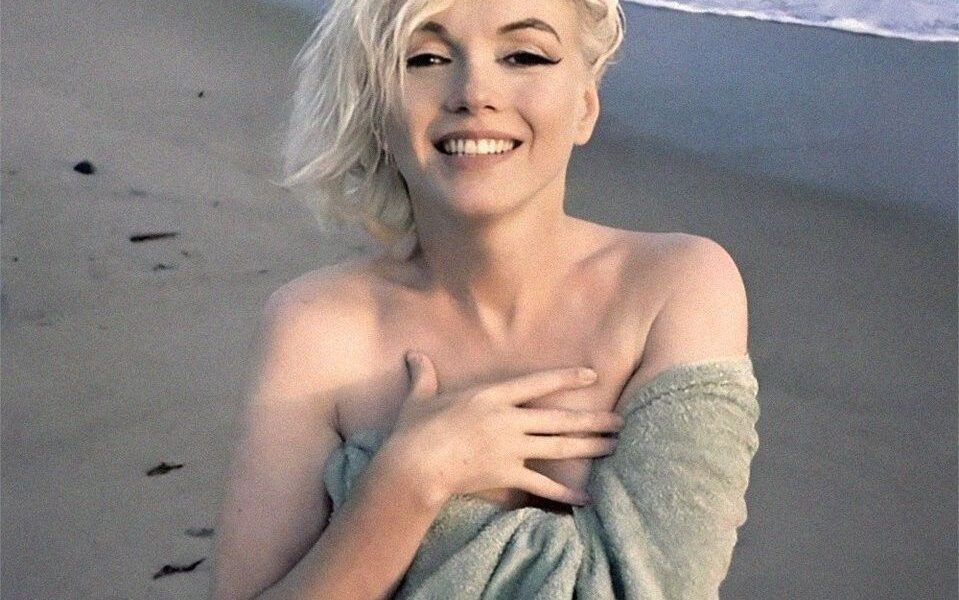

There are people who enter history not only by what they do, but also by what they leave behind after they disappear. Marilyn Monroe is a strange testament to this. Six decades have passed since her death, but the world still whispers the seemingly simple question: ‘Who was Marilyn Monroe really? Why do the secrets surrounding her life continue to haunt humanity?’ On the silver screen, she is the seductive goddess, the embodiment of timeless beauty, the American dream in the golden age of Hollywood. But off the lights, she is Norma Jeane – a small girl with a dark childhood, wavering between abandonment and a yearning for love. Perhaps it is this strange duality – between the dazzling glory and the painful shadows – that has turned Marilyn’s life into a tragic epic that no one dares to stop listening to. Her death at the age of 36 only adds to that mysterious allure. The world lost a star, but gained a legend. And to this day, whenever Marilyn Monroe is mentioned, one cannot distinguish the line between reality and legend, between the person and the symbol. Perhaps the most fascinating part lies behind, in the gaps that history has never filled.

Before becoming Marilyn Monroe, she was just Norma Jeane Mortenson – an ordinary name, born into a situation that few would dream of. Her father was absent from the moment she was born, and her mother was engulfed in mental storms, leaving that little girl to live in the arms of relatives, foster families, and even an orphanage. That childhood was devoid of light. The days Norma Jeane grew up resembled a diary full of empty spaces, where the little girl learned to face loneliness earlier than anyone. Many times, she was abandoned, lived in fear, and was crushed by traumas that no child should have to endure. But it was also in that darkness that a strange desire formed: the desire to be seen, to be loved, to shine. Norma Jeane began to dream of another life – one where she was no longer the forgotten child, but became someone the whole world had to pay attention to. It was this dream, hidden in her unusually bright but sad eyes, that led her to her destined path.

That journey began with advertising photos. Norma Jeane entered the modeling profession not for luxury, but simply to make a living. However, the strange thing is that even in the simplest photos, her eyes and smile contained an unspoken promise: this girl would not stop here. When the name Marilyn Monroe was born, it was not just a stage name, but a rebirth. Norma Jeane transformed into a new character, an icon that the world could not ignore. And then, Hollywood witnessed the rapid rise of a star. In Gentlemen Prefer Blondes, she captivated the world with her charm; in The Seven Year Itch, the image of her white dress blowing up became immortal; and with Some Like It Hot, she proved that she was not only a beauty but also a talented actress. Each role Marilyn played was a peculiar combination of allure and fragility. The audience laughed at her innocence, but then they would feel a chill when realizing that those eyes always concealed a void. It was this contrast that turned Marilyn into an icon, a dream that Hollywood could not stop exploiting, but also a fragile heart that she herself could not protect.
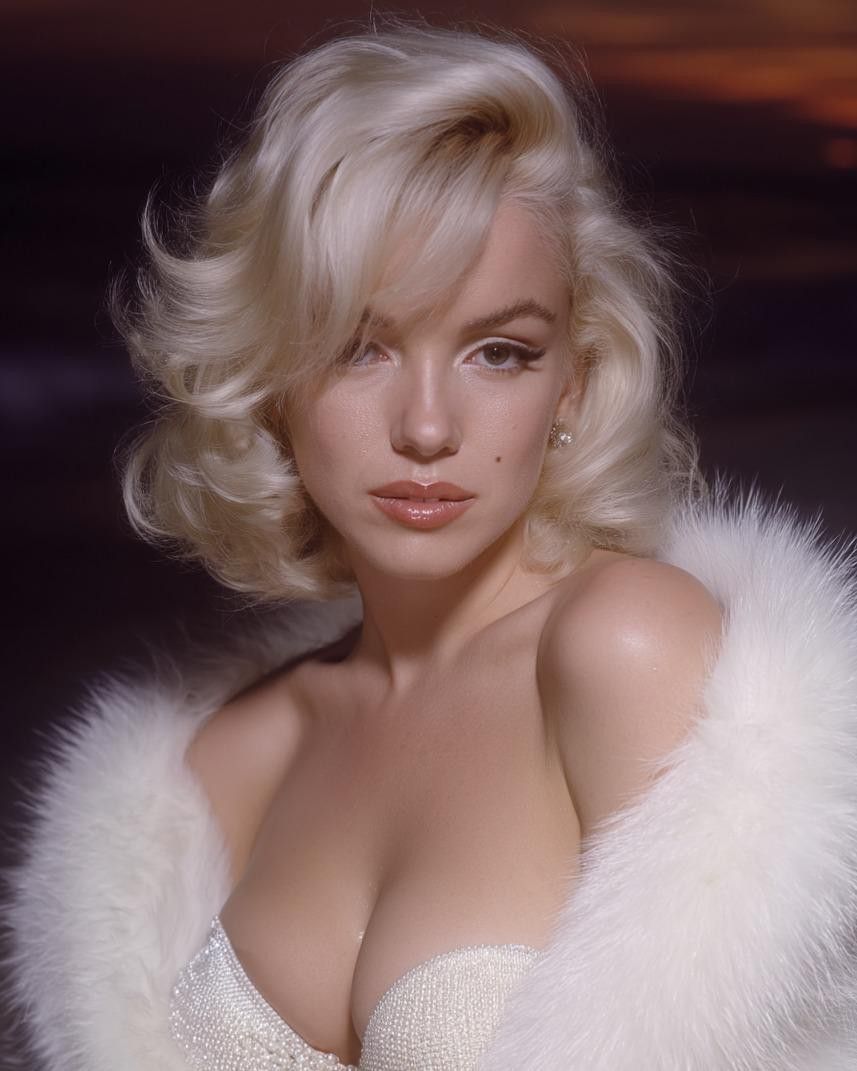
The glory comes, but the tragedy follows closely. While the whole world cheers, Marilyn sinks into the feeling of being trapped. She once said, ‘Hollywood is a place where they pay you a thousand dollars for a kiss, and fifty cents for your soul.’ And indeed, the world loves Monroe – the sex symbol, but hardly anyone truly cares about Norma Jeane – the woman who always longs for a family. Marilyn’s marriages are unfinished quests for happiness. With Joe DiMaggio, the love is passionate but stifling; with Arthur Miller, intellect and art walk hand in hand, but cannot bridge the emotional gap. Each ending of her marriage leaves a more broken, more lost Marilyn. To endure the pressure, she turns to sleeping pills and alcohol, as if they are the only escape routes. But every way out leads her to a deeper abyss. Gradually, the smile in front of the public grows further apart from the tears behind the scenes. And the world, in its admiration, has inadvertently overlooked that silent cry for help.

Marilyn Monroe was not only caught in the whirlpool of Hollywood, but she was also entangled in secrets that astounded the entire world. Establishing her own company to gain control of her career was once considered a bold, groundbreaking act, but it also made her a thorn in the side of many powerful people. And then, the rumors of her affairs with President John F. Kennedy and his brother Robert Kennedy took her life in a different direction. The moment ‘Happy Birthday, Mr. President’ echoed like a seductive whisper, but it also opened up countless theories about her relationship with American politics. Her sudden death in 1962 – officially recorded as a suicide by overdose – has never truly convinced the public. Was it an accident, a political conspiracy, or personal despair? Each theory carries its own weight, but all contribute to one truth: Marilyn Monroe was not just a person, but an unsolvable riddle.

Even though she left when her career was at its peak, Marilyn did not disappear. On the contrary, she became immortal. The films she left behind are still being screened, photos still appear on magazine covers, and the image of her white dress remains one of the most referenced icons in popular culture history. The strange thing is, Marilyn has never become ‘old-fashioned.’ Each generation finds something in her: timeless beauty, courage beyond norms, or the loneliness that everyone can empathize with. Therefore, Marilyn lives on – not by breath, but by the memories of millions of hearts.

Marilyn Monroe’s legacy is not just in cinema. She became a symbol of courage by daring to challenge conventions, asserting that women have the right to control their careers and destiny. She did not win completely in real life, but she triumphed in opening a new chapter for female artists in the future. The lesson she left behind is not about how to be famous, but how to not lose oneself in the limelight. Behind the allure and glory, Marilyn reminds the world that cracks and fragility are also a form of strength, for they make us real and able to reach the hearts of others.

What does Marilyn Monroe represent in the collective memory of humanity? A movie star, a sex symbol, or a broken soul? Perhaps she is all of these. And it is this intertwining that makes her story never-ending. Every time the silver screen lights up, every time an old photo emerges, Marilyn returns as if she never left. More than sixty years have passed, yet the world continues to ask: if Marilyn were still alive, who would she be? A superstar conquering the screen, or an ordinary woman finding peace? No one has the answer. And perhaps, it is precisely because there is no answer that the legend known as Marilyn Monroe will remain immortal forever.