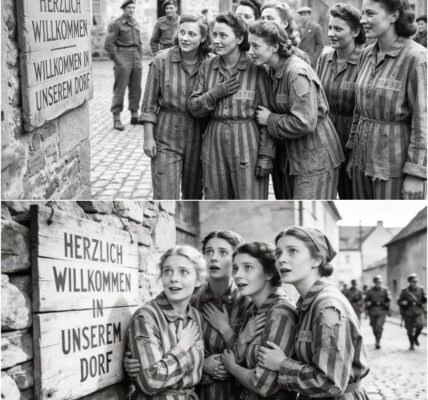
120 BANNED Historical Photos They Never Wanted You to See! — The Hidden Stories Behind History’s Most Powerful Images
Some photographs do more than preserve a moment in time. They challenge the stories people have been told, expose the human consequences of decisions made behind closed doors, and force later generations to confront realities that powerful institutions may once have preferred to keep out of public view. Across the twentieth century and beyond, cameras documented battlefields, destroyed cities, political upheavals, secretive military projects, and ordinary lives caught in extraordinary circumstances. Some images were censored, others classified, and many remained buried in archives until researchers, journalists, or changing political circumstances brought them to light. Now, a compilation titled “120 BANNED Historical Photos They Never Wanted You to See!” is drawing attention online. Its promise is provocative, but an important question comes first: what does it actually mean for a historical photograph to be banned, and how can we distinguish genuine suppressed evidence from an ordinary image presented with a sensational label?
The exact contents of this particular collection have not been independently verified. Nevertheless, the broader history behind its premise is real and worth exploring. Photographs have been withheld, restricted, manipulated, or selectively published for many reasons. Some restrictions were imposed by governments during wartime. Others arose from military secrecy, political pressure, privacy concerns, or the understandable desire to protect people from disturbing images. In still other cases, photographs were never banned at all. They were simply forgotten, overlooked, poorly catalogued, or inaccessible to anyone outside a small circle of researchers.
Understanding these distinctions matters because historical photography is not merely a collection of striking pictures. It is a record of human experience, and every image carries questions about the person behind the camera, the people in front of it, and the institutions that eventually controlled its circulation.
When a Photograph Became a Threat to the Official Story

Photography transformed the way societies experienced history. Before cameras became widespread, accounts of distant wars and political upheavals depended heavily on written testimony, paintings, illustrations, and the reports of those who had witnessed events. Photographs introduced another kind of evidence: a visual record of a particular place and moment.
That evidence was powerful, but it was never entirely neutral. A photograph could reveal details that an official statement omitted, yet it could also mislead when separated from its original context. A camera recorded only what stood within its frame. The photographer chose where to stand, when to press the shutter, and what to leave outside the picture. Editors later decided which images deserved publication and which would remain unseen.
During wartime, these choices acquired enormous political significance. Governments needed to maintain public support, reassure families, protect military operations, and prevent information from reaching enemy forces. Photographs showing troop movements, damaged infrastructure, casualties, or sensitive equipment could reveal information that military authorities considered dangerous.
Censorship was therefore not always motivated by a desire to conceal wrongdoing. Some restrictions served legitimate operational purposes. A photograph revealing the location of a military installation, for example, could endanger the people working there. An image identifying wounded personnel might expose private information or compromise security.
But the same mechanisms could also restrict public understanding of a conflict. When authorities controlled which images reached newspapers and broadcasters, they influenced how the public perceived the war. The distinction between protecting lives and protecting an institution’s reputation could become difficult to determine, particularly when officials had strong incentives to control the narrative.
This tension lies at the heart of the fascination with supposedly banned photographs. People understand that official accounts can be incomplete. They also know that powerful institutions have sometimes withheld information. The temptation is to assume that every obscure image must therefore contain a hidden revelation.
History requires a more careful approach. Some photographs were genuinely restricted. Others became famous only after circumstances changed. Still others were publicly available all along, even if few people had seen them.
The photograph itself cannot settle every question. Its provenance, accompanying records, date, location, and publication history are essential to understanding what it proves.
The Second World War: Images of Destruction and Human Suffering

Few periods demonstrate the power of historical photography more clearly than the Second World War. Between 1939 and 1945, photographers documented military campaigns, occupied cities, bombed neighbourhoods, refugee movements, forced labour, and the devastating consequences of Nazi persecution.
Their photographs now form an essential part of the historical record. Yet the images available to the public at any given moment were shaped by military restrictions, the practical limits of wartime reporting, and the decisions of editors and officials.
Photographers working with Allied military units often operated under regulations governing what they could photograph and publish. Certain images could not be released until they had been reviewed. Operational security was a genuine concern: photographs could reveal troop positions, equipment, defensive arrangements, or other details useful to an enemy.
Images of casualties also presented a difficult public question. Families had a right to know what was happening to soldiers, while editors and officials debated how much suffering readers should be expected to see. Photographs that might have been considered too disturbing for one publication could appear in another context years later.
This does not mean every photograph of wartime suffering was banned. Nor does it mean every image that circulated widely was an accurate representation of the entire conflict. It means that the visual history of the war was shaped by the interaction between what photographers recorded and what institutions allowed audiences to see.
The liberation of Nazi concentration camps provides one of the most consequential examples of photography confronting the world with evidence of atrocity. As Allied forces entered camps in 1944 and 1945, military personnel, journalists, and other witnesses documented conditions that demanded investigation and public attention.
The resulting photographs showed the physical remains of a system of persecution and mass murder. They helped establish a visual record of crimes that might otherwise have been denied, minimized, or distorted by those responsible.
Yet the history of these images is more complicated than the idea of a single forbidden collection suggests. Photographs were made by different people, at different locations, under different circumstances. Some were used in contemporary reporting; others became part of military, legal, or archival records. Their subsequent publication and interpretation varied.
Their historical importance does not depend on a dramatic claim that every image was hidden. Their importance rests on their evidentiary value, their relationship to other records, and their role in preserving the memory of victims.
These photographs also present an ethical responsibility. The people shown were not simply anonymous figures in a historical drama. They were individuals whose lives had been subjected to persecution, deprivation, and violence. Reproducing their images requires care, particularly when the circumstances of their deaths or suffering are uncertain.
A responsible historical presentation does not use human suffering merely to provoke curiosity. It explains what is known, acknowledges what remains uncertain, and treats the people in the photographs with dignity.
The Battlefields That Changed Public Perception
The Vietnam War offered another powerful example of photography influencing public understanding of a conflict.
By the 1960s and early 1970s, television and photojournalism had become increasingly important parts of everyday news. Images from Vietnam could reach audiences far from the battlefield, bringing the consequences of military operations into homes, newspapers, and public debate.
Photographs of wounded civilians, displaced families, soldiers under pressure, and devastated communities complicated official descriptions of military progress. They made it harder for distant audiences to think of war solely through maps, statistics, and statements from political leaders.
Some images became enduring symbols. Eddie Adams’s photograph of the execution of Nguyễn Văn Lém in Saigon on February 1, 1968, captured a killing during the Tet Offensive. Nick Ut’s photograph of children fleeing a napalm attack near Trảng Bàng on June 8, 1972, became another widely recognized image of the war’s consequences.
Neither photograph needs to be described as secretly banned to explain its historical significance. Both became part of the public record and helped shape how audiences remembered the conflict. Their importance lies partly in what they revealed, but also in the questions they raised about violence, responsibility, and the relationship between a single frame and a much larger event.

A photograph can change public discussion because it compresses an overwhelming situation into a moment people can see. But that compression can also create misunderstandings. A still image rarely explains everything that happened before or after the shutter was released. It cannot independently establish every participant’s identity, motive, or responsibility.
For that reason, historians examine photographs alongside eyewitness accounts, contemporaneous reporting, official documents, and other visual evidence.
The lesson is not that images should be distrusted. It is that their power makes context especially important.
When a modern video claims to reveal a photograph that authorities supposedly never wanted anyone to see, the viewer should ask what the image actually documents. Is its date known? Who took it? Was it published at the time? Does a recognised archive preserve the original? Can the surrounding circumstances be independently established?
These questions may appear less dramatic than the promise of forbidden knowledge. They are, however, what transform an intriguing image into reliable historical evidence.
Nuclear Testing and the Human Cost of the Atomic Age
The nuclear age produced photographs that remain among the most unsettling records of modern history. Beginning in the 1940s, nuclear weapons testing transformed military planning and international politics while creating profound environmental and human concerns.
Some tests took place in remote regions or at locations where access was tightly controlled. Authorities documented explosions, blast effects, equipment performance, and the behaviour of structures exposed to intense energy. Such photographs were frequently created for scientific, military, or engineering purposes rather than public consumption.
The reasons for restricted access varied. Some material involved classified weapons programmes. Other records were kept within technical organisations or were difficult to understand without specialist knowledge. Over time, declassification and archival access made portions of this visual record available to researchers and the public.
The history of nuclear testing also extends beyond photographs of mushroom clouds. Communities living near test sites, military personnel involved in testing, and people affected by radioactive contamination raised questions about exposure, health, displacement, and government accountability.
These issues cannot be understood through a dramatic photograph alone. They require environmental records, medical research, official correspondence, oral histories, and careful analysis of the conditions under which testing occurred.
A photograph of a nuclear explosion may demonstrate the scale of a test. It cannot, by itself, establish the long-term health effects experienced by a particular community. Similarly, a photograph of an abandoned settlement cannot independently explain why its residents left or determine which institution bears responsibility.

The distinction becomes especially important when online compilations describe photographs of nuclear-test victims as if every image were deliberately prohibited. Some images may have been classified or restricted; others may have appeared in technical reports, public investigations, or later historical publications. Without examining the specific records, it is impossible to assign one explanation to an entire collection.
Still, the broader question remains compelling. What happens when a government controls information about a technology capable of changing the future of humanity? How much secrecy is justified by national security, and how much transparency is necessary for democratic accountability?
Historical photographs can help answer these questions, but only when they are connected to reliable evidence and the experiences of the people affected.
Political Leaders, Private Moments, and the Construction of Power
Not every controversial photograph depicts a battlefield or a scientific experiment. Some of the most revealing images in political history show leaders away from the podium.
Official photographs often present politicians and heads of state in carefully managed settings. They may be shown meeting foreign dignitaries, inspecting factories, addressing crowds, or standing beside military personnel. The purpose is usually clear: to communicate authority, competence, solidarity, or national purpose.
Informal photographs can offer a different perspective. A leader might appear tired after a long meeting, distracted during a public event, or relaxed among colleagues. Such images can humanize public figures, but they can also be misinterpreted when removed from context.
The existence of an unpublished photograph does not automatically indicate a cover-up. It may never have been selected by an editor. It may have remained in a photographer’s personal archive. It may have been considered unimportant at the time, or its subjects may have requested that it remain private.
Political censorship is nevertheless a real historical phenomenon. Governments have restricted images, controlled news photography, or promoted visual material that supported their preferred narratives. Authoritarian systems have often placed particular emphasis on the presentation of political leaders and national achievements.
Photographs can be removed from public circulation, altered, or selectively reproduced to shape collective memory. The history of political imagery therefore includes not only censorship but also manipulation and the deliberate construction of public identity.
Yet an image must not be treated as proof of a scandal simply because it is unfamiliar. A photograph of two officials standing together does not establish that they reached a secret agreement. A candid expression does not reveal a person’s private thoughts. A picture taken at a government building cannot, by itself, prove that a covert operation occurred there.
The most responsible interpretation begins with what can actually be observed and then distinguishes it from what the evidence supports.
This discipline is especially important in the digital era, when an old photograph can be circulated with a new caption that changes its apparent meaning. A real image can be used to support a false claim without the image itself being altered.
In such cases, the misinformation lies not necessarily in the photograph, but in the story attached to it.
The Photographs That Were Never Meant for Public Consumption
Some historical images remained private for reasons that had little to do with government secrecy.
Family albums contain photographs of weddings, funerals, children, celebrations, journeys, and ordinary days. Many were made for a small audience and were never intended to be examined by strangers decades later. When these images enter public archives, they can become valuable records of clothing, architecture, social customs, migration, and family life.
They can also reveal details their subjects never expected to share.
A photograph taken outside a factory might help researchers understand working conditions. A family portrait could preserve evidence of a community displaced by war or urban redevelopment. A street scene might document buildings that no longer exist, businesses that have disappeared, and forms of everyday life transformed by technological change.

For historians, these ordinary photographs can be as important as images of major political events. They preserve the texture of daily experience, often showing aspects of the past that official documents overlook.
But the fact that an image has historical value does not erase every concern about privacy. People photographed decades ago may have had no reason to expect their faces, homes, or personal circumstances to be distributed to millions of strangers.
The ethical questions become more difficult when photographs show children, people in distress, victims of crimes, or individuals who were never public figures. Even where publication is legally permitted, archivists and editors may need to consider whether sharing an image could expose someone to humiliation, discrimination, or unwanted attention.
The same photograph can therefore possess both historical value and a claim to careful handling.
This tension challenges the simplistic idea that every restriction is an attempt to conceal the truth. Sometimes access limitations exist to protect vulnerable people, respect cultural traditions, or prevent sensitive personal information from being exploited.
Other restrictions may be excessive or unjustified. The task is to examine the circumstances rather than assume that every hidden record represents either a conspiracy or an entirely reasonable decision.
Lost Archives, Forgotten Negatives, and the Work of Discovery
A photograph can disappear from public view without anyone deliberately banning it.
Film negatives deteriorate. Paper prints are damaged by moisture, light, and poor storage. Collections become separated when institutions close or families move. Records may be catalogued under vague descriptions that make them almost impossible to find. Photographers die without identifying the people or places shown in their work.
Sometimes entire collections remain undiscovered for decades because no one knows they exist.
The recovery of such material can transform historical understanding. A newly identified photograph may help establish the appearance of a building before its destruction, clarify the sequence of a public event, or identify a previously unknown participant in a documented gathering.
Yet discovery is only the beginning. Researchers must determine who created the image, when it was made, where the scene occurred, and whether the available evidence supports the proposed identification.

A handwritten note on the back of a photograph may be useful, but it is not automatically correct. A date may refer to the occasion when the print was developed rather than the moment the picture was taken. An image may have been copied from an earlier publication, separated from its original caption, or attributed to the wrong photographer.
Digital reproduction introduces further complications. A scanned photograph may be cropped, sharpened, recoloured, or compressed. A modern caption can travel with the image even when it has no connection to the original archival record.
This is why provenance—the documented history of an object and its ownership or custody—is essential. A credible archive generally aims to preserve information about the source of a photograph, its original context, and any known limitations in its identification.
When a collection is advertised as containing 120 banned photographs, the central question is not simply whether the pictures look unusual. It is whether the collection provides enough information to establish where the images came from and why they are described as banned.
Without that evidence, the label remains a claim rather than a demonstrated historical fact.
How Social Media Turns History Into a Mystery
The internet has dramatically expanded access to historical imagery. Museums, libraries, universities, government agencies, and private collectors can digitise material and make it available to audiences around the world.
An image once accessible only in a reading room can now be viewed on a phone. A photograph from a local archive can reach viewers in countries its subjects never visited. Researchers can compare images across collections, while members of the public can help identify people, buildings, and locations.
This accessibility has created genuine opportunities for historical discovery.

It has also encouraged a style of presentation in which mystery becomes the principal selling point. Titles promising forbidden photographs, concealed truths, or images that authorities supposedly fear can attract attention before viewers know anything about the underlying material.
The language is effective because it offers a simple narrative: someone possessed the truth, someone else tried to hide it, and the viewer is about to discover what was forbidden.
Real history is often less straightforward. A photograph may have been classified for a limited period, withheld by an editor, overlooked by researchers, or simply difficult to locate. Those situations are different, even though each can be presented online as evidence of a sweeping cover-up.
The term “banned” is particularly imprecise. Was the photograph legally prohibited from publication? Was it classified by a government? Was access restricted by a private collection? Was a publisher unwilling to print it? Or was it simply absent from popular history books?
Each question describes a different situation and requires different evidence.
A collection may also mix authentic archival photographs with familiar public-domain images, modern reproductions, illustrations, or pictures whose original captions have been lost. That mixture does not automatically make the entire collection fraudulent, but it makes verification necessary.
Viewers should be cautious about claims that rely solely on dramatic music, anonymous narration, blurred previews, or statements that unnamed authorities feared the images. These features can make a presentation emotionally compelling without establishing the historical status of its contents.
A responsible creator should provide dates, locations, photographer credits where known, archival references, and links to supporting records. If an image’s identity remains uncertain, that uncertainty should be acknowledged rather than concealed.
The goal should be to help audiences understand the past, not merely persuade them that they have been granted access to a secret.
Why the Source Matters as Much as the Image
Imagine discovering a photograph showing a damaged building, a group of soldiers, or a crowd gathered outside a government office. The image may be genuine, but several questions remain.
When was it taken? Who took it? What event was occurring? Was the building damaged during a documented conflict, an accident, or a later reconstruction? Were the soldiers participants in the event or simply passing through the scene? Does the crowd belong to the date claimed in the caption?

Without answers, a viewer can easily construct a story that the photograph does not support.
Historical researchers use multiple lines of evidence to reduce this risk. They compare photographs with newspapers, military records, diaries, maps, official reports, and other images from the same period. They examine physical features, uniforms, signage, architecture, weather conditions, and photographic techniques where these details can help establish context.
Even then, conclusions may remain provisional.
The strongest historical claims are not necessarily the most dramatic. They are the claims supported by the clearest evidence and open to examination by others.
For the compilation titled “120 BANNED Historical Photos They Never Wanted You to See!”, independent verification would require access to the actual photographs and reliable information about their origins. Without those details, it is not possible to determine whether the collection consists of genuinely restricted images, previously unpublished material, familiar photographs presented under a provocative title, or a mixture of different categories.
That uncertainty should not prevent people from exploring the history of censorship. It should encourage them to do so more carefully.
A compelling historical image does not become less important when its sensational caption is removed. In many cases, it becomes more meaningful because viewers can begin to understand the actual people, events, and circumstances behind it.
The Human Beings Behind the Lens
There is another dimension to historical photography that can disappear beneath arguments about secrecy and censorship: the experience of the people who made and appeared in the images.
Photographers working in conflict zones faced practical dangers and difficult decisions. They had to choose what to record, how close to approach an event, and whether photographing a person in distress was appropriate. Some worked under military supervision. Others were journalists attempting to document events independently. Their circumstances differed, and so did their responsibilities.
The people photographed rarely controlled how their images would later be used. A soldier might have expected a photograph to remain among personal records. A civilian fleeing a bombing might never have known that a photographer had captured the moment. A child photographed in a devastated neighbourhood might later discover that the image had become a widely circulated symbol of an entire conflict.
Over time, photographs can acquire meanings far beyond the intentions of the people who created them.
An image can become evidence in an investigation, a memorial to victims, a political symbol, a teaching resource, or a commercial product. It can also be detached from its original context and used to support an argument the photographer never intended.

The responsibility of historians and publishers is therefore not limited to determining whether an image is authentic. They must also consider how it is presented and what viewers are encouraged to believe.
A photograph of a victim should not be used merely as a shocking thumbnail. A picture of a political gathering should not be assigned a date or ideology without evidence. An unidentified person should not be accused of a crime because an online caption claims to know their identity.
Historical inquiry becomes more valuable when curiosity is accompanied by humility.
There will always be photographs whose stories cannot be fully recovered. Some names are lost. Some records were destroyed. Some witnesses died before their accounts could be preserved. Acknowledging these gaps is not a failure of history. It is part of telling the truth about what the surviving evidence can and cannot reveal.
What Does It Really Mean to Reveal a Hidden Truth?
The appeal of a collection of supposedly banned photographs is understandable. People want to know whether important evidence has been withheld, whether official narratives leave out uncomfortable details, and whether images can reveal aspects of the past that written accounts failed to capture.
Sometimes they can.
Photographs have documented atrocities, exposed the consequences of political decisions, challenged misleading public statements, and preserved evidence that might otherwise have disappeared. Their impact can be profound, particularly when they are authenticated and interpreted alongside other records.
But not every forgotten photograph reveals a secret. Not every restricted image demonstrates wrongdoing. And not every dramatic caption describes the picture accurately.
A photograph’s importance depends on more than its apparent rarity. It depends on the circumstances of its creation, the integrity of its preservation, the reliability of its identification, and the questions it helps researchers answer.
The same standards should apply whether an image is held by a national archive, a military museum, a private collector, or a social media account. Institutions can make mistakes, and online creators can uncover valuable material. Neither institutional authority nor the promise of forbidden knowledge should replace the examination of evidence.
For audiences encountering the advertised collection of 120 photographs, the most useful approach is to treat the title as an invitation to investigate rather than proof that the images were suppressed. Look for original sources. Compare captions. Check dates. Seek out reputable archival collections and established historical research. Be willing to change an interpretation when stronger evidence emerges.
Most importantly, remember that the past was experienced by real people, not by abstract characters in a story about hidden truths.

Behind every photograph are circumstances that deserve to be understood. Sometimes those circumstances reveal deliberate censorship. Sometimes they reveal ordinary archival neglect. Sometimes they show how an image became famous through publication, while other equally important images remained overlooked.
The difference matters because history is not strengthened by exaggeration. It is strengthened when evidence is preserved, questions are asked openly, and uncertainty is acknowledged honestly.
Perhaps the most powerful photographs are not necessarily those someone tried to hide. They may be the images that allow us to see familiar events from a different perspective: the civilian waiting for news, the worker leaving a factory, the family standing outside a damaged home, or the young person whose ordinary day became part of a much larger historical story.
These moments remind us that history is not only the story of governments, armies, and political leaders. It is also the accumulated experience of millions of people whose names may never appear in textbooks.
A photograph can preserve a fragment of that experience long after the surrounding world has changed. Whether the image was once classified, overlooked, or openly published, its value lies in what careful examination can teach us.
The promise of “120 BANNED Historical Photos They Never Wanted You to See!” may attract attention, but the deeper challenge is to look beyond the promise itself. We must ask who made the images, what they document, how their stories were established, and whether the evidence supports the claims attached to them.
Only then can curiosity become understanding.
And perhaps that is the most enduring lesson of historical photography: the past should never be accepted uncritically, but neither should every mystery be mistaken for a conspiracy. The responsibility is to question powerful narratives while holding every alternative claim to the same standard of evidence.
When a photograph emerges from an archive or begins circulating online with the promise of exposing a hidden chapter of history, what matters most to you: the possibility that it reveals something authorities once concealed, or the responsibility to establish exactly what the image proves before believing its story?
Some content was generated using AI tools (including ChatGPT) and edited by the author for creativity, storytelling, and historical illustration purposes. Historical facts and key details should be verified against reliable historical sources. Any AI-generated or reconstructed visuals are intended for illustrative purposes and should not be interpreted as original historical photographs or archival evidence.