FORBIDDEN Historical Photos They Never Wanted You to See – Rare Old Images Revealed – Decoding Ancient .V2

The Second World War is often remembered through its largest events: invasions, bombing campaigns, collapsing fronts, and the surrender of governments. Those events shaped the fate of nations, but they were experienced by people who had little control over the decisions made above them.
A photograph dated March 16, 1945, shows German children watching American tanks of the 87th Infantry Division, part of the Third United States Army, enter Coburg. By then, Germany was under increasing military pressure, and the Allied advance was bringing the war directly into towns that had once seemed distant from the front.
The children in the photograph stand on the civilian side of a conflict that had transformed their country. The tanks represented the arrival of an advancing army, but the image alone cannot tell us what each child understood about the war, the Nazi regime, or the future awaiting Germany.
That uncertainty is important. A historical photograph allows us to see a moment, not to read the minds of the people inside it.
What we can establish is the larger context. By March 1945, Nazi Germany was approaching military defeat. Allied forces were advancing from the west, Soviet forces were approaching Berlin from the east, and German cities and transportation networks had suffered extensive destruction.
For civilians, the final phase of the war could mean evacuation, displacement, shortages, or the sudden arrival of foreign troops. The end of Nazi rule was approaching, but the immediate experience of that change varied enormously from one place to another.
Coburg’s children could not know precisely what the following months would bring. Nor could the photograph’s viewers, looking back from the present, determine their later lives from a single frame.
That is the quiet power of such an image. It does not offer a complete story. It leaves us with a moment in which a nation’s future was changing around people who were still children.
The tanks would continue moving. The war would continue toward its conclusion. But the children watching from the roadside belonged to another part of the historical record: the civilians who would have to live in the world that followed.
And the same tension between military events and ordinary life appears throughout the photographs of the Second World War.
One of the most unsettling images associated with the Nazi concentration camp system shows Heinrich Himmler visiting Dachau with his daughter Gudrun in 1941.
Himmler was one of the principal architects of Nazi terror and the Holocaust. As head of the SS, he played a central role in the system of persecution, deportation, forced labor, and mass murder organized by the regime.
The photograph’s family setting creates a disturbing contrast. A father and daughter appear together, while the place associated with them belonged to a system designed to imprison and brutalize human beings.
The caption identifies the location as Dachau, but the precise circumstances of the visit should be checked against the original archival record before being stated more definitively. What is firmly established is Himmler’s central role in the SS and the concentration camp system.
The contrast nevertheless raises an important historical question: how could the architects of such a system maintain ordinary family relationships while participating in extraordinary cruelty?
There is no single photograph that can answer that question completely. Historians examine ideology, institutions, personal responsibility, career incentives, obedience, and the deliberate dehumanization of targeted groups to understand how the Nazi system operated.
The point is not that a family photograph proves a particular private emotion. It does not. Rather, the image confronts us with a documented feature of human history: participation in a system of organized violence did not necessarily prevent its perpetrators from maintaining ordinary routines in other areas of their lives.
That separation between private normality and public criminality is one reason the history of Nazi Germany remains so difficult to comprehend.
The concentration camps were not isolated from the rest of the regime. They formed part of an expanding apparatus of repression. Dachau, established in 1933, was the Nazi regime’s first regular concentration camp, and its model influenced the wider camp system. By the war’s final phase, the camp and its subcamps were also connected to forced labor and armaments production.
The photographs of Himmler and Gudrun, when placed beside images of the camps’ liberation, create a contrast between the people who exercised power and the people who suffered under it.
But the contrast should not distract us from the central historical fact: responsibility for the crimes of the Nazi regime belongs to the people and institutions that organized, enabled, and carried them out. The ordinary appearance of a family scene neither diminishes nor excuses those crimes.

In April 1945, American troops reached Dachau and liberated the remaining prisoners. They encountered overwhelming evidence of the camp’s conditions and began documenting what they found. The world was forced to confront the reality of a system whose victims had been imprisoned, exploited, and murdered on a vast scale.
This was not simply the defeat of an army. It was the exposure of a regime’s crimes.
And elsewhere, as the German military position deteriorated, another image captured Soviet troops advancing toward one of the most recognizable buildings in Berlin: the Reichstag.
The Reichstag assault belongs to the final battle for the German capital in April and May 1945. Soviet forces had fought their way into Berlin, where the remaining German defenders resisted amid damaged streets and buildings.
A Soviet assault group carrying a banner toward the Reichstag symbolizes the final struggle for the Nazi capital. The building had great political and symbolic significance, although the German parliament had not functioned as a normal democratic legislature under Hitler’s dictatorship.
The Soviet capture of the Reichstag became one of the most recognizable episodes of the Battle of Berlin. Photographs associated with the Soviet flag-raising over the building became powerful symbols of Germany’s defeat.
Yet the familiar images must be distinguished from the precise sequence of events. Some of the best-known flag-raising photographs were staged or reenacted for the camera, and the famous image of a Soviet soldier raising a flag over the Reichstag was not a straightforward, unmediated record of the exact first moment the building was captured.
This does not mean the battle itself was fabricated. It means that the historical event and the image later used to represent it are not always identical.
That distinction matters. Photographs can document real events while also being arranged, retouched, or selected to communicate a particular message. Wartime photography was frequently used to create symbols of victory, sacrifice, and national identity.
The Reichstag image became one such symbol.

By the time Soviet troops reached Berlin’s government district, the Nazi regime was approaching its end. Adolf Hitler died by suicide on April 30, 1945. Germany’s military surrender followed in May, bringing the war in Europe to an end.
The Soviet assault on Berlin was therefore both a military operation and a decisive moment in the collapse of Nazi power.
The men advancing toward the Reichstag were not merely moving through another street. They were fighting in the capital of the regime that had launched the war in Europe and carried out the Holocaust.
The building’s symbolic importance helps explain why the image endured.
But the photograph should not reduce the end of the war to a single flag or a single structure. The defeat of Nazi Germany resulted from years of fighting across multiple fronts, immense military and civilian sacrifice, and the combined campaigns of the Allied powers.
The Reichstag was one scene in a much larger historical process.
The Soviet advance also carried a grim human cost. Berlin’s streets had become a battlefield, and civilians were caught between military forces. Buildings were damaged or destroyed, essential services were disrupted, and the population faced uncertainty about what would follow the fighting.
The photograph of the advancing assault group shows a moment of forward movement. It cannot, by itself, represent the full experience of the soldiers or civilians around them.
Nor should it obscure the wider consequences of the war in eastern Europe, where Nazi occupation had brought mass killing, forced labor, destruction, and displacement.
A victory photograph can become iconic because it offers a clear image of an outcome. History itself is rarely so simple.

The Soviet flag over the Reichstag became an emblem of victory, but the human reality behind that victory extended far beyond the frame.
Another photograph from the collection describes Soviet artillerymen writing messages to Hitler, Berlin, and the Reichstag on artillery shells.
If the original image and caption are verified, the inscriptions offer a glimpse into the way soldiers expressed their determination during the final campaign. Such markings were also part of a broader tradition of personalizing military equipment and attaching symbolic meaning to its use.
Yet a shell bearing a message is not a complete account of the campaign. It tells us something about how the weapon was marked, not necessarily about the circumstances in which it was fired or the people affected by it.
That is another lesson in reading wartime photographs: a visible object may be authentic while the story attached to it requires additional evidence.
The same caution applies to an image described as showing a collaborator identifying the location of Soviet partisans for German troops during the Second World War. The caption itself notes that the photograph belongs to a series of staged images showing the arrest of partisans.
That qualification changes how the photograph should be understood.
A staged image may illustrate a practice or communicate a message, but it cannot automatically be treated as direct evidence that the specific scene occurred exactly as shown. Without further documentation, the identity of the people, the circumstances of the staging, and the events behind the image remain uncertain.
The broader historical context, however, is clear. German occupation forces fought partisan movements across occupied Soviet territories, and civilians frequently became caught between occupying forces, resistance groups, and reprisals.
Collaboration could take different forms, ranging from political cooperation and intelligence gathering to direct participation in persecution or violence. The motives and circumstances varied, and a photograph alone cannot establish the full responsibility of an individual.
The war in the east was not only a contest between armies. It also involved occupation policies, resistance, forced displacement, and devastating violence against civilian populations.
That is why the distinction between a staged photograph and a documented event matters so much. Historical accuracy requires more than accepting a caption at face value.
The image may lead us toward an important question. The evidence must determine the answer.

While soldiers fought in Berlin, other Allied units were still engaged in difficult operations across western Europe.
A photograph described as showing a German StuG 40 Ausf. G assault gun destroyed near Bitburg in 1945 belongs to the final phase of the campaign in western Germany. The StuG III family of assault guns had originally been developed to provide armored fire support, and later versions were adapted to fight enemy tanks as well.
By 1945, German armored vehicles operated under increasingly difficult conditions as Allied forces advanced and Germany’s military resources came under severe pressure. But the destruction of an individual vehicle cannot, by itself, establish exactly how it was lost or which unit destroyed it.
What the photograph can represent is the material reality of the retreating German war effort: equipment that had once been part of an organized military force was now left damaged or abandoned in the landscape.
Military historians study such wrecks for information about weapons, tactics, equipment losses, and the course of a campaign. For the wider public, the image can also convey something simpler. War leaves behind objects that outlast the people who used them.
A vehicle may survive in a field long after its crew has departed. A damaged building may remain after the army that fought around it has moved on. A photograph can preserve these objects long after the physical scene has changed.
But the wreckage is only one side of the story. Behind the movement of armies lay a vast system of logistics: food, fuel, ammunition, transport, medical supplies, and the labor required to keep military operations functioning.
The collection includes a photograph described as showing British army dry rations in France in 1917, during the First World War. Although it predates the Second World War, it illustrates a basic reality that remained important in later conflicts.
Armies cannot fight on strategy alone. Soldiers must eat. Equipment must be maintained. Supplies must reach the front, often across damaged roads and railways and through areas exposed to enemy attack.
A ration photograph may appear less dramatic than a tank or an artillery barrage, but it documents one of the practical conditions on which military operations depended.
The same principle can be seen in a photograph associated with Operation Goodwood in August 1944, described as showing British technicians transporting aerial bombs across the deck of an aircraft carrier, with a Vought F4U Corsair in the background.
The caption should be checked against the original photograph before its precise operational context is accepted. The Corsair was primarily associated with United States naval and Marine aviation, so the aircraft’s presence and the identification of the personnel deserve careful verification.
Nevertheless, the broader subject is historically significant. During the Second World War, aircraft carriers and naval aviation provided mobile air power, while the movement and handling of bombs required trained personnel, specialized equipment, and strict procedures.
Weapons seen in photographs did not arrive at the battlefield by themselves. They were part of an industrial and logistical system that connected factories, ports, ships, airfields, maintenance crews, and combat units.
This is one reason the history of war cannot be understood solely through the most dramatic moments. A military operation depends on thousands of supporting tasks, many of which never appear in familiar accounts of a battle.

The people performing those tasks were part of the war even when they were not firing weapons.
The same connection between military preparations and civilian life appears in a photograph from London during the Blitz.
A caption describes a café owner selling tea in the street in 1941, while another image shows London residents talking to one another while wearing gas masks.
The Blitz was the sustained German bombing campaign against British cities, particularly London, from September 1940 into May 1941. Air raids damaged homes, businesses, transport systems, and public infrastructure. Civilians faced the danger of bombardment while trying to preserve the routines that made daily life possible.
The image of tea being sold in the street captures a small but revealing aspect of that experience. A city under bombardment was still a city where people needed food and drink, where workers continued their jobs when possible, and where ordinary commercial activity could persist amid extraordinary danger.
It would be wrong to infer the café owner’s private thoughts from the photograph. The image does not tell us whether the person was afraid, exhausted, determined, or simply concentrating on the immediate task.
But the activity itself is meaningful. It shows a form of everyday life continuing in circumstances that had radically changed.
The gas-mask photograph offers a related perspective. Protective equipment had become part of the visible landscape of wartime Britain, reflecting fears that air raids might involve chemical weapons as well as conventional explosives.
The presence of gas masks in public life was not proof that every person wearing one had experienced a chemical attack. Instead, it documented the preparations and anxieties of a society that believed it might face dangers extending beyond those already posed by bombing.
These images are powerful because they reveal how war enters ordinary routines.
A conversation between neighbors becomes a scene involving respirators. A cup of tea becomes part of life in a city under attack. Streets remain places of work and social contact, but the conditions under which people use them have changed.
The Blitz did not stop London from functioning entirely. Nor did the continuation of daily life mean that the bombing was harmless or that every resident experienced the same circumstances.
It revealed a complicated mixture of disruption, adaptation, danger, and persistence.
The historical importance of such images lies in their ability to show the home front without turning civilians into symbols alone. People continued to make decisions, work, communicate, and care for others, even while the war imposed restrictions and risks on their lives.
For many civilians, survival depended on a combination of public organization and private effort. Emergency services responded to attacks, communities assisted neighbors, and individuals attempted to protect their families and preserve what remained of their homes.
Yet these efforts should not be romanticized. The ability to continue daily activities did not erase the fear, loss, and destruction caused by bombing.
A photograph of someone selling tea may preserve a moment of continuity. It cannot establish that the surrounding community was safe.
That distinction is important because the familiar idea of wartime resilience can sometimes conceal the costs people paid to endure a crisis. Persistence was real, but so was suffering.
The same principle applies to images of children playing, families at the beach, or workers carrying out ordinary jobs during periods of wider political uncertainty. Such photographs can reveal how people lived, but they should not be used to suggest that historical dangers were insignificant simply because daily life continued.
History is often most revealing when both realities are held together.
A city can remain active while being bombed. A family can continue its routines while fearing for the future. A country can prepare for war while much of its population hopes that war will never come.
And when the fighting finally ends, the routines that survive can become the foundations of recovery.
The collection also contains images from the liberation of Belgium in 1944, including a photograph described as showing Major General G. L. Verney, commander of the British 7th Armoured Division, entering Ghent in a Staghound armored car on September 8.
The liberation of Belgian cities was part of the Allied advance following the Normandy landings in June 1944. After breaking out of Normandy, Allied forces moved rapidly across France and into Belgium, though the pace and circumstances of the advance varied by location.
Ghent’s liberation formed part of the campaign to clear German forces from Belgium and secure routes farther north. The advance depended on coordinated action by armored formations, infantry, engineers, and supporting units.
A commander entering a city in an armored vehicle represents only one visible moment within that much larger operation. The photograph does not, by itself, describe the fighting that preceded the arrival, the experiences of local residents during occupation, or the work required to restore ordinary life afterward.
But the historical context gives the scene its meaning. A city that had been under German occupation was entering a new phase as Allied forces advanced.
Liberation could bring relief and renewed hope, but it also created practical challenges. Roads and infrastructure might be damaged, military operations could continue nearby, and residents had to confront the consequences of years of occupation.
The word liberation describes a major political and military change. It does not mean that every difficulty ended on the day a city changed hands.
The distinction does not diminish the importance of liberation. It helps explain what liberation meant in practice.
For people living under occupation, the arrival of Allied forces could mark the end of an imposed military authority. For soldiers, it was one stage in a continuing campaign. For local governments and communities, it marked the beginning of recovery and the task of restoring services and security.
The same event could therefore have different immediate meanings for different people.
This is a recurring feature of historical photographs. The camera records one scene, but the scene belongs to a larger network of experiences.
A tank entering a town may be a military milestone. A child watching it may be witnessing a turning point in the only world the child has known. A resident looking out from a damaged building may be wondering whether normal life will return.
Unless the historical record identifies those people and documents their experiences, we should not invent answers for them. Yet we can understand why the event mattered within its wider context.
The photograph provides a starting point. Historical research supplies the evidence needed to interpret it.
Beyond the battlefields and occupied cities, the collection preserves another important dimension of twentieth-century history: the way technological change, political power, and social attitudes shaped the lives of ordinary people.
A photograph described as showing a mother and her children testing a steel backyard fallout shelter in Sacramento, California, in 1961 belongs to the Cold War rather than the Second World War. It reflects a different kind of fear, one shaped by the possibility of nuclear conflict between the United States and the Soviet Union.
The family was preparing for an emergency that had not occurred. The shelter represented an attempt to protect domestic life against a danger that seemed capable of reaching almost anywhere.
That image belongs to the same broad history of uncertainty as the London gas-mask photographs, although the threats were different. In one case, civilians prepared for the possibility of air raids and chemical warfare. In the other, a family rehearsed how it might respond to a nuclear attack.
Neither photograph proves that catastrophe was inevitable. Both document how the possibility of catastrophe influenced everyday behavior.
The contrast is revealing. During the Second World War, civilians faced bombing, occupation, and displacement. During the Cold War, some families prepared for a nuclear emergency that could destroy the very communities they were trying to protect.
The equipment changed. The political circumstances changed. But the desire to protect children and preserve family life remained recognizable.
This is why photographs from different decades can illuminate one another without being treated as though they depict the same historical event.
A photograph of a family at a fallout shelter does not belong in a direct account of the Battle of Berlin. Yet it can help us understand how the legacy of the Second World War continued to influence later generations.
The war had ended in Europe in May 1945, but its consequences extended into the political and military rivalry that followed. The United States and the Soviet Union emerged as rival superpowers, and the prospect of nuclear war became a defining anxiety of the Cold War.
The historical record therefore stretches beyond the dates of the battles themselves. It includes the institutions, technologies, memories, and fears that remained after the fighting stopped.
And that brings us back to the photographs of 1945.
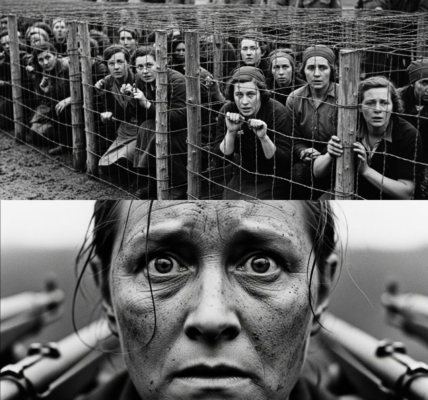
The German children watching American tanks enter Coburg, the Soviet assault group advancing toward the Reichstag, the residents of bombed London, and the survivors emerging from concentration camps all belonged to different circumstances. Their experiences should not be flattened into one story or treated as interchangeable.
But together, they reveal something essential about the history of war: large political and military decisions become real through their consequences for individuals.
A regime falls. A city is occupied. A camp is liberated. A family loses its home. A soldier returns across the ocean. A child watches unfamiliar vehicles move through a familiar street.
The photograph preserves the moment, but the historical record helps us understand what surrounded it.
Some images in this collection may require further verification of their dates, identities, or captions. That is part of responsible historical storytelling, not a weakness in it. A compelling image deserves accurate context, especially when it depicts suffering, persecution, or military conflict.
The goal is not to make every photograph tell a dramatic story. It is to discover what the available evidence genuinely allows us to say.
Because the past does not need invented details to be meaningful.
Sometimes, a photograph of a damaged tank, a cup of tea sold during an air raid, or a child standing beside a road is enough to remind us that history is not only about the people who made decisions. It is also about the people who had to live with them.
When you look at these photographs, which moment most clearly shows you how war changes the lives of ordinary people—and why?
Some content was generated using AI tools (including ChatGPT) and edited by the author for creativity, storytelling, and historical illustration purposes. Historical facts and key details should be verified against reliable historical sources. Any AI-generated or reconstructed visuals are intended for illustrative purposes and should not be interpreted as original historical photographs or archival evidence.