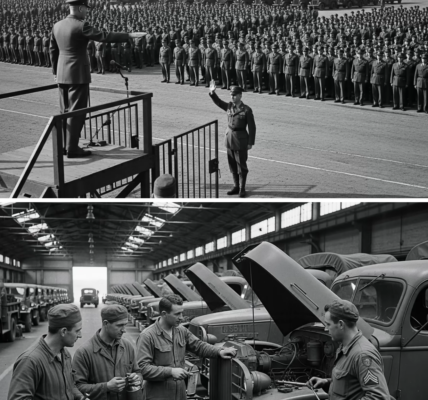
These Shocking Historical Photos Were Hidden From Us | Rare & Vintage Old Photos. VD

These Shocking Historical Photos Were Hidden From Us — The Forgotten Truths Behind Rare Vintage Images
A photograph survives when almost everything around the moment it captured has disappeared. The people in the frame grow old and vanish, the buildings are demolished, the streets change, and the events that once dominated public attention fade into memory. Yet a small piece of film or a forgotten print can preserve details that later generations would otherwise never see. Some images document suffering that powerful people preferred not to discuss. Others reveal the ordinary lives of workers, soldiers, prisoners, and families overlooked by official histories. And some were never deliberately hidden at all; they simply remained unnoticed until someone recognized their importance. The real mystery behind shocking historical photographs is not always who tried to conceal them. It is what their survival can teach us about power, memory, and the uncomfortable truths societies sometimes struggle to face.
The phrase “hidden from us” has an undeniable appeal in the digital age. It suggests a secret collection, a forbidden archive, or a visual record that overturns everything people thought they knew. When rare vintage photographs circulate online with dramatic captions, curiosity quickly follows. Who are the people pictured? What happened before the shutter clicked? Why was the image not widely known? And does it reveal something that contemporary accounts left out?
These are worthwhile questions. But answering them requires more than a compelling title. The original context of a photograph matters as much as the scene itself, and the claim that an image was deliberately concealed must be supported by evidence. An unpublished photograph, a restricted archival record, a forgotten family album, and a picture actively suppressed by a government are not the same thing. Each has a different history, and confusing them can turn genuine historical inquiry into speculation.

Nevertheless, the history of photography contains many examples of images that challenged public assumptions, documented uncomfortable realities, or gained new significance long after they were created. Some became powerful tools for reform. Others preserved evidence of war, discrimination, forced displacement, or political violence. Many simply recorded people whose lives rarely appeared in official accounts. Together, they demonstrate that a photograph can change how history is understood—but only when viewers take the time to discover what lies behind the frame.
One of the clearest examples comes from the struggle to expose child labor during the early twentieth century. At a time when industrial production was celebrated as a sign of national progress, children continued to work in factories, mills, mines, and other workplaces. Their labor was connected to poverty, family survival, weak protections, and the economic interests of employers. In many communities, the presence of working children was not a secret. What remained contested was whether their conditions represented an acceptable cost of economic development or an injustice that demanded reform.
Photographer Lewis Hine helped make that question impossible to ignore. Working with the National Child Labor Committee in the United States, Hine photographed children employed in industrial and commercial settings. His subjects included young workers whose small stature, surroundings, and working equipment made the nature of their employment visible. The photographs formed part of a broader reform effort that sought to document conditions and build public support for stronger protections.
The power of Hine’s work did not depend on a claim that every image had been hidden. Its significance came from the evidence it preserved and the purpose for which it was used. A photograph of a child beside industrial machinery could challenge reassuring descriptions of factory life. A series of images could make a recurring problem harder to dismiss as an isolated incident.

These photographs also illustrate the importance of captions and accompanying records. Without reliable information, viewers might know little about the child’s identity, age, workplace, or circumstances. Hine’s documentation and the broader records associated with reform campaigns helped researchers place images within a more complete account. The photographs became valuable not simply because they were disturbing, but because they could be connected to evidence about the conditions under which children worked.
The wider lesson is uncomfortable. A society can see a problem without agreeing that it must be solved. People may become accustomed to injustice when it supports an established economic system or when those suffering have limited political influence. Photographs can disrupt that familiarity by making individual experiences visible to audiences far removed from the places where they occurred.
Yet it would be misleading to suggest that every employer concealed photographs of child labor or that every image was suppressed by powerful interests. Some photographs were circulated precisely because reformers wanted the public to see them. Others remained in archives or private collections for different reasons. The historical record is more complicated than a simple battle between people hiding the truth and people revealing it.
The same complexity appears in photographs of crowded industrial cities. During periods of rapid urbanization, many families lived in densely populated neighborhoods where housing, sanitation, and public services struggled to meet demand. In some areas, residents endured unsafe buildings, inadequate ventilation, polluted water, and limited access to clean and reliable infrastructure. The visible prosperity of industrial centers could exist alongside living conditions that placed enormous burdens on workers and their families.
Photographs of these neighborhoods preserve details that statistics alone cannot convey. A narrow passage between buildings, a shared water pump, crowded rooms, or children gathered in a street can provide clues about daily life. When matched with housing surveys, maps, census records, and contemporary reports, these images help historians reconstruct the conditions in which people lived.
Such photographs can feel shocking to modern viewers, but their meaning depends on context. An image of an overcrowded dwelling does not, by itself, establish how every resident experienced the neighborhood or whether the scene was typical of an entire city. It does, however, provide a starting point for asking how housing costs, wages, public policy, and economic inequality shaped the lives of the people pictured.
Some images become historically important because they reveal a gap between a society’s public image and the reality experienced by its poorest residents. Grand buildings, busy factories, and expanding transport networks may symbolize progress. Photographs of unsafe housing and exhausting work remind us that progress was not distributed equally. The two realities can exist at the same time, and a serious history must account for both.
War photographs provide another powerful example of the relationship between images and public knowledge. The First World War produced a vast visual record of soldiers, trenches, damaged landscapes, military equipment, medical facilities, and civilian life under wartime conditions. These images help explain the physical environment of a conflict that reshaped societies across Europe and beyond. They also reveal the limitations of the public narratives through which wars are remembered.
Military authorities understood that photographs could influence morale and public opinion. Images might reveal sensitive positions, expose operational details, undermine carefully managed messages, or show conditions that officials did not want widely circulated. For that reason, military photography and publication were sometimes subject to restrictions. The exact rules varied according to the country, the period, the circumstances, and the intended audience.
This history makes censorship a legitimate subject of investigation. But the existence of wartime censorship does not prove that every rare photograph of a soldier or battlefield was deliberately concealed. Some images were never submitted for publication. Others were taken privately, printed in small numbers, or preserved in family collections. Many remained obscure simply because the cost and practical difficulties of reproducing photographs limited their circulation.

Personal albums can offer a different perspective from official publications. A soldier’s private photograph might show companions resting, preparing equipment, visiting a village, or standing among damaged buildings. Such scenes may lack the dramatic composition of an official wartime image, but they can reveal aspects of military life that formal photographs were not designed to emphasize.
These pictures should not automatically be treated as completely unfiltered truth. A soldier still chose what to photograph, and personal albums could omit the most difficult experiences. The surviving images also reflect chance: some families carefully preserved their photographs, while others lost them through displacement, damage, or the passage of time. Even private collections have gaps.
Nevertheless, family photographs can be valuable historical sources. They may help identify individuals, reconstruct relationships, or connect a person to a unit, location, or event. Written notes on the back of a print, letters preserved in the same box, and military service records can help establish context. What appears to be an anonymous image may become much more meaningful when researchers discover who took it and why it was kept.
The emotional force of these photographs often comes from the difference between what the viewer knows and what the people in the frame could have known at the time. A group of soldiers may appear relaxed, unaware that their lives will soon change. A photograph of a street may seem ordinary until records reveal that the area was later destroyed. That knowledge creates a powerful response, but it must not encourage viewers to invent thoughts, conversations, or future events that the evidence does not establish.
The Second World War created an even larger body of photographs documenting military operations, occupation, destruction, displacement, and mass persecution. These images came from many sources, including official photographers, journalists, civilians, prisoners, and members of military organizations. Their purposes differed, and their evidentiary value depends partly on how they were created and preserved.

Photographs documenting the liberation of Nazi concentration camps occupy a particularly important place in the historical record. Allied personnel and journalists recorded the conditions they encountered as camps were liberated in 1944 and 1945. These images helped convey the scale of the crimes committed by the Nazi regime and became part of the extensive documentary record of Nazi persecution and the Holocaust.
Their significance should never be reduced to the promise of shocking content. The people photographed were victims and survivors whose suffering was real. Their images have historical, educational, and evidentiary importance, and their presentation requires care. A responsible account connects photographs to testimony, documents, locations, and established historical research rather than treating them as anonymous scenes of horror.
Some wartime images were restricted or controlled, while others were widely published, collected, and studied. The circumstances varied. A photograph may have been withheld for military reasons, retained as evidence, circulated among officials, or preserved in an archive without becoming familiar to the wider public. These possibilities should not be collapsed into one universal story of deliberate concealment.
The distinction matters because exaggerated claims can weaken the very history they purport to expose. When a caption describes a well-documented photograph as something that “they never wanted you to see,” it may generate clicks while obscuring the real story of how the image was made, circulated, and used. Historical evidence is powerful enough without adding unsupported claims about a secret plot.
Colonial photography reveals another way that images can shape public understanding. During the nineteenth and early twentieth centuries, photographs were produced throughout regions affected by imperial expansion. They recorded landscapes, settlements, ceremonies, workplaces, families, and individuals. Some preserved valuable evidence of communities and cultural practices. Others reflected the unequal relationships between colonial authorities, photographers, commercial publishers, and the people being photographed.
In some cases, Indigenous people were arranged in staged poses designed to fit the expectations of outsiders. Clothing, surroundings, and captions could be selected to support racial stereotypes or claims that colonial rule was justified. Photographs circulated in books, exhibitions, postcards, and other formats, shaping how audiences understood societies they might never encounter in person.
The camera gave such representations a particular authority. A written argument could be challenged as an opinion, but a photograph could appear to provide direct proof. Yet an image created under unequal conditions was not automatically neutral. The photographer’s choices, the staging of the scene, and the captions added later could all influence what the viewer believed the photograph demonstrated.
These images can therefore expose more than the circumstances of the people photographed. They can reveal the assumptions of the institutions that collected and circulated them. An image once presented as a record of supposedly inferior customs may now be examined as evidence of the prejudice embedded in colonial systems of classification and representation.
At the same time, modern interpretation must avoid replacing one oversimplification with another. Not every colonial-era photograph was produced for the same purpose, and the relationship between photographer and subject varied. Some subjects participated actively in their representation. Some images were made by local photographers or members of the communities shown. Others were created by outsiders who exercised substantial control over the process. Each image deserves examination in its own historical context.
A photograph can preserve a person’s appearance while leaving their name, voice, and perspective absent. That absence is not necessarily evidence that the image was intentionally hidden. It may reflect the cataloging practices of the institution, the priorities of the collector, or the unequal conditions under which the photograph was created. Recovering the identity and context of the people pictured is therefore an important part of historical research.

The same questions arise when examining images of racial segregation, public punishment, prisons, and institutions for people with mental illness. Photographs can document practices that later generations find disturbing, but they do not explain themselves. A picture of a segregated facility may show physical separation without fully establishing the laws and policies that maintained it. An image from an institution may reveal conditions inside a building while leaving questions about treatment, consent, and individual experience unanswered.
These records can be essential to understanding systems of control. They can preserve evidence of practices that officials defended, critics challenged, or communities resisted. But the people photographed should not be reduced to symbols of suffering. Their lives extended beyond the moments captured by the camera, and the absence of their own accounts should be acknowledged rather than filled with invented details.
Industrial accidents and natural disasters offer further examples of photographs gaining significance over time. Images of mine collapses, factory fires, shipwrecks, floods, and damaged neighborhoods preserve the visible consequences of events that changed families and communities. Some were widely reported when they occurred. Others survived in local newspapers, municipal collections, or private albums without attracting lasting attention.
A photograph of a collapsed building may reveal the extent of the destruction, but it cannot independently establish why the structure failed. Investigators may need engineering records, maintenance logs, testimony, weather information, and official reports to determine the causes. Likewise, a picture of a damaged ship cannot by itself prove whether negligence, equipment failure, weather, or another factor was responsible.
The distinction between showing an event and explaining it is fundamental. Photographs can make an investigation more concrete, help identify locations, and preserve physical details that later disappear. But the interpretation of those details requires evidence beyond the frame.

Images taken shortly before a disaster can be especially moving because hindsight changes their meaning. A group of workers standing outside a factory may seem unremarkable until the viewer learns that an accident occurred later. A family portrait may acquire new significance when records show that the family was displaced by a subsequent conflict. The photograph itself has not changed; the knowledge surrounding it has.
That does not mean the people in the image were unaware of danger or that their expressions reveal what they expected. It is easy to look at an old photograph and assign meaning to a face, a gesture, or a position in the frame. But a person looking away may simply have been distracted, and a serious expression may have been the result of the photographic conventions of the time. Emotional interpretations should be presented cautiously unless supported by other evidence.
Political photographs also reveal how images can be shaped by selection and circulation. Images of demonstrations, strikes, arrests, public speeches, and clashes between authorities and protesters often become central to the memory of an event. They may capture genuine evidence of conflict, but the position of the photographer and the boundaries of the frame affect what the viewer can see.
A photograph of a confrontation cannot always establish what happened immediately before it. An image of a crowd may not show the actions of people outside the frame. A picture of an arrest may document the moment without explaining the legal grounds or the sequence of events. These limitations do not make the images unimportant. They make corroboration necessary.
Photographs from labor movements, women’s suffrage campaigns, and civil rights struggles have preserved the presence of people who challenged established systems. Signs, clothing, banners, and public spaces can provide clues about the demands being made and the environment in which a demonstration took place. When connected with newspapers, court records, personal accounts, and organizational documents, these images help reconstruct how movements developed and how institutions responded.
Many participants in these movements never became famous. Their photographs may survive without their names or may have been cataloged under broad descriptions that make individual identification difficult. Digital archives and community research can sometimes restore those missing connections. A photograph can become a starting point for descendants, local historians, or researchers seeking to recover a person’s place in a wider story.

This process is one reason the idea of rediscovery is so compelling. A photograph need not have been censored to be historically overlooked. It may have sat in a local archive because few researchers had examined the collection. It may have remained in a family box until a descendant recognized a face. It may have been digitized only after an institution received the funding and equipment required to preserve it.
The growth of digital archives has made such discoveries easier. Museums, universities, libraries, and national archives increasingly provide online access to photographs that once required an in-person visit. Searchable catalog records can connect images with dates, locations, photographers, and related documents. Digital copies also allow researchers to compare images from different collections and examine details without repeatedly handling fragile originals.
Online communities can contribute to this work. People sometimes recognize a street, uniform, building, or family member in an unfamiliar image. A local historian may identify a location that an archive had listed incorrectly. A descendant may supply a name or family history that helps explain why the photograph was taken. Such contributions can improve public knowledge when they are checked carefully and documented.
But digital circulation also creates new problems. Images can lose their original captions when copied between websites. A photograph from one country may be incorrectly attributed to another. A picture taken decades apart from a claimed event may be presented as direct evidence. Cropping can remove details that would otherwise help identify the subject, while colorization or editing can make an image appear more contemporary than it is.
A false caption may spread because it offers a simple, emotionally powerful story. Once shared repeatedly, it can become difficult for viewers to distinguish repetition from verification. Even a genuine photograph can be used to support a misleading claim if its date, location, or circumstances are misrepresented.
This is why the phrase “hidden from us” deserves particular scrutiny. Some photographs were genuinely censored, restricted, or withheld. Others were privately held, difficult to access, overlooked by researchers, or simply never widely published. An image that is new to an online audience is not necessarily new to historians. And a photograph that has been stored in an archive for decades is not proof that an institution deliberately concealed it.

Responsible research begins with provenance: the history of an image’s ownership, creation, and preservation. Who took the photograph? When and where was it made? What does the original caption say? Is the photograph held by a recognized archive or supported by contemporary records? Has it appeared in earlier publications? Can independent sources confirm the description attached to it?
Researchers may compare catalog entries, newspapers, letters, official reports, and other photographs from the same location. They may examine the photographic process, clothing, architecture, or equipment for clues about the date. When the evidence remains incomplete, they should say so. A carefully qualified explanation is more trustworthy than a dramatic claim presented as certainty.
Ethics matter alongside verification. Some historical photographs show people who were imprisoned, injured, humiliated, or subjected to violence. The fact that an image survives in a public collection does not mean it should be presented without thought. Editors, educators, and historians must consider whether publication serves a clear historical purpose and whether the accompanying explanation respects the people represented.
Disturbing photographs can be necessary to document injustice and prevent denial. Avoiding every painful image may leave audiences with an incomplete understanding of what happened. But there is a difference between presenting evidence to explain history and using suffering merely to provoke a reaction. The strongest historical accounts give viewers the information needed to understand the image, rather than relying on shock alone.
Ultimately, the value of a collection of rare and vintage photographs does not depend on whether every image reveals a scandal. Some pictures document exploitation. Others preserve evidence of conflict, prejudice, political change, or disaster. Many record ordinary lives that would otherwise remain largely invisible. Their importance lies in the questions they help us ask and the evidence they allow us to examine.
The past is rarely as simple as the stories later generations tell about it. Governments and institutions may shape public narratives, but families, photographers, reformers, witnesses, and ordinary people also leave records behind. Some records are incomplete, some are biased, and some contradict one another. Historical understanding develops through the careful comparison of those sources, not through the assumption that one dramatic image explains everything.

A photograph may challenge an official account, but it may also complicate a story that was already widely known. It can reveal a missing detail, correct a mistaken identification, or show how a familiar event affected people who rarely appear in textbooks. Sometimes the discovery is not a secret at all. It is a fuller understanding of something that was always there but had not been examined closely enough.
That is the enduring power of historical photography. The camera can preserve details that memory loses, but it cannot provide a complete account of the past. Its images require context, its captions require verification, and its subjects deserve to be understood as people rather than props in a dramatic narrative. When we approach old photographs with curiosity and skepticism in equal measure, they become more than viral curiosities. They become evidence through which forgotten lives and uncomfortable histories can be examined with greater care.
Perhaps the most unsettling realization is that history does not always need to be hidden to be ignored. Evidence can remain visible while its meaning is dismissed, minimized, or misunderstood. A photograph may survive for a century and still wait for someone to ask the right question. The responsibility of later generations is not simply to uncover images, but to investigate them honestly and consider what they reveal about the societies that produced them.
When you encounter a photograph described as “hidden from the public,” what would convince you that it was deliberately suppressed—and what evidence would help you separate a genuine historical discovery from a misleading online claim?
Some content was generated using AI tools (including ChatGPT) and edited by the author for creativity, storytelling, and historical illustration purposes. Historical facts and key details should be verified against reliable historical sources. Any AI-generated or reconstructed visuals are intended for illustrative purposes and should not be interpreted as original historical photographs or archival evidence.