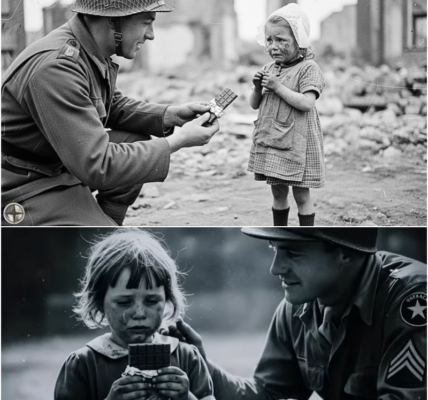
You Won’t Believe These Rare Historical Photos From Lost Archives – Decoding Ancient .V2

History is often remembered through dates, generals, treaties, and the precise moments when wars began or ended. We learn when armies crossed borders, when governments collapsed, when cities were destroyed, and when nations formally surrendered. But the moments between these milestones are harder to capture. They exist in the soldier opening a letter from home, the family trying to protect its children, the crowds watching troops pass through their streets, or the boy holding a newspaper whose full significance he may not yet understand.
Historical photographs preserved across generations sometimes feel like opening an old box. Inside are not complete stories, but fragments: a face, a vehicle, a gun, a crowd, or a building that no longer exists. We cannot know everything that happened before or after the shutter closed. Yet when these images are placed within their proper historical context, they can reveal something larger than the moment they preserve. They show us that war is not merely a confrontation between nations. It is also a force capable of transforming the lives of millions.
Consider January 1933.
On January 30, Adolf Hitler was appointed Chancellor of Germany. Photographs from that period show him alongside members of the new government, surrounded by the formal atmosphere of a political transition. Nothing in the mechanics of the ceremony alone could fully convey the scale of the consequences that would follow.
Hitler did not seize power through a military coup on that particular day. He was appointed by President Paul von Hindenburg amid the deepening crisis of the Weimar Republic. Political instability, economic hardship, social polarization, and the weakening of democratic institutions had created favorable conditions for the Nazi Party to expand its influence. Conservative political figures who helped bring Hitler into government believed they could control him or use his movement to advance their own interests.
That calculation helped open the door to a dictatorship.
Within a short period, the new government began suppressing political opponents, restricting civil liberties, and dismantling democratic institutions. Propaganda expanded. Independent organizations were weakened or destroyed. Groups targeted by the Nazi regime faced escalating discrimination and persecution. Antisemitism was no longer confined to inflammatory speeches and political rallies. It became a central element of state policy.
When we look back at photographs from January 30, 1933, the most important detail is not simply the people standing inside the frame. It is the distance between a formal political ceremony and the historical consequences that followed.
Not every German understood what was coming. Nor was German society a single, uniform body of people sharing the same beliefs or accepting the same responsibilities. Yet the warning signs of extremism, organized hatred, and the destruction of democratic restraints were already visible. History reminds us that great dangers do not always begin with scenes of chaos. Sometimes they emerge from solemn government chambers, through decisions carried out using procedures that initially appear entirely ordinary.
Five years later, in 1938, the Nazi Party Congress in Nuremberg demonstrated the growing power of the regime through mass gatherings, carefully choreographed ceremonies, and displays of apparent unity. These events were more than political meetings. They were performances of authority, designed to project overwhelming strength and create the impression of unanimous public support.
But the size of a crowd cannot prove that every participant was there willingly, much less that every German supported the regime. Behind the appearance of unity existed a society containing committed supporters, opportunists, frightened citizens, opponents, and people who had been deprived of the ability to speak freely.
This is one of the most difficult lessons in interpreting historical photographs: a camera can record a crowd, but it cannot independently tell us what every individual within it believes.
By December 1939, another event demonstrated how quickly the war was reshaping the world beyond the European land battlefields.
The German battleship Admiral Graf Spee had been operating in the South Atlantic, attacking Allied merchant shipping. After its engagement with British cruisers in the Battle of the River Plate in December 1939, the ship sought refuge in the port of Montevideo, Uruguay.
The restrictions on how long the vessel could remain in port, its combat condition, and the calculations of its captain, Hans Langsdorff, brought the situation to a deadlock. On December 17, 1939, the ship was taken out toward the mouth of the Río de la Plata and scuttled by its German crew rather than risk another engagement under unfavorable circumstances. The abandoned battleship burned in the South Atlantic, becoming one of the most memorable images of the early naval war.
This was not simply the story of a battleship destroyed during a decisive naval engagement. The circumstances surrounding its end were what made the episode so significant. Strategic calculations, diplomatic pressure, the ship’s condition, and the commander’s decisions combined to determine its fate.
A warship built to project military strength became a burning mass of steel near a river mouth. Its destruction demonstrated that material power does not guarantee complete control over events. Sometimes a force may still possess the means to fight but no longer have any genuinely favorable options.
Meanwhile, the lives of ordinary people in European cities were being transformed by the widening conflict.
In 1940, at Shorn Mead Fort in England, a BL 6-inch Mark VII coastal gun was operated as Britain prepared to defend itself against the threat of German attack. One photograph is described as showing British soldiers whose rehearsal of Gilbert and Sullivan’s The Pirates of Penzance was interrupted by a German raid.
The detail reveals a striking contrast. Soldiers did not exist exclusively in a permanent state of combat. They still had moments for collective recreation, cultural activities, and performances. But those moments could be interrupted without warning by military necessity.

A theatrical rehearsal and a coastal gun might seem to belong to two entirely separate worlds. In wartime, they could exist side by side.
There is no need to invent dialogue to make the scene moving. The contrast between a musical performance and an enemy attack is enough to demonstrate how war invaded everyday life. It did not necessarily erase ordinary activities in a single instant. Instead, it made them fragile, dependent on circumstances that those living through the conflict could never completely control.
In 1940, communities around the world were also preparing for a war whose scale was becoming increasingly difficult to comprehend.
Photographs from Australia have been described as showing children wearing protective headgear, earmuffs, and devices intended to reduce the risk of injury during wartime emergencies. Without additional documentation, however, it is difficult to establish the exact purpose of every item or how widely such equipment was used.
What the images can help illustrate is the way the threat of war entered even the smallest aspects of civilian life. How could children be protected? How should communities prepare for air raids? How could ordinary routines continue when the possibility of an attack was becoming increasingly real?
By 1942, the war had spread across Asia and the Pacific. Photographs of damaged military vehicles, transportation routes, and logistical operations often receive less attention than images of major battles. Yet no military campaign exists only on a map. Behind every fighting unit are supplies, fuel, food, transport, communications, and the people responsible for keeping those systems functioning.
In Papua New Guinea, a photograph is described as showing Australian soldiers thrown into a river by an explosion, along with the wreckage of their boat, in 1942. According to the accompanying caption, everyone escaped with bruises and fright.
If the caption is accurate, the incident offers a rare glimpse of a dangerous event that did not end in serious casualties.

It should not be transformed into a story of miraculous survival or embellished heroism. Its significance lies in the distance between the danger soldiers faced and the vulnerability of the equipment carrying them through a combat zone. A boat, normally a means of transportation, could become an obstacle in an instant. An ordinary journey could be interrupted by an explosion beyond anyone’s control.
Details like these remind us that military history is not made exclusively by those who issue orders from headquarters. It is also shaped by people carrying out assignments under conditions they cannot fully predict.
In 1944, the war continued to demand unusual methods of transportation and communication.
A photograph described as showing two American engineers riding elephants while inspecting telephone lines in Assam, then part of British-ruled India, illustrates the practical challenges of maintaining communications across difficult terrain.
Telephone lines may seem unremarkable in popular images of war. In reality, communications were essential to military operations. An order could be carried out only if it reached the right place at the right time. A broken line could disrupt coordination, especially in remote regions where access by motor vehicle was limited.
The two engineers on elephant-back are therefore more than an unusual sight. They represent a less visible part of warfare: the technical labor, repairs, and maintenance that keep systems functioning, often without attracting public attention.
Elsewhere in Europe, another event demonstrated how the fate of an entire regime could be challenged in a single moment.
On July 20, 1944, a group of German officers attempted to assassinate Hitler at his military headquarters in East Prussia. The bomb brought into the meeting by Claus von Stauffenberg exploded, but Hitler survived. The subsequent coup attempt failed, and key participants were arrested. Many were executed.
The event is often remembered as an attempt to remove Hitler from power from within the German military establishment. However, opposition to Hitler must be distinguished from opposition to every crime committed by the Nazi regime. The conspirators had different motives, and they did not all share the same views on Nazism, the war, or the regime’s persecution of targeted groups.
What is clear is that the failed assassination did not end the war. Hitler remained in power, and the machinery of Nazi repression continued to operate.
Yet July 20 remains historically significant because it demonstrates that even within Hitler’s own system, some people were prepared to act against him, although their motivations were not identical.
An explosion. A survivor. A failed coup.

And the war continued.
The importance of the event does not lie in imagining an alternative history in which Hitler died that day. We cannot know with certainty how events would have unfolded under circumstances that never occurred. Its historical significance lies in what actually happened: a conspiracy was organized, a decision was carried out, a political opportunity failed, and the Nazi regime survived for several more months as the war moved toward its final phase.
By early 1945, the military situation had changed dramatically. Allied forces were advancing into Germany from the west, while the Soviet Red Army pushed forward from the east. Cities that had once served as centers of political power, industry, and culture were increasingly exposed to the consequences of the war.
The Nazi leadership continued trying to maintain control, but its ability to reverse the military situation was rapidly diminishing.
On February 9, 1945, a photograph is described as showing Hitler examining a model of the city of Linz in the basement of the Reich Chancellery in Berlin. Linz, an Austrian city, had long been associated with Hitler’s architectural ambitions and his plans for reshaping urban space.
In the photograph, the model presents a miniature world. Buildings are arranged according to a designer’s vision. Streets and districts form an orderly composition that can be surveyed from above.
But outside that room, the war was not following the order of an architectural plan.
Armies could not be controlled like pieces on a model. Cities could not be preserved simply through the will of a leader. And decisions made in rooms of political power could not erase the consequences unfolding on battlefields and in civilian communities.
We should not claim that the photograph proves what Hitler understood or felt at that moment. A camera cannot record his thoughts. But the historical context makes the contrast between the model of Linz and the condition of Berlin particularly striking.
While Hitler could still examine a miniature city arranged according to his ambitions, the power of his regime was rapidly shrinking under the pressure of military defeat.
It was a paradox of absolute power. A dictator could concentrate enormous instruments of coercion in his own hands, yet still fail to control the consequences of his policies.

Far from that underground room, another image recorded the end of the war in a much more ordinary way.
In 1945, a photograph described as having been taken in Paris shows a young boy holding up a newspaper announcing Germany’s surrender and reporting that the Allies and the Soviet Union had been informed.
The image cannot tell us exactly how much the child understood. But the newspaper in his hands represents something unmistakable: the war in Europe was approaching its conclusion.
Germany signed its unconditional surrender in May 1945. In Europe, the war ended after nearly six years, having begun with Germany’s invasion of Poland in September 1939.
Yet the day of surrender could not immediately erase what had happened. Survivors still faced loss, destruction, shortages, displacement, and an uncertain future. Millions had died. Communities had been destroyed or scattered. No document could restore everything that had been taken away.
For a child holding a newspaper, the announcement may have been the most tangible expression of an event far larger than himself. A printed notice. News of something happening elsewhere. A sign that a moment many people had been waiting for had finally arrived.
But the end of fighting did not mean that everyone could immediately return to their former lives. Families were missing loved ones. Homes no longer existed. People had to search for relatives, find shelter, and learn how to live in a world that had changed beyond recognition.
It is also important to remember that May 1945 marked the end of the war in Europe, not the end of the Second World War everywhere. Fighting continued in Asia and the Pacific until Japan announced its acceptance of surrender in August 1945 and formally signed the surrender documents on September 2.
Therefore, a photograph capturing the public reaction to Germany’s surrender should be understood within its proper historical limits. It records a moment of relief and hope in Europe, but not the final end of the global conflict.
Photographs taken after the war often possess a peculiar stillness. People return to work. Children go back to school. Vehicles reappear on the streets. Buildings are repaired, and entertainment gradually resumes.
But stillness does not mean the past has disappeared.

A society emerging from war must confront questions that extend far beyond rebuilding houses. How should it address atrocities? How should responsibility be distinguished between those who directly committed crimes and those who were caught within a larger system? How can institutions be rebuilt to reduce the risk of another catastrophe?
These are not questions that can be answered completely on the day victory is declared.
Images from 1946 and the years that followed show people returning to everyday concerns. They tried to earn a living, care for their families, and rebuild community life. Across many countries, governments had to reorganize economies, confront material shortages, and respond to large-scale displacement.
Yet not every photograph from the postwar period directly illustrates these struggles. A single image of ordinary life offers only a fragment. A fuller understanding requires documents, eyewitness accounts, and historical research.
This is also why caution is necessary when interpreting historical photographs shared online. Many circulate with short captions that may be accurate, incomplete, or mistaken about dates and locations. An image can be passed around for decades alongside an appealing story that has never been adequately verified.
A historical photograph does not explain itself. It needs context.

A picture may show Hitler standing beside members of his government, but understanding why he came to power requires examining the collapse of the Weimar Republic and the political decisions that led to January 30, 1933.
A photograph may show the Admiral Graf Spee burning, but understanding why the battleship was scuttled requires examining the Battle of the River Plate, the situation in Montevideo, and Captain Langsdorff’s available choices.
A boy may hold up a newspaper announcing Germany’s surrender, but understanding the significance of that day requires knowing how the war unfolded and why surrender could not immediately restore everything that had been lost.
Often, what lies outside the frame is the most important part of the story.
History did not stop in 1945.
The world entered a new period in which nations that had fought together against Nazi Germany increasingly became rivals in a struggle for global influence. The Cold War emerged, bringing military, political, economic, and ideological confrontation. Conflicts continued in different regions, while scientific and technological advances created new possibilities as well as new dangers.
Some photographs from the following decades reveal these transformations in unexpected ways.
In 1946, a photograph captured Admiral William H. P. Blandy at a celebration associated with the Baker nuclear test, with a cake shaped like a mushroom cloud. The underwater nuclear explosion was part of Operation Crossroads, conducted at Bikini Atoll in the Pacific Ocean.
The cake often attracts attention because of the contrast between a celebratory ritual and a symbol associated with the destructive power of nuclear weapons. But to understand the photograph, we must place it within the early atomic age, when military and political planners were trying to determine the role nuclear weapons might play in future warfare.
The photograph alone cannot establish what the people present thought about nuclear weapons. Nor does it prove that they failed to understand their dangers. It records a particular ceremony at a particular moment. Its broader significance emerges when viewed alongside the history of nuclear weapons development and the debates surrounding their consequences.

During the twentieth century, humanity repeatedly developed technologies capable of transforming life on a vast scale. Aircraft began as symbols of expanding human possibilities; later, they became essential instruments of warfare. Telephones connected people across distances; on battlefields, they became components of military command systems. Nuclear energy opened new scientific horizons while creating a threat of destruction unlike anything previously known.
Technology does not determine humanity’s future by itself. How it is used, what limits are imposed upon it, and which political choices accompany it all help determine the outcome.
This becomes especially clear in photographs from Afghanistan in 1985, showing Soviet fuel trucks destroyed during the war that followed the Soviet Union’s military intervention in the country in 1979.
A convoy of fuel trucks may seem less dramatic than tanks or combat aircraft. Yet fuel is essential to the operation of mechanized forces. When logistical vehicles are destroyed, the consequences can extend far beyond the immediate loss of equipment.
The Soviet-Afghan War demonstrated the limitations of military superiority in a complex conflict. The Soviet Union possessed a modern military, but this did not allow it to achieve its political and military objectives quickly. Geography, the tactics of opposing forces, external assistance, and regional developments all contributed to the war’s prolonged course.
A photograph of burning fuel trucks cannot explain the entire conflict. Nor can it establish, by itself, the precise circumstances in which the vehicles were destroyed.
But when properly verified, it can illustrate an important reality: war is not only a contest between weapons. It is also a struggle to maintain supply networks, transportation routes, and control over territory.
By 1991, another photograph recorded a different kind of transformation. It was described as showing Ethiopians gathered around the site of a recently dismantled statue of Vladimir Lenin in Addis Ababa.
The image evokes a period of political change, when symbols that had once represented state authority were removed or replaced.
But the disappearance of a statue does not mean that all the consequences of the era it represented disappear with it. Political systems can collapse more quickly than social habits, power relationships, and memories formed over decades.

Public monuments always carry multiple layers of meaning. For one person, a statue may represent an ideal once embraced. For another, it may recall oppression or painful experiences. When a monument is removed, the change involves more than the physical appearance of a public space. It may also reflect a society renegotiating its relationship with the past.
Still, a single photograph cannot establish what everyone present believed or whether they shared the same political goals. The image may document an event, but understanding its meaning for different communities requires additional evidence.
Across these decades, from Hitler’s appointment as Chancellor to the end of the war in Europe, from nuclear weapons testing to later conflicts, a common theme emerges: history does not unfold according to a predetermined ending.
People living through each period rarely knew exactly what would happen next. They made decisions based on the information available to them, the interests they pursued, the fears they carried, and the limitations of their circumstances.
Some decisions were made in government offices and affected millions of lives. Others were made in families, on streets, or within military units. These smaller choices also reveal how people adapted to a world changing around them.
Sometimes, the most famous photographs make this difficult to remember. We see political leaders and think about power. We see tanks and think about military strength. We see crowds and assume they represent public agreement.
But what appears inside the frame does not always reveal the full reality outside it.
A photograph cannot replace an archival record. A short caption cannot replace historical research. And a compelling story should not be considered reliable merely because it makes us feel something.
This does not make historical photographs less valuable. It makes them worth examining more carefully.
When we learn to place an image within its proper context, we do more than understand the past. We learn to distinguish evidence from speculation, events from interpretations, and established facts from claims that still require verification.
That ability matters in every era, especially when images can be copied, altered, and distributed far faster than their origins can be checked.
The photographs from the Second World War and the decades that followed do not all tell the same story. Nor are they all directly connected to warfare. They belong to different places, circumstances, and historical moments.
But when examined carefully, they offer a broader view of the twentieth century: an age of profound upheaval, extraordinary technological advances, political regimes that rose and fell, and ordinary people trying to live through circumstances they had not necessarily chosen.
Perhaps the most important thing to remember is not a famous face or a military machine that once astonished the world. It is the distance between a captured moment and the lives that existed beyond the frame.
The soldier reading a letter in Vietnam still had a home far from the battlefield. The boy in Paris was still a child confronted with news of an event much larger than himself. The British soldiers whose rehearsal was interrupted were still living through a conflict that could transform the fate of their country. And those who survived 1945 still had to rebuild their lives after the guns fell silent.
We do not need to invent words they never spoke. We do not need to imagine thoughts we cannot know. The verified historical circumstances are enough to help us understand that war never exists only on a map.
It enters people’s time, interrupts their work, separates families, forces difficult choices, and changes futures that once seemed certain.
History cannot be changed by retelling it. But the way we tell history can help us understand past events more accurately, more completely, and with greater humanity.

When a photograph is approached with curiosity and a commitment to verification, it becomes more than an image from another time. It becomes the starting point for discovering what actually happened, why it happened, and how the people involved had to live with its consequences.
Perhaps that is why old photographs continue to make us stop and look.
They do not provide every answer. Instead, they remind us that behind every moment lies a context, behind every decision lie consequences, and behind every major historical event are human lives that cannot be summarized by a single caption.
If you could choose one lesson that these historical images should leave with future generations, what would it be: the power of political decisions, the fragility of human life, or our responsibility to understand the past truthfully?
Some content was generated using AI tools (including ChatGPT) and edited by the author for creativity, storytelling, and historical illustration purposes. Historical facts and key details should be verified against reliable historical sources. Any AI-generated or reconstructed visuals are intended for illustrative purposes and should not be interpreted as original historical photographs or archival evidence.