In December 1987, inside the United States State Department in Washington, Mikhail Gorbachev and Donald Trump briefly stood together before a breakfast held in the Soviet leader’s honor. Their handshake captured a curious intersection of politics, celebrity, and a world approaching the end of the Cold War. Elsewhere, a German machine-gun crew practiced against aircraft, a circus performer risked her life before a crowd, and ordinary families found ingenious ways to make daily life a little more extraordinary. These photographs seem to belong to different universes. Yet together, they reveal a deeper question: when we look back at history, are we seeing the great events that shaped the world—or the fleeting human moments that made those events real?
The twentieth century rarely moved in a straight line. It lurched between invention and destruction, spectacle and suffering, political idealism and brutal repression. Its photographs captured the machinery of modern warfare, the changing faces of popular culture, the emergence of new technologies, and the ordinary people who lived through transformations they could scarcely have imagined. A single frame might show a weapon being tested, a leader greeting a rival, a performer balancing above an audience, or a child standing beside soldiers in a ruined landscape. Each image preserves a moment, but none can contain the entire story.
In 1942, Wehrmacht soldiers trained to fire at aircraft using an MG 34 machine gun. The weapon had become one of the most recognizable components of the German infantry arsenal, capable of firing rapidly and serving in several tactical roles. Training soldiers to engage aircraft reflected the growing danger posed by air power. By the Second World War, the battlefield no longer belonged exclusively to those fighting on the ground. Aircraft could strike supply routes, attack troop concentrations, and turn previously distant industrial centers into targets. Soldiers who had once watched the sky as something beyond their immediate struggle increasingly understood it as another front in the war.
The MG 34 represented the industrial character of modern conflict. It was engineered for versatility and speed, but its presence in a training photograph also reminds us of the less dramatic reality behind military operations: repetition, preparation, maintenance, and the attempt to make complicated equipment function under pressure. A photograph of soldiers practicing their aim may appear routine. Yet the skill being developed was intended for a battlefield where a moment’s hesitation could determine who survived.
In North Africa, another image places Italian artillerymen among the cacti of Tunisia on March 31, 1943. The date falls during the final phase of the Axis campaign in Tunisia, when German and Italian forces faced mounting pressure from Allied armies advancing from both east and west. The landscape, with its vegetation and harsh terrain, looks far removed from the familiar European images of war. But the same conflict had reached deserts, mountains, coastal plains, and cities across several continents.

The men among the cacti were part of a campaign that was rapidly approaching its conclusion. In May 1943, Axis forces in Tunisia surrendered in large numbers, ending the North African campaign and opening the way for the Allied invasion of Sicily. A photograph taken only weeks earlier would not necessarily have revealed the approaching outcome. The soldiers might have appeared occupied with their immediate duties, unaware of how quickly the strategic situation was changing. History often looks inevitable after the fact. To the people living inside it, the future remains hidden behind the next order, the next march, or the next stretch of difficult ground.
On the other side of the war, an American soldier with binoculars watched the landscape in Normandy in 1944. The familiar image of a soldier scanning the horizon captures one of the defining experiences of military service: waiting while trying to anticipate danger. The binoculars extended his vision, but they could not remove uncertainty. Somewhere beyond the field of view might have been enemy positions, damaged roads, civilians seeking shelter, or fellow soldiers requiring assistance.
The Allied landings in Normandy had begun on June 6, 1944. The campaign that followed was neither simple nor swift. Allied forces fought through difficult terrain, endured heavy casualties, and struggled to move beyond the landing areas. Hedgerows, narrow roads, and villages transformed the countryside into a complicated battlefield. The invasion eventually contributed to the liberation of Paris and the advance into Germany, but for the soldiers moving through Normandy, victory remained a distant abstraction. Their world was measured in patrols, ammunition, meals, sleep, and the next position they were ordered to reach.
One of the most moving wartime scenes shows American soldiers comforting a little girl and her puppy after the invasion of Normandy in 1944. The image offers a different perspective from photographs dominated by weapons and military formations. A child and a small animal occupy the emotional center of the frame, while armed men temporarily step away from their combat roles to offer reassurance.
The photograph does not tell us what happened to the girl afterward, nor does it establish the full circumstances of the encounter. What it preserves is the moment itself: soldiers and civilians meeting within a landscape transformed by war. The child’s presence reminds us that military operations were never experienced only by those in uniform. Families lived through bombardment, displacement, shortages, and the sudden disappearance of familiar places. Even when armies advanced, civilian life did not automatically return to normal.
The little girl’s puppy makes the scene especially intimate. In a world of shattered buildings and unfamiliar uniforms, an animal could represent a small piece of home. A hand reaching toward a child or a frightened dog might appear insignificant beside the scale of a military campaign, yet such gestures belong to the lived history of war as surely as the maps and battle plans do.
Another wartime image, dated December 11, 1944, shows a small boy helping a motorcycle dispatch rider negotiate a muddy road in the Netherlands. The moment captures the relationship between military necessity and local knowledge. Roads in winter could become nearly impassable, and a motorcycle carrying messages might be slowed by mud, damaged surfaces, or difficult terrain. The boy’s assistance suggests a practical encounter between a civilian child and a serviceman trying to complete a task.
Dispatch riders occupied a distinctive place in the military world. Before modern digital communication, commanders depended on messengers, radios, telephone lines, and written orders to maintain contact across a battlefield. A motorcycle offered speed, but it also exposed its rider to weather, mechanical problems, and enemy fire. A muddy road could become an obstacle to information itself.

The boy’s small contribution did not determine the outcome of the war. It did, however, form part of the countless ordinary interactions that surrounded military operations. Not every historical act involved a famous commander or a decisive battle. Sometimes, history moved forward because someone helped another person get through a difficult stretch of road.
In another European wartime scene, women of the Royal Naval Service carried a torpedo for loading onto a submarine in Portsmouth on September 29, 1943. The task illustrates the physical work performed by women serving in Britain’s wartime organizations. Their contribution was not limited to office work or ceremonial duties. Naval operations required stores, ammunition, maintenance, communications, and the coordinated movement of heavy equipment.
A torpedo was a sophisticated weapon, but before it could be used, it had to be transported and handled by people working within a larger system. Photographs of women carrying such equipment challenge the simplified image of wartime service as an exclusively male experience. They also remind us that military effectiveness depended on thousands of people whose work rarely appeared in public celebrations of victory.
The Women’s Royal Naval Service, commonly known as the Wrens, performed a wide range of essential duties during the Second World War. Women served in communications, administration, technical roles, and other support positions. Their work helped sustain the broader naval effort, even when their names were not attached to the ships or operations that later entered popular memory.
Not every wartime photograph depicts danger directly. Members of Watford’s Women’s Home Defense Unit practiced their aim on a firing range in 1942. Their training belonged to a period when the possibility of invasion remained a serious concern in Britain. The country’s defense involved regular armed forces, volunteer organizations, industrial workers, civil-defense personnel, and ordinary citizens preparing for emergencies.

The image of women practicing with firearms reflects the way total war blurred the boundaries between civilian and military life. The conflict required societies to mobilize resources and people on a scale that earlier generations had rarely experienced. Training, drills, blackout precautions, rationing, and civil defense became part of daily life for millions.
Yet behind the uniformity of training lay a more personal reality. Every participant had a life outside the range: a family, a job, friends, and plans for a future that war had made uncertain. The photograph freezes a moment of concentration, but it cannot reveal what each woman thought about the danger her country faced or how she understood her own role in meeting it.
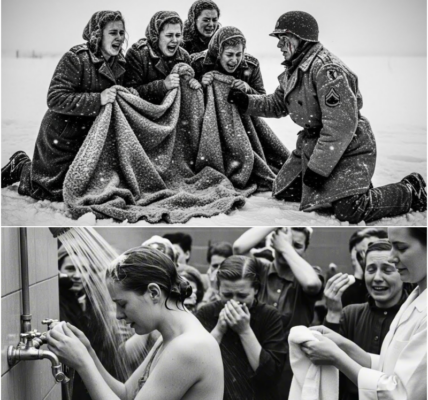
In Germany, the final months of the war brought another kind of human crisis. A photograph dated April 7, 1945, describes Soviet forced laborers being rescued from cellars in Osnabrück that German police had set ablaze. The circumstances belong to the wider history of forced labor under Nazi rule, a system that exploited millions of people from occupied territories and subjected many to brutal treatment.
By the spring of 1945, German authority was collapsing in many regions as Allied forces advanced. The end of the Nazi regime was approaching, but the final weeks of the war remained dangerous for civilians, prisoners, and forced laborers. The people trapped in cellars were not abstract entries in a wartime labor system. They were individuals whose lives had been controlled by an oppressive state and whose immediate survival depended on whether rescue came in time.
The photograph’s caption records an act of rescue, but the scene also invites a broader reflection on responsibility. The collapse of a dictatorship does not erase the suffering it has caused, and the final days of a war can expose both the cruelty of those attempting to preserve power and the courage of those trying to save others.
Another image presents a German Junkers Ju 52 transport aircraft burning at an airfield in March 1942. The Ju 52, with its distinctive corrugated metal skin and trimotor design, was widely used for transport and other military duties. It carried troops, supplies, and equipment across several theaters of the war. The burning aircraft represents more than the destruction of a machine. Aircraft were part of the network that connected armies to their fuel, food, ammunition, and reinforcements.

When an aircraft was destroyed, the immediate loss included its crew and the material invested in its construction, but the wider consequences depended on the role it had been assigned. A transport plane could be as important to a military operation as a more visibly aggressive aircraft. War depended on logistics, and logistics depended on countless machines that rarely became famous individually.
A photograph of an Indian elephant towing a British seaplane in June 1944 offers a striking contrast. The scene brings together an animal associated with centuries of human labor and an aircraft belonging to the technological world of the twentieth century. In wartime India, animals continued to perform heavy work in places where terrain, infrastructure, or available machinery made them useful. The combination of elephant and aircraft looks almost surreal today, but it reflects the practical improvisations that often accompanied military operations.
Modern warfare did not eliminate older methods of transport. Instead, it layered them together. Trucks, trains, ships, aircraft, pack animals, and human labor could all contribute to the same supply system. Technological progress rarely replaced everything that came before it at once. Even in an age of engines and aviation, an elephant could still be part of the solution to a difficult logistical problem.
Elsewhere, an experimental Vickers amphibious tank, described as a four-amphibious vehicle fitted with inflatable floats and an outboard engine, reveals the inventive ambitions of the interwar period. Britain and other powers explored unusual armored vehicles during the 1920s and 1930s, seeking ways to move military equipment across rivers and other obstacles. Some experiments remained little more than technical demonstrations. Others helped establish ideas that would be developed further as another European war approached.
Experimental machines occupy an uncertain place in history. They show what engineers believed might be possible, rather than what armies necessarily adopted. A strange prototype can look ridiculous beside the polished machinery of later decades, but its existence reveals a real problem that designers were attempting to solve. The path from concept to useful technology is rarely straightforward, and many experiments are remembered precisely because they did not become standard equipment.

The danger of aviation was not confined to war. On August 12, 1953, a pilot was rescued after an unsuccessful takeoff from the aircraft carrier USS Block Island in the Atlantic Ocean. Carrier aviation demanded precise coordination between aircraft, pilots, deck crews, and the moving ship itself. A failed launch could become an emergency within seconds, particularly when an aircraft entered the sea.
The image of a pilot being rescued reflects the risks associated with a technology that had rapidly transformed naval power. Aircraft carriers allowed air operations to extend far beyond land-based runways, but they created a demanding environment in which a small error could have serious consequences. Every successful launch depended on extensive training, technical reliability, and the readiness of rescue personnel to respond when something went wrong.
A different kind of experimental aircraft appeared in July 1968, when the Nord 500 made its first tethered takeoff. The project explored an unusual vertical-takeoff concept, but it was soon canceled. The short life of the experiment demonstrates the difference between an engineering achievement and a commercially or operationally successful aircraft. Getting a machine off the ground is one challenge; proving that it can operate reliably, safely, and economically is another.
The history of aviation is filled with such attempts. Some ideas reshaped transportation, while others led to a dead end. Yet canceled projects are not necessarily meaningless failures. They can provide technical knowledge, reveal design limitations, and influence later research. The Nord 500 belonged to that long process of experimentation in which engineers repeatedly tried to redefine what an aircraft could do.
Long before powered flight became commonplace, inventors and adventurers were already experimenting with unusual ways to move through the air. Around the 1920s, American aerial performer Lillian Boyer became known for stunts performed on aircraft, including hanging upside down from an airplane by her legs. Such performances demanded extraordinary strength and balance, as well as a willingness to accept risks that modern audiences might find difficult to imagine.

Early aviation spectacles turned the airplane into both a machine and a stage. Crowds watched pilots and performers test the boundaries of what appeared possible. At a time when air travel was still developing, the sight of a person hanging beneath an aircraft could inspire wonder, fear, and fascination in equal measure.
The stunt also belonged to a broader culture of public risk-taking. Motorcyclists attempted extreme jumps, acrobats performed in circuses, and pilots transformed new technology into entertainment. The audience paid to witness something that ordinary life rarely offered: the possibility of seeing a human being do something astonishingly dangerous and somehow return safely to the ground.
In 1932, Captain George Ash was photographed lying on his back while shooting at a clay pipe held in his teeth. The precise circumstances of the performance are not established by the caption alone, but the image suggests the culture of precision shooting and theatrical demonstrations that flourished in an age of public exhibitions. Such acts relied on carefully controlled conditions, practiced movements, and the audience’s awareness of the danger involved.
The performance belongs to a world in which physical skill could become entertainment. A person might demonstrate accuracy, strength, or courage before a crowd, transforming a technical ability into a spectacle. The photograph preserves the moment of apparent control, but it cannot reveal all the preparation that made the stunt possible—or the consequences that might have followed if it had failed.
The circus pushed this culture of risk even further. In London in 1955, an elephant received a pedicure, a reminder that the enormous animals used in traveling shows required constant care. Their feet had to be inspected and maintained because an elephant’s health depended partly on the condition of its weight-bearing limbs. Behind the performance of strength stood the less glamorous work of animal husbandry.
Circuses presented extraordinary feats as entertainment, but they also depended on daily routines: feeding, cleaning, transportation, medical attention, and the difficult task of managing animals far from their natural habitats. A photograph of a pedicure reveals this practical side of spectacle. The animal that might appear majestic beneath the lights also needed patient, specialized care.
Another circus performer, Millie Cayes, was described as swallowing the head of a twelve-foot python in a hotel bar. The wording itself belongs to the language of sensational entertainment, and the exact mechanics of the act cannot be established from the caption alone. What the description does reveal is the appetite for extraordinary performances that blurred the line between skill, danger, and theatrical illusion.

At the turn of the twentieth century, an even more startling act involved a trainer dressed as a gladiator placing her head inside a lion’s mouth. Such performances depended on the audience’s willingness to watch an encounter that appeared to bring a human being within inches of a powerful animal’s teeth. The spectacle was built around a tension that required no elaborate explanation: the performer appeared vulnerable, the animal unpredictable, and the outcome uncertain.
Modern viewers may respond to these photographs with a mixture of fascination and discomfort. They document an entertainment industry that often treated risk as a selling point and animals as performers. They also invite us to consider how standards of safety, animal welfare, and public amusement have changed over time.
The photographs of the early twentieth century also reveal how people found entertainment in less dangerous ways. Luna Park in New York City in 1905 represented the growing popularity of amusement parks, where electric lighting, rides, theatrical architecture, and carefully staged attractions transformed leisure into a mass experience. Such places were part of a new urban culture in which entertainment became increasingly accessible to people beyond wealthy private circles.
A visit to an amusement park offered a temporary escape from the rhythms of work and domestic life. It allowed visitors to enter a world designed around excitement, surprise, and spectacle. The architecture itself could be theatrical, creating the impression that an ordinary city had opened into a fantasy landscape.
The popularity of such places reflected changes in transportation, industrial production, and working hours. As cities expanded and leisure industries developed, entertainment became an increasingly visible part of public life. The amusement park was not merely a collection of rides. It was a place where modern technology could be experienced as pleasure rather than labor.

Other photographs reveal a more modest side of recreation. A family in Nevada during the 1960s posed with turkeys as an alternative to reindeer for a Christmas picture. The image sounds humorous because it replaces a familiar seasonal symbol with something unexpectedly practical. Yet family photographs have always depended on the desire to make a particular moment memorable. Sometimes that meant formal clothing and carefully arranged poses; sometimes it meant an unusual prop that made everyone laugh.
A goat-powered mobile vehicle from around 1910 suggests a similar spirit of invention and play. The caption does not establish the vehicle’s precise purpose, but it evokes a time when people frequently improvised with whatever materials and animals they had available. Before mass-produced consumer goods became as widespread as they would later become, practical creativity could turn ordinary objects into something unusual.
These images reveal an important truth about the past: people did not spend every day thinking about the great political events that now dominate history books. They celebrated holidays, devised amusements, posed for portraits, experimented with machines, and searched for small pleasures. Their world could be dangerous or uncertain without ceasing to be a place where people wanted to have fun.
The same mixture of ingenuity and spectacle appears in early automobiles. The Alfa Romeo Aerodinamica concept, dated 1914, suggests an early fascination with streamlining and the possibilities of automotive design. The modern car was still developing, and engineers experimented with shapes that might reduce resistance or make vehicles look more futuristic. Not every design entered production, but experimental forms reveal the ambitions of an industry learning what a car could become.
The Russo-Balt C24/55/3, described as the first Russian racing car, appeared at the first international rally in Monte Carlo in 1912. Its presence reflects the growing international culture of automobile competition. Racing tested engines, chassis, tires, and the endurance of both machines and drivers. It also offered manufacturers an opportunity to demonstrate technical ability before a public increasingly fascinated by speed.
Early automobiles were not yet the ordinary background of modern life. They were expensive, mechanically demanding, and sometimes unreliable. Their arrival transformed roads and cities gradually, bringing new possibilities along with new dangers. The automobile promised freedom of movement, but it also required new forms of infrastructure, regulation, and public adaptation.

In 1897, the first automobile in Los Angeles was reportedly photographed. The caption’s wording should be treated cautiously, since claims about a city’s first automobile depend on how the term is defined and what records survive. Still, the image belongs to the early arrival of motorized transportation in a city that would eventually become closely associated with cars, highways, and the automobile industry.
The contrast between that early vehicle and the 1956 Oldsmobile Golden Rocket is remarkable. The Golden Rocket was a concept car whose futuristic styling reflected the optimism and theatrical design language of postwar America. The automobile had become more than a means of transportation. It was also a symbol of status, personal identity, engineering ambition, and the promise of a technologically advanced future.
A Ford Model T packed inside a crate in New Zealand illustrates another aspect of automotive history: the expansion of mass production and international distribution. The Model T helped make the automobile accessible to a much broader market, while its relatively standardized design simplified manufacturing and maintenance. Shipping a vehicle in a crate made practical sense in a world where transport systems and local assembly arrangements varied considerably.
The Model T’s importance lay not simply in its appearance or engineering, but in the social changes it helped accelerate. Cars altered where people could live, how businesses transported goods, and how families spent their leisure time. Over time, the automobile reshaped landscapes and urban planning, often in ways that its earliest designers could not have fully anticipated.
The Mercedes-Benz W125 record car displayed in the German Pavilion at the 1937 Paris World’s Fair represented a different ambition: speed as a demonstration of national engineering prestige. The 1930s saw intense competition among European manufacturers, and record-breaking vehicles became symbols of technical sophistication. At international exhibitions, machines were presented not only as products but as evidence of a nation’s industrial capabilities.

The Paris exhibition itself brought together architecture, technology, design, and political messaging during a tense period in European history. Modern machinery could inspire admiration, but it could also be used to promote national power. The same technological achievements that fascinated crowds could become entangled with the political ambitions of governments preparing for conflict.
Germany’s display of military aviation at the Nuremberg Party Rally around 1936 reflected that troubling overlap between engineering, spectacle, and propaganda. Large public demonstrations allowed the Nazi regime to present itself as disciplined, powerful, and technologically advanced. Aircraft, uniforms, flags, and choreographed formations became elements of a political performance intended to impress supporters and intimidate opponents.
The spectacle was not neutral. The Nazi state used public ceremonies and visual imagery to cultivate loyalty, reinforce hierarchy, and normalize its ideology. The aircraft and formations on display belonged to a wider process of rearmament that violated international restrictions and helped prepare Germany for war. A photograph of such a display may record impressive machinery, but it also preserves evidence of the way technology was incorporated into a dictatorship’s self-image.
The regime’s control extended beyond military displays. A photograph from Munich in 1933 describes a shop being closed by police after prices were raised, with the shopkeeper sent to Dachau under an order associated with Heinrich Himmler. The caption claims that approximately two hundred merchants were arrested under the decree. Without corroborating documentation, the precise details should be treated cautiously rather than repeated as unquestionable fact.
What is historically clear is that Nazi Germany rapidly developed a system of political repression after Adolf Hitler became chancellor in January 1933. Police powers were expanded, political opponents were arrested, and concentration camps were established to imprison those the regime considered enemies. Dachau, opened in March 1933, became one of the earliest and most important camps in this system.
A photograph of a shopkeeper and an official notice can therefore be read within a much larger transformation. Under authoritarian rule, ordinary economic disputes and administrative decisions could become entangled with police power. The threat of punishment extended into daily life, and public authority increasingly served the political objectives of the regime rather than functioning as a neutral protection for citizens.
The consequences of that system became catastrophic for millions of people. Nazi persecution expanded from political opponents to Jewish people, Roma and Sinti, disabled people, and many other groups. The Holocaust was not an isolated event detached from everyday institutions. It depended on bureaucracies, police forces, propaganda, transport systems, and the participation or acquiescence of individuals at many levels of society.

Photographs of official displays and public administration can seem distant from the suffering that followed. That distance is precisely why they deserve careful attention. Authoritarian systems do not always present themselves through images of violence. They may also appear as orderly crowds, formal ceremonies, impressive buildings, and promises of efficiency. The historian’s task is to understand both the visible spectacle and the structures of power behind it.
The war’s end did not instantly resolve the political divisions that had helped shape the century. On July 21, 1945, Winston Churchill, Field Marshal Bernard Montgomery, and Chief of the Imperial General Staff Alan Brooke appeared during a British parade in Berlin, in the British occupation zone. The city had become one of the central symbols of Germany’s defeat and the Allied responsibility for managing what remained of the country.
Berlin in the summer of 1945 was a city of enormous physical and political destruction. The Nazi regime had collapsed, but the future of Germany was uncertain. The victorious powers had to address occupation, disarmament, reconstruction, the treatment of former officials, and the needs of a population living among damaged buildings and disrupted services.
The presence of Churchill and senior military commanders represented the authority of the victorious Allies. Yet even among the powers that had fought together against Nazi Germany, disagreements were growing over the shape of the postwar world. The alliance had been built around a common enemy. Once that enemy was defeated, competing political and strategic interests became more difficult to contain.
Earlier that year, Churchill had attended the Yalta Conference in Crimea, where he met with United States President Franklin D. Roosevelt and Soviet leader Joseph Stalin in February 1945. A photograph of Churchill at the entrance to Livadia Palace recalls the diplomatic negotiations that helped shape the postwar settlement in Europe.
Yalta was not a simple meeting in which the future was neatly divided and permanently decided. The leaders discussed the war against Germany, the organization of postwar Europe, the future of Poland, and the framework for a new international order. Their agreements reflected both cooperation and deep mistrust. The details of implementation would become contentious as the Soviet Union consolidated influence in Eastern Europe and relations between Moscow and the Western Allies deteriorated.
The image of Churchill at the palace entrance carries a sense of historical weight because the decisions being negotiated extended far beyond the room in which they were made. They would affect governments, borders, elections, and the lives of people who had no direct role in the discussions. Diplomacy is often photographed as a meeting between powerful individuals, but its consequences reach people whose names will never appear in the captions.

The Cold War eventually turned that uneasy postwar relationship into a global rivalry. In December 1987, Mikhail Gorbachev traveled to Washington as the Soviet Union and the United States pursued a major arms-control agreement. His meeting with President Ronald Reagan formed part of a period of diplomatic change, including the signing of the Intermediate-Range Nuclear Forces Treaty earlier that month.
The handshake between Gorbachev and Donald Trump before a breakfast in Gorbachev’s honor at the State Department on December 9 is a different kind of photograph. Trump was a prominent American businessman at the time, not a government leader. Their encounter belongs to the social world surrounding the official visit rather than the central negotiations over nuclear weapons. It nevertheless captures an unusual meeting between two figures who would later occupy very different places in global public life.
The significance of the 1987 visit lies in the larger atmosphere of change. Gorbachev’s policies of glasnost and perestroika were reshaping Soviet political and economic life, while Reagan and Gorbachev were seeking to reduce some of the dangers created by decades of nuclear confrontation. The Cold War did not end in a single handshake or one agreement, but the period marked a meaningful movement away from the most rigid forms of hostility.
The contrast between 1945 and 1987 is striking. In the earlier photograph, Allied leaders stood amid the aftermath of a devastating war, responsible for an uncertain occupation. Four decades later, an American businessman and the Soviet leader met in a setting shaped by negotiations over the future of a divided world. The people in these photographs could not have predicted every event that would follow. Yet their images reveal how quickly the political landscape could change across a single human lifetime.
Not every conflict ended through diplomacy. In August 1990, Iraqi forces invaded Kuwait, beginning a crisis that led to the Gulf War. A photograph described as Iraqi tanks in Kuwait City captures the visible presence of military occupation. The invasion threatened Kuwait’s sovereignty and raised wider concerns about regional security and control of oil supplies.
In January 1991, a United States-led coalition began military operations against Iraq after months of international efforts to secure an Iraqi withdrawal. By late February, coalition forces had driven Iraqi troops from Kuwait. The retreat left a devastating trail of destroyed vehicles along Highway 80, the road connecting Kuwait City and Basra. Images of the wreckage became among the most recognizable visual records of the war’s final phase.
The so-called Highway of Death has remained controversial because the destruction of retreating Iraqi forces raises questions about military necessity, proportionality, and the treatment of troops attempting to withdraw. The phrase itself became part of the public memory of the conflict. Behind it were damaged vehicles, burned equipment, and the human consequences of modern firepower.

Such photographs are difficult to separate from the debates that followed them. Military victory can be measured in territory gained or objectives achieved, but the moral and political consequences of a campaign may remain contested long afterward. The images do not settle every argument. They provide evidence that must be considered alongside the circumstances, the decisions made, and the lives affected.
In Argentina in 1989, police and army personnel returned fire during an attempted takeover of the La Tablada barracks by members of the Movimiento Todos por la Patria, or MTP. The clash took place in a country still dealing with the legacy of military dictatorship and the difficult consolidation of democratic government. The episode was violent and politically charged, illustrating how fragile public order could remain after a period of authoritarian rule.
The image of armed personnel exchanging fire is a reminder that the end of a dictatorship does not immediately settle every dispute over political legitimacy, security, and the use of force. Democratic institutions require more than elections. They depend on public trust, lawful authority, and the ability to manage conflict without allowing violence to become the normal language of politics.
The same century witnessed profound struggles over race and citizenship. In September 1957, soldiers from the 101st Airborne Division confronted teenagers in Little Rock, Arkansas, as Central High School was forcibly integrated. The deployment followed a confrontation over the enrollment of nine Black students, known as the Little Rock Nine, who faced fierce resistance from segregationists.
President Dwight D. Eisenhower sent federal troops to enforce the integration of the school after Arkansas Governor Orval Faubus used the state National Guard to obstruct the students’ entry. The soldiers’ presence underscored the conflict between federal authority and state resistance to desegregation. It also exposed the absurdity and injustice of a system in which teenagers required military protection simply to attend school.

The photograph of bayonets directed toward young people is especially powerful because of the contrast between the weapons and the students’ purpose. They were not invading a military installation or participating in an armed uprising. They were attempting to enter a public school and exercise rights recognized under federal law.
The Little Rock crisis became an important moment in the history of the American civil rights movement. It showed both the depth of segregationist resistance and the importance of federal intervention when local authorities refused to uphold constitutional rights. The students’ experience also demonstrated the personal cost of social change. Their education took place under extraordinary pressure, while they faced threats, intimidation, and hostility.
A decade later, protest took another form. In 1968, feminists demonstrated against the Miss America pageant in Atlantic City, New Jersey. The protest challenged the standards of femininity, beauty, and social expectation promoted by the contest. Activists argued that women were too often judged by their appearance and encouraged to conform to narrow ideas about what made them valuable.
The demonstration became associated with the wider women’s liberation movement, which questioned inequalities in employment, education, family life, sexuality, and public representation. The protest was not simply about a beauty competition. It reflected a larger dispute over who had the authority to define women’s roles and whether traditional expectations limited their choices.
The year 1968 was marked by upheaval in many countries. In France, student protests and labor strikes in May brought millions of people into the streets and challenged the authority of established institutions. Photographs of Parisian paramedics evacuating a victim during the riots reveal the physical consequences of political confrontation. The image is a reminder that public protest can contain both idealism and danger, and that those caught in the middle may have little control over the forces surrounding them.
The protests in France grew from multiple sources of dissatisfaction, including university conditions, social conservatism, labor grievances, and opposition to established authority. Students and workers did not always share the same objectives, and the movement’s outcome was complex. Yet May 1968 became a lasting symbol of generational conflict and demands for social transformation.
In Spain, workers in 1968 protested against Franco’s ban on strikes by standing in opposition during their lunch break. Under Francisco Franco’s dictatorship, independent labor organizing and political dissent were heavily restricted. A brief act of collective resistance could carry considerable risk, particularly when the state treated organized opposition as a threat to its authority.
The photograph’s quietness is part of its significance. The workers did not necessarily need banners or dramatic gestures to make their position clear. Their refusal to follow the expected routine could itself become a political statement. In authoritarian environments, resistance sometimes takes the form of small, coordinated actions designed to make dissent visible while limiting the immediate opportunity for repression.
The Prague Spring of 1968, though not represented by a single caption in this collection, belongs to the same wider moment of challenge to established political systems. Reformers in Czechoslovakia sought to create a more open form of socialism, but Soviet-led Warsaw Pact forces invaded in August to suppress the reform movement. Across Europe and beyond, people were questioning whether existing institutions could respond to demands for freedom, dignity, and participation.

The year became a turning point in the memory of postwar politics. Students, workers, women, and reformers raised different demands, but many challenged the assumption that existing hierarchies were natural or permanent. Photographs of these events preserve gestures and faces that political summaries can overlook. A raised sign, a line of soldiers, or a paramedic carrying an injured person can reveal how abstract arguments became physical encounters in public spaces.
History also records the less visible costs of poverty. In Victorian England, some people experiencing homelessness could pay four pence to spend the night in a shelter offering a blanket and pillow, sometimes described as a fourpenny coffin because the sleeping spaces resembled coffins. The arrangement reflected the harsh choices faced by people who could not afford ordinary lodging.
The image of a person sleeping in a coffin-like enclosure is disturbing because it makes the limits of social protection visible. For someone without shelter, the choice might not have been between comfort and discomfort, but between a cramped place indoors and exposure to cold streets. The payment bought a brief refuge, not security or a path out of poverty.
The fourpenny coffin belonged to a society in which charitable organizations, religious institutions, and local initiatives attempted to respond to extreme hardship without eliminating its underlying causes. Industrial cities offered employment and opportunity, but they also produced crowded housing, dangerous working conditions, and severe inequality. The existence of a cheap sleeping place did not solve homelessness. It showed how people improvised around a social problem that remained much larger than the available remedy.
A restaurant in Stockholm in 1940, an American bar in 1941, and a shop selling hats and bags on Copacabana Beach in Rio de Janeiro in 1999 offer three glimpses of ordinary commerce. The settings are separated by geography and time, but each shows people creating spaces where goods, services, and social encounters could occur.
The American bar photograph contains a particularly stark detail: a sign stating that Indigenous people would not be served beer. Such a sign records discrimination in a public establishment. It should not be treated merely as a curiosity from a distant past. It represents the way racial exclusion could be built directly into ordinary commercial life, turning a place of leisure into a site where unequal citizenship was enforced.
The discrimination faced by Indigenous peoples in the United States emerged from a long history of dispossession, forced relocation, unequal legal treatment, and restrictions on cultural and economic life. Local customs and laws varied, but the broader pattern of exclusion was deeply rooted. A sign on a bar wall could communicate that an individual was unwelcome not because of personal conduct, but because of identity.

The image of a seller on Copacabana Beach in 1999 offers a different view of public space. The beach was a place of recreation, tourism, and commerce, where vendors sold everyday goods to visitors and residents. The photograph catches a small economic exchange within the larger rhythm of a city. It reminds us that public spaces are not defined only by their famous landmarks. They are also shaped by the people who work there, move through them, and make a living from the crowds.
A photograph of a pigeon farm in California around 1900 similarly preserves an aspect of daily life that might otherwise disappear from popular memory. Before modern industrial food systems reached their later scale, households and small businesses maintained a wide variety of local practices for producing food and other useful goods. A farm devoted to pigeons might seem unusual today, but it belonged to a world in which people adapted animals and land to local needs.
The same impulse toward practical adaptation appears in the 1935 testing of the Shansen aquaplane lifesaving device in the United States. The described design used a central cylinder to house an electric motor driving a propeller, while side cylinders provided flotation. The concept attempted to combine propulsion and buoyancy in a device intended to assist water rescue.
Such inventions reveal the persistent human desire to solve dangerous problems through mechanical ingenuity. A rescue device must work in conditions that are often unpredictable: waves, wind, limited visibility, cold water, and the physical distress of a person needing help. An experimental machine might look awkward beside modern equipment, but its purpose was serious. It represented an effort to improve the chances of survival when conventional methods were insufficient.

The history of engineering is often told through successful inventions. Yet experimental devices also deserve attention because they reveal what their designers considered urgent. Every successful technology emerged from a landscape of alternatives, revisions, and ideas that did not survive. A photograph of a prototype captures the moment before its final historical judgment has been made.
The human body itself became a subject of extraordinary public curiosity. In Madrid in 1927, a competition celebrated elaborate hairstyles, turning personal appearance into a public spectacle. Hair had long carried cultural meaning, expressing fashion, class, age, and identity. A competition transformed these ordinary choices into a contest of creativity and technical skill.
The photograph of a woman in court dress and jewelry in India around 1890 offers another example of appearance as a language of status and culture. Clothing and adornment can communicate social position, ceremonial role, regional traditions, and personal taste. Yet a single photograph rarely tells us enough to identify all the meanings attached to a garment or piece of jewelry. The safest interpretation begins with what the image shows and recognizes how much remains beyond the frame.
In 1940, a Moroccan bride and some of her servants were photographed in Fez. The image preserves a moment associated with marriage and household hierarchy, but the precise customs represented would have depended on family, community, and circumstances. Wedding photographs can reveal clothing, social relationships, and the importance of ceremony while leaving much of the individuals’ own experience unrecorded.
The same caution applies to an image labeled as showing Eskimo women with children in 1869 and a portrait identified as a Paiute man in northern Arizona between 1871 and 1874. Older photographs of Indigenous peoples often survive through captions imposed by photographers, collectors, or institutions, and those labels may not fully represent the people shown. The historical terminology used in nineteenth-century records can also differ from the names communities use for themselves today.
Such photographs should be approached with respect rather than treated as anonymous specimens of an exotic past. The women and children in the image belonged to communities with their own languages, relationships, histories, and ways of understanding the world. The Paiute man was an individual whose life extended beyond the moment when a camera recorded his appearance. The camera preserved a visible likeness, but it did not preserve everything that made a person who they were.

A photograph described as showing a Navajo shaman in 1904 similarly reflects the encounter between Indigenous cultural practices and the documentary habits of outsiders. Spiritual specialists occupied important roles in many communities, but the meaning of any particular ceremony or object cannot safely be reconstructed from a brief caption alone. Respectful historical interpretation requires attention to context and an awareness that a photograph may reveal less than its original caption claims.
Another image identifies a Kazakh warrior from the late nineteenth or early twentieth century. Central Asia’s history during this period included changing imperial boundaries, shifting economic conditions, and transformations in traditional forms of military service. Clothing and equipment could carry practical and cultural significance, but identifying the person and the precise circumstances of the photograph would require additional evidence.
These portraits remind us that history is not only the story of the states that expanded, fought, or collapsed. It is also the history of communities whose experiences were often recorded through someone else’s camera and described in someone else’s words. A photograph can preserve a face while leaving the person’s own account unheard.
The invention of new technologies also changed how people presented themselves. A watch with a built-in radio receiver in the Soviet Union in 1986 combined two familiar objects into a compact piece of consumer electronics. The idea seems modest compared with today’s smartphones, but it belongs to the longer history of making information portable. Radios had already transformed how people received news, entertainment, and official messages. Miniaturization promised to bring that experience closer to the body.
The device also reflects the material culture of the late Cold War. Consumer products could carry both practical functions and symbolic meanings, serving as evidence of industrial capability or modern design. Yet the value of an object was also personal: a watch told time, a radio delivered voices, and a combined device promised convenience in an increasingly technological world.
A photograph of the enormous cello from around 1925 shows a different kind of engineering challenge. Musical instruments must balance size, resonance, playability, and the physical needs of performers. An unusually large instrument draws attention because it pushes those relationships toward an extreme. It is both a musical object and a demonstration of craftsmanship.
Objects like these reveal how innovation extends beyond factories and military laboratories. It also appears in musical workshops, fashion studios, kitchens, amusement parks, and homes. The history of technology is woven into daily life through thousands of small experiments designed to improve a task, create a new experience, or simply provoke wonder.
The twentieth century’s popular culture generated its own enduring archive. Audrey Hepburn on a Vespa scooter during the 1950s evokes the elegance associated with her screen persona and the European settings that became part of her cinematic image. Hepburn’s fame was built through film, but her public identity also became associated with a particular kind of understated style. A scooter offered a more intimate and approachable image than a limousine or a formal studio portrait.

The Vespa itself became an emblem of postwar mobility. Compact and practical, it suited crowded streets and appealed to people seeking inexpensive personal transport. In films and photographs, it also acquired a romantic quality, suggesting freedom, youth, and spontaneous movement through the city. A machine designed for ordinary transportation became part of an international visual language.
Marilyn Monroe and Marlon Brando, photographed together in 1955, belonged to different but overlapping worlds of American celebrity. Monroe became one of the defining screen icons of her era, while Brando helped reshape film acting through performances that emphasized emotional intensity and a less polished naturalism. Their image preserves a meeting of two influential figures at a moment when Hollywood was changing.
Steve McQueen and Jayne Mansfield appeared at the Los Angeles Examiner Grand Prix in 1959, bringing together a future symbol of cool, rebellious masculinity and a performer whose public image was closely associated with glamour. Mansfield’s presence at racing events also reflected the relationship between celebrity culture and automotive spectacle. Racing was not only a sporting competition. It was a social occasion where famous people, manufacturers, journalists, and spectators gathered around speed and style.
Jayne Mansfield appears again at Deauville in 1963, giving a concert. Her career crossed film, publicity, and live entertainment, and her public image was carefully shaped by the demands of celebrity. Photographs of performers away from the movie set can seem spontaneous, but they also belong to an industry in which appearance and publicity played major roles.
Joan Collins in the 1950s, Monica Bellucci as a rising Italian fashion model in the 1980s, and Kim Cattrall photographed beside mannequins in 1987 reveal different stages in the changing relationship between cinema, fashion, and popular identity. The fashion model and the actor could become recognizable public figures in their own right, while clothing and photography shaped the images through which audiences encountered them.
A photograph of Al Pacino in 1961 carries a more ambiguous caption suggesting possession of a concealed weapon. Without reliable corroboration, the wording should not be treated as proof of a specific legal incident. Pacino’s later career would make him one of the most recognizable actors of his generation, but a caption attached to an early photograph can easily encourage viewers to project later roles onto the person shown.
The distinction between a performer and a character is important. An actor may portray criminals, soldiers, or morally complicated figures without sharing those characteristics in private life. Public memory often merges the person with the roles that made them famous, especially when a photograph is accompanied by an arresting but unverified description.
A behind-the-scenes photograph of the filming of Police Academy in Los Angeles in 1983 reveals the constructed nature of cinema. What appears on screen as a continuous scene is assembled from separate takes, camera positions, lighting decisions, rehearsals, and editing. A production photograph shows the machinery of performance and reminds us that the apparent reality of a movie is the result of coordinated work by many people.

Another image, from the set of The Terminator in 1984, belongs to a film that would become a landmark of science-fiction action cinema. The movie’s vision of a technological future was shaped by anxieties about automation, weapons, and the possibility that machines might become uncontrollable. Its cultural impact extended beyond its original release, influencing later depictions of artificial intelligence and human survival.
The film’s central idea—that technological systems might develop consequences their creators cannot easily control—continues to resonate. Yet its production was also a practical human undertaking involving actors, crew members, physical sets, special effects, and the limitations of the technology available at the time. A behind-the-scenes photograph reveals that the future imagined on screen was created through the labor and ingenuity of people working in the present.
In 1987, Patricia Arquette appeared unfazed on the set of A Nightmare on Elm Street 3: Dream Warriors. Horror filmmaking often depends on a contrast between what the audience sees and what the performer experiences. A frightening scene may require precise choreography, artificial effects, repeated takes, and an actor who must maintain concentration amid equipment and crew activity. A calm expression between takes can seem almost comical when placed beside the terror the finished film is designed to evoke.
The same gap between image and reality appears in photographs of stars at leisure. Frank Sinatra was photographed playing poker with a dog in 1955, and another image shows him indulging in pancakes. Such scenes soften the distance between celebrity and ordinary life. A famous singer might occupy concert halls and movie screens, but he could also enjoy a meal or participate in a playful moment that had little to do with his professional image.
Sinatra, Bob Hope, and Bing Crosby appeared together in 1940, representing an era in which music, radio, film, and live performance were increasingly interconnected. Their careers crossed different forms of entertainment, and their popularity helped establish the modern celebrity as a figure whose voice and image could travel through several media at once.
Alastair Sim’s portrayal of Scrooge in the 1951 film adaptation of A Christmas Carol demonstrates the enduring appeal of a story about moral transformation. Charles Dickens’s tale follows a miser who confronts the consequences of his behavior and learns to see other people differently. Its continued adaptation reflects a persistent cultural interest in generosity, social responsibility, and the possibility that a person’s future need not be determined entirely by their past.
John Lennon trying on five pairs of glasses in 1970 offers a more informal glimpse of another cultural icon. Glasses became closely associated with Lennon’s public image, but a photograph of him selecting or testing different pairs captures a practical, everyday act. Even a familiar face is composed of small decisions about clothing, accessories, and personal presentation.
The cultural shifts of the 1960s and 1970s also appear in photographs of fashion, music, and changing social attitudes. Swimwear in Sweden in 1932, the creator of the bikini Louis Réard in France in 1946, and images of fashionable celebrities across later decades reveal how clothing became a visible arena for debates about modesty, freedom, commercial culture, and changing ideas of the body.
Réard’s bikini, introduced in 1946, initially provoked controversy because it exposed more of the body than many contemporary swimsuits. Its later acceptance reflected wider changes in leisure culture, media, and social attitudes. The history of fashion rarely consists of a single designer changing the world overnight. It unfolds through the interaction of designers, manufacturers, consumers, public debate, and the gradual normalization of once-unfamiliar choices.

A photograph of women in swimwear in Sweden in 1932 belongs to an earlier phase of that evolution. Clothing for swimming had already been changing as recreational bathing became more common and ideas about health, leisure, and the body shifted. Such images should be understood within their particular social context rather than judged only by modern expectations.
In 1964, a model known as El Capitan appeared in a photograph whose brief caption does not establish much beyond its subject’s name. The label may refer to a person, a design, or another contemporary subject, and additional evidence would be needed to determine its precise meaning. The uncertainty itself is a useful reminder: a caption can identify an image without explaining why it mattered.
Not all famous faces belonged to entertainment. President Herbert Hoover posed with winners of a woodworking contest organized through the Department of Commerce in 1930. The photograph connects presidential ceremony with practical skill and vocational achievement. Woodworking required patience, precision, and an understanding of materials, while a public contest offered recognition for abilities that did not necessarily lead to national fame.
Dwight D. Eisenhower was photographed in 1954 pausing while painting his daughter-in-law Barbara and grandchildren David, Anne, and Susan. The scene reveals a personal interest that existed alongside his public responsibilities. Eisenhower had been a senior military commander during the Second World War before becoming president, and photographs of him painting offer a different perspective from images of conferences, speeches, or military ceremonies.
A president’s public image often emphasizes authority and decision-making. A private hobby suggests another dimension: the need for concentration, creativity, and activities that are not directly connected to political power. The photograph does not tell us everything about family life, but it offers a glimpse of a man engaged in an ordinary act of attention.
An even longer relationship with a home appears in the story of Elsie Alcock, described as having lived in the same house for 104 years. The claim is extraordinary and would require independent verification to establish its exact circumstances, but the idea evokes the deep connection that can develop between a person and a familiar place. A house is more than a structure. It can become a physical record of family memories, changing neighborhoods, and decades of ordinary life.
The homes people inhabit often outlast the circumstances in which they first moved into them. Walls may witness childhood, work, illness, celebration, and bereavement without recording any of those events formally. A photograph of a long-term resident invites us to think about time on a scale that political history often neglects.

The photographs of ordinary Americans and their leaders repeatedly show how public and private identities overlap. In 1983, Bill Clinton appeared with his daughter Chelsea. In another image, young Barack Obama appeared with his mother, his Indonesian stepfather Lolo Soetoro, and his half-sister during the 1960s. These family photographs predate the presidencies that would later make the men internationally recognizable.
The images are meaningful partly because the future was not yet visible. A child standing with family members does not appear as a future political figure in any inevitable sense. The photograph records a particular stage of life, when relationships, experiences, and personal development were still unfolding. Later fame can make an early image feel prophetic, but that feeling comes from what viewers know afterward rather than what the photograph could have predicted.
The same is true of a young Natalie Wood, who at eight years old posed in 1946 wearing a dress described as the first made in the United States from a design sent by the Moscow Fashion House. The caption suggests an unusual cultural connection during the early postwar period. Wood would later become a celebrated actress, but the child in the photograph belonged to a world still adjusting to the consequences of war and the emerging tensions between the United States and the Soviet Union.
The image also points to the way fashion could cross political boundaries. Even as international relations grew more suspicious, designs, films, music, and consumer goods continued to circulate through various channels. Cultural exchange did not always follow the same path as official diplomacy, and people could encounter influences from abroad even when their governments were moving toward confrontation.
At the other end of the century, photographs of Winona Ryder, Jodie Foster, and Julia Roberts in 1989 capture three performers whose careers would continue to evolve in different directions. A single group image cannot summarize those careers, but it preserves a moment when the future remained open. The faces would become familiar to audiences through later films, yet the photograph records them before much of that future had unfolded.
The history of fame is often written backward. People become icons because later generations remember their achievements, but their lives are made of uncertain beginnings, ordinary decisions, and opportunities that might have developed differently. Photographs make the process visible by preserving moments before their significance was fully understood.
Sport offered another arena where a brief instant could become permanently recognizable. On March 8, 1971, Joe Frazier knocked Muhammad Ali down in the eleventh round of their first meeting, a bout widely remembered as the Fight of the Century. The fight brought together two heavyweight champions whose athletic ability and public personas had made them central figures in American culture.
Ali and Frazier were not simply competitors in a ring. Their rivalry became entangled with the politics, media culture, and social divisions of the era. Ali had been stripped of his heavyweight title after refusing induction into the United States armed forces during the Vietnam War, and he spent several years away from championship competition while challenging the legal consequences of his decision. Frazier, meanwhile, built his own reputation through relentless pressure, power, and technical discipline.
The first Ali–Frazier fight was a major sporting event because it brought two undefeated champions together at the height of public attention. Frazier’s knockdown in the eleventh round became one of the bout’s defining moments, although the fight continued until its conclusion, with Frazier winning by unanimous decision. The photograph captures a split second of physical impact, but the contest’s significance extended beyond that instant.
A later image of Muhammad Ali with Sylvester Stallone at the 49th Academy Awards in 1977 shows how sport and cinema could intersect. Stallone had achieved enormous success with Rocky, a film about an underdog boxer, while Ali remained one of the world’s most recognizable athletes. Their meeting brought together two different forms of public storytelling: the real athlete whose career had become part of political and social history, and the actor associated with a fictional fighter who embodied perseverance.
A photograph of Arsenal supporters at King’s Cross railway station in 1936 reveals a different kind of sporting devotion. Fans gathered before traveling to Huddersfield for an FA Cup semi-final involving Arsenal and Grimsby Town. Football supporters have long transformed journeys to matches into social rituals, filling railway platforms with anticipation, conversation, songs, and shared identity.
The scene is a reminder that sporting history is not only about the athletes on the field. It is also about the people who travel, wait, argue, celebrate, and return home together. A match may last only ninety minutes, but the memories surrounding it can persist for decades.
The 1960 Indianapolis 500 grandstand collapse, which reportedly killed two people and injured eighty-two, illustrates the risks that can accompany mass sporting events. Large crowds create logistical challenges, and temporary structures must bear enormous loads under demanding conditions. When safety fails, the consequences extend far beyond the event itself. Spectators arrive expecting entertainment, not to become victims of a structural disaster.
The photograph preserves a moment in the history of public gatherings when engineering, crowd management, and safety procedures remained critical challenges. Modern event planning relies on regulations and technical practices developed through many years of experience, including lessons learned from accidents. Such images remind us that behind every successful public event lies an often-invisible system of preparation intended to protect the people who attend.
The twentieth century also witnessed extraordinary changes in transportation and communication, and the photographs of ships tell part of that story. The ocean liner Lusitania arrived in New York on her maiden voyage in 1907, not 1911 as some captions have incorrectly stated. The ship became famous partly because she was sunk by a German submarine in May 1915, during the First World War, with the deaths of nearly 1,200 people. Her destruction contributed to public outrage, particularly in the United States, although the United States did not enter the war until 1917.
The Lusitania represented the confidence of an age when large ocean liners connected continents and carried passengers, mail, and cargo across the Atlantic. For many travelers, the voyage offered a bridge between old homes and new opportunities. The sea was a route of migration, commerce, and personal ambition. But the First World War transformed it into a dangerous space where civilian travel could become entangled with military strategy.
The ship’s fate illustrates how technology and modern mass transportation could be drawn into conflict. A liner designed for passenger service became part of a much larger argument over submarine warfare, naval blockade, and the protection of civilians. The photograph of the vessel in port preserves the ship before its loss, when its future still appeared ordinary.
In 1871, a Prussian parade took place in defeated Paris following the capitulation of France in the Franco-Prussian War. The conflict had ended with the collapse of the Second French Empire and the establishment of a new German Empire in January 1871. The parade symbolized a humiliating moment for France and a major shift in the European balance of power.

The consequences extended far beyond the ceremony. The Treaty of Frankfurt, signed later that year, required France to cede Alsace and part of Lorraine and pay a substantial indemnity. The loss intensified French resentment and became part of the political background to later European tensions. National humiliation, territorial disputes, and the desire for revenge helped shape the environment in which future conflicts developed, although no single event can explain the outbreak of the First World War on its own.
A photograph of a military parade can therefore carry meanings that reach across generations. For those watching in 1871, it may have represented defeat and occupation. For others, it symbolized national unification and victory. For later historians, it became evidence of a moment when military power altered the political map of Europe.
The First World War itself introduced new forms of destruction and new efforts to survive them. An American training exercise simulating a gas attack in 1918 reflects the widespread fear of chemical weapons after poison gas had been used extensively on the Western Front. Soldiers were trained to recognize the threat and use protective equipment, but gas attacks remained terrifying because they could affect people who were not directly engaged in combat and could leave lasting injuries.
Chemical warfare transformed the relationship between soldiers and their environment. Air that was normally invisible and essential to life could become a source of danger. Protective masks offered some defense, but they were uncomfortable and could restrict breathing, communication, and vision. A drill photograph records an attempt to prepare for a threat that was difficult to see and could spread beyond the immediate point of attack.
The First World War also produced strange and often tragic forms of improvisation. A photograph of a British Joy Rides company in 1920 describes a Mark IV tank with its armament removed and a passenger structure built onto it. Benches for women were installed inside, while a wooden superstructure for men was placed above. The vehicle had been transformed from a weapon of war into a form of public entertainment.
The conversion is striking because it demonstrates how societies attempted to reuse the machinery left behind by conflict. Tanks had once represented the terrifying industrial power of the battlefield. In peacetime, a surplus vehicle could be stripped of its weapons and repurposed as an attraction. The result was not necessarily elegant, but it reflected the ingenuity of people trying to find new uses for expensive equipment.
The same postwar world produced a British regiment that accepted a Russian orphan in 1919, according to another caption. The details of the child’s identity and the circumstances of the adoption are not established here, but the description evokes the human displacement that followed the war and the Russian Revolution. Soldiers and civilians encountered children separated from their families, and charitable or informal arrangements sometimes attempted to provide care.

The aftermath of war often receives less attention than the battles themselves. Yet the end of fighting can leave children without parents, families without homes, and communities without the resources required to rebuild. An orphan taken into a regiment would have entered an unusual environment, shaped by discipline and military routine, but perhaps also by the practical kindness of individuals who felt responsible for a child in need.
A photograph of survivors of the 1988 earthquake in Spitak, Armenia, records another kind of disaster. On December 7, a powerful earthquake struck northern Armenia, then part of the Soviet Union, devastating towns and villages and killing tens of thousands of people. Buildings collapsed, transport and communications were disrupted, and rescue operations faced severe challenges in cold weather.
Earthquakes expose the limits of human control. Unlike a military operation, a natural disaster has no opponent to negotiate with and no strategy that can guarantee safety. Yet the scale of destruction depends partly on human decisions: construction standards, urban planning, emergency preparation, and the availability of medical and rescue resources.
The photographs of survivors preserve the immediate human consequences of the disaster. They show people confronting the loss of homes, relatives, and familiar surroundings. Rescue work required machinery, trained personnel, local knowledge, and the cooperation of people from different regions. In the aftermath, grief and practical necessity existed side by side as survivors searched for loved ones and tried to determine what remained possible.
The earthquake also occurred during a period of enormous change in the Soviet Union. Gorbachev’s reforms were reshaping the political atmosphere, and the disaster exposed weaknesses in infrastructure and emergency response while prompting international assistance. A catastrophe can reveal the vulnerability of a society, but it can also generate solidarity across political and geographical boundaries.
Other photographs capture less dramatic moments of national life. Judge R. N. Stevens reading the Declaration of Independence to a crowd during a July Fourth celebration in Nome, Alaska, in 1901, represents the public rituals through which communities express political identity. In a remote settlement, a holiday ceremony connected local residents with the founding narrative of the United States.
Such rituals are not merely repetitions of the past. Each generation reinterprets national principles in the context of its own circumstances. A public reading of the Declaration could celebrate independence and self-government while raising questions about how fully those ideals were realized for every person living under the nation’s laws. The ceremony preserved an official story, while the broader historical record reveals the tensions within it.
The first automobile in Los Angeles, the family Christmas photograph in Nevada, the Woodstock-era protests against beauty standards, the Soviet radio watch, and the rescue of earthquake survivors may appear unrelated. Yet each image records people adapting to a world in motion. They responded to new machines, new political expectations, new forms of entertainment, and sudden emergencies. The scale differed, but the underlying process was familiar: people tried to understand their circumstances and find a way forward.

The twentieth century also made photography itself an increasingly powerful historical force. A camera could preserve a face, a public event, a damaged vehicle, or an ordinary domestic scene with a speed and detail that earlier forms of documentation could not match. Yet photographs are not complete explanations. They are selective views, shaped by the photographer’s position, the moment chosen, the caption attached, and the decisions made about what to preserve.
A photograph of a soldier scanning the horizon tells us that he was looking for something beyond the frame, but not what he saw. A picture of a celebrity tells us how someone appeared in a particular moment, but not what they were thinking. A photograph of a crowd shows bodies gathered in one place, but the people may have held different beliefs, motives, and hopes.
The captions accompanying historical photographs are therefore part of the evidence, not the whole truth. Dates can be misremembered, names misspelled, and stories repeated without sufficient verification. A claim that sounds vivid may turn out to be incomplete or mistaken. Careful historical storytelling does not require abandoning the emotional power of an image. It requires separating what is documented from what is inferred.
The most compelling photographs often gain their meaning from that restraint. The little girl and her puppy in Normandy do not need an invented conversation to become moving. The soldiers do not need imagined thoughts placed in their minds. The image already shows the essential fact: in a landscape shaped by violence, people paused to comfort a child and an animal.
Likewise, the women carrying a torpedo in Portsmouth do not need to be transformed into fictional heroines. Their work was significant because it was real. The workers protesting Franco’s restrictions do not need an invented speech. Their refusal to accept the expected routine already carries meaning. And the soldiers standing in Berlin in July 1945 do not need to be given prophetic knowledge of the Cold War to remind us that victory and uncertainty can exist at the same moment.
History becomes more humane when we recognize that the people in photographs were neither symbols alone nor characters waiting for us to assign them a role. They were individuals living in circumstances they did not fully control. Some participated in terrible systems; others resisted them. Some gained fame, while others remained anonymous. Many were simply trying to finish a task, protect a loved one, earn a living, or get through another day.

The photographs in this collection span more than a century of technological change and political upheaval. They show aircraft above battlefields, elephants assisting with military transport, machines built to race or rescue, leaders negotiating in formal rooms, teenagers facing armed soldiers, and performers risking their lives for applause. They preserve both the extraordinary and the ordinary, reminding us that the history of a century cannot be reduced to its most famous names or most devastating wars.
Perhaps the most revealing contrast is between the scale of historical events and the scale of individual experience. Governments can redraw borders. Armies can destroy cities. New technologies can transform transportation, communication, and work. Yet each transformation is experienced by people through immediate, personal realities: the loss of a home, the excitement of a journey, the fear of a dangerous road, the pride of learning a skill, or the comfort of a familiar face.
A photograph cannot tell us everything about the people it preserves. It cannot restore the voices that were never recorded or recover every detail of a vanished world. But it can interrupt the distance that time creates. It allows us to look again at people who lived before us and recognize that their lives were not simply a prelude to our own.
And perhaps that is the enduring power of historical photographs. They do not merely show us what the past looked like. They ask us to consider what it felt like to live inside a moment whose consequences were not yet known.
When you look at these images—from the battlefield in Normandy to the streets of Paris, from a Soviet leader’s diplomatic visit to a circus elephant receiving a pedicure—which photograph makes you feel closest to the people who lived through that moment, and what do you think it reveals that a conventional history book might leave out?
Some content was generated using AI tools (including ChatGPT) and edited by the author for creativity, storytelling, and historical illustration purposes. Historical facts and key details should be verified against reliable historical sources. Any AI-generated or reconstructed visuals are intended for illustrative purposes and should not be interpreted as original historical photographs or archival evidence.