SHOCKING Vintage Images That Reveal the TRUTH About History – Archaeology Magazine .V2

In April 1945, amid a collapsing Germany, buildings stood as little more than skeletal ruins, and streets bore the scars of a war that had lasted for years. Yet history did not record only advancing armies or flags being lowered. It also preserved smaller moments: a child held in a soldier’s arms, a young soldier standing in unfamiliar territory, a discarded steel helmet, and faces that time seemed unable to erase.
Old photographs often give us the impression that the past has come to rest. But look closely, and we begin to realize that some stories have never truly ended. During the darkest years of the twentieth century, what happened to the people standing on the other side of the camera?
To understand these images, we must return to where many of these stories began: a Europe that seemed to have entered a modern age, with crowded cities, bustling railway stations, cultural landmarks, and families building lives of their own.
Before war turned streets into battlefields, cities such as Dresden, Berlin, and Kraków were more than names on a map. They were places where people worked, studied, met friends, raised children, and preserved memories across generations. A monument in a public square could recall the history of an entire nation. A railway station could connect families hundreds of kilometers apart. An ordinary house could hold memories that no one imagined would one day become part of the past.
Then, on September 1, 1939, Nazi Germany invaded Poland. Two days later, Britain and France declared war on Germany. The war in Europe entered a new phase, beginning a period in which decisions made by governments and military commanders would transform the lives of millions of people.
Not everyone experienced the beginning of the war in the same way. For soldiers, it might mean deployment orders and long marches. For civilians, it might mean the disappearance of a loved one, the closure of a familiar route, or waking up one morning to discover that the security of ordinary life could no longer be taken for granted.

As war penetrated everyday life, it was not only territory that came under threat.
Memory was threatened, too.
In Kraków, Poland, the German occupation authorities sought not only to control the city but also to impose their power on Polish cultural life. On August 17, 1940, German occupation forces destroyed the monument to Adam Mickiewicz, one of Poland’s most important poets. The monument was not a military target in the conventional sense. It represented literature, language, and national identity.
A statue can be destroyed in a matter of hours. What it represents is not so easily erased.
This is one of the dimensions of war that often disappears when history is told only through arrows on military maps. Occupation does not simply mean sending soldiers into a city. It can also involve controlling schools, arresting intellectuals, confiscating property, and destroying the symbols through which a community recognizes itself.
For people living under occupation, war did not necessarily arrive through gunfire every day. Sometimes, it appeared in a book that could no longer be read, a door that remained closed, or a name erased from a place where it had once belonged.
A photograph may show a destroyed monument. It cannot tell us everything the people who witnessed its destruction were thinking. But the historical record helps us understand that physical destruction and cultural repression were often part of the same system of domination.
War transformed familiar places into locations with entirely different meanings. As the conflict entered its final years, that transformation became more visible than ever.
In 1944, Allied forces advanced deeper into Europe. On the Eastern Front, the Soviet Red Army pushed German forces back across occupied territories. In the west, British, American, and other Allied forces expanded their operations following the Normandy landings. By early 1945, the German military was increasingly fighting under unfavorable conditions on both fronts.
Yet a retreating army does not mean that the war immediately becomes shorter or less devastating for those caught in its path. On the contrary, the final months of the war in Europe still brought widespread destruction, evacuations, and military decisions whose consequences would endure for decades.
Among the photographs associated with 1945, Dresden often appears as a city that had lost much of its former identity. What had once been streets, homes, and historic buildings had become isolated walls standing amid the ruins.
To understand that image, we must return to February 1945.

Dresden, located in eastern Germany, was an important transportation center with industrial facilities supporting the German war effort. The city was also a destination for civilians and refugees as Soviet forces advanced westward. Before the air raids of February 1945, much of Dresden’s historic center remained more intact than those of many other major German cities.
On the night of February 13, British bombers launched a large-scale attack. Further raids followed the next day, when American aircraft also took part in bombing the city. Explosive and incendiary bombs ignited widespread fires, destroying large areas of the urban landscape. By the time the attacks ended, the appearance of central Dresden had been profoundly transformed.
Consider a black-and-white photograph of Dresden after the raids. No added effects are necessary. The destruction is already visible in the structure of the city: walls without roofs, rows of buildings stripped of their facades, streets buried beneath rubble, and landmarks that once defined the skyline no longer standing.
But what makes such photographs so haunting is not simply the number of buildings destroyed.

A collapsed house had once been a place where someone slept every night. A burned shop had once been a source of livelihood. A school or theater had once been associated with activities that had nothing to do with the battlefield. From above, the damage to a city can be measured in devastated districts. Standing before a particular house, however, means confronting losses that cannot easily be counted on a map.
Researchers now estimate that approximately 25,000 people died in the Dresden air raids of February 1945. This figure conveys the scale of the tragedy, but it cannot fully represent the consequences suffered by those who survived.
Dresden also left behind a historical question that has never been entirely settled: How militarily necessary were the air raids, and where should the boundary between military objectives and the destruction of civilian life have been drawn?
That question cannot be answered by a photograph alone. It requires examining the strategic context, the city’s transportation and industrial significance, the state of the military fronts, the decisions made by commanders, and the actual consequences of the attacks. Historians continue to debate the necessity and justification of the campaign. Recognizing the destruction and loss of life does not require reducing the entire event to a single, simplistic conclusion.
History demands that we hold two things in the same frame: the context of a military decision and the human beings who suffered its consequences.
And Dresden was not the only place where the distance between strategic objectives and events on the ground became painfully apparent.
Elsewhere in Europe, as Allied forces advanced into German territory in the spring of 1945, soldiers encountered more than retreating German military units. They also uncovered evidence of the concentration camp system and the crimes committed by the Nazi regime.
At camps such as Buchenwald, Bergen-Belsen, and Dachau, liberating soldiers encountered prisoners suffering from severe hunger, disease, and exhaustion. These discoveries became an important part of the historical record documenting the persecution and murder of millions of people under Nazi rule.
This marked a turning point in how the world understood the war. Victory over a hostile government raised questions beyond which army had captured which territory. It also raised questions about what had happened while that government exercised and maintained its power.
Photographs of war sometimes show only a group of soldiers standing outside a building. Yet when placed in the correct historical context, they can become evidence that helps us understand how a system of persecution operated.
The memory of war, therefore, does not exist only in major battles. It also survives in preserved documents, the testimonies of survivors, and images captured at a time when many people could not yet fully comprehend what they were witnessing.
Every photograph has its limitations. But when compared with reliable historical sources, an image can open a door to truths that later generations might otherwise struggle to imagine.

Among the images in the supplied collection is a caption describing American soldiers caring for a Filipino infant in November 1944. If the caption and date are verified against the original photograph, it would be a remarkable image not because it depicts a military victory, but because it returns us to something fundamental: war can place people in roles they might never have faced under ordinary circumstances.
A soldier may be trained to fight. Yet in particular circumstances, that same soldier may also have to care for a child, assist an injured person, or help civilians trapped in a conflict zone.
We should not use a single photograph to conclude that an entire war unfolded in a particular way. Nor should we speculate about the identities or private emotions of the people shown. What we can say is that acts of care, when documented and verified, remind us that human life continues even under the harshest conditions.
A child does not understand the borders drawn on a map. A child does not decide which nations become allies or enemies. Nor does a child participate in the meetings where leaders choose their strategies. Yet children may find themselves living under occupation, watching their families become separated, or leaving their homes as fighting approaches.
The disparity between those who make decisions and those who bear the consequences is precisely why the history of war must be told from multiple perspectives. If we focus only on leaders and military campaigns, we may understand how the conflict unfolded while overlooking an essential part of the price people paid.
Soldiers, too, did not share a single fate. Some volunteered for military service; others were conscripted. Some entered the war believing in the mission they had been given, while others fought within systems that left them little room to choose. These circumstances must be examined individually rather than assuming that everyone in uniform shared the same responsibility or experience.
Understanding circumstances, however, does not mean erasing responsibility. Deliberate decisions, criminal acts, and organized systems of violence must still be judged on the basis of historical evidence. Humanity does not require us to forget the truth. On the contrary, it requires us to face the truth without reducing people to simplistic symbols of good and evil.
This is also why photographs of soldiers become different when they capture an ordinary moment rather than a military formation. A meal, a brief rest, a small animal beside a soldier, or an act of assistance may reveal a dimension that military reports rarely have room to describe.
These moments do not make war beautiful. They simply remind us that the people living through war still carried the needs, limitations, and relationships of ordinary life.
Then came the spring of 1945.

In Germany, the front lines moved closer to Berlin. Soviet forces launched their final offensive against the German capital on April 16. Allied forces advancing from the west continued deeper into German territory. The final days of the Nazi regime were approaching, but no single moment could immediately end all the suffering the war had created.
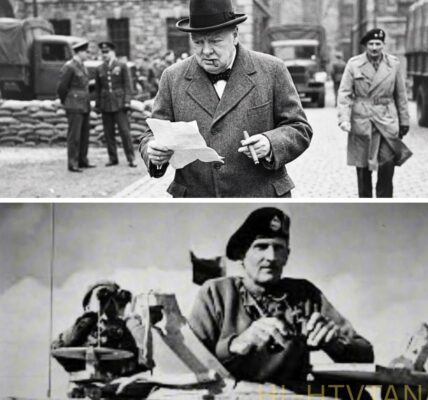
Some photographs from this period show Soviet soldiers in Berlin and in areas that became part of the Soviet occupation zone after the city fell. One caption in the supplied collection refers to Colonel General of Tank Forces Semyon Bogdanov inspecting military spoils in Berlin on May 1, 1945. This detail should be checked against the original photographic records to confirm the identity, location, and circumstances of the image.
Nevertheless, the broader historical context is clear: by that time, Berlin stood amid the collapse of Nazi Germany’s military apparatus. The city that had once served as the center of the regime’s power had become one of the most recognizable symbols of its defeat.
Captured military equipment, damaged buildings, and flags appearing in photographs recorded more than a change in territorial control. They also marked the end of a political order that had brought war on an enormous scale.
On May 8, 1945, Nazi Germany surrendered unconditionally, marking the end of the war in Europe. But the Second World War continued in Asia until Japan accepted surrender in August, with the formal surrender document signed on September 2, 1945.
These two dates matter. They remind us that the world war did not end everywhere at the same time. While many people in Europe began thinking about returning home, others were still living amid active conflict, waiting for news of their families, or facing an uncertain future.
Even after the guns fell silent, returning to normal life was not simple. Destroyed cities needed to be rebuilt. Homeless people needed shelter. Separated families had to search for one another. Societies had to confront questions of responsibility, justice, and how to remember the dead.
A photograph of ruins can be dated precisely. The reconstruction of a city, however, cannot be contained within a single frame. It unfolds over years, sometimes generations, through the labor of survivors and those born after the war.
This is where historical photographs begin to acquire a different meaning. They show us not only what was lost, but also what people chose to preserve.

A destroyed monument can be rebuilt. A road can reopen. A city can become crowded once again. But not everything can be restored. The dead do not return. Traumatic experiences do not disappear simply because buildings have been repaired. Communities torn apart may need a long time to recover a sense of security.
For this reason, looking back at photographs from 1945 is not simply an exercise in viewing a distant past. It is also a way of examining how societies attempt to transform catastrophe into meaningful memory, rather than allowing it to become nothing more than a sequence of events remembered through numbers.
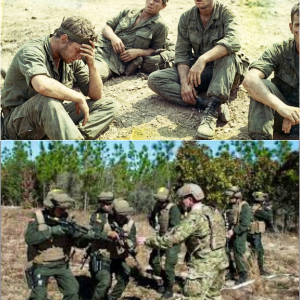
Yet this collection contains photographs from other conflicts as well: a soldier who lost both legs during the First World War, Korean refugees leaving Hungnam Harbor in December 1950, the Iran–Iraq War in the early 1980s, and an American soldier in Vietnam in 1968.
These images do not belong to the same event, nor can they be combined into a single story with shared characters or a continuous timeline. Each photograph must be placed in its proper historical context. Nevertheless, when viewed alongside one another, they reveal a sobering continuity: wars change in their weapons, strategies, and political objectives, but their consequences for human life often extend far beyond the moment when fighting ends.
A soldier returning home with permanent injuries may have to learn how to live again in a world that has changed. A family forced to abandon its homeland may never return to the place it once called home. A child born during wartime may grow up surrounded by memories of events the child never personally witnessed.
This does not mean that all wars are the same. The causes, circumstances, responsibilities, and consequences of each conflict must be studied separately. But these images demonstrate why the history of war cannot be measured solely by its beginning, its end, or the names of its victors.

A war may end with a surrender document. The recovery of people and societies is an entirely different journey.
And old photographs, despite their limitations, can help us pause and reflect on that journey. They invite us to look more carefully at what was once considered ordinary, recognize what has disappeared, and question the decisions that brought people to that moment.
Perhaps the deepest value of preserving history does not lie in making the past feel as vivid as a film. It lies in helping us distinguish what actually happened from what we would like to believe, understand decisions within their historical context, and remember the people who had to live with the consequences.
Because beyond campaign maps, casualty figures, and photographs of victory, history remains a story about human beings—people capable of bringing the world to the brink of destruction, but also people who must rebuild their lives after everything has fallen apart.
If you could choose one lesson for future generations to remember from these wartime photographs, what would matter most: the memory of what was lost, the lesson of responsibility, or humanity’s ability to rebuild a peaceful world together?
Some content was generated using AI tools (including ChatGPT) and edited by the author for creativity, storytelling, and historical illustration purposes. Historical facts and key details should be verified against reliable historical sources. Any AI-generated or reconstructed visuals are intended for illustrative purposes and should not be interpreted as original historical photographs or archival evidence.