These 120 Vintage Photos Were Kept SECRET From the Public Eye! – Ethereal Relics. VD

At 12:15 p.m. on June 22, 1941, voices carried through the streets of Moscow. People gathered around loudspeakers and radios to hear an announcement that would change the course of their lives. Germany had invaded the Soviet Union. Far to the west, the war had already transformed cities, families, and entire nations. Now a vast new front was opening, stretching across territories too large to understand at a glance. The photographs left behind by the conflict show soldiers, leaders, prisoners, and children—but behind each image lies a question that military maps cannot answer: what did it mean to be an ordinary person when the world you knew suddenly became a battlefield?
The announcement in Moscow did not arrive in a world at peace. By the summer of 1941, Europe had already endured nearly two years of war. Nazi Germany had invaded Poland in September 1939, and the conflict had spread through western and northern Europe. France had fallen in 1940, Britain had endured the Blitz, and German forces had occupied territories across the continent. Yet the invasion announced that June morning brought a new scale of danger. The German attack on the Soviet Union, launched under the codename Operation Barbarossa, opened a front that would become one of the largest and deadliest theaters of the Second World War.

For people standing beneath the loudspeakers in Moscow, the announcement was not a distant diplomatic development. It was the arrival of a war that would soon reach deep into their own country. The Soviet government had signed a non-aggression pact with Germany in August 1939, but that agreement had not prevented the invasion. German forces crossed the Soviet frontier along an immense line, attacking from the Baltic region toward the Black Sea. The scale of the assault was extraordinary, and the first weeks brought severe Soviet losses, mass captures, and rapid German advances.
The radio announcement transformed an abstract threat into public knowledge. Its words could tell listeners what had happened, but they could not tell them what would happen to their homes, their families, or the men who would be sent to fight. A person hearing the news might have been a factory worker, a shopkeeper, a student, or someone who had never expected to see a battlefield. History records the date and the announcement. It cannot recover every private thought that passed through the crowd.

That distinction matters. A photograph of civilians listening to a wartime broadcast is not merely an illustration of a political event. It captures a moment when information became a dividing line between one world and another. Before the announcement, the invasion was an event unfolding elsewhere. After it, the war had entered the daily lives of people who could no longer treat it as something happening beyond their horizon.
The Soviet Union would ultimately become central to Germany’s defeat, but the path from invasion to victory was neither immediate nor inevitable. The Eastern Front consumed enormous military resources and caused catastrophic suffering among soldiers and civilians. Cities and villages changed hands. Families were displaced. Prisoners were taken in vast numbers. Entire communities were subjected to occupation, forced labor, hunger, and mass violence. The front was not simply a line moving across a map; it was a shifting boundary that determined who controlled a town, what food was available, and whether people could remain in their homes.

One of the most important turning points came in 1944. By then, the German army had been driven back across much of the territory it had conquered in the Soviet Union. In the summer, Soviet forces launched Operation Bagration, a major offensive against German Army Group Centre in what is now Belarus and surrounding areas. The operation devastated German positions and contributed to the collapse of the German front in the east. It also produced enormous numbers of prisoners.
On July 17, 1944, Moscow staged a public march of captured German soldiers through the city. Contemporary records describe tens of thousands of prisoners being paraded through the streets. The event became known as the Parade of the Vanquished. It was not simply a movement of prisoners from one place to another. It was a carefully visible demonstration of the reversal taking place on the Eastern Front.

The contrast with June 1941 was striking. When German forces invaded, the Soviet Union had faced a sudden and devastating attack. Three years later, German soldiers were being marched through the Soviet capital as prisoners. The military balance had changed dramatically, and the parade offered the Soviet public a visible sign of that transformation.
But photographs of captured soldiers require care in interpretation. A picture can show uniforms, columns, faces, and the streets through which prisoners passed. It cannot, by itself, explain every person’s role in the war, the circumstances of their capture, or their individual responsibility for crimes committed during the occupation. Nor does a public display tell us everything about what happened to prisoners afterward. The image documents defeat, but it does not contain the whole history of the defeated.
The parade also reveals how war operates on two levels. On the battlefield, armies pursue strategic objectives, seize territory, destroy supply lines, and attempt to break the enemy’s capacity to fight. Away from the battlefield, governments and societies interpret those outcomes, turning military events into public symbols. The Soviet authorities used the parade to demonstrate the success of their forces. For people who had endured invasion and enormous losses, the sight of captured German troops could represent a dramatic reversal of fortune. Yet victory on a public stage did not erase the destruction already suffered, nor could it restore those who had died.
There was another side to the changing fortunes of the war: the individual men and women whose experiences became part of its wider history. Among them was Lyudmila Pavlichenko, a Soviet sniper whose military record made her one of the best-known female combatants of the conflict. Born in 1916, Pavlichenko was studying history at Kyiv University when Germany invaded the Soviet Union. She joined the Red Army and served as a sniper, fighting in major engagements, including the defense of Odesa and Sevastopol.

Her final recorded tally was 309 confirmed kills, a figure widely cited by historical institutions, including the National WWII Museum. The number explains why her military career became so notable, but it should not reduce her life to a statistic. Pavlichenko entered a war in which the survival of cities and armies depended on countless individual acts of combat, endurance, and coordination. Her experience also challenges the simplistic assumption that the battlefield belonged exclusively to men. Women served in a wide range of Soviet military roles, including aviation, medical services, communications, and combat.
It is tempting to turn a figure such as Pavlichenko into a legend and to let the legend replace the person. The historical record supports her achievements as a sniper, but the meaning of her service belongs to a wider reality: a country under invasion mobilized its population on an immense scale. People who had been students, workers, and parents found themselves serving in roles that could expose them to extraordinary danger. Some became famous. Most did not. Their absence from celebrated histories does not make their contribution less real.

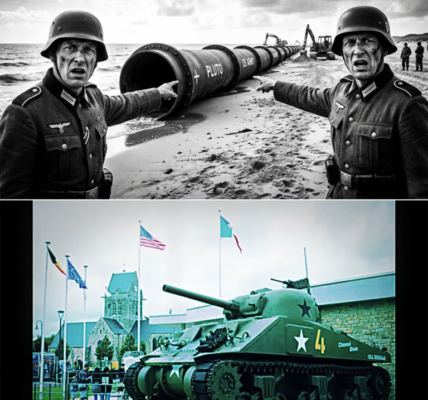
By 1944, the war had reached another decisive stage in western Europe. The Allied powers were preparing to land in Normandy, France, and open a major front against German forces occupying western Europe. The operation, known as Operation Overlord, required an extraordinary combination of planning, deception, transport, air power, naval support, and ground forces. The landings would take place on June 6, 1944, in an operation now widely known as D-Day.
The preparation was enormous, but much of it remained hidden from civilians and from the German defenders who would face the invasion. Troops trained for amphibious landings. Military planners studied beaches and defensive positions. Vehicles, ammunition, food, medical equipment, and other supplies had to be transported across the English Channel. Thousands of vessels would take part in the operation, and the invasion depended on coordination across sea, air, and land.

The photographs from this period often show soldiers gathered around maps, vehicles being loaded, equipment arranged in rows, and men waiting for orders. Such images can appear quiet compared with photographs taken during an assault. Yet preparation was itself a decisive part of the campaign. A landing force could not succeed merely because its soldiers were brave. It needed ships to deliver them, aircraft to support them, supplies to sustain them, and a plan capable of surviving the confusion of battle.
The stakes were immense. Since the fall of France in 1940, German occupation had shaped life across much of western Europe. An Allied landing in Normandy offered a route into France and the possibility of advancing inland toward the liberation of occupied territory. But the outcome was uncertain. German defenses were substantial, the weather could disrupt plans, and the landing forces would have to cross exposed beaches under fire. The operation’s success was not guaranteed simply because it was planned on a vast scale.

On June 5, after weather conditions forced a delay, the decision was made to proceed with the landings the following day. In the early hours of June 6, Allied forces began crossing the Channel. The invasion brought together American, British, Canadian, and other Allied personnel in an operation of extraordinary complexity. More than 132,000 ground troops landed on the Normandy beaches on D-Day itself, supported by a much larger naval and air effort.
The landing did not end the war in Europe. It began a costly campaign to establish a foothold, break through German defenses, and move inland. The fighting that followed would last for months. Towns and villages became battlegrounds, transport networks were damaged, and civilians were caught in the path of advancing armies. The liberation of western Europe was not a single dramatic moment followed by immediate peace. It was a long military process, marked by difficult advances and further losses.
Still, D-Day was a turning point. It forced Germany to fight a major land campaign in western Europe while its forces were already under severe pressure in the east. The Soviet advance and the Allied invasion placed Germany under pressure from opposite directions. Neither front can be understood in isolation from the other. Together, they narrowed Germany’s options and contributed to the eventual defeat of the Nazi regime in May 1945.
The photographs of D-Day preparations carry a particular kind of tension because their subjects stand at the threshold between waiting and action. A soldier in a landing craft, a vehicle being loaded, or a group receiving a briefing may appear to occupy an ordinary moment. Yet the historical context gives that moment extraordinary weight. The next stage of the operation could mean the liberation of a town, the loss of a friend, an injury, or a journey into a country the soldier had never seen.
We should not pretend to know what every individual in these photographs was thinking. A camera records a visible moment, not a complete inner life. But the circumstances surrounding the images allow us to understand why the preparations mattered. Each vehicle, ration, weapon, and medical supply formed part of a system designed to carry men across the sea and sustain them after landing. Behind the great strategic plans stood countless practical tasks, performed by people whose names may never appear in a history book.
The human consequences of war were not confined to the great fronts or the decisive operations. They also appeared in small encounters far from the most famous battlefields. In Greece, where occupation had brought severe hardship and famine, a photograph taken around October 1944 records two members of the Royal Air Force Regiment sharing their breakfast rations with a young Greek boy on a beach. The men were part of the first British land forces to arrive on the Greek mainland.
The Australian War Memorial identifies the servicemen as Leading Aircraftman Frank Harper of Edinburgh and Leading Aircraftman Edward Carswell of Stanley, Stoke-on-Trent. The archival caption describes them sharing their early morning food with the child. This is a modest act, recorded without the scale or spectacle of a major military operation. Yet its simplicity makes it significant.
By the autumn of 1944, German forces were withdrawing from Greece, and British troops were arriving as the occupation came to an end. The country had endured years of hardship. During the occupation, food shortages and famine devastated civilian life, especially during the early years of the war. The end of occupation did not mean that every household immediately had enough to eat, that infrastructure was restored, or that political stability returned overnight. Relief, reconstruction, and the struggle to rebuild daily life would continue after the armies moved on.
In the photograph, the child is not shown as a symbol of a nation or as a representative of every Greek civilian. He is one boy receiving food from two servicemen. The image does not tell us his name, his family’s circumstances, or what happened to him later. It would be wrong to invent those details simply to make the scene more moving. What the record does establish is enough: a young civilian and two servicemen share a small portion of food during a period of war and hardship.
That is why the photograph matters. It reminds us that history is made not only through decisions taken by generals and governments, but also through the conditions those decisions create for people who have little control over them. Military campaigns determine which army controls a territory. Occupation policies, disrupted transport, and shortages affect whether a child can obtain food. The connection between strategy and daily survival is not always visible in official accounts, but it is central to understanding the human cost of conflict.
A shared meal cannot repair a ruined economy or reverse years of deprivation. It cannot settle political disputes or erase the losses caused by occupation. Yet it can represent a practical response to an immediate need. The act documented in the photograph is small, but it belongs to the same history as the movements of armies and the decisions that brought them to Greece. The scale is different. The human stakes remain.
The war’s many photographs can be difficult to place alongside one another. A broadcast in Moscow in 1941, German prisoners marching through the Soviet capital in 1944, Allied troops preparing for Normandy, and British servicemen sharing food with a Greek child belong to different places, circumstances, and stages of the conflict. They should not be treated as if they were scenes from one continuous day, nor should the people shown be made into characters in a story whose details are not known.
But when considered together, these moments reveal the breadth of the war. In the Soviet Union, invasion became a struggle for survival and eventually a massive counteroffensive. In western Europe, preparations for D-Day became an operation that opened a new front and helped lead to liberation. In Greece, the effects of occupation remained visible in the everyday need for food. Each image records a different dimension of a conflict that reached across continents and affected military personnel and civilians alike.
There is also a danger in allowing the most dramatic images to define our entire understanding of World War II. Photographs of tanks, aircraft, ruined cities, and marching prisoners are powerful because they make military history visible. They show force, scale, and destruction. Yet they can make the people affected by those events seem secondary, as if their lives were merely the background to decisions made elsewhere.
The quieter photographs challenge that impression. A crowd listening to a radio announcement shows how war entered civilian awareness. A column of prisoners reveals how dramatically the balance of power could change. A soldier preparing for a landing stands within an operation larger than any individual. Two airmen sharing their rations with a child remind us that, even amid the machinery of war, people continued to face immediate human needs.
These photographs do not tell the entire story. No photograph can. Their captions may be incomplete, their subjects may remain unidentified, and the moment preserved may represent only a fraction of what happened before or afterward. Historical care requires us to distinguish what an archive records from what we imagine. That restraint does not make the story less compelling. It makes the story more trustworthy.
The end of the war in Europe came in May 1945, after Germany’s military defeat and the collapse of the Nazi regime. But the conclusion of military operations did not restore the world to its earlier state. Cities lay in ruins. Families had been separated. Millions of people had been killed, displaced, imprisoned, or deprived of their homes. Survivors faced the difficult work of rebuilding not only streets and buildings but also communities and ordinary routines.
Looking back, it is easy to arrange the past into a sequence of dates: invasion, retreat, counteroffensive, landing, liberation, surrender. Those milestones are essential. Without them, the scale and direction of the war become difficult to understand. But dates alone cannot explain what it meant to live through those events. They do not show the uncertainty of waiting for news, the disruption of a household, or the immediate importance of a meal when food is scarce.
The photographs help restore some of that human scale. They do not give us permission to invent private thoughts or unrecorded conversations. Instead, they ask us to pay attention to what is actually visible and to place it within the best-supported historical context. Sometimes that is enough to change how we see an event.
A crowd in Moscow heard that Germany had invaded. Three years later, German prisoners passed through the Soviet capital. In the west, Allied troops crossed the Channel to begin the liberation of France. In Greece, servicemen shared food with a child during the closing phase of the occupation. These were not identical experiences, and they should not be flattened into a single moral lesson. Yet together they show how war reshaped the lives of people far beyond the rooms where strategy was decided.
Perhaps that is one of the most important reasons to preserve historical photographs. They connect events that might otherwise remain abstract to the physical presence of the people who lived through them. They show us uniforms and streets, equipment and food, crowds and children. They also remind us of the limits of what we can know. The past deserves both empathy and accuracy.
World War II was shaped by military power, political ideology, industrial capacity, and decisions made by governments and commanders. Its outcome depended on enormous collective efforts and immense sacrifice. But its history also survives in small, ordinary moments that do not fit neatly into a timeline of victories and defeats.
When we look at such photographs, we are not simply looking backward. We are deciding what kind of history we want to remember: one concerned only with who won and who lost, or one that also asks what happened to the people caught within the struggle. The two perspectives are not mutually exclusive. Understanding the military outcome is essential, but so is recognizing the lives that made up its human cost.
The photographs cannot bring those lives back, and they cannot answer every question about what happened next. What they can do is keep the distance between past and present from becoming too comfortable. They remind us that events now summarized in a sentence once unfolded in real time, amid uncertainty, danger, and choices whose consequences could last for generations.
If these images leave us with one enduring thought, it may be this: history is not only the record of how a war was fought, but also the record of the people who had to live through it. When we remember World War II, how can we preserve both the truth of its great turning points and the humanity of those whose names the photographs never recorded?
Some content was generated using AI tools (including ChatGPT) and edited by the author for creativity, storytelling, and historical illustration purposes. Historical facts and key details should be verified against reliable historical sources. Any AI-generated or reconstructed visuals are intended for illustrative purposes and should not be interpreted as original historical photographs or archival evidence.