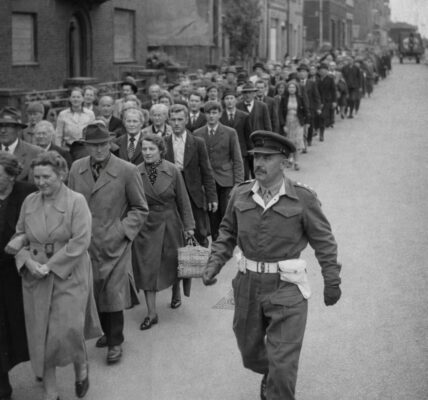
The Photographs That Revealed the Human Cost of World War II
On April 16, 1945, a photograph recorded a scene inside Buchenwald concentration camp that the world could no longer afford to ignore. Prisoners lay in their bunks, many weakened by prolonged starvation and the brutal conditions of imprisonment. American troops had reached the camp, and the reality concealed behind its fences was becoming visible. Thousands of miles away, women were learning new industrial skills to support the war effort, families were waiting for sons to return, and a United States Navy blimp had drifted back to California with its two-man crew missing. These images seem to belong to different worlds. Yet together, they reveal something essential about a war that reached into nearly every part of human life.
The Second World War is often remembered through its largest events: invasions, major battles, the fall of cities and the surrender of nations. Such events provide the structure of history, but they cannot tell the whole story. The war also unfolded in hospital wards, vocational classrooms, military workshops, family homes and the quiet spaces between one headline and the next.

The photographs left behind allow us to move between those worlds.
Some show people preparing for dangers they could only imagine. Others record the consequences after those dangers became reality. And a few confront us with questions that remain difficult to answer even decades later.
The photograph from Buchenwald belongs to the first category of images that cannot be understood as ordinary documentary records. It is evidence of a human catastrophe.
Buchenwald, established by Nazi Germany in 1937 near Weimar, became one of the largest concentration camps within the German camp system. Prisoners were subjected to forced labor, deprivation, abuse and systematic violence. The people held there came from different countries and backgrounds, and their experiences were shaped by a system that treated human beings as instruments of persecution and exploitation.

By April 1945, Nazi Germany was approaching defeat. Allied forces were advancing into German territory, while the camp system was increasingly affected by the collapse of the regime. Prisoners had endured years of deprivation, and conditions in many camps had deteriorated catastrophically as the war neared its end.
The liberation of Buchenwald unfolded amid this final collapse. American forces reached the camp on April 11, 1945, and prisoners were no longer held under the same control of the SS that had governed the camp. The arrival of Allied troops did not erase what had happened. It made the evidence impossible to conceal in the same way.
Five days later, on April 16, an American photograph documented prisoners in their bunks. The National Archives preserves the image under a caption describing slave laborers at Buchenwald, noting that many had died from malnutrition by the time American troops of the 80th Division entered the camp.

The date matters. The photograph was not an image of a battle in progress. It showed what remained after years of persecution and imprisonment.
There is a particular difficulty in looking at photographs like this. The camera records bodies and surroundings, but it cannot contain the full history of each person in the frame. It cannot tell us every name, every family connection, every hope that had survived imprisonment, or every loss that could no longer be repaired.
It can, however, establish that these people were there.
It can document conditions that might otherwise be denied, minimized or pushed aside.
And it can make it harder for later generations to treat the Holocaust and the Nazi concentration camp system as distant abstractions.
The men in those bunks were not simply evidence of a defeated regime. They were human beings whose lives had been subjected to a system of organized persecution. Their condition was not an inevitable consequence of war in general. It was the result of specific policies, institutions and decisions made by the Nazi state and carried out by those who served it.
That distinction is essential.

The Second World War produced suffering on an immense scale, but not every kind of suffering had the same cause. Buchenwald cannot be reduced to the general hardship experienced by civilians or soldiers. Its history belongs to the record of Nazi persecution, forced labor and the concentration camp system.
When American troops reached the camp, liberation brought an end to one form of immediate control. It did not instantly restore health, reunite families or return the years that had been taken away. Survivors faced the physical consequences of deprivation and the difficult task of discovering what had happened to relatives and communities.

For some, the end of imprisonment was the beginning of a long search for a place to live and a life that could continue. For others, there was no family left to return to.
The photograph from April 16 captures a moment in that transition, but the transition itself could not be completed in a single day.
The historical record is clearest about the conditions documented and the dates preserved. The emotional lives of every individual in the image are not equally recoverable. We should not invent their thoughts or place words in their mouths. Their humanity does not depend on our doing so.
The fact that they endured what the photograph records is already enough to demand our attention.
Yet while scenes like Buchenwald revealed the devastating consequences of Nazi rule, other photographs from the same war show the enormous effort required to keep societies functioning.
In the United States, the war transformed the workplace.
A photograph taken in April 1942 shows women from central Florida attending vocational training to prepare for wartime employment. The original caption identifies the group as including secretaries, housewives and waitresses who were entering vocational schools to learn war work. The women pictured were attending the Daytona Beach branch of the Volusia County vocational school.
Their presence tells a different part of the wartime story.

The war required weapons, vehicles, aircraft, ships, communications equipment and countless other supplies. Those materials did not appear simply because a government ordered them. They depended on factories, skilled labor, training programs and the organization of industrial production on a vast scale.
As men entered military service and demand for war production increased, women took on work that had previously been less accessible to them. Some trained in manufacturing and technical occupations. Others worked in offices, transport, hospitals and essential services.
The photograph of the Florida students does not establish what happened to every woman after training. It does show a moment when people from different walks of life were preparing to enter new kinds of employment because the demands of war had changed the labor market.
Their classroom was part of the wider military effort, even though it was far from the battlefield.
This is one of the great contradictions of modern warfare: a conflict fought by armies depends on the labor of people who may never see combat.

The worker learning a new skill, the mechanic checking an engine, the welder assembling a ship and the factory employee preparing an aircraft component could all contribute to operations taking place thousands of miles away.
The relationship between these activities was not always visible to the people doing the work. A student in a vocational classroom might not know where the equipment she helped produce would eventually be used. A factory worker might see only the next task in a long production line.
But the cumulative effect was enormous.
The National Archives’ wartime photographs document women working in aircraft plants, shipyards and industrial facilities. They also preserve images of rationing, scrap collection and other forms of civilian participation in the war economy. Taken together, they show that the home front was not merely a place where people waited for news. It was an active part of the war effort.

Still, the image of women training for war work should not be turned into a simplistic story in which every barrier disappeared or every opportunity became permanent. Wartime necessity opened doors, but it did not automatically eliminate discrimination or guarantee that women would retain every job after the conflict.
The photograph establishes participation. The broader historical record explains its context.
Between those two things lies the difference between a compelling historical narrative and an invented one.
The same care is necessary when looking at another wartime image: a maternity hospital preparing for the possibility of a gas attack.
The photograph described in the source appears to belong to the wider British civil-defense effort. During the war, hospitals and other institutions had to consider how they would protect vulnerable people if Britain faced chemical attack. Such preparations existed within a society already adapting to bombing raids, evacuation and the possibility of further danger.
For a maternity hospital, the responsibility was especially serious. Its patients included women recovering from childbirth and newborn children who could not protect themselves.

A hospital was supposed to be a place of care and safety. War forced its staff to think about how that safety might be preserved under circumstances for which the institution had never been designed.
It is important not to confuse preparation with proof that an attack occurred. A photograph of a drill documents a response to a feared possibility, not necessarily the realization of that danger. Nor should the image be assigned to a specific hospital or location without a verified caption.
But even with those limits, the scene reveals a great deal.
Civil defense was not only about air-raid shelters and military installations. It involved hospitals, local authorities, families and ordinary citizens who had to consider what they would do if familiar routines suddenly became impossible.
The threat of war entered the planning of childbirth, childcare and medical treatment.
It entered the lives of people who had no military role.
And it changed what preparedness meant.

A maternity ward might have to think about protective equipment. A household might need to respond to an air-raid warning. A school might have to prepare pupils for an emergency. Each institution faced its own practical questions, but all were responding to the same wider reality: civilians could no longer assume that distance from the front meant safety.
The war had changed the meaning of home.
For some families, that change was temporary. For others, it lasted years.
One of the most moving descriptions in the source concerns a mother whose eight sons all served during the Second World War and all returned home. Without a fully verified caption identifying the family, their individual names, service branches and dates of enlistment should not be supplied as fact. Yet the central detail, if accurately captioned, captures a powerful dimension of wartime family life.
Eight sons.
Eight military experiences.
One family waiting for the war to end.
The return of all eight would have been an extraordinary outcome for any household carrying such a burden of separation. But it should not be used to imply that other families who lost relatives had somehow experienced less courage, less devotion or less hope. Families did not control the dangers their loved ones faced, and survival was never a simple measure of merit.
The photograph’s significance lies in the fragile distance between departure and return.
When a family member entered military service, the household became connected to events far beyond its control. News arrived through letters, official notices and newspaper reports. Communication could be delayed. Information could be incomplete. A person might be serving in a theater of war that relatives at home knew only through maps and headlines.
For parents, spouses and children, the conflict often took the form of waiting.
The military could record a unit’s movement or a battle’s outcome. A family wanted to know something more immediate: whether the person they loved was safe.
No photograph of a reunited family can represent every wartime household. But the image described in the source offers a rare and hopeful counterpoint to the thousands of families whose stories ended in loss.
All eight sons came home.
That fact, if confirmed by the original caption, deserves to be remembered without turning it into a claim that the war’s consequences were somehow gentle for this family. Even those who returned could have been changed by what they experienced, and the photograph alone cannot tell us what their lives became afterward.
The end of military service was not always the end of war’s influence.
The conflict also created uncertainties that had no obvious relationship to the battlefield. One of the most unusual occurred on the California coast in August 1942.
On the morning of August 16, a United States Navy airship designated L-8 departed Treasure Island in San Francisco Bay on a routine anti-submarine patrol. Its crew consisted of Lieutenant Ernest DeWitt Cody and Ensign Charles Ellis Adams.
The patrol was part of the American effort to watch the coast for possible enemy submarines. After the attack on Pearl Harbor in December 1941, the possibility of Japanese submarine activity near the American mainland was taken seriously. Coastal patrols formed part of the wider effort to protect shipping and monitor the approaches to the United States.
L-8 was a blimp, a lighter-than-air craft that could remain aloft while carrying out surveillance. It was not a large strategic bomber or a dramatic symbol of aerial power. Its task was more modest: patrol the coast, observe the sea and report anything suspicious.
The mission began normally.
At one point, the crew reported spotting an oil slick and said they were investigating it. An oil slick could be a clue worth examining in an anti-submarine patrol, although the sighting alone could not establish the presence of an enemy submarine.
Then the communications stopped.
Hours later, L-8 returned toward land without its crew.
The empty airship was seen drifting over the California coast before it came down in Daly City. It had sustained damage during its journey, but the control car was empty. The two men were nowhere to be found.
Their disappearance transformed an ordinary patrol into one of the war’s enduring aviation mysteries.
The immediate questions were practical. Had the crew fallen into the sea? Had an emergency forced them to leave the airship? Was there some explanation that had not yet been discovered? The Navy investigated the incident, and searches were conducted, but neither man’s fate was conclusively established.
The aircraft itself survived. After repairs, L-8 returned to service.
The two crewmen did not return.
Their disappearance has attracted speculation over the years, but speculation is not the same as evidence. The surviving record does not justify presenting a dramatic theory as a proven explanation. The responsible historical account remains simpler and more unsettling: the airship returned, the crew was missing, and their fate remained unresolved.
Why does this story belong beside photographs of concentration camp survivors, women training for industrial work and families waiting for servicemen?
Because war was not experienced only through events that could be neatly categorized as victories or defeats.
It was also experienced through uncertainty.
A missing person.
A message that never arrived.
A family that could not learn what had happened.
A mission that ended without an explanation.
The L-8 incident did not have the same historical weight as the liberation of Buchenwald, and the two should never be treated as equivalent tragedies. But both remind us of a limitation that runs through the photographic record: an image may preserve a moment while leaving the most important part of the story unresolved.
In Buchenwald, photographs documented what had been hidden from much of the outside world.
With L-8, the photograph of an empty airship raised questions that the available evidence could not answer.
One revealed a documented system of persecution.
The other recorded an unexplained disappearance.
The difference between those histories matters just as much as the connection.
A responsible account of the past must know when the evidence supports a firm conclusion and when it does not.
By 1945, photographs of the war were increasingly documenting the consequences of the conflict’s final months. The image of an abandoned child in London, dated in the source to 1945, belongs to a wider landscape of displacement and disruption. Without a verified caption, it would be wrong to invent the child’s name, family history or circumstances. Yet the image’s broad context is historically recognizable: European cities had endured bombing, evacuation, separation and the movement of millions of people.
Children were especially vulnerable to the collapse of ordinary life.
Some had been evacuated from cities. Some had lost parents. Others were separated from their families by occupation, forced movement or the chaos of retreat and liberation. The exact circumstances varied, and a single photograph cannot establish which of these experiences belonged to the child it depicts.
That uncertainty should not make the image less meaningful.
It should remind us that historical photographs are not complete biographies. They are fragments that must be interpreted carefully.
The same is true of the images of workers, servicemen and families. Their surroundings can tell us much, but not everything. A uniform may establish military service; it cannot reveal every experience that followed. A classroom may document training; it cannot prove what career each student eventually pursued. A reunion may record a moment of relief; it cannot tell us how a family remembered the years of separation.
The historian’s task is not to fill every gap with an imagined scene.
It is to distinguish what can be known from what remains unknown, while explaining why the surviving evidence still matters.
This distinction becomes particularly important when looking at the liberation photographs from Buchenwald.
The images are evidence, but they are also a challenge to memory. They force later generations to confront the gap between the language used by a regime and the reality experienced by its victims.
The Nazi state built systems of persecution and presented them through propaganda, bureaucratic language and ideological claims. Photographs made after liberation helped expose the conditions that those systems had created. They could not restore the dead or erase the suffering of survivors, but they provided records that could be preserved, examined and used to challenge denial.
The date of April 16, 1945, therefore carries more than chronological significance. It marks a moment when documentation became part of the work of confronting the consequences of Nazi rule.
The war in Europe was nearing its end, but the truth of what had happened would require far more than a surrender ceremony to understand.
Survivors needed care. Families needed answers. Investigators needed evidence. Societies would have to decide how to remember crimes committed in their name or under their governments, and how to prevent the historical record from being distorted.
The photographs were only one part of that process.
Yet they became among its most enduring parts because they allowed people who had not witnessed the events to encounter evidence that was difficult to dismiss.
A photograph cannot explain every cause. It cannot replace testimony or archival documents. It cannot speak for every person whose life it records.
But when properly identified and interpreted, it can preserve a moment that might otherwise disappear.
That is why the most ordinary wartime photographs also deserve attention.
The women in the Florida vocational school were not photographed in the middle of a battle. The family with eight sons was not shown in a military command center. The crew of L-8 was not part of a famous invasion. These stories are smaller in scale than the campaigns that dominate history books, but they reveal how the war moved through different layers of society.
It changed employment.
It changed family life.
It changed the responsibilities of medical institutions.
It placed people in unfamiliar jobs and dangerous situations.
It created mysteries that could not always be solved.
And it produced crimes whose consequences extended far beyond the moment when the fighting stopped.
The war was global, but its effects were intimate.
It reached a training classroom where women prepared for industrial work. It reached a household waiting for sons to return. It reached a maternity hospital preparing for emergencies. It reached a coastal patrol whose crew vanished. And it reached concentration camps where prisoners endured a system of deliberate persecution until Allied troops arrived.
These experiences cannot be collapsed into one simple moral or emotional narrative. They were different in cause, scale and consequence. Their connection is not that everyone suffered in the same way. It is that the war altered the conditions under which millions of people lived, worked, waited and survived.
When we look back, the temptation is to organize the past around what we already know happened next.
We know that Nazi Germany surrendered in May 1945. We know that the war against Japan continued until the formal surrender in September. We know which campaigns became turning points and which military operations ended in failure. We know that the world that emerged from the conflict would be reshaped by new political rivalries, new institutions and the beginning of the nuclear age.
The people in the photographs did not possess that knowledge.
The women entering vocational school in 1942 could not know exactly how long the war would last or how their work would shape their futures. The families waiting for servicemen could not be certain who would return. The crew of L-8 began their patrol without knowing that their names would become attached to an enduring mystery. The prisoners at Buchenwald could not know precisely what their lives would look like after liberation.
That uncertainty is one of the most important things photographs allow us to recover.
The people in them were living through events, not studying them after the outcome had become clear.
They had no guarantee that the next day would bring safety.
They could not see the entire war.
They could only confront the circumstances in front of them.
And yet, within those circumstances, people continued to learn, work, care for one another, carry out duties and search for answers.
This should not be turned into a sentimental claim that human courage always overcomes suffering. History does not support such an easy conclusion. Courage did not save every family. Work did not protect every civilian. Liberation did not restore every life. Some questions remained unanswered, and some losses could never be repaired.
The more honest lesson is that human beings continued to act within conditions they did not control—and that their choices, institutions and actions helped shape what followed.
The photographs preserve parts of that record.
The image from Buchenwald demands that we remember the victims and recognize the historical reality of Nazi persecution. The Florida training photograph documents a society mobilizing its workforce for a global war. The family described as having eight sons who all returned offers a glimpse of an outcome many households hoped for but could not guarantee. The empty L-8 reminds us that even careful investigation does not always produce a complete answer.
Each image has its own meaning.
Together, they reveal a war that cannot be understood through generals and battle maps alone.
History is also found in the people who performed essential work without becoming famous, in the families who lived between hope and fear, in the institutions that tried to protect civilians, and in the records left behind by events that could not be fully explained.
A photograph is not the whole past. It is a doorway into it.
The responsibility lies with us to enter carefully—to verify captions, respect the people shown, avoid inventing what we cannot know and recognize the difference between documented fact and interpretation.
When we do that, the images become more than striking scenes from another century. They become part of a historical record that helps us understand not only what happened, but also what must never be forgotten.
When you look at these photographs, which aspect of the Second World War do you think is most often overlooked: the suffering of its victims, the work of ordinary people, or the uncertainty faced by families waiting for the war to end?
Some content was generated using AI tools (including ChatGPT) and edited by the author for creativity, storytelling, and historical illustration purposes. Historical facts and key details should be verified against reliable historical sources. Any AI-generated or reconstructed visuals are intended for illustrative purposes and should not be interpreted as original historical photographs or archival evidence.