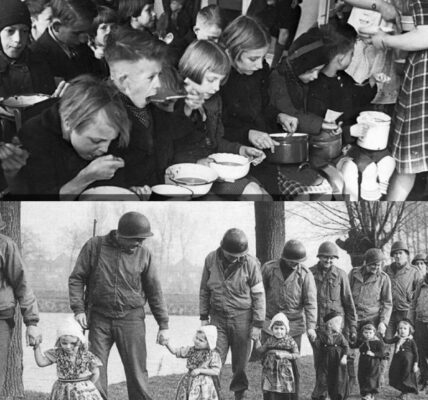
▶ UNBELIEVABLE Old Pictures You’ve Never Seen Before – Historical Photos – Ethereal Relics. VD

On the night of October 8, 1940, the platforms and tracks of Aldwych Underground Station became a place of refuge. People slept where trains normally ran. Families gathered beneath London, waiting for the warning sirens to pass and for the German bombs above them to stop. It was an extraordinary scene, but by then Britain had already learned a terrible lesson: the modern war did not remain on distant battlefields. It entered railway stations, kitchens, factories, streets, ships, and homes. And thousands of miles away, a submarine called USS Trout was carrying something almost impossible to imagine as ballast—gold and silver being evacuated from the Philippines as Japanese forces advanced. The war was becoming a struggle not only over territory, but over survival itself. How had the world arrived at this point?
Only two decades earlier, photographs could still capture a very different world.

In 1919, people gathered in New York around captured German weapons and pyramids made from German helmets. The First World War had ended, and its military equipment had been transformed into symbols of victory and public spectacle. In Europe, the Treaty of Versailles was being signed that same year, with leaders attempting to construct a political settlement from the wreckage of the conflict.
It was tempting to believe that the machinery of war could be put away when the fighting stopped.
But the photographs that survived from the years that followed tell a more complicated story.
They show people experimenting with machines, building enormous structures, traveling by strange new vehicles, raising children, posing for portraits, working in factories and enjoying ordinary life. They show a world fascinated by progress. Engines crossed canyons. Airships floated over cities. Automobiles became increasingly common. The Chrysler Building rose above Manhattan. New transportation devices promised to make distance smaller.

The modern age seemed to be accelerating.
And perhaps that was part of the tragedy.
The same industrial confidence that produced skyscrapers, aircraft, automobiles and new communications systems could also produce weapons and logistical systems on a scale earlier generations had never experienced.
By the time the Second World War began, the world had become deeply interconnected. Railways could move armies. Factories could produce thousands of machines. Ships could carry enormous quantities of supplies across oceans. Radio could transmit information almost instantly compared with earlier generations. Aircraft could cross borders that had once been protected by distance alone.

The technology that promised to make life easier could also make destruction faster.
That contradiction would define the war.
Among the most revealing photographs from the period are not always pictures of famous battles. Sometimes they show ordinary people preparing for dangers they hoped would never arrive.
In Britain, one such image is the infant gas mask.
It looks strange today—almost frightening in its shape. But its purpose was brutally practical. Gas warfare had haunted European memory since the First World War, and during the Second World War British authorities prepared civilians for the possibility of chemical attack. Special protective devices were developed for babies and very young children who could not use ordinary masks themselves. One surviving example resembles a sealed bag into which filtered air could be pumped.

The object tells us something important about the atmosphere of the period.
The war had not yet reached every British street in the form people feared most, but the possibility was serious enough that even babies had to be considered in civil-defense planning.
This was the new nature of total war.
A soldier was no longer the only person who needed protection.
The civilian became part of the battlefield simply by living in a city that an enemy might attack.
And then the sirens came.
On October 8, 1940, people in London sought shelter in Aldwych Underground Station as German bombing raids threatened the city. The photograph described in the source shows people sleeping not only on the station platforms but even beside the tracks.
There is something especially powerful about that image because nothing about it looks heroic.
There are no dramatic speeches.
No victorious soldiers.

No battlefield formations.
Only people trying to sleep.
The Underground was designed to move passengers through the city. That night, it became something else: a shelter.
The distinction between transportation and refuge disappeared.
A railway station became a bedroom.
A public space became a place of survival.
The photograph captures one of the defining realities of the Blitz. Londoners had to adapt their ordinary routines to an extraordinary threat. The city continued functioning, but its citizens had to learn how to live with interruption, uncertainty and danger.

Above them, the capital remained a military and political center.
Below them, people waited.
The war had become physical in a way that maps could never fully explain.
It was no longer simply about armies advancing across Europe. It was about whether a family could sleep safely through the night.
And Britain was not alone in adapting ordinary life to extraordinary circumstances.
Across the world, the war was pulling people into roles they had never expected.
In New Zealand, members of the 28th Māori Battalion became part of the country’s wartime military effort. A photograph from 1941 shows members of the battalion performing a haka in Egypt after the campaign in Greece, in a ceremony for the King of Greece at Helwan.
The image is striking because it carries several layers of history at once.

The men were far from New Zealand.
They were serving in a global conflict thousands of miles from home.
Yet the haka connected them to a cultural tradition that was unmistakably their own.
The 28th Māori Battalion had been formed as a Māori infantry battalion, and by the end of the war it would become one of the most celebrated units in New Zealand’s military history. Nearly 16,000 Māori enlisted during the Second World War, and the battalion served in campaigns across the Mediterranean and Europe.
The photograph from Egypt is therefore more than a picture of soldiers performing a ceremonial dance.
It is a reminder that the Second World War was experienced differently by different communities, yet people from those communities were drawn into the same global conflict.

For some, military service meant defending a homeland.
For others, it involved navigating the complicated relationship between identity, citizenship and empire.
The men of the Māori Battalion carried their own history with them.
So did soldiers and resistance fighters elsewhere.
In Slovenia, the war took a particularly complicated form after the Axis invasion of Yugoslavia in April 1941. Slovene territory was divided among occupying powers, and the population faced repression, deportations, confiscation and other forms of coercion.
Resistance developed.
So did internal political conflict.
One young woman who became part of this history was Albina Mali-Hočevar.

Born in 1925, she was only sixteen when she joined the partisan movement in 1941. Later she became a medic and worked with wounded fighters. She was wounded several times during the war, including seriously in 1943, and continued her involvement in the resistance through the final years of the conflict.
Her story is important precisely because she was not an abstract symbol.
She had been a teenager.
Then history changed the circumstances of her life.
The transition from civilian to resistance member did not happen in a vacuum. It happened because the political order around her had collapsed and occupation had transformed everyday life.
This is one of the recurring patterns visible in wartime photographs.
The people inside them rarely appear to have been born for the roles history eventually assigned to them.
They became soldiers, nurses, mechanics, workers, refugees, couriers and survivors because circumstances demanded it.
The war did not ask whether someone was ready.
It simply arrived.
And while young people were entering resistance movements, older institutions were being forced to improvise.
The story of USS Trout offers one of the strangest examples.
In early 1942, the situation in the Philippines was deteriorating rapidly. American and Filipino forces were under enormous pressure as Japanese forces advanced. The submarine USS Trout had been sent toward Corregidor carrying urgently needed ammunition.
After delivering the ammunition, the submarine had a problem.
It had become lighter.
A submarine designed to operate at sea needed ballast.
What could be used?
The answer was extraordinary.
Trout took aboard approximately 20 tons of gold and silver from the Philippines, along with securities and other important materials, for evacuation to safety.
The gold was not cargo in the ordinary sense.
It was ballast.
The precious metal that represented national financial reserves had become part of the physical balance of a submarine.
The image is almost surreal: a warship moving through dangerous waters with gold beneath the deck, not because its crew was transporting treasure for personal gain, but because the material had to be removed from an area threatened by Japanese occupation.
The submarine departed and ultimately brought the precious metal safely to Pearl Harbor.
The story illustrates another side of total war.
Governments were not only trying to move soldiers and ammunition.
They were trying to preserve institutions.
Money.
Documents.
Securities.
Government records.
The physical foundations of political authority.
In a war where territories could be lost within weeks, governments had to think about what could survive if the territory itself did not.
And Trout was operating in precisely the kind of environment where survival depended on the ability to move through danger without being detected.
Its mission was not glamorous.
It was necessary.
That distinction matters.
History often remembers battles because battles have clear names and dates. But wars are also won or lost through thousands of less visible tasks—moving ammunition, evacuating valuables, maintaining communications, repairing machinery, feeding populations, protecting civilians and keeping transportation systems functioning.
The photographs and stories from this period repeatedly return to the same truth.
The war was enormous.
But it was built from small human decisions.
Someone had to drive the train.
Someone had to maintain the factory.
Someone had to prepare food.
Someone had to carry medical supplies.
Someone had to shelter a child.
Someone had to keep a submarine moving.
Someone had to decide what could be saved.
And sometimes, someone simply had to wait.
That last act—waiting—is everywhere in the visual record.
People waiting in underground stations.
Families waiting for loved ones to return.
Workers waiting for trains.
Children waiting for adults.
Soldiers waiting for orders.
Communities waiting for the sound of aircraft overhead to disappear.
The photographs from the home front therefore deserve to be read alongside photographs of battlefields.
A grocery-shopping image from wartime Britain may appear completely ordinary. Yet the ordinary itself was part of the struggle.
During the Second World War, civilian populations were subject to rationing, shortages and changing expectations. Clothing, food and household goods could become difficult to obtain. People learned to reuse materials and adapt to restrictions.
A woman preparing a household for her family was participating in the war effort in a way that might never have appeared on a military map.
That is one reason images of domestic life are so valuable.
They reveal how war entered the smallest spaces.
The kitchen.
The pantry.
The nursery.
The railway platform.
The factory floor.
The street outside the house.
The war could be heard in the sky, but its consequences were often felt in the most ordinary objects.
A family that once took daily life for granted had to start calculating what could be spared.
A child who once played outside might be taught what to do when the siren sounded.
A mother could become responsible for preparing the household while another member of the family was away.
The boundary between military and civilian life became increasingly difficult to maintain.
Meanwhile, industrial production continued at a remarkable pace.
The Sears Roebuck assembly line photographed in 1942 belongs to this wider transformation. Factories across the United States were being drawn into wartime production, and industrial labor became one of the foundations of Allied military power.
This was the other face of total war.
If one photograph showed civilians hiding underground, another showed workers manufacturing the equipment that would keep armies supplied.
The contrast is almost impossible to miss.
Underground: people waiting for bombs.
Above ground and elsewhere: factories producing the means to fight the war.
One depended on the other.
And across the Atlantic, another generation of machines filled the skies and seas.
The airship photographs and early aviation images preserved from the decades before the war now seem almost innocent. They belonged to an age when flight represented wonder and possibility.
By the 1940s, aircraft had become something else as well.
They were instruments of reconnaissance, transport, bombing and defense.
The dream of flight had become inseparable from the reality of war.
The same transformation could be seen in transportation.
Before the war, automobiles and experimental vehicles had represented modernity. During the war, mobility became strategic.
Railways moved troops.
Ships moved supplies.
Aircraft moved people and equipment.
Submarines crossed oceans beneath the surface.
The machinery of modern civilization had become part of a global military system.
Yet even within that system, human vulnerability remained.
The infant gas mask is a perfect symbol.
It is a piece of technology designed to protect someone too small to protect themselves.
Its existence tells us how far the logic of war had extended.
There was no assumption anymore that the youngest members of society would be untouched.
And this is where the photograph of Aldwych becomes more than a scene from wartime London.
People sleeping beside railway tracks were not soldiers.
They were citizens.
Their presence beneath the city demonstrated that the war had altered the meaning of ordinary places.
The Underground was not merely infrastructure.
It had become shelter.
The home was no longer necessarily safe.
The street was no longer necessarily safe.
The sky itself had become uncertain.
The world above could change within minutes.
But perhaps the most haunting aspect of the war is that all of this was happening while ordinary life continued.
People still traveled.
People still worked.
People still cared for children.
People still prepared meals.
People still wrote letters.
People still posed for photographs.
People still tried to imagine the future.
That coexistence of normality and danger is one of the reasons wartime images can feel so unsettling today.
A photograph freezes one second.
History keeps moving.
A smiling face in 1941 does not reveal what happened to that person afterward.
A soldier photographed in Egypt cannot tell us everything that happened during the campaigns that followed.
A submarine carrying gold cannot reveal the fear and uncertainty surrounding its mission.
A child wearing protective equipment cannot explain what adults were thinking when they prepared it.
The photograph gives us the surface.
The historian must carefully reconstruct what lies behind it.
And sometimes the details behind the image are more powerful precisely because they do not require embellishment.
Consider Albina Mali-Hočevar again.
The documented record tells us that she joined the partisan movement as a teenager, became a medic, was wounded more than once, and continued working with the resistance through the war.
Nothing needs to be invented.
Her age is enough.
Her circumstances are enough.
The fact that she survived the war is enough.
Her life demonstrates how the conflict could compress adulthood into a few brutal years.
The same can be said of the Māori soldiers photographed in Egypt.
Their haka did not need fictional dialogue.
The photograph itself tells us that they were carrying culture into a war fought far from home.
And USS Trout needs no invented suspense.
The gold really was there.
The submarine really did carry it.
The mission really did involve navigating waters threatened by Japanese forces.
The reality is already extraordinary.
This is the lesson that emerges when these scattered photographs are placed beside one another.
The Second World War was not one story.
It was millions.
There was the story of armies and governments.
There was the story of resistance.
There was the story of industry.
There was the story of civilians.
There was the story of children.
There was the story of technology.
There was the story of survival.
And all of those stories existed at the same time.
In one place, soldiers performed a haka under the Egyptian sun.
In another, a submarine carried the financial reserves of a threatened government through dangerous waters.
In Britain, civilians slept beneath the streets.
In homes, parents prepared children for dangers that earlier generations could barely have imagined.
In occupied Europe, young people entered resistance movements and medical units.
In factories, workers helped turn industrial capacity into military power.
Above all of them was the same war.
But there was another historical layer beneath it.
The First World War had already demonstrated what industrial warfare could do. The pyramids of German helmets displayed in New York after the First World War were symbols of victory, but they were also remnants of a conflict that had failed to create lasting security.
The Treaty of Versailles attempted to establish a new political order.
Twenty years later, Europe was again at war.
That gap between hope and reality may be one of the most important connections among the photographs.
After the First World War, people had reason to believe that the catastrophe had taught humanity something permanent.
Instead, the next generation inherited unresolved political tensions, economic instability, competing national ambitions and new technologies.
By 1939, the machinery was ready.
And once the Second World War began, it spread rapidly.
The photographs from the war years therefore do not simply document events.
They document adaptation.
People adapted to sirens.
To rationing.
To military service.
To occupation.
To shortages.
To new responsibilities.
To separation.
To uncertainty.
And, above all, to the knowledge that the old assumption of safety had disappeared.
When the war finally ended, the world that emerged was profoundly changed.
Cities had been damaged.
Borders had shifted.
Empires were weakening.
New political divisions were taking shape.
Millions of people had been killed, displaced or permanently affected.
The technological revolution that had accelerated during the war would continue into the postwar world.
Aircraft would become faster.
Transportation would become more efficient.
Communication would become more powerful.
But the memory of what modern technology could do would remain.
That is why these old photographs still matter.
The picture of people sleeping in Aldwych is not merely an image of London during the Blitz.
It is a reminder that civilians could become part of a modern war without ever choosing to enter a battlefield.
The image of the Māori Battalion in Egypt is not merely a military photograph.
It is a reminder that soldiers carried identities, cultures and histories with them.
The story of USS Trout is not merely an unusual naval anecdote.
It demonstrates how survival in wartime could depend upon decisions that seemed almost unimaginable outside the circumstances that produced them.
And the story of Albina Mali-Hočevar is not simply a portrait of a young partisan.
It shows how quickly war could transform a teenager into someone responsible for the lives of wounded people.
These are the details that make history human.
Not because they soften the war.
But because they reveal its true scale.
Wars are often described through maps, numbers and operations.
Those things matter.
But history also lives in a sleeping family beneath a railway station.
In a young woman carrying medical responsibilities before she was fully grown.
In soldiers far from home performing a ceremony that connected them to their own culture.
In a submarine carrying gold because an entire government was trying to preserve what could still be saved.
In a protective mask designed for a baby.
Those details reveal what statistics cannot.
They show what the war demanded from ordinary people.
And perhaps that is the most important reason to keep looking at photographs from the period.
A photograph can make the past seem close.
But it can also remind us how different the world of 1940 or 1942 really was.
The people in these images did not know how the war would end.
They did not know which cities would survive untouched.
They did not know which soldiers would return.
They did not know which technologies would become symbols of liberation and which would become symbols of destruction.
They simply lived through the next day.
That uncertainty is easy to forget when history is told backward.
We already know the ending.
They did not.
And that changes everything.
Looking back today, the Second World War can appear like a sequence of inevitable events: invasion, resistance, campaigns, bombing, liberation, surrender.
For the people who lived through it, nothing was inevitable.
Every day contained uncertainty.
Every decision carried consequences.
Every journey might become the last.
Every shelter could become a place where strangers shared the same fear.
And yet, amid all of that, people continued to build, work, care, travel, resist and preserve what they could.
That may be the most enduring truth hidden inside these old photographs.
History is not only made by the people whose names appear in textbooks.
It is also made by the people sleeping underground, carrying supplies, caring for children, crossing oceans, treating the wounded and trying to keep ordinary life alive.
The Second World War changed the world through enormous battles and political decisions.
But it was experienced one human life at a time.
And when we look closely at the photographs left behind, the distance between then and now begins to disappear.
We see not just soldiers.
We see people.
Not just weapons.
We see the systems that carried them.
Not just victory.
We see the uncertainty that came before it.
And perhaps that is why the oldest photographs can still feel so unsettling.
They remind us that history did not happen in the distant past.
It happened to people who woke up that morning expecting, in some ordinary way, to live another ordinary day.
What do these photographs make you think we most often forget when we look back at the Second World War?
Some content was generated using AI tools (including ChatGPT) and edited by the author for creativity, storytelling, and historical illustration purposes. Historical facts and key details should be verified against reliable historical sources. Any AI-generated or reconstructed visuals are intended for illustrative purposes and should not be interpreted as original historical photographs or archival evidence.