▶ UNBELIEVABLE Historical Images That’ll Change How You See the Past – RARE Vintage Photos – Ethereal Relics. VD

In the spring of 1945, the photographs of war began to change.
For years, the images had been filled with soldiers advancing through smoke, civilians searching ruined streets, prisoners behind fences, and cities disappearing beneath bombardment. But now, something different was appearing. Soviet soldiers from the Battle of Berlin were being welcomed at Belarussky Railway Station in Moscow. Prisoners of war were being released from German captivity. In the United States, people who had spent years watching casualty lists and waiting for letters finally began to understand that the war was approaching its end.
Yet the end of a war is rarely a single moment.
There is no instant when the dead return, when ruined homes rebuild themselves, or when survivors simply become the people they were before. In 1945, millions were discovering that liberation and loss could exist in the same photograph. The guns were falling silent, but the consequences were only beginning to be understood.

And that is what makes the photographs of 1945 so difficult to look away from.
The Soviet soldiers returning from Berlin had witnessed one of the final and most devastating battles of the European war. By the time the fighting in Berlin ended, Nazi Germany was collapsing. The German capital had become the center of a conflict that had consumed enormous numbers of lives across Europe.
When those Soviet soldiers were welcomed home at Belarussky Railway Station in Moscow, the scene could easily be remembered as a celebration.
But behind the celebration was another reality.
Many soldiers had spent years fighting their way westward across a continent devastated by war. They had seen cities destroyed, villages emptied, and entire populations displaced. Some had lost comrades whose names would never appear in a family photograph again.
The railway station therefore represented two things at once.

Victory.
And the price of victory.
That contradiction appeared repeatedly during the final months of the war.
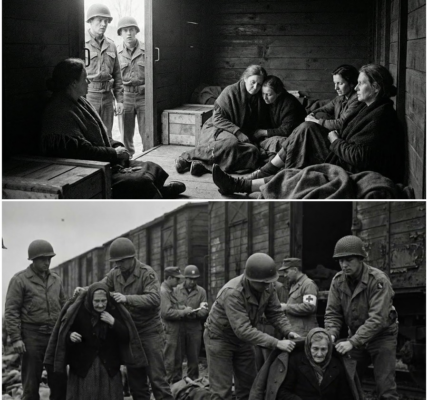
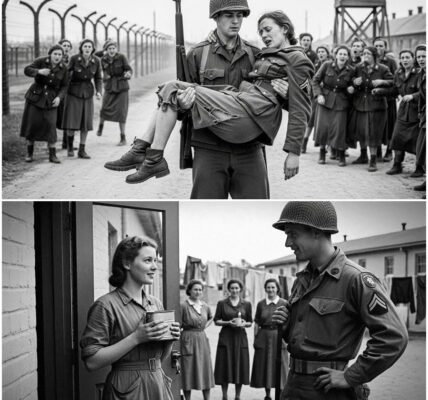
In May 1945, Soviet prisoners of war were among those liberated from German captivity by American forces. For people who had spent years as prisoners, freedom was not an abstract political concept. It meant being able to move without permission, to see beyond a fence, to hear that the war that had imprisoned them was ending.
But liberation did not erase what had happened.
Across Europe, the war had left millions displaced. Cities were damaged or destroyed. Families had been separated. Infrastructure had collapsed. Food shortages and homelessness remained serious problems even after the fighting stopped.
The camera could record the moment of liberation.

It could not record everything that came afterward.
That is why some of the most powerful images from 1945 are not images of battles at all. They are images of people standing, walking, waiting, returning, and trying to understand what the end of the war meant for them.
One photograph from the period shows survivors of Dachau after liberation. The scene is difficult because liberation did not instantly produce calm. The prisoners had endured a system of persecution and imprisonment that had reduced human beings to numbers and denied them basic dignity.
When the camp was liberated on April 29, 1945, the reality of what had taken place there became increasingly visible to the outside world.
The photograph of liberated prisoners beating a camp guard belongs to that violent and chaotic moment. It should not be romanticized. Nor should it be removed from its context.
The image reveals something uncomfortable about the final days of the camp system: liberation did not arrive into an orderly world. It arrived after years of brutality, deprivation, fear and death.
For the prisoners, the word “freedom” carried a meaning that those outside the camps could scarcely understand.

And yet, even after liberation, survival remained uncertain.
The physical and psychological consequences of imprisonment would remain with survivors long after the gates opened.
That is one reason photographs from the end of the war can feel strangely quiet.
There may be no explosion in the frame.
No aircraft overhead.
No battlefield.
Instead, there may be a face.
A person waiting.
A family trying to return home.
A soldier carrying his belongings.
A crowd standing in a railway station.

These ordinary moments contain the aftermath of enormous historical forces.
The same year brought another transformation on the opposite side of the world.
Japan’s surrender in August 1945 brought the Pacific War toward its conclusion. In Los Angeles, children celebrated V-J Day on August 15, the day Japan’s surrender was announced.
For those children, the event may have seemed like a moment of pure celebration.
The adults around them knew there was more to it.
The Pacific war had been extraordinarily destructive. Soldiers and civilians had endured years of fighting, bombing, occupation, hunger and uncertainty. The announcement of surrender meant that the immediate danger was ending, but it also marked the beginning of a difficult transition.
The world had to figure out what came next.

This question appears repeatedly in photographs from the period.
What does a soldier do when there is no longer a battlefield?
What does a prisoner do when the gate opens?
Where does a refugee go when the place called home no longer exists?
How does a family begin again after years of separation?
History books often mark the end of World War II with dates.
Europe: May 1945.
Japan: August 1945.

But human lives do not end chapters on the same day.
For some people, the war continued in memory for decades.
For others, it continued through physical injuries, displacement, grief, poverty, or the struggle to rebuild.
The photographs from 1945 therefore contain a strange mixture of celebration and uncertainty.
One image in the collection describes German women being forced to repave streets in Prague after the war.
The image is uncomfortable precisely because it reminds us that the collapse of Nazi Germany did not erase the consequences of the occupation overnight. Postwar Europe had to confront destruction, responsibility and reconstruction simultaneously.
There were also countless people whose wartime experiences were never captured by famous photographers.

A miner returning home.
A mother waiting for news.
A child seeing a soldier for the first time.
A displaced person registering at a camp.
A family searching through belongings that survived a bombing.
These people rarely appear in the traditional narratives of military history, yet they were the people who had to live with the consequences of military decisions.
The same collection includes an image of French civilians using a carrier cycle after cars had been taken to support the German war effort in 1940.
At first glance, it is simply a picture of an unusual form of transportation.
But photographs like this can reveal the war’s reach into ordinary life.
War does not remain on battlefields.

It changes what people eat.
How they travel.
What they can buy.
What machines they have access to.
Which relatives are present at the dinner table.
Even something as simple as a bicycle can become evidence of an economy transformed by war.
And when the fighting ends, those changes do not disappear immediately.
In Denmark in 1945, another photograph shows German helmets being repurposed into chamber pots.
It is a small and almost strange detail.

But historically, it carries a powerful symbolism.
An object designed for war has been stripped of its original purpose and turned into something associated with everyday domestic life.
The helmet is no longer a piece of military equipment.
It has become an ordinary household object.
The transformation is almost mundane.
And perhaps that is precisely why it is memorable.
The end of war is not only marked by treaties and surrender documents.
It is also visible when the objects of war begin to lose their military meaning.
Weapons are stored away.

Uniforms disappear into cupboards.
Military vehicles become obsolete.
Factories change production.
Cities begin rebuilding.
And people slowly return to routines that had been interrupted for years.
But the war had changed the world too profoundly for everything to simply return to normal.
The collection also contains an image connected to abandoned Japanese chemical weapons discovered in China decades after the war.
Workers were photographed gathering Japanese-manufactured chemical weapons that had been left behind at the end of the conflict.
The image was taken in 1996, more than fifty years after the war had ended.
That distance in time is important.

It demonstrates that the consequences of war can survive long after the people who fought it have disappeared from the battlefield.
A war can end politically while its physical remnants remain.
Unexploded weapons.
Abandoned military equipment.
Ruined buildings.
Contaminated areas.
Memories.
Documents.
Photographs.
And stories passed from one generation to another.
This is one of the most important lessons contained in the photographs.
History does not disappear simply because the calendar moves forward.
Consider the American shipyards of the 1940s.

During World War II, industrial workers became part of the enormous effort required to supply the Allied war machine. Shipyards built cargo ships and other vessels needed to sustain the war.
To someone looking at a photograph decades later, the workers may appear almost ordinary.
But ordinary people were essential to extraordinary events.
A person welding metal.
Another moving equipment.
Someone working long hours in a factory.
Someone repairing machinery.
Someone loading supplies.
None of them necessarily appeared in the great military photographs of the war.
Yet without this industrial effort, armies could not have been supplied across oceans.
The war therefore belonged not only to generals and presidents.

It also belonged to workers.
Farmers.
Nurses.
Engineers.
Drivers.
Clerks.
Factory workers.
Families.
And children who waited for their parents to come home.
The photographs remind us that history is usually larger than the famous people who occupy its pages.
There are images of Winston Churchill, Franklin Roosevelt and other major political figures.
But alongside them are images of anonymous people whose names were never preserved.
That contrast matters.
A photograph of a world leader can tell us about power.
A photograph of an ordinary family can tell us what power did to ordinary life.
During the war, millions of people had little control over the decisions that determined whether they would remain safe.
They lived under governments, armies and occupations whose decisions could reshape their lives overnight.

And when the war ended, they inherited a world that they had not chosen.
This is particularly visible in the story of displaced people.
In 1947, refugees crowded into registration offices at displaced-person camps in Berlin. The war had ended, but people were still trying to determine where they belonged.
For many, returning home was impossible.
Their homes might have been destroyed.
Their communities might have disappeared.
Borders had changed.
Families had been scattered.
Some people had no safe place to return to.
This is why the word “postwar” can be misleading.
It suggests a clean division.
Before the war.
During the war.
After the war.

Human experience was rarely that simple.
For many survivors, the years after 1945 were still years of uncertainty.
And perhaps that is the most important thing these photographs can teach us.
A historical date is precise.
A human recovery is not.
The camera freezes one moment.
Life continues beyond the frame.
That is why the image of children celebrating V-J Day is so powerful when placed beside photographs of refugees and survivors.
One represents relief.
The other represents what relief could not immediately repair.
Both are true.
Both belong to 1945.
And neither cancels the other.
The end of World War II was therefore not simply the conclusion of a military conflict. It was the beginning of a new political and social world.
Europe would be divided by new tensions.
The Soviet Union and the United States would emerge as competing superpowers.
The Cold War would soon shape international politics.
Countries would begin reconsidering colonial systems.
International institutions would be created with the hope of preventing another catastrophe on the same scale.
But the most immediate challenge was more basic.
People needed to rebuild.
They needed homes.
Food.
Work.
Security.
And the chance to live ordinary lives again.
The photographs from the years surrounding 1945 capture the strange moment when the old world was disappearing but the new one had not yet fully arrived.
Soldiers returned.
Prisoners were freed.
Children celebrated.
Factories continued working.
Cities began repairing themselves.
And millions carried memories they would never completely leave behind.
Some images are beautiful.
Some are disturbing.
Some appear almost trivial.
A helmet turned into a household object.
A bicycle replacing a confiscated car.
A railway station filled with returning soldiers.
A child celebrating victory.
A worker standing inside a shipyard.
A refugee waiting to register.
But together, these fragments form something larger.
They show that history is not only made during the moments when leaders sign documents.
History also happens in the days afterward.
It happens when someone walks through a ruined street.
When a family opens a letter.
When a soldier steps off a train.
When a prisoner sees daylight beyond a gate.
When a child realizes that the adults around them are finally smiling.
And sometimes history survives in an image that seems almost too ordinary to matter.
That is why old photographs deserve patience.
The first thing we see is rarely the whole story.
Behind the uniform there may be years of war.
Behind the celebration there may be grief.
Behind the smiling face there may be a journey that the photograph cannot show.
Behind the silence there may be millions of voices.
The photographs do not speak by themselves.
We have to look carefully.
We have to separate what is documented from what we imagine.
And we have to remember that an image can preserve a moment without explaining everything that happened before or after it.
That distinction matters especially when photographs are used to tell the history of war.
A dramatic image can tempt us to invent a story around it.
But the responsibility of historical storytelling is the opposite.
The task is not to make the past more dramatic than it was.
The past was already dramatic enough.
The task is to understand it.
To preserve the facts.
To acknowledge uncertainty where the evidence is uncertain.
And to remember the people who lived through events that, for us, exist mostly as dates and photographs.
In 1945, the world celebrated the end of the deadliest conflict of its time.
But the photographs tell us something that a simple victory announcement cannot.
The war ended.
The people did not suddenly become untouched by it.
They carried it home.
They carried it into rebuilt cities, new political systems, new families and new generations.
Some carried medals.
Some carried photographs.
Some carried grief.
And some carried memories they could never fully explain.
More than half a century later, photographs were still documenting objects left behind by that war.
The passage of time had not erased the physical evidence.
Nor had it erased the responsibility to remember.
Perhaps that is why the most meaningful way to look at these photographs is not simply to ask, “What happened?”
We should also ask, “What remained?”
The answer is visible everywhere.
In the faces of returning soldiers.
In the crowds of refugees.
In the ruins of European cities.
In the factories that had once produced weapons and ships.
In the children celebrating the end of war.
In the abandoned equipment that remained decades later.
And in the quiet lives of people who simply wanted to return to something resembling normality.
World War II ended on paper through surrender, treaties and political decisions.
But for millions of human beings, its final chapter was written much more slowly.
Years passed.
Then decades.
And still, photographs remained.
A frozen second.
A face.
A street.
A train station.
A camp.
A celebration.
A reminder.
Perhaps the deepest lesson is also the simplest: history is not only about how wars are won or lost. It is about what happens to human beings afterward.
When we look at these images today, we are not looking at a distant world completely disconnected from our own.
We are looking at people who woke up, worked, worried, waited, celebrated, mourned and hoped.
They lived through events that seemed impossible while they were happening.
And when the fighting finally stopped, they faced the difficult task of building a future from what remained.
That is the part of history that photographs sometimes reveal most clearly.
The war may have ended.
But the human story continued.
And perhaps that is the question worth carrying with us when we close the album:
When the fighting finally stops, what does it truly take for a generation to begin again?
Some content was generated using AI tools (including ChatGPT) and edited by the author for creativity, storytelling, and historical illustration purposes. Historical facts and key details should be verified against reliable historical sources. Any AI-generated or reconstructed visuals are intended for illustrative purposes and should not be interpreted as original historical photographs or archival evidence.