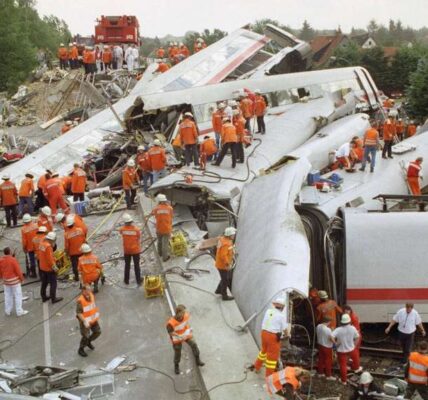
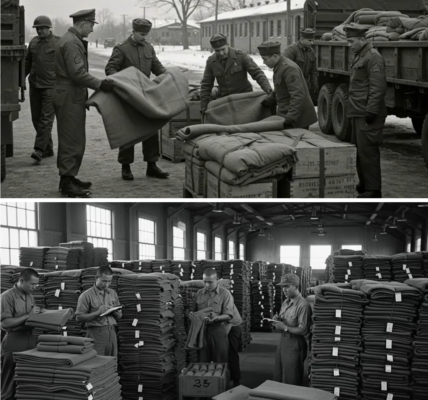
The photograph appeared quietly, almost like a forgotten page pulled from an old archive.
There was no dramatic announcement, no official ceremony, and no explanation for why the image had remained unseen for so long. Only a frame from another era: people caught in ordinary moments, surrounded by circumstances that history would later describe in much larger words—war, censorship, protest, displacement, fear, and survival.
That is what makes rare historical photographs so unsettling. They do not simply show us what happened. They show us what people looked like while it was happening.
For generations, the past has often reached us through carefully selected images: generals standing beside maps, politicians addressing crowds, soldiers marching in formation, leaders shaking hands, cities celebrating victory. Such photographs have enormous historical value. But they are only part of the record.
Behind them existed another history.

It lived in factories, bomb shelters, railway stations, prisons, orphanages, hospitals, streets filled with protesters, and homes where families waited for someone who might never return. Some of those photographs were never published. Others disappeared into private collections, newspaper archives, government storage rooms, or family albums.
And when they eventually resurfaced, they offered something official records could not always provide.
A human face.
The idea of a collection containing photographs that authorities, editors, institutions, or private owners once kept from public view is powerful. But it also demands caution. A photograph being unpublished does not automatically mean it was deliberately “hidden.” Some images were withheld for privacy, security, editorial reasons, technical limitations, or simply because thousands of photographs were produced and only a handful could ever appear in newspapers.
That distinction matters.
Because the real story is not necessarily that someone constructed a vast conspiracy to erase these images.
The deeper story is that historical memory has always been selective.
And sometimes, decades later, an image that seemed insignificant suddenly becomes one of the clearest windows into an age.
Consider the photographs associated with periods of war.

The twentieth century produced images on an unprecedented scale. Cameras followed armies across continents. Photographers documented battlefields, military hospitals, refugee columns, ruined cities, prisoners, factories, and civilians attempting to maintain some resemblance of ordinary life.
But not every photograph was allowed to reach the public.
Military censorship existed for practical reasons. Governments feared that photographs could reveal troop movements, defensive positions, military weaknesses, or information useful to an enemy. Editors also made choices based on what their audiences were permitted—or expected—to see.
As a result, the public image of war could be very different from the experience of those who lived through it.
Official photographs often emphasized determination, courage, sacrifice, and victory.
Other photographs showed exhaustion.
They showed soldiers whose expressions no longer resembled the confident faces of recruitment posters. They showed civilians surrounded by damaged buildings and displaced families carrying what possessions they could save. They showed the uncomfortable spaces between major historical events—the waiting, uncertainty, boredom, fear, and confusion that rarely fit neatly into a newspaper headline.
These images are difficult not because they necessarily contain spectacular scenes, but because they make war personal.
A history book can tell us that a city was bombed.

A photograph can show us the street afterward.
And suddenly the word “bombing” is no longer an abstract event.
It becomes a row of buildings, broken windows, displaced families, and ordinary objects left behind.
Yet even here, photographs require interpretation.
A single frame cannot explain an entire war. It cannot tell us everything that happened before or after the shutter closed. It cannot automatically identify who was responsible, what motivated the people in the frame, or what happened to them later.
This is one of the most important lessons hidden inside collections of rare photographs.
Seeing is not the same as understanding.
The camera records a moment.
History must reconstruct the world surrounding that moment.

That is why archivists and historians spend so much time examining dates, captions, negatives, provenance, photographer records, newspaper files, military documents, personal papers, and other sources. An apparently extraordinary photograph can become far more meaningful when its context is established.
And sometimes the context changes everything.
A photograph of women working in a factory, for example, can initially appear to be a simple picture of wartime labor.
But placed within the broader history of the Second World War, it can reveal the enormous transformation of civilian society.
As millions of men entered military service, women took on roles that had previously been dominated by male workers. They operated machinery, assembled aircraft components, produced ammunition, transported goods, worked in offices, farms, hospitals, and countless other occupations.
The famous image of the wartime female worker became a symbol of this transformation.
But another part of the story came after the war.
As servicemen returned, many women were expected to leave industrial positions and return to more traditional roles.

That transition could easily disappear behind the larger narrative of victory.
Photographs preserve evidence of the change.
They show that wartime society was not simply a story of armies moving across maps. It was also a transformation of work, family life, expectations, and identity.
The camera could therefore preserve changes that political speeches did not always emphasize.
The same is true of photographs depicting minority communities living under segregation and discrimination.
Historical narratives have sometimes reduced such communities to statistics: populations counted, laws recorded, protests documented.
But photographs can restore individuality.
They show people going to work, attending school, gathering with friends, raising children, attending religious services, celebrating important occasions, or simply looking into a camera.
This matters because discrimination does not erase ordinary human life.
People continued to build families, friendships, communities, and hopes even when the societies around them imposed severe restrictions.

A photograph can capture that contradiction in a single frame.
Oppression may define the legal circumstances surrounding a person.
It does not necessarily define the entirety of that person’s life.
Some of the most difficult photographs in historical archives come from institutions.
Mental hospitals.
Orphanages.
Prisons.
These images can reveal conditions that institutions preferred not to display publicly. But again, context is essential.
Institutional photography could serve many purposes. Some photographs were created for medical documentation. Others were produced for administrative records, journalism, reform campaigns, or propaganda. Some were taken by visitors or investigators. Others were kept within institutional archives.

The photograph itself does not tell us why it was created.
That question belongs to the historian.
And sometimes those images became evidence in broader debates about how societies treated vulnerable people.
This is where historical photography becomes more than nostalgia.
An old photograph is not valuable merely because it is old.
It becomes valuable when it allows us to ask better questions.
Who took it?
Why?
Who was the intended audience?
Who was absent?
Who controlled the caption?
Who decided whether it would be published?

And perhaps most importantly:
What does the photograph show that written records failed to preserve?
The journey of an image through history can be almost as fascinating as the image itself.
A negative might sit for decades in a newspaper archive.
A print might remain inside a family album.
A photographer might preserve unpublished material in a private collection.
A box might be moved from one storage room to another until the institution itself changes ownership.
Sometimes photographs survive simply because someone refused to throw them away.
A journalist keeps them.
A relative stores them.
An archivist recognizes their importance.

A collector notices something unusual.
Decades later, someone opens the box.
And the past returns.
The rediscovery of historical photographs has been transformed by digitization.
Images that once required a visit to a physical archive can now be scanned, catalogued, and shared with researchers around the world. Museum collections, libraries, newspapers, universities, and private archives have increasingly made historical material accessible online.
This has changed the relationship between ordinary people and history.
Someone sitting thousands of miles from an archive can now encounter a photograph taken before their grandparents were born.
A researcher can compare images from different collections.
A family can discover photographs of relatives whose stories had almost disappeared.
A forgotten negative can suddenly become part of a global conversation.
But the digital world also introduces a new danger.
Context can disappear faster online than it ever did in a physical archive.
An image is copied.
Its original caption disappears.

A new date is attached.
A dramatic story is added.
The photograph is reposted thousands of times.
Soon, the image may remain authentic while the story surrounding it becomes false.
This is why claims that a photograph was “banned,” “suppressed,” or “hidden from the public” should be examined carefully.
Sometimes the claim is supported by evidence.
Sometimes it is simply a dramatic description added decades later.
And sometimes the truth is more complicated.
Perhaps the image was never censored at all. Perhaps it was simply unpublished.
Perhaps it was available in a local newspaper but never widely circulated.

Perhaps it was kept private because the people pictured had not consented to publication.
Perhaps editors considered it unsuitable for their audience.
Or perhaps nobody at the time realized that future generations would consider the image historically important.
History is full of such accidents.
The photograph that seemed insignificant in 1945 may become invaluable in 2026.
The famous photograph that appeared on every front page may tell us less about everyday life than a forgotten image sitting in a box for seventy years.
That is one reason rare photographs can feel almost uncanny.
They interrupt the version of the past we have become accustomed to seeing.
Instead of famous leaders, we encounter ordinary workers.
Instead of military formations, we see exhausted families.
Instead of official ceremonies, we see people waiting.
Instead of polished public figures, we sometimes see politicians and celebrities between the carefully managed moments that made them famous.

The effect can be surprisingly intimate.
A political leader may appear tired.
A celebrity may look young and uncertain before fame.
A future historical figure may appear completely ordinary.
Someone who would later become famous may be standing in a classroom, walking down a street, or sitting among friends without any indication of what the future holds.
That is perhaps one of photography’s strangest powers.
The camera knows what the people inside the frame do not.
We know what comes next.
They did not.
A photograph of civilians during wartime can therefore carry an emotional weight that has little to do with dramatic composition.
The people in the image might simply be standing together.
But we know that the world around them is changing.
We know that borders will move.
Governments will fall.
Cities will be destroyed and rebuilt.
Millions will be displaced.
Some people will return home.
Others will not.
The photograph freezes the moment before those outcomes become history.
This is especially powerful when looking at photographs from the Second World War.
The war was not experienced as one continuous event by the people who lived through it.
For a civilian, it might have been a sequence of ordinary days interrupted by extraordinary danger.
For a soldier, it could involve long periods of waiting punctuated by moments of intense uncertainty.
For a child, the war might be remembered through sounds, rationing, uniforms, evacuation, school changes, or the absence of a parent.
For a factory worker, it could mean longer hours and unfamiliar responsibilities.
For a refugee, it could mean a road, a train station, a temporary shelter, and the uncertainty of not knowing when—or whether—home would become reachable again.
Rare photographs can preserve fragments of these experiences.
Not the entire story.
Fragments.
And sometimes fragments are enough to make us reconsider what we thought we knew.
One of the most revealing aspects of historical photography is how often extraordinary events coexist with ordinary behavior.
People still laughed.
They still posed for cameras.
Children still played.
Families still celebrated.
Workers still complained about long hours.
Friends still gathered.
People still fell in love.
This does not make the surrounding historical circumstances less serious.
It makes the people more recognizable.
War did not turn human beings into symbols.
They remained human beings.
That distinction is important.
When we study history only through battles, treaties, casualty figures, and political decisions, it is easy to imagine the past as a machine driven by governments and armies.
Photographs remind us that history was also experienced at street level.
The great events of the twentieth century entered kitchens, factories, schools, train stations, hospitals, and family conversations.
They changed what people ate.
Where they worked.
Where they lived.
Who they feared.
Who they trusted.
Whom they missed.
What they hoped would happen next.
A photograph can sometimes reveal this without saying a single word.
And perhaps that is why the most compelling historical images are not always the most dramatic.
A child standing beside a damaged building can say something about war.
A worker looking toward a camera during a strike can say something about labor.
A woman operating machinery can say something about social change.
A family gathered around a table can say something about continuity.
A crowd waiting for news can say something about uncertainty.
None of these images explains history by itself.
But each one adds another piece to the record.
The idea of “100 rare vintage photographs” therefore matters less as a number than as a reminder.
There are countless images of the past still waiting to be properly identified, preserved, and understood.
Some may be hidden in archives.
Others may already be online but incorrectly captioned.
Some may be sitting in private homes.
Others may exist only as deteriorating negatives.
Every year, photographs are lost through neglect, deterioration, poor storage, or simple accidents.
Preservation is therefore not merely about saving pictures.
It is about saving evidence of human experience.
But preservation must be accompanied by responsibility.
An authentic photograph can still be misleading when separated from its context.
A photograph can be real while its caption is false.
A genuine image can be used to support a story that never happened.
A photograph taken in one country can be falsely attributed to another.
A picture from one year can be repeatedly reposted with a different date.
And modern editing technology makes these problems even more complicated.
This is why the rediscovery of historical photography should never be reduced to the thrill of finding something “forbidden.”
The greater value lies in verification.
In asking questions.
In comparing sources.
In resisting the temptation to believe the most dramatic explanation.
The archive does not become more truthful simply because the photograph is rare.
Its value comes from evidence.
And evidence becomes meaningful through context.
There is something quietly powerful about that principle.
History does not need to be exaggerated to be fascinating.
The real past is already strange enough.
People once lived without technologies that now seem indispensable.
They crossed cities by transport systems that have disappeared.
They worked in industries that no longer exist.
They followed fashions that now look extraordinary.
They experienced wars whose consequences still shape international borders and political institutions.
They watched famous figures before those figures became famous.
They stood in places that no longer look the same.
And sometimes, without knowing it, they looked directly into a camera and left us a record of their existence.
That may be the most important thing these photographs preserve.
Not merely events.
People.
When we look at an old photograph, we are not looking at “the past” as some distant, lifeless country.
We are looking at a moment when the past was someone’s present.
The person standing in the frame did not know that decades later a stranger might examine their face.
They did not know that their clothes, workplace, neighborhood, expression, or surroundings might become evidence for future historians.
They were simply living.
And that is why rediscovered photographs can feel so immediate.
They collapse distance.
For a moment, 1905, 1939, 1945, or 1956 no longer feels impossibly far away.
The people become visible.
The world becomes tangible.
The distance between “then” and “now” becomes thinner.
Yet there is another lesson hidden in these photographs.
Not everything that disappears from public memory was deliberately erased.
Sometimes history forgets because there are too many stories.
There are too many photographs.
Too many people.
Too many events competing for attention.
Archives are selections.
Museums are selections.
Newspapers were selections.
Even memory itself is selective.
That means recovering forgotten photographs is not necessarily about exposing a single hidden truth.
It can be about widening the frame.
Adding voices.
Restoring context.
Allowing the historical record to become more complicated—and therefore, perhaps, more honest.
The most valuable photograph may not confirm what we already believe.
It may force us to ask a better question.
Why was this person absent from the story?
Why did this event receive so little attention?
Why was this image never published?
Who made that decision?
Was the reason political, practical, ethical, financial, or simply accidental?
And what else might still be waiting in the archive?
Those questions matter because history is never only what survived in famous textbooks.
It is also what survived in boxes.
In envelopes.
In private albums.
In damaged negatives.
In forgotten newspaper files.
In photographs whose captions were almost lost.
The rediscovery of those images does not give us a perfect window into the past.
Nothing can.
But it can give us another window.
And sometimes another window is enough to change the way we see the entire building.
Perhaps that is why rare vintage photographs continue to fascinate people across generations.
They do not simply show us how different the past was.
They show us how familiar it could be.
The clothes change.
The buildings change.
The technology changes.
The political systems change.
But people remain recognizable.
They worry.
They hope.
They work.
They celebrate.
They protest.
They endure.
They make mistakes.
They love.
They wait for tomorrow.
And sometimes, they leave behind a photograph.
Decades later, someone finds it.
The dust is brushed away.
The image is scanned.
The date is investigated.
The names are identified.
The context is restored.
And suddenly, a moment that nearly disappeared from history becomes visible again.
That is the quiet power of the archive.
Not every forgotten photograph reveals a secret.
Not every unpublished image was censored.
Not every missing record hides a conspiracy.
But every authentic historical photograph has the potential to ask us something.
It asks us to look more carefully.
To doubt easy explanations.
To distinguish evidence from interpretation.
And above all, to remember that the people who appear in old photographs were not characters from a distant world.
They were living through their own present.
We are simply fortunate enough to see it now.
Perhaps the greatest mystery is not why some photographs disappeared.
It is how much of ordinary human experience may still be waiting to be rediscovered.
If another forgotten archive were opened tomorrow, what part of the past would we finally see differently?
Some content was generated using AI tools (including ChatGPT) and edited by the author for creativity, storytelling, and historical illustration purposes. Historical facts and key details should be verified against reliable historical sources. Any AI-generated or reconstructed visuals are intended for illustrative purposes and should not be interpreted as original historical photographs or archival evidence.