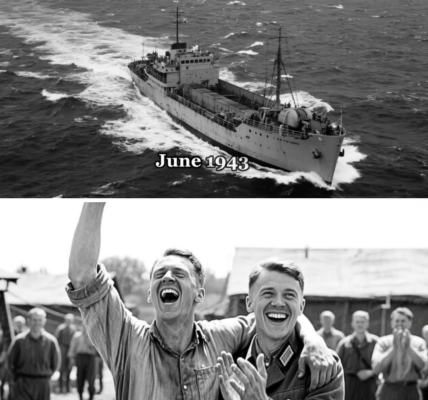
100+ Shocking Historical Photos That Were Hidden From You | Rare & Old Photos Mystery in History – Archaeological Ruins .P2

There are photographs that seem almost too ordinary to carry the weight of history. A child sits beside an object that should never have been touched. Workers stand hundreds of feet above a city. Families rest beside a car. Soldiers prepare to leave for another battlefield. A ruined street stretches into the distance, silent where thousands of people once lived their daily lives. And then there are photographs in which everything changes in an instant: a landing craft approaching Normandy, a city reduced to ruins, children leaving a country at war, or a young girl walking toward a school where she had been told she did not belong. The photograph freezes the moment, but history continues beyond its edges. What happened before the shutter opened? And what happened after the world moved on?
On June 6, 1944, Allied forces came ashore along the coast of Normandy in one of the largest military operations ever undertaken. D-Day was not simply a dramatic morning on a French beach. It was the beginning of the Normandy invasion, part of Operation Overlord, and the opening of the Western Front against Nazi Germany. More than 150,000 Allied troops took part in the landings, supported by thousands of ships and aircraft. The operation had been planned for months, and its success depended on an enormous combination of military organization, intelligence, weather forecasting, naval power, air power and the willingness of ordinary servicemen to move toward fortified beaches under fire.
The famous photographs of that morning show only fragments. Landing craft. Men moving through surf. Smoke hanging over the water. Equipment carried through the waves. Yet the photographs cannot show everything that the soldiers themselves could not know. They did not know exactly how the day would end. They did not know which units would reach their objectives, which friends would survive, or how long the campaign would last.

Even Eisenhower had prepared a statement accepting responsibility in case the invasion failed. That document survives as a reminder that D-Day was not remembered as inevitable by the people who launched it. Before the landings began, failure remained a genuine possibility.
That is what gives the photographs their extraordinary power. They do not merely show victory. They show uncertainty before the outcome was known.
And D-Day was only one chapter in a war that had already transformed entire cities.
In Germany, photographs taken during the final months of the Second World War reveal another side of the conflict. Berlin appears devastated. Buildings stand damaged or hollowed out. Familiar landmarks, including the area around the Brandenburg Gate, are surrounded by destruction. The photographs are almost difficult to reconcile with the image of Berlin that exists today.
Dresden presents an even more haunting example. In February 1945, Allied bombing attacks devastated large parts of the city. Photographs taken afterward from the city hall tower show a landscape of ruins extending across the urban center. The attacks occurred during the final months of the European war, when Germany was already facing military defeat, yet the bombing left destruction on a scale that became one of the most debated episodes of the air war.
A photograph cannot settle every historical argument surrounding such an event. It can, however, show the physical consequence. Streets that had carried people, businesses and ordinary routines became fields of broken buildings.
The same relationship between catastrophe and memory appears much earlier, across the Atlantic.
On April 18, 1906, San Francisco was struck by a devastating earthquake. The ground shook violently in the early morning, but the disaster did not end when the shaking stopped. Broken water and gas mains contributed to fires that spread through the city. The fires burned for days and destroyed more than five hundred blocks. More than half of the city’s population lost their homes.
Photographs of Market Street after the disaster therefore record two disasters at once: the violence of the earthquake and the destruction that followed.
The city was not simply waiting to be rebuilt. People needed food, shelter, communication and order. Army personnel helped establish relief camps, restore communications and coordinate emergency operations. Fort Mason became an important center for relief, while temporary systems were created to reconnect a city whose communication infrastructure had been badly damaged.
Years later, San Francisco would be photographed for very different reasons: skyscrapers, automobiles, modern transportation and the energy of an expanding American city. The contrast is one of the quiet lessons of historical photography. A city can appear permanent in one photograph and vulnerable in another.
The same century that produced enormous destruction also produced extraordinary attempts to move people farther and faster.

In 1904, the first passengers boarded the newly opened New York City subway. The event represented a new stage in urban life, allowing enormous numbers of people to travel beneath the city rather than through its increasingly crowded streets.
Elsewhere, the modern transportation age was taking stranger forms.
The Sikorsky S-40 represented the ambitions of early long-distance air travel. Electric cars were being experimented with decades before modern electric vehicles became common. The Jeantaud automobile of 1898 reflected a period when engineers were still exploring what the automobile might become. The experimental Dynasphere, with its unusual spherical design, looked almost like an object from science fiction. The four-person bicycle suggested that even something as familiar as a bicycle could be redesigned.
Some ideas survived. Others disappeared.
History is filled with inventions that looked promising in their own time but became curiosities afterward.
The same can be said of the early relationship between people and technology. In 1963, television glasses were presented as a futuristic way of bringing a screen closer to the individual. In 1965, Ford experimented with television equipment designed for use inside a car. In 1971, electronic mail introduced a new form of communication that would eventually transform everyday life.
The remarkable thing about the first email is not how primitive the technology now seems. It is how difficult it would have been to imagine where that idea would eventually lead.
The same pattern appears in the 1980 Space Invaders Championship. What once seemed like a novelty of electronic entertainment became part of the history of competitive gaming.
Photographs often capture these moments before anyone understands their full significance.
A worker sketches a symbol in 1970 that would become the familiar recycling symbol. A young engineer may see a design problem. Decades later, millions of people recognize the result without knowing the name of the person who drew it.
History does not always announce its turning points.
Sometimes it looks like a person sitting at a desk.
Sometimes it looks like a machine no one has seen before.
And sometimes it looks like a child.
In 1957, Dorothy Counts walked toward Harding High School in Charlotte, North Carolina, becoming the first Black student to integrate that school. Her first day was marked by hostility and racist harassment. Photographs of her walking toward the school became enduring images of the struggle over school desegregation in the United States.
The importance of the image lies partly in its simplicity. She is walking. Around her are people watching. Yet the ordinary act of entering a school had become a confrontation with the racial order of the time.
The photograph does not need invented dialogue to communicate the tension. The historical context already does that.
The same year, another image captured a completely different kind of confrontation: a young Stephen Hawking with Jane Wilde shortly after their marriage. At that point, Hawking was still near the beginning of the academic career that would later make him one of the most recognizable theoretical physicists of the twentieth century.
The photograph contains none of the fame that would eventually surround him.
It simply shows a young couple at an early point in their lives.
That is another reason old photographs can be so powerful. They often capture people before history knows what they will become.
A similar feeling surrounds a photograph of a teenage Vladimir Putin with friends in Leningrad in the 1960s. Whatever political significance his later life would acquire, the photograph itself belongs to an earlier and much more ordinary moment.

Marilyn Monroe reading James Joyce’s Ulysses in 1954 creates another unexpected image. Salvador Dalí walking with an anteater in 1969 creates another. Julia Child appearing with Fred Rogers in 1974 creates another.
These photographs remind us that historical figures did not live permanently inside the identities assigned to them afterward.
They had ordinary moments.
They experimented.
They worked.
They traveled.
They laughed.
They waited.
And then history gave their photographs meanings that could not have been known at the moment they were taken.
War, however, repeatedly interrupted ordinary life.
During the First World War, the Royal Pavilion in Brighton was transformed into a military hospital. Wounded Indian soldiers were treated there, far from the battlefields of Europe. The building itself had once been associated with royal life and leisure. During wartime, it became a place of treatment and recovery.
That transformation tells us something about the global character of the First World War. Soldiers from across the British Empire were drawn into a conflict that was being fought on multiple continents.
Above the battlefields, another transformation was occurring.
Manfred von Richthofen, known as the Red Baron, became the most famous German flying ace of the war. He was credited with 80 aerial victories, the highest total achieved by a World War I pilot. Yet the mythology surrounding him can sometimes make early aerial combat seem glamorous. The surviving historical record shows something harsher: pilots entered machines whose technology was developing rapidly, fought at close range, and faced lethal risks that could end a career in seconds. Richthofen himself was killed in April 1918.
The image of the Red Baron therefore belongs to two histories at once.
One is the history of aviation.
The other is the history of how war can transform death into legend.
A century later, photographs from other conflicts would repeat the pattern.

In Vietnam, Bob Hope performed for American troops during a Christmas show in 1970. Entertainment was used to provide moments of relief and connection to soldiers far from home. Yet the existence of such performances also reveals the distance between the temporary world created for an audience and the reality of the war surrounding it.
In 1975, Operation Babylift carried Vietnamese children out of South Vietnam during the final weeks of the war. The operation became an important and contested chapter in the history of the conflict and its aftermath. U.S. government records confirm that thousands of Vietnamese children were evacuated, although figures vary depending on which flights, destinations and stages of the evacuation are counted.
Photographs of the children being carried from aircraft can therefore be read on more than one level. They show a humanitarian effort, but they also belong to the chaotic final days of a war and the complicated questions surrounding evacuation, adoption and separation.
The children in those photographs did not choose the war that determined where they would live.
That human detail is easy to lose when history is reduced to dates.
The same is true of another photograph from wartime Europe: a child sitting beside a naval mine washed onto the beach at Deal, Kent, in 1940. Today, the image may appear almost surreal. A child is close to an object associated with danger. But the photograph belongs to a time when military hardware had become part of the physical landscape of civilian life.
War did not always arrive as a distant battlefield.
Sometimes it washed ashore.
Sometimes it passed through a street.
Sometimes it appeared in a hospital.
And sometimes it changed what children were allowed to see.
Other images from the same period reveal how people continued living despite the uncertainty around them.
A woman working in a farmhouse kitchen around 1900.
Children playing beside a fountain in Berlin in 1927.
A family resting in a car near Charleston in 1938.
Workers living in temporary housing near the sugarcane fields of Louisiana.
Sharecroppers resting near their vehicle.
A woman churning butter while reading.
These are not spectacular events. That is precisely why they matter.
Most people do not experience history as a sequence of famous moments. They experience it while cooking, working, traveling, raising children and trying to earn enough money to continue.
The Great Depression made that ordinary struggle visible in new ways.
On October 29, 1929, as the Wall Street crash intensified, Walter Thornton attempted to sell his Chrysler Imperial roadster for only $100. The photograph became an emblematic image of a moment when luxury and financial desperation could appear side by side.
The car was still an impressive object.

Its owner was struggling.
The contrast tells more about economic crisis than either detail would alone.
The same tension appears in the makeshift homes photographed in Peoria in 1938 and in the temporary dwellings of rural workers elsewhere. Economic history is not only about markets, banks and stock prices. It is also about where people sleep.
And while some families struggled, cities continued to grow.
New York’s Times Square in 1912 was already crowded with pedestrians and carriages. Chicago’s State Street in 1895 showed the energy of a rapidly expanding industrial city. Workers constructing the Empire State Building stood high above Manhattan in 1930, performing dangerous work on a structure that would become one of the world’s most recognizable skyscrapers.
One photograph shows an ironworker waving from high above the city.
It is a small gesture.
But beneath him, an entire metropolis is changing.
The Empire State Building would soon symbolize engineering ambition and modernity. Yet the workers who built it faced risks that are easy to forget when the finished structure becomes an icon.
The same contrast appears in the photographs of miners at Serra Pelada in Brazil decades later. The gold mine became famous for the extraordinary scale of manual labor visible in photographs from the 1980s. Thousands of workers and enormous quantities of earth created a landscape almost impossible to recognize as a conventional mine.
Technology changes.
Human labor remains.
In another part of the world, a street scene from Japan in 1950 showed live models in a store window wearing swimsuits. Japan was rebuilding after the devastation of the Second World War, and consumer culture was beginning to reflect a rapidly changing society.
A few years later, crowded beaches would show another side of the postwar transformation: leisure becoming an increasingly important part of modern life.
The twentieth century was not simply an age of war.
It was an age in which societies repeatedly rebuilt themselves.
Berlin had ruins.
Tokyo had reconstruction.
San Francisco had rebuilt.
New York reached upward.
Air travel expanded.
Television entered homes.
Cars became symbols of status and mobility.
Computers and electronic communication began to reshape the future.
And alongside all of this, older traditions survived.
In Niigata, Japan, children wore traditional straw garments during winter celebrations. In England, hop workers used wooden stilts to reach tall plants. In Naples, a street vendor carried musical instruments stacked above his head. In Italy, women continued traditional agricultural labor. In Montana and Louisiana, rural households maintained ways of life that were increasingly distant from the rapidly modernizing cities.
The past was never one single world.
It was many worlds existing at the same time.
A child in Berlin could play beside a fountain while political forces were reshaping Germany.
A shopper could admire new fashions while economic and political tensions were building around them.
A soldier could stand in a parade while ordinary civilians tried to maintain daily life.
A photograph from 1934 showing the headquarters of the Italian Fascist Party with an enormous image of Mussolini captures the political atmosphere of Fascist Italy. The repeated word “yes” around the image was designed to communicate loyalty and support for the regime.
It is important, however, to distinguish the image’s political purpose from the private beliefs of every person who saw it. Propaganda is designed to project unity. The photograph documents that projection; it does not by itself prove that everyone shared the sentiment being displayed.
That distinction matters throughout historical photography.
An image can show what a government wanted people to see.
It can show what a photographer chose to capture.
It can show what survived.
But it cannot automatically tell us everything outside the frame.
The same principle applies to the Soviet-style military parade photographed in Kabul in 1983, staged to commemorate the fifth anniversary of the Saur Revolution. Afghanistan was already caught in a wider Cold War conflict, and the image reflected the political relationship between the Afghan government and the Soviet Union.
The photograph freezes the ceremony.
It does not freeze the conflict.
Beyond the parade were competing political forces, a continuing war and a society being pulled apart by events far larger than any single photograph could contain.
Elsewhere, history was being recorded in quieter ways.
A man carries his mother to vote during India’s first general election in 1951–52. The image belongs to a remarkable democratic transition after independence from British rule. Millions participated in an electoral exercise on an extraordinary scale.
The photograph’s power comes from its intimacy.
A national political milestone is reduced to one person helping another reach the place where she can cast her vote.
That is how large historical processes often become visible: through small human actions.
The twentieth century repeatedly produced these contrasts.
A giant sequoia beside two lumberjacks.
A child beside an enormous machine.
A worker beside a skyscraper.
A family on an unusual bicycle.
A mother pushing a baby carriage.
A crowd playing chess on Broadway.
People window-shopping on a city street.
Cats trying to catch milk as a farmer milks a cow.
None of these photographs appears to announce a turning point.
Yet together they reveal what historians often struggle to describe with statistics alone: what life looked like while the great events were happening.
Then there are photographs that seem to stand outside time altogether.
The Statue of Liberty photographed from its torch.
A worker climbing the monument during maintenance.

Nelson’s Column undergoing its first major cleaning.
Abu Simbel being dismantled and relocated in the 1960s.
The Abu Simbel temples were originally built in ancient Egypt during the reign of Ramses II. In the twentieth century, the construction of the Aswan High Dam threatened the monuments with rising waters. An enormous international preservation effort led to their dismantling and reconstruction at a higher location between 1964 and 1968.
The result is one of the clearest examples of how modern technology could be used not only to build the future, but to preserve the distant past.
The photographs of the relocation show something extraordinary: an ancient monument being carefully taken apart so that it could survive the modern world.
Elsewhere, Howard Carter’s discovery of Tutankhamun’s tomb in 1922 brought ancient Egyptian history into the modern public imagination. The statue of Anubis photographed during the excavation became one of the visual symbols of that discovery.
Again, the photograph captures only one moment.
The object itself had already survived thousands of years.
The camera simply arrived much later.
And perhaps that is the central thread connecting all these images.
History is not only what happened in the moments that textbooks consider important.
It is also what surrounded those moments.
The soldier preparing to board a ship.
The child leaving a country at war.
The worker standing above a city.
The woman preparing food.
The family sleeping beside a car.
The young student walking toward a school.
The engineer drawing a symbol.
The passenger boarding a new form of transportation.
The photographer looking through a camera and deciding, for a fraction of a second, that this particular scene was worth preserving.
Even the strangest photographs carry that same message.
The experimental tank motorcycle from 1939 represents the restless imagination of a world preparing for another war. The enormous military machines and unusual inventions of the period reveal how rapidly technology was being pushed forward.
Some ideas disappeared.
Others became foundations of the modern world.
The twentieth century therefore cannot be reduced to war alone.
But war accelerated change.
It transformed cities.
It displaced populations.
It reshaped borders.
It pushed aviation, medicine, communications and manufacturing forward.
It also left behind ruins, memories and questions that could not be answered simply by declaring one side victorious.
That is why the photographs of Normandy and Dresden belong in the same historical conversation as the photographs of factories, families, hospitals and city streets.
One shows history exploding into view.
The others show the world that people were trying to preserve while it happened.
And sometimes the most haunting image is not the one showing destruction.
It is the one showing normal life immediately before everything changes.
A crowded street.
A family beside a car.
Children playing.
A worker looking toward a colleague.
A passenger stepping aboard a train.
A child holding someone’s hand.
The camera cannot tell us what those people were thinking.
It does not need to.
The surrounding history tells us that they were living inside a world that felt permanent, even though it was already changing.
D-Day reminds us that enormous historical events are made by individual people acting under circumstances they cannot fully control. Dresden reminds us that victory and destruction can exist in the same historical record. San Francisco reminds us that catastrophe can come from nature and then be intensified by human infrastructure. Operation Babylift reminds us that children can become caught inside the final movement of a war they did not create. Dorothy Counts reminds us that social change can begin with something as simple—and as difficult—as walking through a school entrance.
The photographs do not give us permission to invent what happened outside the frame.
They give us a reason to investigate it.
That distinction is important.
A photograph is evidence of a moment, not automatically an explanation of the entire event. The deeper story exists in documents, testimonies, archives, photographs, physical sites and the work of historians who compare sources.
When we look again at these old images, the goal should not be to turn the past into a spectacle.
It should be to see the people inside it.
The wars had generals and presidents.
But they also had soldiers.
The cities had monuments.
But they also had families.
The political movements had leaders.
But ordinary people had to live through their consequences.
And behind every famous photograph is a moment when the future was still unknown.
That may be the most unsettling thing about historical images.
We know what happened next.

The people inside the photograph did not.
Perhaps that is why a single old photograph can sometimes feel more powerful than a page of dates. It gives us a brief encounter with a world before its outcome was decided.
A landing craft approaching Normandy.
A ruined Dresden seen from a tower.
A burned San Francisco street.
A child leaving Vietnam.
A young girl walking toward a school.
A worker standing above Manhattan.
A family resting beside a car.
A scientist at the beginning of his career.
An ancient temple being moved stone by stone.
These are not separate fragments.
Together, they form a record of a century in which humanity repeatedly destroyed, rebuilt, invented, adapted and remembered.
The past is not silent.
It remains in the photographs.
But the photographs only open the door.
The real story begins when we ask what happened before the shutter clicked—and what happened after it closed.
What do these images make you think we still misunderstand about the people who lived through this extraordinary century?
Some content was generated using AI tools (including ChatGPT) and edited by the author for creativity, storytelling, and historical illustration purposes. Historical facts and key details should be verified against reliable historical sources. Any AI-generated or reconstructed visuals are intended for illustrative purposes and should not be interpreted as original historical photographs or archival evidence.