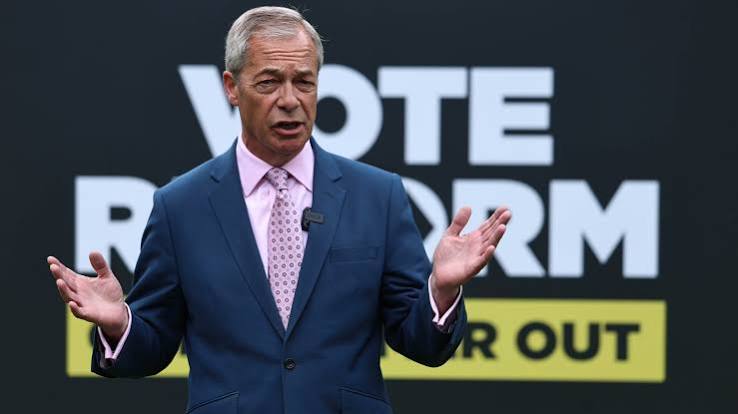
Farage and Four Reform MPs Reject New Foreign Donation Laws in Crucial Vote This Week. n1

Shadow Over Birmingham: The Sting, the Money, and Farage’s Dangerous Defense
Few political operations in modern British history have ridden the currents of financial controversy as aggressively as Reform UK. Propelled by populist anger and an uncanny knack for commanding front pages, the party’s rise has run parallel to escalating scrutiny over its ledger books.
From multi-million-pound injections gifted by cryptocurrency titans—most notably Thailand-based billionaire Christopher Harborne—to swirling inquiries into campaign accounting, Reform’s balance sheet has long resembled that of a high-risk venture fund rather than a traditional political outfit. Under UK electoral law, the rules are supposed to be unambiguous: parties are barred from accepting political donations from foreign nationals or overseas entities. Donations must originate from registered British electors or bona fide UK-operating businesses.
Yet, on the eve of Reform UK’s annual party conference in Birmingham, the boundary between legal fundraising and covert foreign subversion blew wide open.
The Sting: Oysters, Polling, and a Half-Million-Pound Pitch
On Thursday night, Channel 4 News broadcast a devastating, 30-minute investigative report produced in collaboration with Verbatim, an undercover investigative journalism outfit founded by the Centre for Climate Reporting.
Over months of covert surveillance, undercover reporters posed as a wealthy American financier and his UK-based son. Their target: the inner circle of Nigel Farage.
The footage captured interactions that dismantled the party’s public image of clean-hands patriotism:
-
The “Clandestine” Polling: James Orr, Cambridge theologian and Reform’s Head of Policy, and Dan Jukes, Farage’s long-standing media aide and right-hand man, orchestrated an offshore financial conduit. The fake American father covertly financed £32,500 worth of public opinion polling via polling firm J.L. Partners. These polls, which boosted Reform’s narrative on immigration and social cohesion, landed on the front pages of national broadsheets without either the newspapers or the public knowing they were secretly commissioned by Reform and bankrolled by American capital.
-
The Route Around the Law: In private meetings at London’s luxury Claridge’s hotel, Orr was filmed boasting: “The reality is we could easily get away with it if we wanted to.” When discussing whether Nigel Farage knew the source of the funds, Orr whispered: “Nigel doesn’t know and won’t know. It’s the kind of thing he would rather not know.”
-
The £500,000 Conduit: Jukes went further, actively strategizing how the American financier could funnel an illicit £500,000 into party coffers by “washing” the cash through his British-based son—an illegal proxy donation scheme designed to dodge Electoral Commission controls.
-
The Clacton Lunch: Farage himself was filmed dining on oysters and champagne with the undercover operatives in his Clacton constituency. When the fake American patron explicitly told Farage he had “picked up the tab for the polls that you have commissioned,” Farage raised a glass, smiled, and replied: “Great. It worked, boom.” When the illicit donation framework was outlined, Farage was recorded telling the pair: “Thank you both.”
The Fallout: Midnight Resignations and “Pub Talk”
By 2:30 a.m. Friday morning, as panic tore through the party’s high command, Reform released a statement announcing that Dan Jukes and James Orr had stepped down.
Party Chairman Lee Anderson took to the morning airwaves in a damage-control blitz, declaring the pair gone for good. Meanwhile, on the conference floor in Birmingham, Nigel Farage attempted to wave the scandal away with his characteristic bravado, dismissing the recorded conversations as “loose pub talk” and claiming the party was the victim of an elaborate political smear. Reform insisted that its internal compliance teams would have rejected any improper funds and that no illegal money had entered its accounts.
The Metropolitan Police and the Electoral Commission, however, confirmed they were assessing the dossier of undercover footage to determine if criminal conspiracy to bypass donation laws had taken place.
The Commons Division: Voting to Protect the Pipeline
What transformed an acute political scandal into an indelible portrait of hypocrisy was Farage’s parliamentary record just 48 hours earlier.
On Wednesday, the House of Commons returned from its summer recess to vote on the Government’s flagship Representation of the People Bill—legislation explicitly crafted to close foreign loop-holes, outlaw opaque proxy donations, and kick “big money” out of British democracy.
When the division bells chimed, Nigel Farage walked straight into the “No” lobby to vote down the bill.
He did not vote alone. A disciplined phalanx of Reform MPs joined him in attempting to scuttle the integrity bill:
-
Richard Tice (Boston and Skegness)
-
Sarah Pochin (Runcorn and Helsby)
-
Andrew Rosindell (Romford)
-
Danny Kruger (East Wiltshire)
-
James McMurdock (voting alongside his former colleagues despite losing the party whip)
Farage also voted to kill a key Liberal Democrat cross-party amendment demanding the creation of an independent Royal Commission to enforce strict legal caps on party donations and campaign expenditure.
The only clauses Farage and his cohort supported were amendments loosening restrictions on British overseas voters and banning non-English election campaign literature. The pattern was impossible to misread: when it came to curbing the influence of global capital in British elections, Reform stood shoulder-to-shoulder with the checkbooks.
2. Professional Analysis & Personal Perspective
My Professional Perspective: The Architecture of Plausible Deniability
In thirty years of investigative reporting, I have tracked dirty political money from the backrooms of Washington political action committees to off-the-books slush funds in Eastern Europe. The tape broadcast by Channel 4 does not depict an aberration; it exposes the operating system of 21st-century political insurgencies.
The media’s natural impulse is to treat this as a comedic farce: two boastful aides getting tipsy on expense-account wine, talking big to actors, and getting caught with their hands in an imaginary cookie jar. Farage’s team wants you to laugh it off as “pub talk.”
Do not buy it for a second. This was not loose talk. It was a tradecraft demonstration.
What Important Details Have People Overlooked?
While the public fixates on the £500,000 figure, the true smoking gun of the Verbatim sting was the £32,500 polling operation.
Pundits missed that this was not a hypothetical negotiation. A financial transaction actually took place. Foreign money was transferred from an American entity into a British polling company to generate weaponized political data for a UK political party.
Consider the anatomy of this manipulation:
-
The Ghost Operation: Reform did not declare this polling as an in-kind donation to the Electoral Commission.
-
The Media Echo Chamber: The polls were laundered onto the front pages of reputable national broadsheets like The Daily Telegraph and The Times. Readers saw what appeared to be independent, authoritative data showing soaring public anxiety over immigration, completely unaware that the questions had been shaped by Reform strategists and paid for by foreign cash.
-
The Feedback Loop: Those front pages were then used by Farage on television to justify his legislative agenda.
This is information laundering in its purest form. It bypassed electoral limits, escaped the regulator’s notice, misled major newsrooms, and manipulated public discourse—all for the price of a modest family car. As James Orr accurately observed on tape: “The reality is we could easily get away with it.” They did get away with it, until the actors took off their microphones.
What Deeper Meaning Lies Behind This Event?
This scandal strips away the foundational mythology of the contemporary populist right: the claim to be the solitary champion of the “left-behind” working-class against an indifferent, globalist elite.
For years, Nigel Farage has excoriated the establishment for selling out Britain to international technocrats, multinational corporations, and Brussels bureaucrats. He wrapped himself in the Union Jack, promised to “take back control,” and claimed to represent ordinary, salt-of-the-earth taxpayers against predatory elites.
Yet look at where Reform’s lifeblood actually originates:
-
Multi-million-pound cryptocurrency fortunes held in overseas hubs.
-
Silicon Valley-linked ideologues like James Orr, who serve as transatlantic bridges to the radical intellectual circles of Peter Thiel, JD Vance, and Viktor Orbán.
-
A willingness to court anonymous US financiers over champagne and oysters to dodge British election law.
The irony is savage. While telling blue-collar voters in coastal towns that foreigners are the root cause of their economic ruin, Reform’s elite operatives were actively courting foreign capital to buy the megaphones required to sell that very message. It reveals Reform not as an organic, self-sustaining people’s revolt, but as a heavily subsidized, internationalized franchise of the transatlantic hard right.
Why Does This Story Matter?
This story matters because it exposes the fatal toothlessness of British democracy’s regulatory framework.
The United Kingdom likes to lecture the world on good governance. Yet Westminster’s campaign finance architecture is a relic of an analog century, built on an aristocratic honor code: “gentlemen don’t cheat, and if they do, an apology to the Speaker settles it.”
In the modern digital era, that honor system is obsolete. Electoral laws were written before offshore shell corporations, crypto wallets, and cross-border digital consulting became standard tools of political warfare.
When Farage and his fellow Reform MPs voted against the Representation of the People Bill on Wednesday, they were not voting on an abstract principle of free speech. They were voting to protect their own supply lines. They understand that under a strict cap system—where donations are limited to £100,000 or £500,000—a party sustained by mega-checks from crypto billionaires and wealthy individual patrons faces an immediate existential squeeze.
What Questions Remain Unanswered?
As an investigator, the official party statements raise far more questions than they resolve:
-
How many other “off-the-book” projects exist?Dan Jukes was filmed introducing the undercover reporter at a private party function as a “key donor for [an] off-the-book project.” In the language of political intelligence, you do not use the phrase “off-the-book project” if only one exists. How many other polls, digital advertising sweeps, or opposition research files have been financed through third-party intermediaries without Electoral Commission disclosure?
-
What did Farage know, and when did he know it?Orr’s comment that Farage “doesn’t know and won’t know… it’s the kind of thing he would rather not know” is classic institutional insulation. It is the textbook definition of willful blindness designed to give the leader plausible deniability. Did Farage actively seek to remain ignorant of the funding conduits while enjoying the political dividends of the resulting front pages?
-
Will the Metropolitan Police treat this as criminal conspiracy?Attempting or conspiring to evade the controls on political donations is a criminal offense under Section 61 of the Political Parties, Elections and Referendums Act 2000. If ordinary citizens conspired on camera to evade financial laws, an arrest would follow swiftly. Will British law enforcement treat political leaders with equal rigor, or will Westminster’s magnetic field deflect the consequences?
What Audiences Must Understand Beyond the Headline
The public is being urged to focus on whether Dan Jukes and James Orr were “rogue contractors” or whether Farage drank too much champagne.
Look past that distraction.
Look instead at the vote recorded in the Hansard division lobbies on Wednesday night. Look at the names: Farage, Tice, Pochin, Rosindell, Kruger.
Politicians can say whatever they like to a television camera. They can perform outrage, declare their innocence, and blame “activist traps.” But their voting buttons reveal their real commitments. Two days before this sting broke over their heads, when given the legislative opportunity to slam the door shut on dark, foreign, unaccountable money, every single Reform MP voted to leave that door wide open.
They didn’t vote against regulation because they believed British democracy was too clean. They voted against it because they know the machinery they have built cannot survive without the very money the law seeks to ban.
The spectacle in Birmingham this weekend will go down as one of the most surreal chapters in modern British politics. On stage, Nigel Farage will project defiance, leading thunderous applause against the metropolitan elites, the legacy broadcasters, and the political establishment.
Yet behind the curtain, the stench of Claridge’s and Clacton oysters lingers.
The undercover sting by Verbatim was not just an embarrassment of two overzealous aides. It was an X-ray of an entire political ecosystem that preaches national sovereignty while quietly asking overseas financiers to pick up the tab. It demonstrates that in the modern populist playbook, “taking back control” does not mean returning power to the citizen; it means transferring power to whichever multi-millionaire has the capital to purchase the narrative.
As police investigators review the footage and Parliament continues to debate the integrity of our elections, the British public is left to reckon with a foundational rot.
The great tragedy of modern politics is not that politicians can be bought; it is that they have convinced millions of disenfranchised citizens that the transaction is being done in their name.
Which forces every voter, regardless of party, to confront the ultimate question:
When the very people who promise to protect your borders are caught on camera asking foreign millionaires to fund their crusade, who are they really fighting for—the country on the ballot, or the cash behind the curtain?