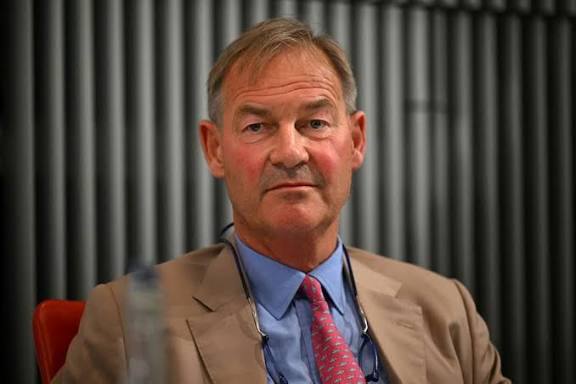
£500,000 Boost for Rupert Lowe’s Restore Britain as Tech Tycoon Makes Major Donation. n1

Capital, Grievance, and the Fringe: How Half a Million Pounds Ignited Westminster’s Right-Wing Turf War
For the past two years, the narrative surrounding insurgent British politics was defined by a single, monolithic juggernaut: Nigel Farage’s Reform UK. From sweeping town halls to dominating national headlines, Farage had largely cornered the anti-establishment revolt. Flush with staggering sums from overseas crypto barons—most notably Christopher Harborne, whose tens of millions drew both awe and intense police scrutiny—Reform appeared unassailable on its flank.
Yet under the surface of the populist revolt, a bitter ideological and personal civil war was brewing. Rupert Lowe, the former Southampton FC chairman and hardline Member of Parliament, found himself increasingly alienated from Farage’s orbit. Accusing Farage of a dictatorial, “messianic” style of leadership, Lowe parted ways with Reform to launch an unapologetically nativist vehicle: Restore Britain.
For months, political commentators relegated Restore Britain to the category of vanity project—a peripheral, underfunded curiosity destined to be swallowed whole by Farage’s formidable PR apparatus.
That complacency vanished in an instant.
The Transaction: Two Checks, Half a Million Pounds
The financial landscape of the British fringe ruptured when Rupert Lowe took to X (formerly Twitter) to announce that Restore Britain had secured its first transformative war chest: £500,000 in cold, hard cash.
The money arrived not from obscure crowdfunding or foreign shell accounts, but from Simon Galbraith, a prominent Cambridge-based technology entrepreneur and investor. Galbraith, who built a fortune after co-founding the enterprise database company Redgate Software—a firm serving over 90% of the Fortune 100 before selling to private equity—funneled the cash via his private investment entity, Cade Hill Investments.
The funding was split into two tranches of £250,000: the first quietly wired in April, followed by a second installment in August.
In an extensive public statement explaining his decision to fund an insurgent party, Galbraith painted a stark, apocalyptic portrait of contemporary the United Kingdom:
“There is a centralised, bloated and incompetent state which is increasingly undemocratic, British institutions are unfocused on what they should be for, and our democracy doesn’t represent the interests and opinions of many.I love my country. I’ve built my businesses here, raised my family here and made my life here. Financially it would make a great deal of sense for me to leave, as many people with my wealth have chosen to do, but I don’t want to. I want to live in Britain, and feel a responsibility to contribute to fixing it.”
Galbraith added that while most Britons can sense national decline, an alternative political force like Restore Britain could unleash a “British renaissance” by systematically dismantling the administrative state.
The Legislative Powder Keg: A System on the Brink
The disclosure of Galbraith’s donation could not have arrived at a more volatile legislative moment. As Westminster returned from its summer recess, the Labour government under Prime Minister Andy Burnham was already grappling with intense public fury over the influence of high-net-worth mega-donors.
Labour’s flagship elections bill—the Representation of the People Bill—had arrived back on the floor of the House of Commons. In its baseline form, the legislation was designed primarily to clamp down on foreign interference by placing strict caps on overseas donations.
However, Galbraith’s half-million-pound injection into a hardline nativist outfit provided immediate ammunition to backbench rebels demanding systemic campaign finance reform.
Leading the charge is veteran Labour MP Stella Creasy, who has formally tabled an aggressive cross-party amendment (NC120). Creasy’s amendment seeks to outlaw mega-donations entirely, regardless of where the money originates:
-
An immediate, hard statutory cap of £500,000 on all political donations.
-
A planned reduction of that ceiling to £100,000 in year two.
-
A binding mandate forcing the Government to implement an enduring, permanent ceiling on domestic political contributions thereafter.
With Restore Britain suddenly armed with institutional capital and Reform UK reliant on offshore crypto fortunes, the battle over British democracy has ceased to be an academic debate. It is now an open legislative war over who owns British politics.
2. Professional Analysis & Personal Perspective
I have spent three decades standing in press scrums across Washington, London, and Canberra, watching how political machines digest money. When an editor looks at this story, they see an open-and-shut campaign finance item: rich businessman writes check to former football chairman, prompts row in Parliament.
That reading is superficial. It misses the seismic structural shift taking place beneath the floorboards of British governance.
What we are witnessing with Simon Galbraith’s £500,000 check is not merely another entry in the Electoral Commission’s disclosure database. It represents the crossing of a dangerous Rubicon: the quiet migration of domestic, respectable tech capital into radical, explicitly nativist political projects.
For years, the British political establishment comforted itself with a comforting myth. The assumption was that hardline nativism—the type of politics that openly questions the citizenship of minorities and demands mass deportations—was an impoverished, fringe phenomenon. It was perceived as the preserve of angry pub backrooms, algorithmic echo chambers, or eccentric offshore financiers living in tax havens like Christopher Harborne.
Simon Galbraith shatters that consensus entirely.
What Important Details Have People Overlooked?
If you want to understand the true significance of this donation, you must look at who Simon Galbraith actually is—and where his money used to go.
The press has focused heavily on the size of the check. But the critical investigative detail is Galbraith’s political trajectory. He is not an unhinged political extremist lurking in an internet swamp. He holds a doctorate in physics from the University of Cambridge. He spent two decades building Redgate Software into a widely respected, blue-chip pillar of the Silicon Fen tech cluster.
Even more astonishing is his paper trail: as recently as 2019, Galbraith was a repeat donor to the Liberal Democrats—the ultimate avatar of Europhile, centrist, metropolitan moderation.
How does an elite-educated Cambridge technologist go from funding the quintessential party of polite, suburban liberalism to underwriting Rupert Lowe’s Restore Britain—an outfit whose spokespeople have argued on national television that people without “indigenous British ancestry” cannot be truly British?
The answer exposes an intellectual rot quietly spreading through sectors of the Anglo-American tech elite:
-
The Silicon Valley Libertarian-to-Nativist Pipeline: Galbraith’s statement echoes the precise ideological grammar pioneered by tech figures like Peter Thiel and Elon Musk. It merges legitimate complaints about state bureaucracy, planning paralysis, and institutional sclerosis with hard-right nationalism. In their view, if the administrative state cannot be reformed through conventional democratic consensus, it must be shattered from the outside.
-
The “Taxpayer Shield”: Galbraith went out of his way to emphasize that he is an active “British taxpayer” spending money earned from a domestic business sale. This was an intentional swipe at Reform UK’s reliance on foreign and crypto-backed cash. Galbraith is presenting himself as the “patriotic oligarch”—a domestic industrialist using his private fortune to rescue a crumbling homeland.
-
The Scale of the Leverage: In British politics, £500,000 is immense leverage. In the United States, half a million dollars barely buys a competitive digital ad campaign in an Ohio congressional district. In the UK, where party running costs are modest, £500,000 almost matches the largest single private donation the governing Labour Party received all year. It is more than the Green Party’s entire declared national budget last year. With that single check, Galbraith did not merely help Lowe; he purchased an entire ground game for an insurgent party.
What Deeper Meaning Lies Behind This Event?
Beyond the personalities of Lowe, Farage, and Galbraith lies a profound systemic truth: the British right is undergoing the same radical balkanization that tore the American Republican Party apart a decade ago.
For forty years, the British Conservative Party maintained a ruthless monopoly over right-of-centre politics. That monopoly was broken by Brexit and finished off by the rise of Reform UK. But now, the insurgency itself is splintering.
Restore Britain is not competing with Labour or the Liberal Democrats; it is engaged in an aggressive takeover bid for Reform UK’s base.
Rupert Lowe recognized Farage’s fatal vulnerability: in his quest to appear credible and capture disillusioned moderate Tories, Farage has had to professionalize, purge overt extremists, and temper his rhetoric. Lowe is deliberately outflanking Farage to the right—proposing bans on the burqa, an end to halal and kosher slaughter, referendums on the death penalty, and the mass deportation of millions.
By securing serious private funding, Lowe has proven that there is a viable domestic donor base eager to finance politics far beyond the boundaries of traditional conservatism. This creates a vicious reactionary cycle: to prevent Lowe from bleeding off his activist base, Farage is forced to drag Reform’s policies further to the extreme (such as recently prioritizing housing exclusively for the “British-born”). The Overton window doesn’t just nudge rightward; it gets shoved off a cliff.
Why Does This Story Matter Beyond the UK?
If you are looking at this from Washington, Sydney, or Toronto, this is not an isolated dispatch from a rain-soaked island. It is an early-warning radar signal for every Western democracy.
We are entering an era of hyper-individualized political venture capital.
Historically, funding fringe political movements was difficult. It required physical union halls, sprawling community networks, or institutional party machines. Today, the combination of algorithmic outrage engines—like X, where Rupert Lowe personally netted over £100,000 just for generating viral engagement—and single wealthy patrons can conjure an entire political party out of thin air within six months.
When a multi-millionaire decides that the state has failed, they no longer need to lobby an established party. They can simply buy their own party, run targeted digital operations, capture 8% to 10% of the vote in a regional mayoral race—as Restore did in Greater Manchester—and throw the entire constitutional order into chaos.
This is the privatization of the democratic process. It bypasses grassroots membership in favor of checkbook-fueled grievance.
What Questions Remain Unanswered?
As an investigative reporter, when the press releases stop, the real questions begin:
-
How deep does Galbraith’s checkbook go?Galbraith’s statement explicitly described the £500,000 as “starting with two separate donations”. If this was merely the opening salvo, is Cade Hill Investments prepared to underwrite a full slate of parliamentary candidates at the next general election? If so, Restore Britain ceases to be a fringe curiosity and becomes a permanent disruptor capable of splitting the right-wing vote in dozens of marginal constituencies.
-
Will Andy Burnham’s government dare to pass the Creasy Amendment?Stella Creasy’s proposed £500,000 cap is a direct test of the Labour government’s integrity. While Burnham’s ministers publicly decry right-wing dark money, the governing party is quietly reliant on its own mega-donors—figures like Lord David Sainsbury and Gary Lubner, who regularly cut six-figure checks. Will Burnham whip his MPs to kill Creasy’s amendment to protect his party’s fundraising, even if it leaves the door wide open for tech tycoons to bankroll the hard right?
-
What is the commercial fallout in Cambridge?The UK tech ecosystem has long prided itself on being globalist, immigrant-reliant, and proudly cosmopolitan. Galbraith built his fortune on the backs of brilliant international software engineers. Already, whispers are circulating within Cambridge venture circles that Galbraith’s name is becoming toxic. Will the founders and start-ups that rely on Cade Hill capital push back, or will the tech industry quietly look the other way as long as the money clears?
The story of Simon Galbraith’s £500,000 donation to Rupert Lowe is not a simple chronicle of party funding. It is a stark diagnostic report on the health of British democracy.
It reveals a political system so hollowed out, so starved of public trust, and so financially deregulated that a single wealthy investor, armed with a grievance and a private equity payout, can reshape the national conversation over a summer recess.
Rupert Lowe now possesses the resources to build a formidable nativist apparatus. Nigel Farage is being forced to radicalize his own platform to survive the assault on his right flank. And the Labour government in Downing Street sits paralyzed, caught between its lofty rhetoric about clean politics and its own addiction to elite donor wealth.
As Parliament debates the future of our elections this month, the debate must go far beyond legal technicalities and foreign disclosure filings. We are being forced to confront a foundational question about self-governance:
When a nation’s political identity can be bought, weaponized, and radicalized by the highest bidder at will, do we still have a democracy—or are we simply living inside an auction house where the anger of the public is traded as a commodity?