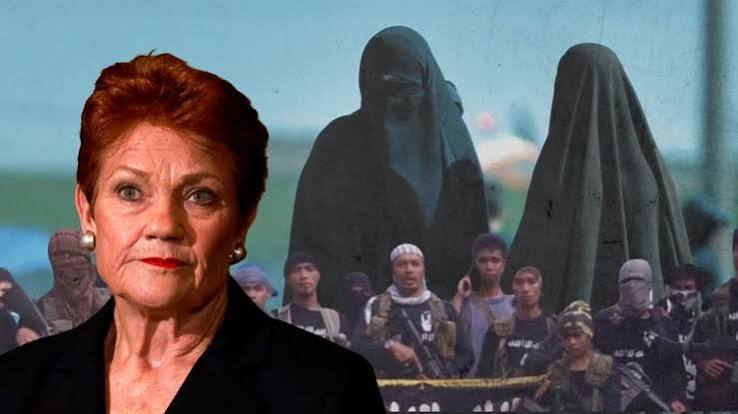
Pauline Hanson writes the bill banning ISIS fighters for good as Burke admits the door is open. u1

The Constitutional Siege: Inside the Race to Lock Australia’s Front Door
In the high-security cells of an Iraqi prison near Baghdad, the sentence clocks on thirteen Australian citizens are quietly winding down. Among them, according to investigative reporting by The Australian, is Tareq Kamleh—the notorious Adelaide-trained doctor who once served as the public medical face of Islamic State propaganda videos and was long presumed dead in the ruins of Raqqa.
Half a world away on the Australian mainland, the legal echoes of the Syrian conflict have returned to suburban courtrooms. Accused “ISIS brides” Kawsar Abbas and Rayann El Houli walk under strict bail conditions, their matters still unresolved before the bench. In Canberra, Home Affairs Minister Tony Burke conceded what security analysts have privately known for months: under existing statutory frameworks, the executive branch may ultimately be powerless to prevent the return of radicalized Australian citizens once foreign detention gates swing open.
Into this legal vacuum stepped One Nation leader Pauline Hanson.
Circulating a 22-page private member’s bill—the Protecting Australians from Foreign Terrorist Fighters Bill 2026—alongside a 17-page explanatory memorandum directly to parliamentary crossbenchers, Senator Hanson has forced a sudden showdown ahead of Parliament’s return on August 11.
The bill does not merely attempt to block the return of foreign fighters; it exposes a decade-long failure by both Coalition and Labor governments to construct counter-terrorism laws capable of surviving the unyielding scrutiny of the High Court of Australia.
With the nation still reeling seven months after the December 14 Bondi Beach attack—where a father and son allegedly killed 15 people in Australia’s deadliest domestic terrorist event—the fight over foreign fighter returnees has evolved from an academic debate on constitutional law into an urgent test of national security.
1. The News Story: The 22-Page Gambit and the Decade of Deadlock
To understand why the proposed legislation has triggered an immediate response across Canberra, one must examine the specific mechanics of Hanson’s bill, the sudden counter-mobilization from the Coalition, and the landmark High Court rulings that dismantled a decade of counter-terrorism laws.
       ┌─────────────────────────────────────────────────────────────┐
       │             THE CONSTITUTIONAL BLOCKADE (CHAPTER III)       │
       └──────────────────────────────┬──────────────────────────────┘
                                      │
          ┌───────────────────────────┼───────────────────────────┐
          ▼                           ▼                           ▼
 ┌─────────────────┐         ┌─────────────────┐         ┌─────────────────┐
 │ 2015 & 2020     │         │ High Court      │         │ Hanson 2026     │
 │ Executive Laws  │         │ Precedents      │         │ Judicial Model  │
 ├─────────────────┤         ├─────────────────┤         ├─────────────────┤
 │• Abbott/Morrison│         │• Alexander      │         │• Federal Court  │
 │  ministers      │         │  (2022)       │  exclusion order│
 │  strip status   │         │• Benbrika       │• 2-year limits  │
 │• Struck down    │         │  (2023)       │• Strict bail    │
 │  as punitive    │         │• "Only courts   │  safeguards     │
 │  by High Court  │         │   can punish"   │• Protects Border│
 └─────────────────┘         └─────────────────┘         └─────────────────┘
What Hanson’s Bill Actually Does
Drafted to circumvent the legal flaws that torpedoed previous iterations, the 22-page bill amends four major commonwealth statutes—the Counter-Terrorism (Temporary Exclusion Orders) Act, the Crimes Act, the Australian Passports Act, and the Criminal Code.
The legislation is anchored by five primary operational mechanisms:
-
Federal Court Exclusion Orders: Rather than empowering the Home Affairs Minister to unilaterally ban a citizen, the Minister must apply to the Federal Court of Australia. The court can issue an exclusion order lasting up to two years if it finds the individual voluntarily served, participated in, or materially supported a listed terrorist organization, poses an unacceptable risk, and cannot be managed by less restrictive measures.
-
Suspension of Return Permits: The statutory obligation requiring the Minister to issue or consider return permits is suspended while the Federal Court evaluates the application.
-
Overhauled Bail Thresholds: National security and community safety are elevated to the paramount considerations in terrorism proceedings. Personal factors such as childcare duties, family circumstances, accommodation availability, or electronic monitoring conditions “would not, by themselves, amount to exceptional circumstances justifying bail.”
-
Targeted Passport Powers: The Minister is granted statutory power to refuse, cancel, or suspend Australian passports for any individual subject to an exclusion order, or who has been charged with or convicted of a terrorism offense.
-
Criminalization of Facilitated Entry: A new federal offense carrying up to 10 years’ imprisonment is established for any person or entity organizing or facilitating an unauthorized return without Commonwealth executive approval.
According to the explanatory memorandum, the scheme is designed to operate within existing intelligence and judicial budgets, requiring fresh evidentiary applications and updated intelligence assessments every two years to maintain an exclusion order.
+------------------------------------+------------------------------------+
| Statutory Mechanism                | Core Legal Function & Constraint   |
+------------------------------------+------------------------------------+
| Federal Court Exclusion Order      | Prevents return for up to 2 years; |
|                                    | requires judicial determination    |
+------------------------------------+------------------------------------+
| Suspended Return Permits           | Eliminates ministerial obligation  |
|                                    | to facilitate immediate repatriation|
+------------------------------------+------------------------------------+
| Hardened Bail Restrictions         | Prevents release based solely on   |
|                                    | family/monitoring conditions       |
+------------------------------------+------------------------------------+
| Facilitation Penalty (10 Years)    | Penalizes unauthorized logistical  |
|                                    | or activist-led return networks  |
+------------------------------------+------------------------------------+
The Political Duel: Hanson vs. Angus Taylor
On July 23, Senator Hanson formally approached Opposition Leader Angus Taylor, offering One Nation’s voting bloc in the Senate and House of Representatives for any constitutionally sound legislation. Taylor’s delayed response arrived only after Hanson forwarded her drafted bill directly to the crossbench, accompanied by a pointed covering note noting the Opposition’s hesitation.
While the Coalition moved to strengthen its own June counter-terrorism proposal ahead of the August 11 parliamentary sitting, Hanson dismissed the Coalition’s draft as insufficient, arguing that any legislation failing to definitively bar ISIS-linked individuals from setting foot on Australian soil leaves the central national security vulnerability wide open.
A Decade of Constitutional Failures: The Breakdown
The history of Australia’s attempts to bar extremists from returning reveals a pattern of legislative overreach followed by judicial invalidation:
+----------------------------------------------------------------------------------------------------+
| DECADE OF DEADLOCK: HOW SUCCESSIVE GOVERNMENTS HIT THE CONSTITUTIONAL CEILING                       |
+--------------------------+------------------------------------+------------------------------------+
| Administration / Date    | Policy Mechanism Enacted           | Why It Failed in the High Court    |
+--------------------------+------------------------------------+------------------------------------+
| The High Court Mandate   | Upholds Chapter III of the         | The Court's job is to enforce the  |
|                          | Australian Constitution.           | principle that only independent    |
|                          |                                    | judges can inflict punishment.     |
+--------------------------+------------------------------------+------------------------------------+
| Abbott Government (2015) | Automatic citizenship cessation    | Struck down in *Alexander (2022)*: |
|                          | provisions for dual citizens       | Executive cannot unilaterally      |
|                          | linked to offshore terrorism.      | impose the punishment of exile.   |
+--------------------------+------------------------------------+------------------------------------+
| Morrison Gov. (2020)     | Ministerial discretion to strip    | Struck down 6-1 in *Benbrika       |
|                          | citizenship post-conviction        | (2023)*: Minister cannot impose    |
|                          | (used by Dutton against Benbrika). | secondary criminal punishment.    |
+--------------------------+------------------------------------+------------------------------------+
| Labor Opposition Era     | Voted in favor of both Coalition   | Co-owned the flawed statutory      |
|                          | citizenship-stripping bills.       | architecture without fixing flaws. |
+--------------------------+------------------------------------+------------------------------------+
| Albanese Gov. (2023)     | Passed court-ordered citizenship   | Law is constitutional, but only    |
|                          | stripping at time of sentencing.   | applies at sentencing; cannot reach|
|                          |                                    | past convicts like Benbrika.      |
+--------------------------+------------------------------------+------------------------------------+
| Labor Administration     | Abdul Nacer Benbrika's post-       | The final supervisory order        |
| (November 2025)          | sentence supervision order expired.| lapsed without a public renewal    |
|                          |                                    | application on the court record.   |
+--------------------------+------------------------------------+------------------------------------+
2. My Professional Perspective
===============================================================================
                    INVESTIGATIVE DISPATCH: BEYOND THE HEADLINE
                     Observations from 30 Years on the Beat
===============================================================================
Over thirty years of reporting from conflict frontlines in the Middle East and the appellate courts of common-law democracies, I have seen a recurring vulnerability in counter-terrorism strategy: the dangerous gap between what politicians promise at a press conference and what a written constitution actually permits.
For ten years, Canberra played political theater with national security. Both major parties knew that Section 51 and Chapter III of the Australian Constitution reserve punitive powers strictly for the judiciary. Yet, successive prime ministers passed ministerial-stripping laws because it generated decisive headlines. When the High Court inevitably struck down those laws in Alexander and Benbrika, the public was left with the worst possible outcome: no citizenship stripped, no durable exclusion mechanism, and no strategic plan for the day foreign prison gates opened.
       ┌─────────────────────────────────────────────────────────────┐
       │             THE "POLITICAL HEADLINE" VS. REALITY CYCLE      │
       └──────────────────────────────┬──────────────────────────────┘
                                      ▼
                      Government Passes Ministerial Ban
                                      ▼
             ┌────────────────────────┴────────────────────────┐
             ▼                                                 ▼
   Public Perception:                               High Court Reality:
   "The borders are locked;                         "The executive has usurped
    the terrorists are banished."                    judicial power. Struck down."
             │                                                 │
             └────────────────────────┬────────────────────────┘
                                      ▼
                       Sudden Operational Exposure
                                      ▼
                   Foreign Fighters Eligible for Repatriation
The Judicial Pivot: Hanson’s Uncomfortable Accuracy
Whatever one’s political views on One Nation, an objective legal analysis of the Protecting Australians from Foreign Terrorist Fighters Bill 2026 reveals that its drafters learned from the Coalition’s constitutional mistakes.
By placing the power to exclude firmly in the hands of the Federal Court rather than the Home Affairs Minister, the bill directly respects the Lim principle and the precedents set in Alexander v Minister for Home Affairs:
-
It treats temporary exclusion not as permanent administrative banishment, but as an ongoing judicial risk-management order subject to sunset clauses and two-year evidentiary reviews.
-
It closes the legal loophole where a minister is administratively forced to issue return permits to citizens stranded abroad.
However, this approach introduces a different challenge: The Two-Year Rolling Clock. A system relying on biennial court reviews requires intelligence agencies like ASIO and the Australian Federal Police to continually present fresh, uncompromised, courtroom-grade evidence regarding activities in unstable jurisdictions like Syria and Iraq.
+------------------------------------+------------------------------------+
| The Executive Stripping Myth       | The Hanson Judicial Mechanism      |
+------------------------------------+------------------------------------+
| Minister signs a paper order;      | Federal Court assesses operational |
| permanent, immediate banishment.   | evidence; temporary 2-year order.  |
+------------------------------------+------------------------------------+
| Struck down by High Court as an    | Built to withstand Chapter III     |
| unconstitutional executive penalty.| judicial separation of powers.   |
+------------------------------------+------------------------------------+
| Zero evidentiary standard required | Requires fresh, continuous court-  |
| inside a public court of law.      | admissible intelligence updates.   |
+------------------------------------+------------------------------------+
The Ultimate Fix: The Referendum Question
What remains unaddressed in the parliamentary sparring between Labor, the Coalition, and One Nation is the constitutional ceiling itself.
Exclusion orders are a holding action. They keep a suspect outside the physical borders, but they do not alter the legal status of an Australian passport holder. Because the High Court established that citizenship is a constitutional relationship that cannot be severed by executive decree, foreign fighters remain Australian citizens under international and domestic law.
To permanently close the loop and grant an executive the power to denationalize individuals who take up arms with foreign terrorist organizations, Australia would need to amend its Constitution via a Section 128 referendum.
With only eight out of forty-five referendums succeeding in the nation’s history, neither Labor nor the Coalition has shown the political appetite to take that question to the public. As a result, the Parliament is forced to operate in the gray zone of rolling judicial orders.
Unanswered Questions for Canberra
As Parliament prepares for the August 11 sitting, several crucial questions require public clarity:
-
The Repatriation Pipeline: If Tareq Kamleh and the twelve other Australian fighters in Baghdad complete their local sentences, what immediate legal mechanism will the Commonwealth use if Hanson’s bill is delayed or rejected?
-
Evidentiary Integrity: How will federal prosecutors satisfy the Federal Court’s strict rules of evidence using battlefield intelligence obtained from Syrian democratic forces, Kurdish militias, or foreign security agencies?
-
The Supervision Deficit: Why was convicted terrorist Abdul Nacer Benbrika’s supervision order permitted to expire in November 2025 without a transparent, public application for extended civil restrictions?
The return of ISIS-linked fighters is no longer a theoretical national security scenario. With sentences expiring across the Middle East and legal proceedings underway in domestic courts, the Commonwealth faces an urgent constitutional and operational reckoning.
The decade-long habit of passing performative laws designed for political consumption rather than constitutional endurance has left Australia vulnerable. Locking the front door requires structural legal craftsmanship, not partisan talking points.
If the Commonwealth is to protect its citizens while upholding the rule of law, it must choose between two real paths:
-
Pass constitutionally compliant judicial exclusion frameworks that give the Federal Court the tools to manage high-risk individuals on an evidence-based, rolling basis.
-
Hold a national referendum to explicitly grant Parliament the constitutional authority to strip the citizenship of those who take up arms against the nation.
Until the major parties confront this constitutional reality, the gap between the Baghdad prison gates and the Australian border remains precariously open.
When a citizen takes up arms with a foreign terrorist group against Western democracies, should their exclusion depend on rolling court orders—or is it time for Australia to put the question of citizenship stripping directly to the people in a constitutional referendum?