
Anatomy of a Fracture: Inside Britain’s Volatile New Security Climate
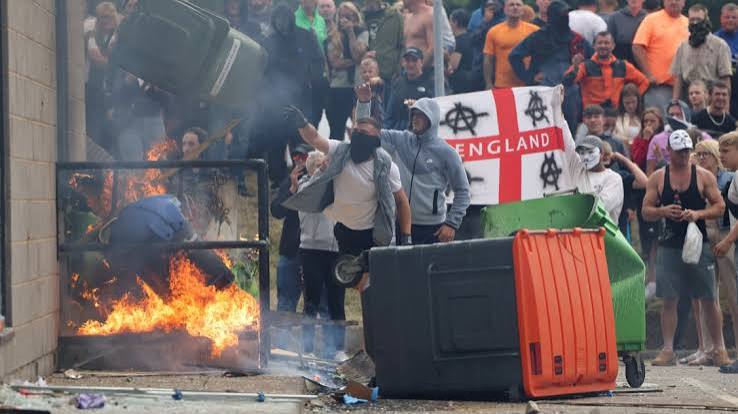
The rain had just begun to slicken the pavement outside Glasgow Green late on a humid July afternoon when the shouting curdled into something far more dangerous. Within minutes, what was billed as a political demonstration dissolved into running street skirmishes across the city center. Weapons were drawn; fifteen people were taken away in handcuffs; sirens cut through the evening air.
Just weeks earlier in Belfast, the pattern had played out with even greater ferocity following a violent knife attack: petrol bombs arched through the twilight, emergency crews dodged masonry, and by the time detectives finished tallying the wreckage, 35 suspects were in custody facing severe charges including arson with intent to endanger life and attempted murder.
To walk the streets of modern Britain today is to feel an unmistakable, low-frequency hum of civic anxiety. Across encrypted Telegram channels, private WhatsApp groups, and algorithmic feeds on mainstream platforms, apocalyptic warnings circulate with relentless momentum. Anonymous voices claim that a coordinated, dissident-led wave of nationwide riots is about to break across the British Isles.
Yet, when strip-searched for operational intelligence, these sweeping predictions of inevitable nationwide revolt lack verified evidentiary backing. No credible Whitehall briefing or senior police commander has declared that Britain is condemned to collapse into systemic civil war.
What the evidence does reveal, however, is a country whose social fabric and operational security apparatus are being stretched across a dangerous threshold. Britain has entered an era where political polarization, algorithmic radicalization, ideological fragmentation, and geopolitical sabotage have converged to form an exceptionally dry bed of tinder—waiting only for the next sudden spark.
1. The News Story: Anatomy of an Escalating Threat
To understand why British security officials are treating public order with unprecedented urgency, one must look at the hard data, the escalating intelligence assessments, and the series of localized flashpoints that have ignited across the United Kingdom.
       ┌─────────────────────────────────────────────────────────────┐
       │   UK TERRORISM THREAT LEVEL: SEVERE ("Highly Likely")       │
       └──────────────────────────────┬──────────────────────────────┘
                                      │
          ┌───────────────────────────┼───────────────────────────┐
          ▼                           ▼                           ▼
 ┌─────────────────┐         ┌─────────────────┐         ┌─────────────────┐
 │ Ideological     │         │ Digital & State │         │ Socio-Economic  │
 │ Fragmentation   │         │ Interference    │         │ Stressors       │
 ├─────────────────┤         ├─────────────────┤         ├─────────────────┤
 │• Unaligned mix  │         │• Algorithmic rage│         │• NHS pressure   │
 │• Far-right hub  │         │• Hostile states │         │• Housing crunch │
 │• Islamist threat│         │  (IRGC, GRU)    │         │• Asylum disputes│
 └─────────────────┘         └─────────────────┘         └─────────────────┘
The Intelligence Landscape: Threat Level “Severe”
At the apex of Britain’s national security infrastructure sits the Joint Terrorism Analysis Centre (JTAC). JTAC maintains the UK’s national terrorism threat level at SEVERE—a classification indicating that an attack remains “highly likely.” The threat was formally escalated from Substantial following high-profile violent incidents, including the Golders Green stabbing, alongside a measurable surge in intelligence traffic linked to both extreme-right-wing terrorism and Islamist extremism.
Security chiefs are careful to emphasize that counter-terrorism matrices are not identical to riot forecasting. Mass civil unrest, opportunistic street disorder, lawful democratic protest, and targeted acts of ideological terror represent legally distinct behaviors. Nevertheless, the elevated threat posture reflects a shared, destabilizing reality: the UK security ecosystem is dealing with an unprecedentedly complex, multi-vectored operating environment.
+-------------------+---------------------+---------------------------------------------+
| Location / Entity | Key Incident Date   | Documented Impact / Operational Response    |
+-------------------+---------------------+---------------------------------------------+
| Belfast, NI       | June – July         | 35 arrests; attempted murder & arson charges|
| Glasgow Green     | July 25             | 1,700 demonstrators; 15 arrests; weapons    |
| Border Force / HO | May (Unite Kingdom) | 11 foreign far-right agitators barred entry |
| Security Registry | July                | IRGC, GRU Volunteer Corps formally designated|
+-------------------+---------------------+---------------------------------------------+
Flashpoints on the Ground: Belfast and Glasgow
The operational strain on policing has manifested in sharp, violent outbursts:
-
The Belfast Riots: Sparked by a knife attack, disorder swept neighborhoods in June and early July. Communications regulator Ofcom issued urgent formal warnings to major social media companies regarding the weaponization of their platforms to organize violence, spread hate, and coordinate property destruction. Police later presented evidence to Parliament detailing 35 arrests and charges including attempted murder.
-
The Glasgow Standoff: On July 25, an estimated 1,700 individuals assembled at Glasgow Green. The gathering fractured into splinter factions that clashed in central corridors, leading to 15 arrests and the recovery of multiple concealed weapons.
-
The “Unite the Kingdom” Mobilization: Ahead of a major national demonstration in May, the Home Office took the extraordinary step of pre-emptively barring 11 foreign far-right figures from entering the country. Emergency protocols were activated across Crown Prosecution services and regional courts to process anticipated mass arrests.
The Death of the Structured Extremist Organization
Historically, British intelligence monitored defined extremist groups with recognizable chains of command, published manifestos, and rigid membership rosters. Today, counter-extremism officials with the Prevent program report that incoming referrals increasingly defy neat ideological categorization.
Instead, security agencies confront an atomized landscape. Individuals—frequently isolated and self-radicalizing online—consume an eclectic, toxic mixture of:
-
Racial, cultural, and anti-immigrant hostility.
-
Violent misogyny and online subculture grievances.
-
Islamist radicalism.
-
Deep anti-establishment and anti-government conspiracy theories.
When an unexpected local crisis occurs, these unaligned actors mobilize in hours, using social networks to bypass traditional activist networks entirely.
The Weaponization of the Digital Sphere
Online dynamics have altered crowd mobilization. In past decades, police had hours or days to negotiate protest routes. Today, algorithms reward high-arousal content, allowing unverified claims to travel millions of screens before authorities can verify simple facts:
-
Crimes committed by single actors are instantly attributed to entire demographic or religious populations.
-
Recycled video footage from years prior—or from entirely different nations—is circulated as live, local breaking news.
-
Deliberate falsehoods concerning suspects’ asylum status or religious backgrounds outpace police press conferences, directing angry crowds toward hotels, community centers, and places of worship.
The Foreign Influence Factor
Domestic vulnerabilities are not unfolding in a geopolitical vacuum. In July, under updated national security legislation, the British government formally designated several foreign entities as state-level threats:
-
The Islamic Revolutionary Guard Corps (IRGC)
-
The Islamic Movement of Companions of the Right
-
Russia’s GRU Volunteer Corps
While security officials do not allege that foreign intelligence agencies manufacture every street protest, they recognize an adversarial doctrine: hostile state actors routinely leverage bot farms and coordinated disinformation networks to amplify existing domestic flashpoints around immigration, housing, religion, and the war in Gaza, attempting to corrode public trust in democratic institutions.
2. My Professional Perspective
===============================================================================
                    INVESTIGATIVE DISPATCH: BEYOND THE HEADLINE
                     Observations from 30 Years on the Beat
===============================================================================
Over three decades of reporting from conflict zones, political summits, and fractured inner cities, I have learned a fundamental rule: societies do not spontaneously combust.
When an empire, an institution, or a city square erupts into flames, casual observers blame the match. The investigative reporter looks for who soaked the floorboards in kerosene months before the spark was struck.
The current public panic regarding “imminent civil war” in the United Kingdom misses the deeper, far more insidious transformation underway. The true danger is not a cinematic, coordinated revolution orchestrated by a shadowy cabal. The danger is a gradual, systemic decay of the unwritten social contract that keeps civil order intact.
       ┌─────────────────────────────────────────────────────────────┐
       │             THE CYCLE OF ASYMMETRICAL POLICING              │
       └──────────────────────────────┬──────────────────────────────┘
                                      ▼
                        Disorder Flares on the Street
                                      ▼
                        Heavy Tactical Police Response
                                      ▼
             ┌────────────────────────┴────────────────────────┐
             ▼                                                 ▼
   Community A Percepts:                            Community B Percepts:
   "We are being singled out                       "The law is soft on them,
    and brutally suppressed."                       but brutal against us."
             │                                                 │
             └────────────────────────┬────────────────────────┘
                                      ▼
                        Collapse of Institutional Trust
                                      ▼
                       Next Incident Escalates Faster
The Real Engine of Unrest: Institutional Exhaustion
Behind closed doors in Whitehall and regional police headquarters, the primary concern is not just extremist rhetoric—it is institutional bandwidth.
Civil stability in Britain has historically rested on “policing by consent”—the principle that the public accepts the authority of the police because that authority is exercised impartially and transparently. That consent is eroding across the ideological spectrum:
-
On the political right, a widespread narrative insists that authorities practice “two-tier policing,” showing leniency toward left-wing or minority demonstrators while coming down with maximum force on working-class native communities.
-
On the political left and within minority communities, decades of historical friction, stop-and-search controversies, and aggressive public order tactics generate the opposite conviction: that state enforcement remains fundamentally biased against them.
When both sides of a polarized debate conclude that the judicial system is rigged against them, the law ceases to function as a neutral referee. The street becomes the courtroom of appeal.
The Weaponized Feedback Loop: When Prediction Becomes Mobilization
What many commentators overlook is that hyperbolic warnings of civil unrest are themselves active weapons of public manipulation.
In the tradecraft of modern political agitators, declaring that “riots are coming” is rarely an innocent weather forecast. It serves three distinct tactical objectives:
-
Normalization: By convincing ordinary citizens that mass violence is inevitable, it lowers the moral threshold for joining a riot. The participant rationalizes their violence not as an assault, but as pre-emptive self-defense.
-
Deterrence of Rivals: Exaggerated threats of massive street actions are designed to frighten counter-protesters, intimidate local authorities, and force city councils into canceling civic gatherings.
-
Audience Capture: In the attention economy, panic drives subscriber numbers, donations, and engagement. Extremist influencers and fringe commentators trade in apocalypse because moderation generates zero clicks.
The danger arises when irresponsible commentators treat these coordinated digital echo chambers as organic public sentiment.
+------------------------------------+------------------------------------+
| Classic Extremism (1990s-2010s)    | Networked Rage (Present Day)       |
+------------------------------------+------------------------------------+
| Formal political parties/cells     | Decentralized, algorithmic hubs    |
| Fixed manifestos & printed papers  | Memes, clipped video, livestreams  |
| Clear hierarchies and spokespeople | Anonymous moderators & agitators   |
| Multi-week operational lead times  | Mobilization in hours via Telegram |
+------------------------------------+------------------------------------+
The Broken Foundations: The Material Roots of Rage
It is impossible to report on British unrest without looking at the economic and institutional erosion visible across its towns and cities. You cannot divorce street violence from:
-
A healthcare infrastructure (the NHS) buckled under post-pandemic backlogs.
-
A chronic housing shortage that leaves younger generations with the feeling of economic eviction.
-
Local councils teetering on the edge of effective bankruptcy, resulting in shuttered youth facilities, potholed roads, and diminished basic public services.
When people feel that the standard political process cannot fix their broken local clinic, secure their neighborhood, or manage immigration, their disillusionment turns outward. Economic despair provides the dry fuel; cultural grievance provides the spark; social media provides the accelerant.
The Unanswered Questions
As an investigative reporter, several critical questions remain unanswered by official inquiries and government press releases:
-
Platform Accountability: Why have regulatory bodies like Ofcom struggled to stem the immediate flow of provably fabricated content during active public emergencies, despite expansive new legislative powers?
-
Intelligence Gaps: How equipped are security services to detect the single, non-aligned actor whose radicalization happens entirely within private, encrypted chatrooms without touching traditional watchlist criteria?
-
Political Responsibility: Where is the boundary line between genuine parliamentary debate over immigration, foreign policy, and taxation, and the reckless rhetoric from elected leaders that deliberately nudges volatile crowds toward confrontation?
The story of contemporary Britain is not a headline about an approaching civil war. It is a complex narrative about an advanced, mature democracy wrestling with whether its social infrastructure, judicial institutions, and digital boundaries can withstand the pressures of modern, hyper-networked polarization.
3. Conclusion
The sirens that echoed through the streets of Belfast and Glasgow were real, the broken glass was real, and the fear experienced by local communities was palpable. Britain’s security architecture is navigating one of its most complex, multi-front environments since the height of the Troubles.
Yet, confusing tactical volatility with structural doom is a dangerous mistake. To declare civil war inevitable is to absolve society of the duty to prevent it. It surrenders nuance to hysteria, replacing hard-headed investigative skepticism with the apocalyptic sales pitch of algorithmic agitators and hostile foreign actors.
The coming months will serve as a profound test of British resilience. Containing unrest will require:
-
Vigilant, unyielding policing that applies the law with complete, unassailable impartiality, regardless of the ideology involved.
-
Swift, radical transparency from local authorities and police chiefs to dismantle digital misinformation before it takes root in the streets.
-
Political courage from leaders willing to address the deep-seated, material grievances of neglected communities without scapegoating minorities or inflaming division for short-term electoral gain.
Law and order cannot be maintained through tactical riot squads alone. Peace is preserved when citizens believe that their grievances are heard, their communities are respected, and the law protects everyone equally.
If we look past the sensationalist headlines and listen to the real warning signs on Britain’s streets today, we are left with a defining question:
When a society’s faith in its public institutions begins to fracture, can democratic dialogue repair the damage—or have our algorithmic echo chambers made mutual understanding impossible?