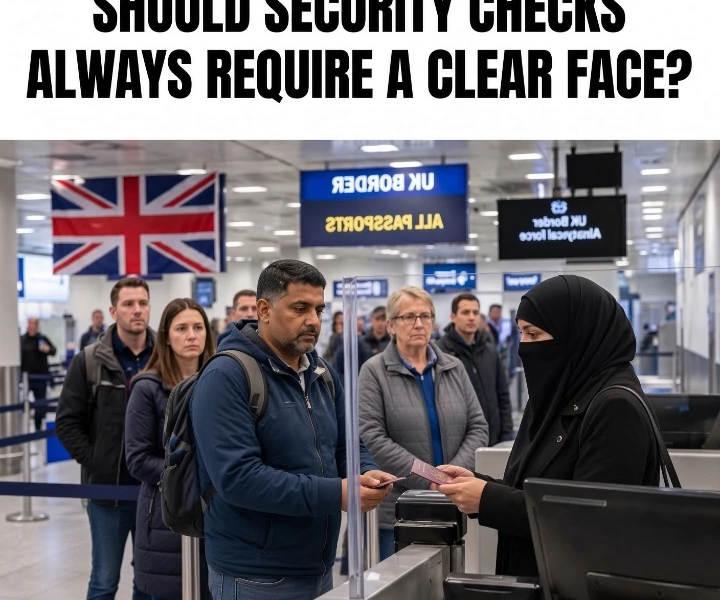
Security at our borders should be based on basic common sense, not political correctness. n1

The Threshold of Identity: Inside Britain’s Quiet Border Protocol and the Battle Over the Public Face
At five o’clock on a cold Tuesday morning inside London Heathrow’s Terminal 5, the ambient roar of aviation feels mechanical and relentless. Thousands of travelers, stiff from long-haul flights across different continents, shuffle in serpentine queues toward a row of pale, illuminated automated gates.
Above them, monitors flash simple pictograms: Remove hats. Remove sunglasses. Remove face coverings. Have passports ready.
For the vast majority, the instruction is an automatic transaction. They pull off wool beanies, slide reading glasses down to their shirts, gaze unblinkingly into an infrared optical sensor for three seconds until an acrylic barrier swings open, and step onto sovereign British soil.
Yet, outside the terminal, in newspaper op-eds, television studios, and viral social media feeds, this three-second transaction has been transformed into a ferocious national proxy war.
The public debate suggests a state paralyzed by ideological hesitation, with claims that border officials are routinely cowed by political correctness from demanding full-face identity verification. But step away from the rhetoric and look at the statute books and Border Force operational handbooks: the reality on the ground is radically different, operationally clear, and far more complex than the headlines acknowledge.
1. The Operational Reality: A Universal Rule at the Checkpoint
The surface debate gripping the United Kingdom centers on a seemingly simple premise: should every single traveler, without exception, be required to uncover their full face when their identity is assessed at the border?
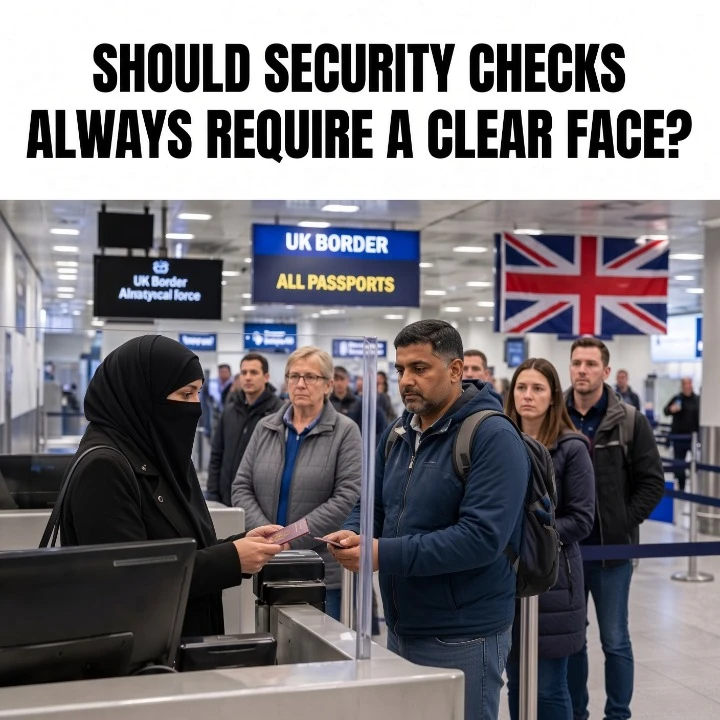
To understand the controversy, one must separate political theatre from statutory border control.
THE BORDER IDENTITY CYCLE
+-------------------------------------------------------------+
| 1. DOCUMENT PRESENTATION (e-Passport / Biometric Chip)      |
+-------------------------------------------------------------+
                              │
                              ▼
+-------------------------------------------------------------+
| 2. LIVE FACIAL MATCHING (Border Force Desk or eGate Engine)  |
|    * Universal standard: Full facial visibility required   |
|    * Removal of hats, sunglasses, and all face coverings    |
+-------------------------------------------------------------+
                              │
                              ▼
+-------------------------------------------------------------+
| 3. VERIFICATION OR DIVERSIFICATION                           |
|    * Routine Clear: Barrier opens                           |
|    * Religious/Privacy Accommodation: Secondary private     |
|      inspection room with matched-sex officer               |
+-------------------------------------------------------------+
The Legal and Operational Baseline
Under formal UK Home Office and Border Force operational instructions, the state already enforces a clear baseline: temporary facial visibility is universally mandatory during identity verification.
Anyone entering the country via staffed immigration counters or automated eGates is explicitly instructed to uncover their face. The operational logic is administrative and functional rather than cultural:
-
The Checkpoint’s Sole Purpose: Border control exists to verify that the physical human standing on the floor is the legal owner of the biometric document presented, and that the person holds permission to enter.
-
The Biometric Requirement: Over 270 automated eGates deployed across UK airports rely on algorithmic geometry—measuring the inter-pupillary distance, jawlines, and nodal points of the face against the high-resolution digital image encrypted inside an ICAO-compliant e-Passport chip. The machine cannot function through fabric, dark lenses, or obstructed profiles.
-
Universal Standard: Whether an obstruction is a motorcycle helmet, a medical mask, a winter scarf, or a religious veil (such as a niqab), the operational requirement remains identical: the facial landscape must be visually compared against the credential.
The Myth of Administrative Paralysis
Online narratives frequently claim that UK border officials are systematically barred or too intimidated to enforce these rules with certain groups. However, internal guidance reveals that the machinery of border security balances strict compliance with procedural dignity.
When a traveler wears a religious covering, current protocols do not waive the check. Instead, standard operational procedures provide for a secondary screening route:
-
The individual is escorted out of public view into a private examination room.
-
A female Border Force officer conducts the visual inspection in private.
-
Once the visual match to the passport photograph is secured, the covering is restored, and the passenger continues into the arrivals hall.
This system mirrors British policing protocols under the Police and Criminal Evidence Act (PACE). During lawful police searches where the removal of intimate or religious garments (such as a veil or turban) is legally required, officers are mandated to conduct the process out of public view, using officers of the same sex whenever practicable.
The Widening Scope: From the Airport to the Street
The sharpest edge of the contemporary debate does not actually lie at the airport arrival hall—it lies in the expansion of state powers into public civic spaces.
In recent legislative sessions, particularly with measures codified in the Crime and Policing Act 2026, Parliament broadened police powers to prohibit identity-concealing items within designated protest zones.
Under these statutory measures:
-
Senior police commanders can designate an area where they reasonably believe public disorder or criminal offenses may occur.
-
Officers within that zone hold the legal authority to order the removal of face coverings worn primarily to conceal identity.
-
Refusal to comply constitutes a distinct criminal offense, designed to stop agitators from removing masks temporarily upon request only to put them back on deep inside a crowd.
The crucial legal boundary line is clear: at an immigration counter, identification is a mandatory condition of entry. On an ordinary high street, citizens enjoy a presumption of anonymity unless a clear, narrow statutory threshold is crossed.
2. My Professional Perspective
I have spent three decades covering national security apparatuses, war zones, and civil rights battles from Belfast to the post-9/11 corridors of Washington and Whitehall. If there is one enduring lesson about state power, it is this: the fiercest public panics are frequently engineered around problems the state has quietly solved decades ago, precisely to divert attention from the deeper, systemic transformations it is actively constructing.
When you strip away the viral outrage and political posturing, the real story here is not whether someone should show their face at an airport desk. That standard has been settled administrative law for generations.
The real, untold story is the quiet, profound rewriting of the social contract between the citizen, the state, and the lens.
THE REAL CONFLICT: A SHIFT IN THE SOCIAL CONTRACT
┌─────────────────────────────────────────────────────────────┐
│ TRADITIONAL CIVIL LIBERTIES                                 │
│ Presumption of public anonymity; physical borders mark      │
│ the clear edge where identity verification is required.     │
└──────────────────────────────┬──────────────────────────────┘
                               │
                               ▼
┌─────────────────────────────────────────────────────────────┐
│ THE EXPANDING SURVEILLANCE PARADIGM                         │
│ Algorithmic verification shifts from physical border gates  │
│ into everyday streets via live facial-recognition vans.     │
└──────────────────────────────┬──────────────────────────────┘
                               │
                               ▼
┌─────────────────────────────────────────────────────────────┐
│ CRITICAL POLICY QUESTIONS                                   │
│ • Who owns and stores biometric data?                       │
│ • What happens when algorithms misidentify minority faces?  │
│ • Is privacy being redefined as inherent suspicion?         │
└─────────────────────────────────────────────────────────────┘
The Invisible Shift: How “Border Logic” Crept In
What the headlines overlook is how the operational logic of the high-security border counter has begun seeping out into everyday public life.
When you stand at Heathrow, you enter an exceptional zone. You forfeit certain privacy rights in exchange for international transit. But over the past few years, through targeted protest laws and the rapid rollout of Live Facial Recognition (LFR) surveillance vans in central London, Birmingham, and Manchester, the state has begun treating the public street like a continuous immigration checkpoint.
When the language of “removing masks for security” is weaponized in political discourse, it blurs the line between two fundamentally different concepts:
-
Functional Identification: Asking someone to prove they are the holder of a ticket or document at a designated security gate.
-
Universal De-Anonymization: Eliminating the legal and cultural right of individuals to move through public spaces without being cataloged, scanned, and mapped by state algorithms.
By focusing public anger on religious garments and cultural flashpoints, political actors have successfully masked an uncomfortable shift: ordinary citizens are losing the right to public anonymity, while assuming the debate is merely about border integrity.
The Technological Reality: The Fallacy of the Perfect Camera
There is another critical dimension rarely discussed on cable news: modern border security relies far less on the human eye than on machine learning models.
Biometric eGates match live faces against digitized passport photos using deep neural networks. Independent audits—including studies by the National Institute of Standards and Technology (NIST)—have consistently demonstrated that facial recognition algorithms exhibit measurable demographic variance, with higher false-rejection and false-match rates among women and individuals with darker skin tones.
When automated systems misread an individual, that traveler is diverted to manual secondary screening. If we make automated matching the single point of failure in our border strategy, we risk building a system that treats biological variance as an inherent security threat.
========================================================================
             IMMIGRATION DESK vs. PUBLIC DEMONSTRATION
========================================================================
CRITERIA               BORDER IMMIGRATION DESK      PUBLIC STREET / PROTEST
------------------------------------------------------------------------
Primary Function       Legal Entry Verification     Free Movement & Speech
Legal Presumption      Explicit Consent to Check    Presumption of Anonymity
Standard for Removal   Universal & Automatic        Reasonable Suspicion /
                                                    Designated Police Order
Identity Architecture  Closed Loop (Passport Match) Open Environment (LFR)
------------------------------------------------------------------------
The Systemic Distraction
Why does this story keep returning to the news cycle if the border rules are already clear?
Because border security is operationally difficult, expensive, and logistically fraught. Real border integrity depends on complex intelligence sharing, unglamorous container port inspections, tracking organized trafficking networks, verifying visa overstays, and updating legacy IT databases that run on decades-old government software.
Demanding that the government “get tough” on face coverings provides a clean, visual, and highly emotional narrative. It creates a simple, binary spectacle of authority versus vulnerability that plays well on camera, while leaving the deep, structural flaws in border management unexamined.
3. The Unanswered Questions
As facial recognition technology accelerates and governments worldwide expand their biometric networks, the debate over visible identity is only beginning. We must confront several critical questions:
-
Data Governance and Storage: When live facial recognition systems capture biometric templates at border eGates and municipal surveillance vans, how long is that unencrypted biometric data retained, who audits the third-party private software vendors managing the systems, and are those templates shared across intelligence databases without explicit judicial warrants?
-
Algorithmic Accountability: What statutory rights does a traveler retain when an automated biometric gate repeatedly fails to authenticate their identity due to systemic algorithmic bias, and what safeguards prevent secondary inspections from becoming discriminatory?
-
The Normalization of Surveillance: If the legal threshold for demanding the removal of face coverings has successfully migrated from international transit hubs to municipal protest zones, what prevents future legislation from expanding mandatory identity checks to rail stations, sporting arenas, and shopping centers?
-
Administrative Neutrality vs. Cultural Stigmatization: Can a Western democracy maintain a strict, universally applied standard of visual identification without allowing the policy to be hijacked as an instrument for marginalizing minority communities?
The Road Ahead
Security and civil liberties are rarely natural enemies; they become adversaries only when administrative systems abandon proportional reasoning in favor of political theatre.
The United Kingdom’s border framework proves that a nation can enforce a strict, non-negotiable verification standard while maintaining personal dignity and procedural decency. An immigration officer can confirm the identity of a traveler in a private room with a female officer just as effectively as at an open gate. The security standard remains absolute; only the circumstances of the check adjust to preserve the individual’s dignity.
The true test of a mature democracy lies in its ability to tell the difference between an airport checkpoint and an ordinary high street.
At the border, showing one’s face is a practical, administrative step in international transit. But outside those terminals, within the public squares of a free society, the right to walk uncatalogued and unmonitored remains one of the defining foundations of individual freedom.
If we allow the operational logic of the international border gate to quietly swallow the public square, we will eventually build a society where every citizen is permanently treated as a foreign traveler requesting permission to walk down their own street.
When the price of public safety becomes the total surrender of personal privacy, who is the security apparatus truly protecting—the citizen, or the state that watches them?