
The Industrialization of the Channel: When Smuggling Tactics Outpace Border Policy
The Era of the “Mega-Dinghy”
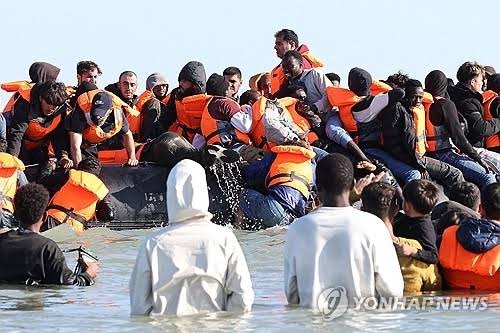
In the early morning mist of the English Channel—the world’s busiest commercial shipping lane—a new operational reality emerged on the water. A massive 49-foot reinforced inflatable craft, visibly buckling under the weight of 230 passengers, crossed the maritime boundary from northern France into British territorial waters before being intercepted by UK Border Force and escorted into the Port of Dover.
The passenger load exceeded the standard seating configuration of a commercial Boeing 737 airliner. With criminal smuggling cartels charging approximately £2,000 per passenger, intelligence estimates calculate that this single transit yielded roughly £450,000 in gross illicit revenue for the organized network behind the operation.
                              EVOLUTION OF CHANNEL VESSELS
  ========================================================================================
  2018–2020   Standard RIBs & small inflatable dinghies (10–20 passengers per boat)
  2021–2023   Mid-sized modified craft (35–50 passengers per boat)
  MID-2024    Scaled inflatables (Record: 165 passengers on July 23; 173 on vessel fire incident)
  CURRENT     Heavy industrial crafts: 49-foot mega-dinghies (230 passengers on a single keel)
  ========================================================================================
The launch itself bordered on operational disaster along the French coastline. According to reports from the Société Nationale de Sauvetage en Mer (SNSM)—the French equivalent of the RNLI—the vessel was initially spotted near Berck-sur-Mer already carrying approximately 50 passengers before moving parallel to the beach to embark a secondary contingent.

During the frantic boarding sequence at 5:00 PM on Sunday:
-
Approximately 30 individuals fell into the surf amid the rush to board.
-
A trailing group became stranded by the incoming tide and required rescue by shore teams.
-
Two passengers requested immediate medical extraction and were evacuated back to Calais, leaving 232 original passengers reduced to 230 heading out to sea.
-
Eye-witness footage and rescuer dispatches confirmed the overloaded hull was “buckling under the swell” as it navigated the open sea lanes.
Concurrently, at Camiers beach south of Boulogne, observer reports documented French security personnel watching as dozens of individuals, including infants and small children, were loaded onto another inflatable bound for the UK.
+---------------------------------------------------------------------------------------+
|                                    BY THE NUMBERS                                     |
+---------------------------------------------------------------------------------------+
|  230        Passengers confirmed on the single 49-foot craft entering Dover           |
|  £450,000   Estimated gross revenue generated by the smuggling ring for this crossing |
|  15,242     Total recorded small-boat crossings year-to-date                          |
|  2,773+     Arrivals logged since the new administration took office on July 20       |
|  £662M      Value of the multi-year Anglo-French border security funding pact         |
|  +40%       Target increase in French beach patrol boots under payment agreements     |
+---------------------------------------------------------------------------------------+
The Political and Diplomatic Fallout

The arrival of the 230-person craft immediately intensified political debate across Westminster. Following the formal scrapping of the previous administration’s offshore processing mechanism in Rwanda, the government has focused its border strategy on enhanced international policing partnerships and targeted disruption of criminal logistics supply chains.
Shadow Home Secretary Chris Philp leveled severe criticism at Home Secretary Shabana Mahmood and the administration’s handling of coastal enforcement:
“Labour’s weak attempts at fixing the Channel crisis have turned the UK into a complete laughing stock. Shabana Mahmood is presiding over a complete and utter farce. She’s handing over £660 million of our money to the French, who are pathetically standing around on the beaches while hundreds of migrants embark on massive dinghies… Out-of-touch leadership claims there is no problem. If they were serious, they would adopt the plan to leave the European Convention on Human Rights and deport all illegal arrivals within a week.”
From the political right, Reform UK leader Nigel Farage argued that cross-Channel crossings must be formally designated an acute “national security emergency,” while party home affairs spokesman Zia Yusuf termed the scale of the single-boat arrival “a national humiliation” that proves smuggling gangs operate with commercial impunity.
David Goodhart, immigration policy specialist at the Policy Exchange think tank, pointed to structural diplomacy:
“This is a violation of territory and political common sense. Such an enormous boat crossing underlines the ineffectiveness of French controls, and our own Government’s impotence… It remains a bewildering failure of international cooperation, and British diplomacy, that France does not agree to accept back anyone who crosses illegally.”
Whitehall’s Defense and Law Enforcement Response
In response to the operational criticism, the Home Office defended its strategic focus on upstream law enforcement disruption:
-
Cross-Channel crossings for July reached their lowest monthly volume since 2020, with year-to-date arrivals standing at 15,242—down relative to historical highs across the same comparative calendar period.
-
Law enforcement operations have seized over 1,100 small boats and outboard motors across European transit routes since the general election.
-
The newly formalized £662 million three-year security agreement with Paris is tied to a performance-and-results structure designed to deploy 40 percent more patrol personnel onto French beaches.
Security officials noted that the deployment of 49-foot mega-dinghies represents a tactical counter-adaptation by criminal networks: as beach-level vehicle interceptions and warehouse raids in northern France pinch equipment supplies, cartels are consolidating larger cohorts into fewer, highly lucrative, single-trip vessels.

========================================================================================
                          INVESTIGATIVE DISPATCH: BEHIND THE GAVEL
                               By a Veteran News Analyst
========================================================================================
When you spend thirty years investigating organized crime, transnational logistics, and executive governance, you learn to look past political slogans and examine the market economics underpinning illicit trade. The emergence of the 230-passenger “mega-dinghy” is not simply an embarrassing political headline for Downing Street. It marks the structural industrialization of migrant smuggling across the English Channel.
What the Headlines Overlook: The “Container Ship” Economic Pivot
For years, the public debate has treated Channel crossings as an ad-hoc collection of desperate individuals buying rubber rafts at local sporting goods stores. That era ended long ago. What occurred off Berck-sur-Mer is the maritime smuggling equivalent of a shipping line transitioning from break-bulk cargo to wide-body container vessels.
                         THE SMUGGLER'S LOGISTICAL ARBITRAGE

   [Increased Beach Interdictions] ---> [Boat & Outboard Motor Supply Scarcity]
                  |                                     |
                  v                                     v
   [Higher Per-Hull Equipment Costs] ---> [Scale Hull Size from 30ft to 49ft]
                  |                                     |
                  v                                     v
   [Consolidate Demand: 230 per launch] ---> [Net Cargo Yield: £450k per crossing]
Consider the operational pressures forcing this tactical shift:
-
Supply-Side Choke Points: Law enforcement crackdowns on the supply of cheap Turkish-manufactured PVC inflatables and Chinese-manufactured outboard engines across the Franco-Belgian corridor have raised the street cost of smuggling hardware.
-
Margin Optimization: If a cartel faces a 50 percent risk of its equipment being seized before touching the water, it makes zero economic sense to launch five small boats carrying 30 people each. Launching a single, heavy-gauge 49-foot vessel loaded with 230 people yields nearly half a million pounds in revenue on a single motor run.
-
Mass-Infiltration Tactics: Launching over 200 people simultaneously overwhelms the physical arrest capacity of a standard French gendarme squad on a beach. Twelve officers cannot safely arrest or detain 230 desperate individuals in the surf without using kinetic force, which French tactical doctrine explicitly forbids once vessels reach knee-deep water due to drowning risks.
Smugglers are actively utilizing the safety protocols of Western maritime law to build an unassailable operational wedge.
The Diplomatic Impasse: The French Coast Paradox
The recurring debate over why French police “stand and watch” in knee-deep water exposes the structural friction between British domestic expectations and French operational reality.
+-----------------------------------------------------------------------------------+
|                        THE CHANNEL LAW ENFORCEMENT PARADOX                        |
+-----------------------------------------------------------------------------------+
|  BRITISH POLITICAL VIEW:   |  "We paid £662M; French police must stop all crafts."|
|  FRENCH LEGAL/MARITIME LAW:|  "Interception in water risks immediate capsizing,   |
|                            |  drowning, and sovereign liability for loss of life."|
|  SMUGGLER TACTIC:          |  "Get passengers into the surf instantly to trigger  |
|                            |  international search-and-rescue (SAR) protections." |
+-----------------------------------------------------------------------------------+
Under international maritime safety conventions (SOLAS) and French domestic policing directives, law enforcement cannot deploy spike strips, physical nets, or kinetic tactics against overloaded, non-seaworthy vessels in coastal waters. The risk of triggering a mass panic that drowns children in the surf creates absolute legal and operational liability.
Smuggling gangs understand this framework thoroughly. They stage passengers behind coastal dunes, conduct rapid launches within three to five minutes, and once the keel touches water, French authorities shift from an enforcement posture to a search-and-rescue (SAR) posture.

Until an operational and diplomatic mechanism resolves that fundamental legal dynamic, financial transfers from Westminster to Paris will continue to operate as an expensive monitoring service rather than an effective deterrent.
Unanswered Questions for Both Sides of the Channel
A rigorous investigative review must demand answers to the operational questions neither government has transparently addressed:
-
Where Is the Heavy Industrial Hardware Originating?A 49-foot reinforced dinghy equipped to hold 230 people is not an off-the-shelf leisure product from Decathlon. It is an industrial-scale platform requiring specialized multi-chamber manufacturing, commercial-grade fabric, and high-horsepower commercial steering rigs. Through which European customs ports and transport corridors are these mega-hulls moving undetected into northern France?
-
What Are the Verifiable Benchmarks of the £662M Deal?Whitehall cites a “payment-by-results” framework. What specific key performance indicators (KPIs) govern whether French authorities receive funding tranches? Are disbursements tied to verified arrests of cartel kingpins, or merely patrol hours logged on beaches?
-
What Is the Threshold for a Mass-Casualty Maritime Disaster?With crafts buckling under open-sea swells in traffic lanes traversed by hundreds of ultra-large container ships daily, a catastrophic structural failure of a 230-person craft is an acute mathematical probability. What shared contingency plans exist between Dover and Calais when a craft of this volume suffers structural failure in mid-channel?
3. Comparative Perspectives: Border Interdiction in Maritime Corridors
The challenge of stopping high-capacity unseaworthy vessels along heavily trafficked straits is a shared issue across international maritime boundaries:
| Strategic Theater | Operational Dynamic | Interdiction Doctrine | Systemic Friction & Consequences |
| English Channel (UK / France) | High-density shipping lanes; short crossing distances; large industrial inflatables. | Shore patrols on land; SAR intercept and transfer to mainland processing at sea. | Legal restrictions on coastal water intercepts; political disputes over sovereign returns. |
| Central Mediterranean (Italy / Libya) | Long open-sea transits; unseaworthy wooden trawlers and basic rubber crafts. | Naval SAR operations; bilateral funding of North African coastguards for offshore intercepts. | Severe human rights scrutiny over interception methods and detention conditions in transit states. |
| Torres Strait / Timor Sea (Australia) | Vast open-ocean approaches; covert commercial fishing vessels. | Hard maritime turnback policy (Operation Sovereign Borders) paired with offshore processing. | High operational cost; international diplomatic friction with regional neighbors; strict secrecy protocols. |
The arrival of a 49-foot mega-dinghy in Dover carrying 230 passengers marks a qualitative turning point in the English Channel border dispute. The narrative of individual opportunism has been superseded by an industrial logistics model capable of moving passenger volumes comparable to commercial airliners in single launches.
While Westminster debates the merits of international legal conventions and bilateral payment treaties, criminal cartels continue to adapt with corporate speed and calculated disregard for human safety. The central challenge facing policymakers is no longer simply managing reception centers or increasing beach foot patrols. It is confronting an organized, profitable illicit industry that systematically leverages the vulnerabilities of international maritime law.
========================================================================================
                                  THE OPEN QUESTION
========================================================================================

   Can an enforcement strategy focused primarily on bilateral funding and domestic
   policy ever dismantle a multi-million-pound illicit logistics network, or does the
   growth of 230-passenger vessels make a catastrophic open-water disaster inevitable
   before international legal frameworks adapt?

========================================================================================