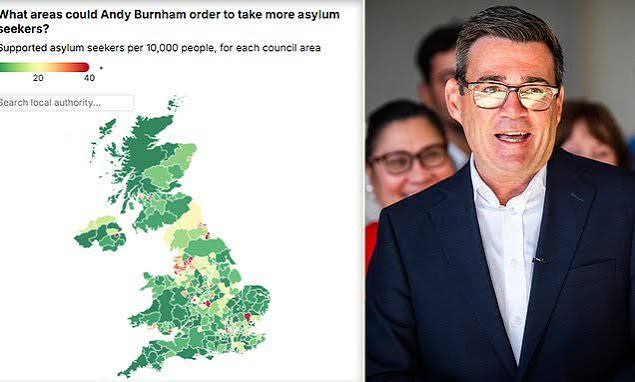
MAP REVEALS 17 UK AREAS WITH ZERO ASYLUM SEEKERS AS ANDY BURNHAM VOWS ‘WEALTHIER’ COMMUNITIES MUST TAKE THEIR SHARE. n1

The Geography of Displacement: Inside the Battle Over Britain’s Asylum Map
The Spatial Divide in Britain’s Asylum Network
A widening geographical and socioeconomic divide sits at the center of the United Kingdom’s asylum system. Official Home Office dispersal figures, compiled into a national mapping analysis, indicate that several local authorities across England, Wales, and Scotland house zero asylum seekers, while urban areas with high deprivation scores support a heavy concentration per capita.
Industrial towns and urban centres—including Glasgow, Hyndburn, Blackburn, Burnley, Middlesbrough, Blackpool, and South Tyneside—rank among the highest per-capita hosts in the country. In Burnley, for example, approximately 455 asylum seekers reside in local housing, equating to roughly 46 individuals for every 10,000 residents. Similar ratios are recorded in Middlesbrough (43 per 10,000) and South Tyneside (42 per 10,000).

In sharp contrast, seventeen local council jurisdictions contain zero recorded asylum seekers in dispersal or emergency accommodation:
-
England: Cotswold (pop. 91,661), Derbyshire Dales (pop. 71,757), East Hertfordshire (pop. 156,875), Hart (pop. 103,162), Isle of Wight (pop. 141,660), Isles of Scilly (pop. 2,366), Malvern Hills (pop. 83,227), Mid Devon (pop. 84,993), New Forest (pop. 176,116), and Tewkesbury (pop. 101,949).
-
Scotland: Highland (pop. 237,290), Na h-Eileanan Siar (pop. 26,020), Orkney Islands (pop. 22,020), and Shetland Islands (pop. 23,190).
-
Wales: Ceredigion (pop. 72,599).
-
Northern Ireland: Mid and East Antrim (pop. 139,913) and Mid Ulster (pop. 152,718).
+-----------------------------------------------------------------------------------------+
|                              LOCAL RECEPTION DISPARITY                                  |
+-----------------------------------------------------------------------------------------+
|  AREAS WITH ZERO PLACEMENTS:       |  HIGH-DENSITY PLACEMENT HUBS (per 10,000 pop):     |
|  - Cotswold (Pop. 91,661)          |  - Burnley: ~46 per 10,000 residents               |
|  - Derbyshire Dales (Pop. 71,757)  |  - Middlesbrough: ~43 per 10,000 residents         |
|  - New Forest (Pop. 176,116)       |  - South Tyneside: ~42 per 10,000 residents        |
|  - East Hertfordshire (156,875)    |  - Blackpool: ~34 per 10,000 residents             |
+-----------------------------------------------------------------------------------------+
The Dispersal Policy Debate
The government has called for a fundamental rebalancing of the asylum housing network, arguing that affluent and rural areas must absorb a fairer proportion of incoming claimants. Addressing the current disparity, the administration stated:
“We cannot have a situation where it’s only the poorest communities in the country that receive all of the dispersal of refugees and asylum seekers. I do believe all parts of the country need to work, to play their part.”
Immigration Minister Anna Turley defended the planned rebalancing, stating the initiative centers on regional fairness and proportional capacity:
“I think this is about fairness, and we won’t be asking anyone to take more than they can. It’s about their fair share, and we have to look across the country at what is appropriate for areas to take, what is the infrastructure, what is manageable with the local community.”
The policy focus comes amid local pushback in rural areas, notably in Piddington, Oxfordshire. In the village of roughly 350 residents, local councilors, human rights organizations, and local MP Calum Miller raised objections over proposals to accommodate up to 1,000 asylum seekers at a nearby Ministry of Defence installation (“Site A”). Responding to concerns regarding pressure on local services, the Immigration Minister maintained that the military facility is self-contained and equipped to manage health and administrative processing directly on-site to reduce community impact.

Political Counter-Arguments and Cross-Channel Inflows
The proposal has drawn sharp criticism from the parliamentary opposition. Shadow Home Secretary Chris Philp described the initiative as an unfair burden on suburban communities, stating:
“Labour has hammered hard-working families with punitive tax increases galore, increased regulation and soaring energy bills. Now, [the government] plans to deliberately flood more neighbourhoods with thousands of illegal immigrants who he has let into this country.”
+-----------------------------------------------------------------------------------------+
|                               BORDER & LOGISTICS CONTEXT                                |
+-----------------------------------------------------------------------------------------+
|  >200,000    Total small-boat arrivals recorded across the English Channel since 2018.  |
|  >15,000     Cross-Channel arrivals recorded year-to-date.                              |
|  1,100+      Smuggling dinghies and outboard motors seized via disruption operations.   |
|  230         Migrants intercepted in a single large-capacity vessel incident.           |
+-----------------------------------------------------------------------------------------+
Official figures document that more than 200,000 individuals have crossed the English Channel in small vessels since 2018. While year-to-date arrivals have exceeded 15,000, overall seasonal volumes remain lower than comparative peaks in the preceding two years, with July totals reaching their lowest levels since 2020.
Home Office officials state that ongoing enforcement partnerships have seized more than 1,100 boats and engines, attributing the emergence of larger dinghies (carrying over 200 passengers) to increased beach-level interceptions in northern France.
2. My Professional Perspective
========================================================================================
                          INVESTIGATIVE DISPATCH: BEHIND THE GAVEL
                               By a Veteran News Analyst
========================================================================================
Covering public policy over several decades reveals how easily complex structural dilemmas get flattened into simple political rhetoric. The map showing zero asylum seekers in the Cotswolds or the New Forest while Burnley and Middlesbrough carry high per-capita loads is treated in political debate as a deliberate moral choice. In reality, it is the result of long-standing procurement mechanics, property markets, and public sector contracting.
The Structural Reality: Market-Driven Dispersal
The root cause of geographic clustering does not stem from an explicit strategy to target lower-income towns. Rather, it is driven by the commercial framework used to procure asylum accommodation.
                              THE PROCUREMENT FEEDBACK LOOP

  [Private Accommodation Providers] ---> [Target: Lowest Cost per Bed / HMO]
                  |                                     |
                  v                                     v
  [Depressed Housing Markets: North/Midlands] <--- [Excluded: Affluent Southern Markets]
                  |
                  v
  [High Concentration in High-Deprivation Councils] ---> [Local Services Strained]
When central governments contract private providers under multi-billion-pound dispersal schemes, those contractors operate under statutory mandates to secure bed spaces at the lowest possible cost to the taxpayer:
-
Property Price Arbitrage: A standard multi-occupancy house (HMO) or decommissioned hotel in East Lancashire, Teesside, or South Yorkshire can be acquired or leased at a fraction of the cost required in Hertfordshire, Oxfordshire, or Surrey.
-
The Dispersal Paradox: Because commercial providers operate within fixed budget caps, they systematically bypass affluent areas where high rents and competitive property markets make state contracts commercially unviable.
-
Service Infrastructure Lag: Local authorities with cheaper housing often already face high pressures on primary care, specialized education, and community social services. This concentrates logistical strain in areas with the narrowest fiscal buffers.
The Rural Base Dilemma: Piddington as a Case Study
The friction in Piddington, Oxfordshire, underscores the limits of attempting to bypass private rental markets by repurposing public assets.

When the state repurposes MoD land or former airfields to establish centralized accommodation centers, it encounters immediate logistical hurdles:
-
The Scale Imbalance: Placing 1,000 individuals alongside a village of 350 residents fundamentally alters local community dynamics, generating understandable anxiety regardless of party affiliation.
-
The “Self-Contained” Contradiction: While ministers pledge that these sites operate independently with dedicated medical and security personnel, the secondary demands—such as emergency services, ambulance dispatch, regional legal aid, and local transport networks—invariably rely on county-level infrastructure.
-
Planning and Judicial Resistance: Rural councils and advocacy groups frequently challenge these projects via planning regulations and judicial reviews, adding substantial legal expenses and procedural delays.
+-----------------------------------------------------------------------------------+
|                        COMPLEX VECTORS OF THE CRISIS                              |
+-----------------------------------------------------------------------------------+
|  1. FISCAL REALITY:    Renting accommodation in affluent boroughs costs up to 4x  |
|                        more per person than in northern industrial towns.         |
|  2. CAPACITY LIMITS:   Large-scale institutional sites face severe legal and      |
|                        infrastructural bottlenecks in low-density rural villages. |
|  3. CASELOAD PRESSURES:Dispersal disputes are a direct symptom of backlogs        |
|                        in initial asylum case processing and appeals.             |
+-----------------------------------------------------------------------------------+
The Unaddressed Question: Processing Speed
The entire debate over where people should be housed obscures the critical issue: how long they remain in state accommodation.
Accommodation crises are symptoms of processing bottlenecks. When average initial decision times stretch across months or years, the state requires vast residential capacity. If claims were decided, integrated, or resolved within weeks—matching standards in certain comparable jurisdictions—the requirement for long-term hotels, HMO blocks, and repurposed military installations would decrease substantially.
Until processing workflows and backlogs are fundamentally addressed, every proposal to relocate accommodation remains a temporary reallocation of an unresolved caseload.
3. Comparative Perspectives: How Other Nations Handle Dispersal
The challenge of balancing asylum reception across regional jurisdictions is not unique to Britain. Other Western democracies face similar operational frictions:
| Country | Dispersal Mechanism | Operational Strategy | Key System Friction |
| United Kingdom | Hybrid contractor-led model using private HMOs, hotels, and select MoD sites. | Centralized Home Office contracting targeting cost-effective property zones. | Disproportionate clustering in deprived areas; significant rural pushback on base conversions. |
| Germany | The Königstein Key (Königsteiner Schlüssel). | Strict mathematical quota allocating arrivals across 16 states based on tax revenue and population. | Municipalities in wealthier southern states struggle with high real estate costs to build facilities. |
| France | Regional reception network (DNA overseen by OFII). | Structured quota system moving arrivals out of Paris/Calais into regional reception centers (CADA). | Resistance from smaller communes; persistent spontaneous transit hubs near northern coastal areas. |
Germany’s quota model demonstrates that enforcing dispersal into high-cost areas requires substantial statutory mandates and central subsidies, as market forces naturally push accommodation toward lower-value properties.
The map illustrating zero-asylum zones across rural Britain versus high concentrations in former industrial towns captures a core challenge of modern governance: balancing operational cost against equitable civic distribution.
Achieving a truly balanced system requires moving beyond rhetorical arguments between inner-city housing density and rural preservation. Doing so involves addressing the commercial frameworks that dictate accommodation procurement, modernizing public decision-making processes, and ensuring local infrastructure receives adequate support wherever facilities are established.
========================================================================================
                                  THE OPEN QUESTION
========================================================================================

   Can a national dispersal model ever achieve genuine regional fairness
   without fundamentally overhauling the commercial procurement practices
   that naturally funnel accommodation into the country's cheapest property markets?

========================================================================================