Socialist Alternative organised the Pauline Hanson protest and Labor didn’t stop it. u1

The Machinery Behind the Megaphone: Inside Australia’s National Student Walkout
The Spark on the Streets
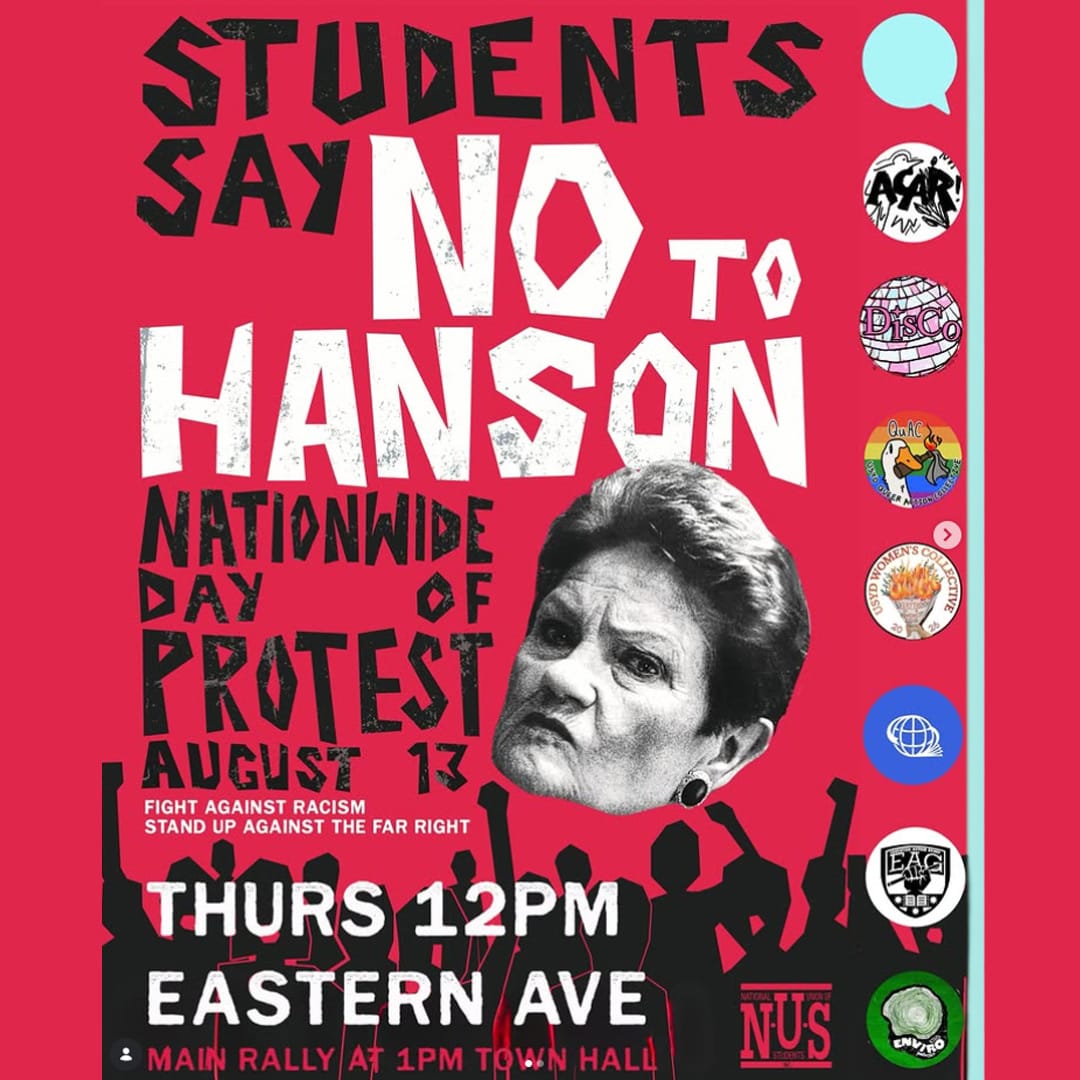
On Thursday, August 13, thousands of high school and university students walked out of classrooms across eight major Australian cities. Billed under the rallying cry “Students Say No to Hanson,” the coordinated day of action brought metropolitan centers to a temporary standstill. In Sydney, demonstrators congregated at noon along Eastern Avenue at the University of Sydney before marching down to a mass demonstration outside Town Hall. In Melbourne, secondary school pupils emptied out of fifth-period classes to rally at the steps of the State Library at 2:00 PM. Simultaneous protests erupted at Forrest Place in Perth, King George Square in Brisbane, and outside state parliament buildings in Adelaide, alongside organized gatherings across Canberra, Wollongong, and Newcastle.
The visible participants were teenagers and young adults carrying handcrafted placards, megaphones, and anti-racism slogans. In Victoria, media reports highlighted contingents from elite and public institutions alike, including Methodist Ladies’ College, Northcote High School, University High School, and Strathmore Secondary College. In South Australia, student groups from Adelaide High School, Adelaide Botanic High School, and University Senior College were mobilized.
On the surface, the protest presented itself as an organic, youth-led revolt against the resurgence of Pauline Hanson and her right-wing populist One Nation party. Yet behind the sea of cardboard signs and teenage energy sat an elaborate, months-long political apparatus engineered by seasoned activists, factional organizers, and revolutionary socialist networks.
The Trigger and the Political Backdrop
The catalyst for the national mobilization stemmed from Pauline Hanson’s address at the National Press Club on June 16. In her speech, Hanson asserted that Australia “cannot be a multicultural society” and insisted that the country “must be monocultural.” She subsequently attempted to soften her framing during a national broadcast on the Australian Broadcasting Corporation, comparing her vision of national cohesion to the Australian national soccer team, the Socceroos, where individuals from varied backgrounds wear a single jersey.
Organizers swiftly seized on Hanson’s remarks, alongside scrutiny over her international engagements—notably a July appearance in Luton alongside British far-right activist Tommy Robinson, as well as political travel co-funded by mining magnate Gina Rinehart.
Crucially, the walkouts were timed against an unprecedented surge in electoral support for One Nation. Following state elections in South Australia that saw One Nation secure seven parliamentary seats (four in the House of Assembly and three in the Legislative Council on nearly a quarter of the primary vote), federal and state polling showed the populist party reaching historic heights. Polling aggregates placed One Nation at roughly 30% of the primary vote nationally, running neck-and-neck with the governing Labor Party and outpacing the traditional Coalition opposition. In Victoria, state polling placed One Nation in a decisive kingmaker position ahead of the upcoming state election.
The Architects: NUS and Socialist Alternative
While mainstream headlines framed the demonstrations around the spontaneous anger of school pupils, promotional material, logistics, and organizing networks pointed directly to the National Union of Students (NUS) and its dominant ideological faction, Socialist Alternative.
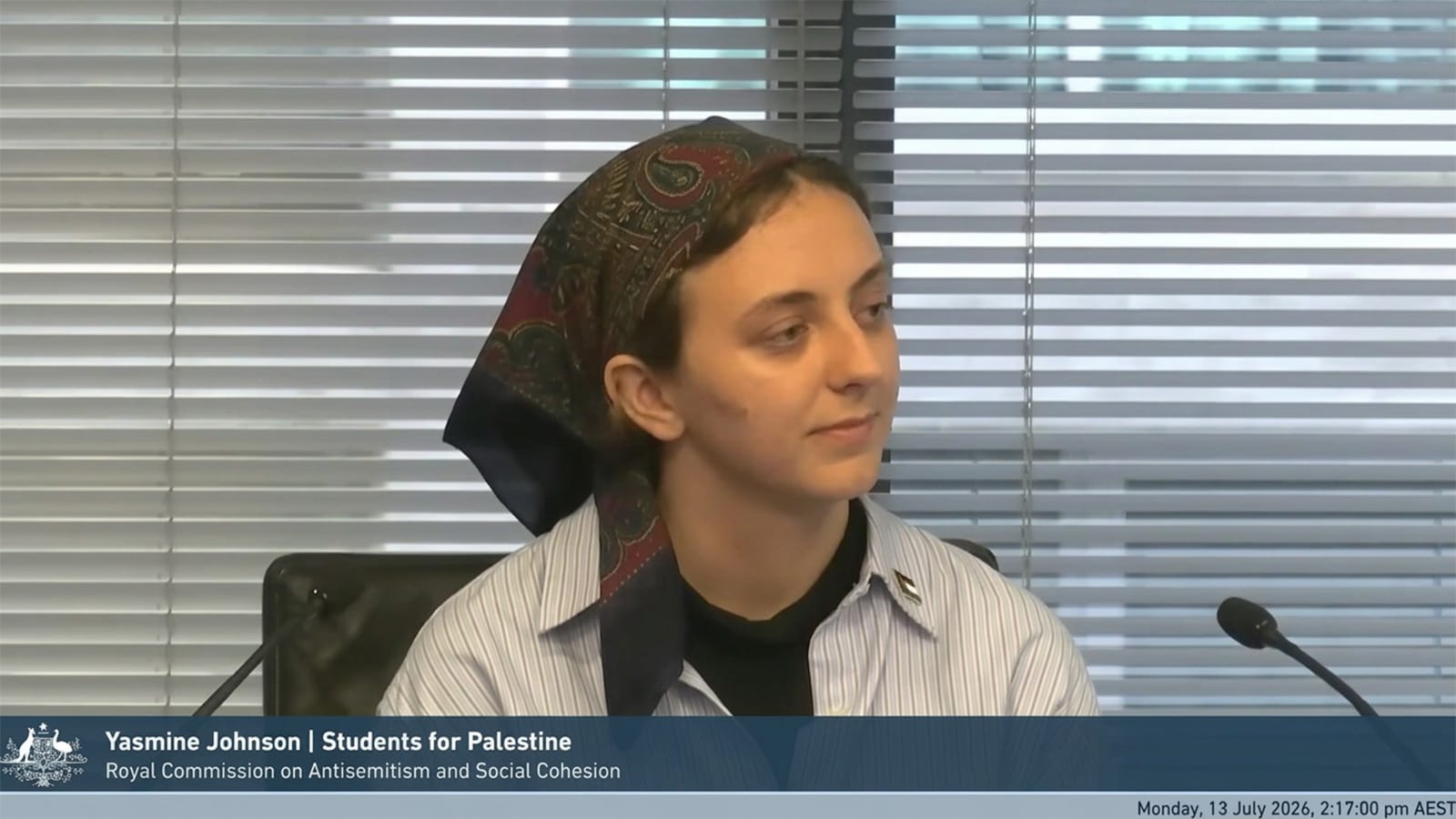
At the center of the campaign is Yasmine Johnson, the 2026 National Education Officer for the NUS and national co-convenor of Students for Palestine. A long-standing activist at the University of Technology Sydney and a self-described Jewish socialist, Johnson secured her national union post following an internal factional campaign documented in Socialist Alternative’s publication, Red Flag, under the headline: “We need a socialist NUS education officer who’ll stand up for Palestine”.
Johnson’s public profile had already drawn intense national scrutiny just weeks earlier on July 13, when she testified before the Royal Commission on Antisemitism and Social Cohesion. During her testimony, when pressed on methods of resistance to colonization, Johnson stated that historical resistance “has always involved elements of both mass non-violence and also violent resistance”.
The institutional network endorsing and driving the August 13 walkout spanned a wide array of campus organizations and ideological caucuses:
-
Monash Socialist Alternative, Uni Melb Socialists, Deakin Socialists, and UNSW Socialists
-
Socialist Alternative branches across Curtin, Adelaide, and Flinders Universities
-
RMIT Socialist Club and campus-based Students for Palestine collectives
-
The University of Sydney Student Representative Council (SRC)
-
The Queensland University of Technology (QUT) Guild
-
High School Anti-Capitalists, an emerging secondary school organizing initiative
In Adelaide, organizing efforts were fronted by Jordan Armstrong of Socialist Alternative, who told reporters from The Advertiser that Hanson’s ideology had been systematically “normalized by every existing political institution, whether it be the media or parties like the Labor Party.”
The Blueprint: From the Marxism Conference to the Streets
Far from an impromptu reaction, the strategic foundation for the walkouts was laid months in advance at Socialist Alternative’s annual Marxism Conference, held in Melbourne from April 2 to 5.
The conference schedule served as an explicit tactical blueprint for the mid-year campaign. Programmed sessions included:
-
“Resisting Hanson’s One Nation in the 1990s”
-
“Explaining and resisting the One Nation surge”
-
“How can the far right be stopped?”
-
“Meet the high school anti-capitalists”
-
“Organise the party: workshop with Socialist Party comrades from your city or district”
According to Red Flag, the High School Anti-Capitalists convened one of their foundational national meetings during the April conference. Simultaneously, allied factions operated within secondary education unions. Under the banner of Socialists in Schools—identified by the World Socialist Web Site as a Socialist Alternative initiative—activists pushed for industrial walkouts within the Australian Education Union (AEU) in Victoria, aligning school staff labor disputes with broader street mobilizations.
The explicit strategy behind the school strikes was articulated in a June 21 essay by organizer Nick Everett in Red Flag. Defending direct street action, Everett laid out a straightforward recruitment calculus:
“We have to orient to the people repulsed by the far right, to the subset of them who want to do something about its rise, and to those among them who can be organised into a larger socialist movement. One Nation has grown to around 60,000 members. The Socialist Party has around 6,000. We need to recruit more socialists so that we can engage in more sustained on-the-ground organising in more suburbs and cities across the country.”
Everett drew direct inspiration from the July 1998 student walkouts against Hanson, arguing that mass student defiance in the late 1990s successfully forced the center-right Liberal Party into an electoral preference boycott that effectively marginalized One Nation for a generation. While current campaign literature cited a historic attendance of 14,000 students in 1998, contemporary archival reports from Green Left Weekly, The Militant, and the World Socialist Web Site recorded the actual crowd at approximately 10,000.
Institutional Responses and Legal Ambiguity
The coordinated walkout placed educational authorities and government ministers in a delicate regulatory bind. Because the vast majority of high school participants are minors under the age of 18 without voting rights, school attendance laws became an immediate point of friction.
In South Australia, Labor Education Minister Lucy Hood declined to prohibit student participation, stating on August 5 that attendance was “always up to an individual parent” while maintaining that the classroom remains “the best place for a child to be during the school week”. Under South Australia’s Education and Children’s Services Act 2019, parents face statutory duties to ensure full-time school attendance, with non-attendance escalating to administrative penalties only after ten unexcused days in a single school term.
In Victoria, the Department of Education reiterated that standard attendance policies applied, noting that individual principals retain discretion under the Education and Training Reform Act 2006 to approve absences deemed reasonable upon parental explanation. Political protest does not appear on the state’s formal registry of approved absences—which is strictly reserved for medical appointments, bereavement, recognized cultural observances, or pre-approved student learning plans.

For One Nation’s leadership, the walkouts provided fresh political ammunition. Former Liberal senator Cory Bernardi, leading One Nation in South Australia, attempted to engage with activists directly, while South Australian party president Carlos Quaremba remarked that while Australia remains a free society where youth may assemble, the demonstrators appeared “not interested in debating, they are just interested in believing their ideology”.
The Anointed Cadre vs. The Unwitting Chorus
When you spend three decades covering political movements across Washington, London, and Canberra, you develop an instinct for distinguishing between organic civic unrest and calculated political stagecraft. The August 13 student walkout is a textbook case study in the anatomy of modern cadre-led mobilization.
To understand what transpired on the steps of the Melbourne State Library or Sydney Town Hall, one must look past the emotive, high-definition television coverage. What the public saw was an image of fresh-faced, morally impassioned teenagers exercising democratic dissent. What was concealed beneath that veneer was a sophisticated transmission belt designed by professional campus ideologues.
       +-------------------------------------------------------------+
       |             Socialist Alternative / Cadre Leadership        |
       |  (Formulates doctrine, sets targets, defines recruit KPIs)  |
       +------------------------------+------------------------------+
                                      |
                                      v
       +-------------------------------------------------------------+
       |             National Union of Students (NUS) Engine         |
       |   (Provides institutional brand, media access, resources)   |
       +------------------------------+------------------------------+
                                      |
                                      v
       +-------------------------------------------------------------+
       |           Sub-Brand Collectives & High School Groups        |
       |   (Students for Palestine, High School Anti-Capitalists)    |
       +------------------------------+------------------------------+
                                      |
                                      v
       +-------------------------------------------------------------+
       |               Secondary School Student Base                 |
       |    (Mobilized via social media, peer momentum, walkout)     |
       +-------------------------------------------------------------+
The leadership of Socialist Alternative does not view political protests as mere expressions of moral outrage. In orthodox Marxist-Leninist organizing doctrine, mass mobilizations serve two primary mechanical functions:
-
Cadre Expansion (Recruitment Pipeline): Street protests act as an ideological funnel. Thousands of curious, alienated, or idealistic teenagers attend; hundreds register their contact details at sign-up stalls; dozens are invited to post-rally branch meetings; and a select few are forged into committed, lifelong party cadres. Nick Everett stated the math with startling candor in Red Flag: the objective is to close the gap between 6,000 socialist organizers and 60,000 One Nation supporters.
-
Institutional Leverage: By demonstrating the ability to shut down central business districts and empty classrooms, student factions signal to mainstream political parties—specifically the Australian Labor Party and the Greens—that failure to adopt hardline anti-populist stances will result in persistent civil disruption.
For a fifteen-year-old student walking out of a Melbourne high school, the motivation is overwhelmingly pure: a desire to stand against racism, fear for social cohesion, and a search for community. But that student is not the strategist; they are the human capital in a broader war of attrition between rival political fringes.
The Double-Edged Paradox of Anti-Populist Action
The grand irony of the “Students Say No to Hanson” campaign is that it provides Pauline Hanson with the exact cultural adversary her movement requires to sustain its momentum.

Right-wing populism thrives on the perception that an entrenched, urban, ideological elite controls the institutions that shape young minds. When high school students from prestigious private and inner-city public schools walk out of class with union-backed placards, it validates One Nation’s core narrative to its working-class, regional base: that educational institutions have abandoned foundational learning in favor of progressive indoctrination.
+-------------------------------------------------------------------------+
|                  THE POLARIZATION FEEDBACK LOOP                         |
|                                                                         |
|   1. Populist Surge: One Nation captures ~30% primary polling.          |
|   2. Far-Left Mobilization: Socialist networks organize student strikes.|
|   3. Institutional Tension: Education departments display passivity.    |
|   4. Populist Retaliation: Hanson uses walkouts to fundraise & campaign |
|      against classroom politicization.                                  |
|   5. Deepened Polarization: Mainstream voters feel squeezed between     |
|      two militant extremes.                                             |
+-------------------------------------------------------------------------+
When One Nation organizers attempted to sit in on student organizing meetings in Adelaide, only to be ejected, and when party figures subsequently appeared outside rallies to film content for social media, they were executing their own media playbook. Every megaphone chant branding one-third of the electorate as “bigots and sickos” cements the loyalty of One Nation’s voting bloc, driving working-class voters away from traditional political homes and directly into Hanson’s camp.
The Abdication of Institutional Authority
One of the most consequential yet underreported dimensions of this story is the profound administrative paralysis displayed by state education departments.
In both Victoria and South Australia, ministerial responses were characterized by equivocation. By framing school attendance during a coordinated political walkout as “ultimately a matter for parents,” political leaders avoided direct confrontation with powerful education unions and progressive voter bases. However, this passivity creates severe long-term institutional precedents:
-
Erosion of the Common Educational Contract: Compulsory schooling laws exist to guarantee universal educational instruction and protect minors under the state’s duty of care. When governments normalize political walkouts during instructional hours, they dissolve the boundary between educational spaces and partisan arenas.
-
The Precedent of Selective Permissibility: If students are tacitly permitted to strike during school hours against Pauline Hanson, upon what statutory basis can an education department prohibit future walkouts organized by conservative, religious, or climate-skeptic student groups? By declining to enforce clear standards, authorities invite ideological warfare directly into school yards.
-
The Democratic Deficit: High school students under 18 cannot vote. Engaging young people in civic debate is vital for a healthy democracy, but substituting classroom civics education with orchestrated street mobilization bypasses the nuanced critical thinking required for mature political agency.
The 1998 Myth vs. The 2026 Reality
The organizers’ reliance on the historical precedent of the 1998 anti-Hanson walkouts exposes a critical analytical flaw in their strategy.
In 1998, One Nation was an insurgent, untested political novelty operating in an era of monolithic television broadcast news and rigid two-party parliamentary discipline. When mainstream parties agreed to put One Nation last on preference tickets, they were able to contain the party’s electoral breakthrough.
The political landscape of 2026 is fundamentally different:
-
The Collapse of Two-Party Dominance: Primary vote shares for major parties have cratered across Western democracies. A populist party commanding 25% to 30% of the primary vote cannot be eradicated through backroom preference deals; it possesses structural permanence.
-
Decentralized Media Ecosystems: In 1998, organizers relied on hand-distributed leaflets and physical meetings. Today, algorithmic echo chambers allow both radical socialist collectives and populist insurgencies to bypass traditional editorial gatekeepers entirely, reinforcing tribalism without requiring consensus.
-
Economic Precarity: Today’s student body faces unprecedented housing unaffordability, generational wage stagnation, and climate instability. Their anger is tangible and legitimate. However, channeling structural socioeconomic anxiety into factional recruitment drives risks burning out youth idealism in exchange for short-term organizational metrics.
The images beamed from Sydney, Melbourne, and Adelaide on August 13 were vibrant, loud, and visually compelling. They captured a generation of Australian youth determined to make their voices heard against a political philosophy they find reprehensible.
Yet investigative journalism demands that we look behind the curtain. The national student walkout was not simply an explosion of teenage civic conscience; it was a calibrated, professionally executed deployment of institutional student union resources by a dedicated socialist vanguard with specific recruitment targets and electoral aims.
As Australia navigates an increasingly volatile political landscape characterized by populist surges, institutional decay, and deep ideological polarization, the battle lines are no longer confined to parliament chambers or campaign trails. They have breached the school gate.
When our classrooms become the staging grounds for proxy wars between seasoned political cadres, we must confront a fundamental question: Are we genuinely empowering the next generation to think critically and lead, or are we simply using their idealism as fuel for an escalating ideological machine?