Inside Hanson’s migration ban: the 23 red-list countries and the tier 2 scrutiny catching India. u1

The Red Map Doctrine: Inside the Fight to Turn Australia’s Travel Warnings into an Iron Border
CANBERRA — Deep within the secure corridors of the Department of Foreign Affairs and Trade (DFAT) in Canberra, analysts maintain a living map of global catastrophe. It is an index of failing states, active battlefields, kidnapping syndicates, and authoritarian crackdowns. For decades, this map has served a singular, advisory purpose: warning Australian passport holders where they cannot safely walk.
Today, that map is being weaponized as the blueprint for an unprecedented immigration firewall.
Senator Pauline Hanson, leader of Pauline Hanson’s One Nation, has thrown down a high-stakes challenge to Prime Minister Anthony Albanese’s Labor government: If a nation is deemed too volatile, violent, or lawless for an Australian diplomat or tourist to step foot in, why is Australia continuing to process, approve, and welcome thousands of migrants from those very same borders?
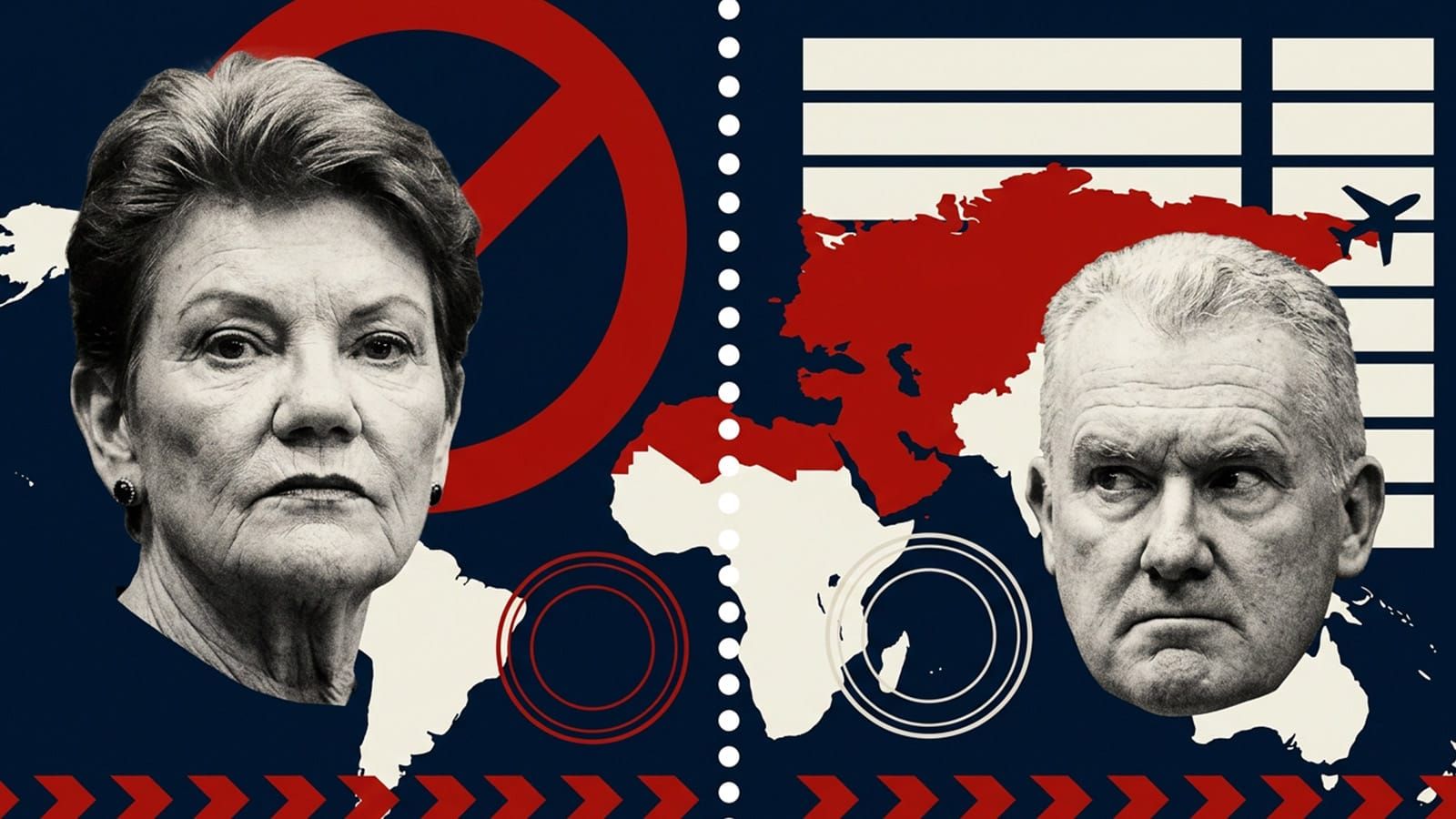
The proposal demands an immediate, statutory freeze on all offshore migration and visa processing from 23 nations currently designated under DFAT’s highest security rating: “Level 4: Do Not Travel.”
The political friction is not merely theoretical. Earlier this year, the Albanese government demonstrated that the machinery for blanket national exclusions is not only legally viable—it is already operational. On March 26, Home Affairs Minister Tony Burke utilized newly minted statutory powers under the Migration Amendment (2026 Measures No. 1) Act 2026 to issue an Arrival Control Determination, effectively barring offshore Iranian visitor visa holders from entering the country.
With that temporary six-month directive expiring on September 26, Hanson is demanding that the government strip away diplomatic selectivity and apply the same unyielding standard across every territory torn apart by civil war, terrorism, and institutional collapse.
The Mechanics of the Blacklist
At the heart of the debate lies DFAT’s Smartraveller advisory database. The department evaluates threat environments across 179 distinct global destinations, grading risks from Level 1 (“Exercise normal safety precautions”) to Level 4 (“Do Not Travel”).
Of those 179 destinations, 26 carry the Level 4 warning across their entire territories. Hanson’s proposal carves out explicit exemptions for three of them: Ukraine, Kuwait, and Bahrain. DFAT records clarify that these three nations are flagged due to external regional escalations and conventional interstate conflict, rather than the systemic internal disintegration, institutional collapse, or rogue-state governance that characterizes the remaining 23.
A line-by-line examination of DFAT’s security briefings details the exact statutory threat profiles assigned to the 23 blacklisted nations:
| Country | Region | Primary Threats Cited by DFAT |
| Afghanistan | Asia | Terrorism, kidnapping, arbitrary detention, armed conflict |
| Belarus | Europe | Spillover from Russia’s war, arbitrary enforcement of local law |
| Burkina Faso | Africa | Terrorism, kidnapping, violent crime |
| Central African Republic | Africa | Terrorism, kidnapping, violent crime |
| Chad | Africa | Terrorism, kidnapping, violent crime |
| Democratic Republic of the Congo | Africa | Armed conflict, violent protests, terrorism, kidnapping |
| Haiti | Americas | Violent crime, kidnapping, acute shortages of fuel, water, and food |
| Iran | Middle East | Armed conflict, civil unrest, state-sponsored arbitrary detention |
| Iraq | Middle East | Terrorism, armed conflict, kidnapping, violent crime (includes Kurdistan Region) |
| Lebanon | Middle East | Armed conflict, civil unrest, terrorism, missile strikes |
| Libya | Africa | Terrorism, violent factional militia clashes, kidnapping |
| Mali | Africa | Terrorism, kidnapping, violent crime |
| Myanmar | Asia | Nationwide civil war, military strikes, armed civil unrest |
| Niger | Africa | Terrorism, kidnapping, violent crime |
| North Korea | Asia | State arbitrary detention, volatile nuclear security posture |
| Palestine | Middle East | Active military operations, armed conflict, civil unrest, terrorism (Gaza & West Bank) |
| Russia | Europe | War with Ukraine, arbitrary detention, drone attacks, conscription risks |
| Somalia | Africa | Active insurgency, terrorism, kidnapping, violent crime |
| South Sudan | Africa | Armed conflict, inter-communal violence (including Juba) |
| Sudan | Africa | Severe civil war, armed conflict, civil unrest, terrorism |
| Syria | Middle East | Armed conflict, airstrikes, terrorism, arbitrary detention |
| Venezuela | Americas | Violent crime, political and economic instability, arbitrary detention |
| Yemen | Middle East | Active armed conflict, airstrikes, kidnapping, terrorism |
Note: Smartraveller entries for Palestine cover Gaza and the West Bank (excluding Jerusalem), while Iraq explicitly incorporates the semi-autonomous Kurdistan Region.
The Legal Precedent: The Iranian Precedent
The federal government’s primary defense against blanket immigration bans has long rested on the premise that Australia’s visa architecture relies on individual, non-discriminatory vetting rather than broad geographic blockades.
That defense was significantly complicated by Minister Tony Burke’s actions on March 26.
Leveraging new provisions under the Migration Amendment (2026 Measures No. 1) Act 2026, Burke enacted an Arrival Control Determination targeting offshore Iranian visitor visa holders. The stated legal justification was not character-based security screenings, but “system integrity.” The Department of Home Affairs argued that escalating geopolitical hostilities in the Middle East created an unacceptable risk that Iranian nationals arriving on temporary visitor visas would refuse or be unable to return home upon visa expiry, converting temporary visas into permanent asylum caseloads.
While the regulation carved out protections for Australian citizens’ immediate family members and existing visa holders, it established a transformative legal precedent: the federal executive can suspend visa pathways for an entire national cohort overnight based on the domestic condition of their home state.
With the six-month determination sunsetting on September 26, the Albanese administration faces a sharp dilemma: extending the order validates national-origin profiling based on home-country volatility, while letting it lapse risks accusations of abandoning border integrity amid soaring migration numbers.
       ┌─────────────────────────────────────────────────────────┐
       │   DFAT Smartraveller Security Advisories (179 Total)   │
       └────────────────────────────┬────────────────────────────┘
                                    │
                                    ▼
       ┌─────────────────────────────────────────────────────────┐
       │         26 Countries Rated "Level 4: Do Not Travel"     │
       └────────────────────────────┬────────────────────────────┘
                                    │
                 ┌──────────────────┴──────────────────┐
                 ▼                                     ▼
   ┌───────────────────────────┐         ┌───────────────────────────┐
   │    Exemptions Carved Out  │         │  Hanson's Proposed Block  │
   │  (Ukraine, Kuwait, Bahrain)│         │       (23 Nations)        │
   │   External Regional Risk  │         │ Internal State Collapse / │
   └───────────────────────────┘         │  Terrorism / Dictatorships│
                                         └─────────────┬─────────────┘
                                                       │
                                                       ▼
                                         ┌───────────────────────────┐
                                         │  Tier 2: The Gray Zones   │
                                         │  (37 Sub-Regional Red     │
                                         │   Zones: India, Pak, PH)  │
                                         └───────────────────────────┘
The Uncharted Second Tier: The 37 Sub-Regional Zones
Beyond the 23 fully red-listed countries lies an even more consequential dimension of the One Nation platform: a secondary tier targeting any nation containing localized “Do Not Travel” zones.
DFAT’s global risk register contains 37 nations where high-risk alerts apply to specific provinces, border strips, or insurgent corridors, even if the capital city remains at Level 2 or 3. This secondary tier intersects directly with Australia’s primary labor and migration pipelines:
-
India: Australia’s largest source of permanent migration (74,540 arrivals in 2024–2025) carries Level 4 warnings for Jammu and Kashmir, the state of Manipur, and the immediate Pakistan border.
-
The Philippines: A core pipeline for Australia’s healthcare sector and nursing workforce maintains Level 4 warnings across central and western Mindanao and the Sulu Archipelago.
-
Pakistan: Singled out by Hanson for extreme personal vetting due to active insurgencies and counter-terror operations in Balochistan and Khyber Pakhtunkhwa.
-
Türkiye & Egypt: Flagged with Level 4 zones along the 10-kilometer Syrian border buffer and North Sinai, respectively.
-
African Partners: Nigeria, Ethiopia, Cameroon, and Algeria all feature sharp geographic bifurcations between stable commercial centers and active conflict zones.
Because One Nation has not codified what proportion of a country must be engulfed in instability to trigger this second tier, the policy creates a massive administrative question mark: Does a narrow border buffer trigger the same visa freeze as a multi-province civil conflict?
Broken Checks and the ISIS Repatriation Flashpoint
The political momentum behind Hanson’s proposal is fueled by growing public skepticism over Australia’s security vetting capabilities.
Hanson has repeatedly attacked the government’s handling of complex repatriations, pointing to the contentious debate surrounding the return of Australian-born wives and children of Islamic State fighters from Syrian detention camps like Al-Hawl and Roj. The controversy heightened after the government refused to definitively rule out taxpayer-funded reintegration and accommodation support, alongside admissions by Minister Burke that existing statutory frameworks constrained the minister’s ability to prevent certain citizens from returning.
When Hanson introduced a 22-page private senator’s bill seeking to empower the Federal Court to permanently bar non-citizens and dual nationals linked to foreign terrorist enterprises from entering the country, the legislation was swiftly defeated. On August 11, Labor and Greens senators joined forces to vote down the bill within 21 minutes, bypassing extended committee inquiry and floor debate.
This legislative standoff unfolds against a backdrop of heightened intelligence warnings. The Australian Security Intelligence Organisation (ASIO) maintains the National Terrorism Threat Level at PROBABLE. In unclassified annual threat assessments, ASIO Director-General Mike Burgess warned that the threat baseline is increasingly volatile, with politically motivated violence, violent extremism across diverse ideologies, and lone-actor radicalization outpacing traditional security tripwires.
Institutional Double Standards: The Sydney University Iran Scandal
Skeptics of Australia’s administrative coherence point to how high-level travel warnings are handled within the nation’s elite public institutions.
A notable case emerged at the University of Sydney, which received $874.3 million in federal government grants in 2024. In late 2023, the university authorized and funded travel to Iran for its Director of the Institute for Transport and Logistics Studies, Professor Behnam Fahimnia, despite DFAT maintaining an unbroken “Do Not Travel” advisory for Iran since 2020.
While Professor Fahimnia maintained the travel was a personal detour to visit aging family en route to an academic conference in Turkey, the university issued three conflicting public explanations within 90 days. It initially categorized the trip in its official annual report as institutional business, later retreated to classifying it as approved personal leave taken in conjunction with business travel, and ultimately attributed the approval to a travel booking system oversight.
The incident triggered an intervention from the federal Department of Education, which issued a formal compliance inquiry to Vice-Chancellor Mark Scott. On August 13, the university announced an independent external review into its international travel governance. To border hardliners, the episode exposed a glaring paradox: an elite, billion-dollar institution treated the nation’s highest security warning as an administrative technicality, highlighting the institutional complacency that Hanson aims to curtail.
The Demographic Backdrop: Record Net Arrivals
The debate over origin-based vetting unfolds amid unprecedented demographic expansion.
Official data released by the Australian Bureau of Statistics (ABS) confirmed that net permanent and long-term arrivals reached an all-time peak of 476,870 for the financial year ending June 30. Analysis published by the Institute of Public Affairs (IPA) verified that this represents the highest gross intake across any twelve-month reporting cycle in Australian history.
       NET ARRIVALS VS. POLICY TARGETS (FY 2024–2025)
       ══════════════════════════════════════════════════════════
       Net Permanent & Long-Term Arrivals: 476,870  [Historic Record]
       Net Overseas Migration (NOM):       306,000  [3rd Highest]
       Labor Stated Policy Target:         225,000
       ══════════════════════════════════════════════════════════
While net overseas migration (NOM)—which measures net population gain based on the 12/16-month residency rule—eased to 306,000, it remains the third highest annual figure on record, substantially overshooting Treasury’s nominal ceiling of 225,000.
With five-year Treasury forecasts projecting an intake of 1.2 million new residents through 2030, migration has become Australia’s central political battleground, touching housing affordability, infrastructure strain, and domestic cohesion. A scheduled address by Minister Burke at the National Press Club intended to clarify the government’s long-term population strategy was abruptly postponed following internal caucus divisions and has yet to be rescheduled.
The Architecture of the Proposed Freeze
In unveiling the mechanics of her proposal, Hanson emphasized that the policy focuses strictly on the nation’s entry points rather than internal enforcement:
-
No Retrospective Deportations: Australian citizens, permanent residents, and existing visa holders currently onshore are exempt from visa cancellations or status reviews.
-
Universal Offshore Freeze: A total moratorium on the lodgment and processing of all new offshore permanent, skilled, student, and visitor visas originating from the 23 listed nations.
-
Removal of the Refugee Exemption: A complete halt to offshore humanitarian and refugee allocations from Level 4 nations, unless intelligence agencies can guarantee 100% biometric and identity verification.
“There should be no refugee loophole,” Hanson stated. “Any future refugee or humanitarian visa from a ‘do not travel’ country should be considered only if the Government and relevant security agencies can give Australians an absolute assurance that the person’s identity has been established and that they present no security risk to Australians.”
                       THE SECURITY VETTING MATRIX
                       ───────────────────────────
   SOURCE COUNTRY INTEGRITY               HOST COUNTRY CAPABILITY
 ┌───────────────────────────┐         ┌───────────────────────────┐
 │ • Destroyed Registries    │         │ • High Asylum Demand      │
 │ • Forged Passports        │ ──────> │ • Intelligence Gaps       │
 │ • Terrorist Data Deficits │         │ • Legal Non-Refoulement   │
 └───────────────────────────┘         └───────────────────────────┘
When you cover international borders and intelligence communities for three decades, you learn that every migration policy rests on a foundational fiction.
The fiction sustaining Australia’s current immigration framework is that modern security vetting is universally capable, technologically omniscient, and capable of distinguishing between bad actors and innocent civilians in any theater on earth.
It cannot. And deep down, every security analyst in Canberra, Washington, and London knows it.
1. The Broken Legitimization of Source-Country Intelligence
The most significant detail consistently overlooked in the daily political coverage is the complete collapse of foundational record-keeping in Level 4 nations.
Western immigration systems do not evaluate applicants in a vacuum. Background checks rely on institutional counter-checks:
-
National police clearances from source governments.
-
Biometric cross-matching against local criminal databases.
-
Verified civil registries confirming birth, parentage, marriage, and military service.
-
Intelligence sharing between domestic security services and host-nation embassies.
In a functioning democracy, these systems work. But what happens when you run a background check in Mogadishu, Port-au-Prince, Khartoum, or Kabul?
In Afghanistan, the civil registry is under the direct administrative control of the Taliban. In Syria, obtaining a genuine passport with a completely fabricated identity from a compromised state registry costs less than $1,500 on the black market. In Haiti, the central police archives in Port-au-Prince have been physically overrun and torched by armed syndicates. In Sudan, the civil data headquarters in Khartoum was gutted during the opening weeks of the clash between the Sudanese Armed Forces and the Rapid Support Forces.
When an immigration officer in Canberra or an overseas processing post reviews an application originating from these zones, they are not conducting an empirical background check; they are reviewing unverified assertions. The source documents are often un-verifiable, the local police forces are either non-existent or hostile, and foreign intelligence officers cannot safely deploy into these territories to conduct field investigations.
The real debate Hanson is provoking is not merely about geography. It is an indictment of administrative transparency: Can a Western nation reliably vet people from societies where civil records have been systematically erased?
2. The Diplomatic Double Standard: The Iran Contradiction
The Albanese government’s most vulnerable flank is its own legal precedent with Iran.
When Tony Burke signed the March 26 Arrival Control Determination, the Department of Home Affairs crossed a major policy threshold. The administration did not claim that every Iranian tourist was an operative of the Islamic Revolutionary Guard Corps (IRGC). Instead, it argued that the instability inside Iran made the entire national cohort a structural immigration risk.
By using state instability as the legal trigger to shut the door on Iran, the government undermined its own standard argument against geographic restrictions.
Why Iran, but not Syria? Why Tehran, but not Sana’a, Tripoli, or Port-au-Prince?
The answer lies in diplomatic realpolitik rather than administrative logic. Iran is an international adversary with no domestic political lobby inside the Australian parliamentary establishment capable of swaying federal swing seats. Expanding that exact same standard to other nations—or acknowledging that sub-regional Level 4 zones in India, Pakistan, or the Philippines present vetting dilemmas—carries immense diplomatic and electoral consequences.
Australia’s bilateral trade agreements with India, strategic defense ties with the Philippines under the ASEAN umbrella, and delicate diplomatic balancing acts across the Global South make it politically unfeasible for Canberra to apply a uniform standard. The result is an inconsistent policy: geographic profiling is deployed against strategic adversaries, while absolute, non-discriminatory vetting is defended when dealing with vital economic and regional allies.
       ┌─────────────────────────────────────────────────────────┐
       │     THE ASYMMETRIC MIGRATION LOOPHOLE                   │
       ├─────────────────────────────────────────────────────────┤
       │                                                         │
       │   TEMPORARY ENTRANT (Visitor / Student / Work)          │
       │                            │                            │
       │                            ▼                            │
       │          Onshore Protection Visa Lodgment               │
       │                            │                            │
       │                            ▼                            │
       │             Article 33 (Non-Refoulement)                │
       │                            │                            │
       │                            ▼                            │
       │    Indefinite Onshore Stay (De Facto Permanent Status)  │
       │                                                         │
       └─────────────────────────────────────────────────────────┘
3. The Unspoken Crisis: The Onshore Asylum Trap
The structural engine driving this entire political battle is Australia’s onshore protection visa architecture.
Under the 1951 Refugee Convention and Australia’s domestic implementation of complementary protection obligations, the principle of non-refoulement is absolute. If a foreign national arrives in Australia on a temporary visa—whether as a tourist, student, or business traveler—and subsequently lodges a protection claim demonstrating a well-founded fear of persecution, Australia cannot legally deport them back to a Level 4 conflict zone.
This creates a structural dynamic that migration policymakers rarely acknowledge publicly:
-
A national from a war-torn country secures a routine, temporary visitor or student visa.
-
Upon clearing customs in Sydney or Melbourne, they lodge an onshore application for a permanent Protection Visa (Subclass 866).
-
Even if the Department of Home Affairs rejects the claim, the applicant enters a multi-year appeals process through the Administrative Review Tribunal (ART) and the federal court system.
-
Throughout this judicial review period—which routinely spans three to seven years due to case backlogs—the applicant remains onshore on a bridging visa with full work rights and Medicare access.
-
If the home country remains classified as a Level 4 war zone, removal remains legally impossible, converting temporary entry into permanent settlement regardless of original visa intent.
This dynamic explains why Minister Burke moved so swiftly against Iranian visitor visas in March. The government was not just managing travel volumes; it was trying to prevent a surge in onshore protection claims that would be legally impossible to reverse. Hanson’s proposal seeks to close this structural loop entirely by locking the front door before the legal mechanisms of onshore protection can be initiated.
4. The Human Cost: The Innocence Penalty
There is, however, an undeniable human cost to blanket national exclusions that must be weighed in any objective analysis.
The fundamental flaw of broad geographic bans is that they penalize individuals based entirely on the crimes, extremism, or incompetence of the regimes they are trying to escape.
Consider the secular academic in Kabul who spent two decades educating young women, now running from Taliban execution squads. Consider the Coptic Christian in Upper Egypt, the Ahwazi Arab or Baháʼí artist in Shiraz, the democratic dissident in Caracas, or the ethnic minority doctor in Myanmar’s Karen State. These individuals are not threats to Australia’s national security; they are the primary victims of the very violence that triggers DFAT’s Level 4 warnings.
A blanket ban on visa processing based purely on geography removes administrative nuance. It treats the persecutor and the persecuted as an undifferentiated national threat. When a Western democracy closes its offshore humanitarian pathways from the world’s most dangerous environments, it does not stop the human impulse to flee; it simply shuts down orderly, vetted pathways, driving desperate people directly into the hands of maritime human-smuggling syndicates and irregular border crossings.
       ══════════════════════════════════════════════════════════
       THE POLICY BALANCING ACT
       ══════════════════════════════════════════════════════════
       NATIONAL SECURITY MANDATE     HUMANITARIAN RESPONSIBILITY
       ─────────────────────────     ───────────────────────────
       • Zero Risk Tolerance         • Refuge for the Persecuted
       • Integrity of Records        • Moral Obligation of Wealthy
       • Prevention of System Abuse    Democracies
       • Defending Social Cohesion   • Strategic Global Engagement
       ══════════════════════════════════════════════════════════
The clash between Pauline Hanson’s proposed blacklist and the Albanese government’s case-by-case vetting approach marks a fundamental debate over the future of national sovereignty in an era of global volatility.
The debate exposes a central tension within Australia’s immigration policy: Can a Western democracy continue to operate an individualized, rules-based visa system when large parts of the world are descending into structural lawlessness?
For the political class in Canberra, pretending that every visa applicant from a failed state can be thoroughly vetted is becoming increasingly difficult to sustain. The intelligence community knows that record-keeping in conflict zones is broken, the public sees the strain of record-breaking population growth on domestic infrastructure, and the government itself has already demonstrated that it will freeze visas from an entire country when systemic pressures demand it.
Yet, shutting the door completely based on a map drawn by diplomats carries deep moral consequences. It risks abandoning the fundamental humanitarian commitments that have defined Australia’s post-war identity, while ignoring the complex diplomatic alliances required to navigate an unstable world.
As the September 26 expiration of the Iran visa ban approaches, the Albanese government will be forced to make a defining choice. Letting the ban expire will be seen by critics as a retreat on border integrity; renewing it will prove that the mechanism for Hanson’s 23-country blacklist is not just possible, but already active policy.
In a century that will be increasingly defined by climate shocks, geopolitical fragmentation, and state collapse, Australia must confront an uncomfortable question:
When the world outside our borders is on fire, does true national sovereignty mean building a higher wall around the entire perimeter, or preserving the courage and capacity to rescue the innocent from the flames?