
The Social Engineering of Tolerance: The State, the Syllabus, and the $66 Million Strategy
The Press Room at Lakemba
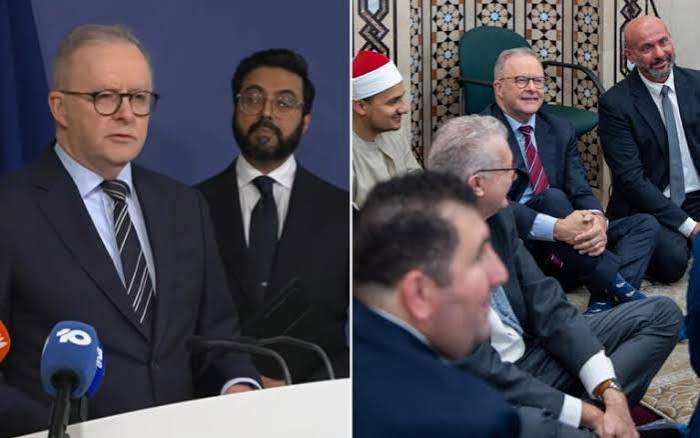
The political maneuver unfolded in the middle of July 2026, framed by the modern optics of executive urgency. Prime Minister Anthony Albanese stepped up to a microphone in Sydney to announce a massive, unprecedented financial and structural intervention into the fabric of Australian civil society: a $66 million funding package engineered exclusively to combat “Islamophobia” and restructure the state’s approach to social cohesion.
[Special Envoy Report Submitted] ──> [10-Month Cabinet Assessment] ──> [35 of 54 Recommendations Adopted] ──> [$66M Structural Allocation]
The sweeping package marks the official executive response to a landmark, heavily scrutinized report delivered ten months prior by the administration’s Special Envoy to Combat Islamophobia, Aftab Malik. Of the 54 systemic recommendations compiled by the Envoy, the Labor Cabinet formally adopted 35, committing tens of millions of taxpayer dollars to embed anti-discrimination training across the entire continuum of public life.
Pre-Schools, Syllabi, and the Classroom
The absolute cornerstone of the government’s newly announced strategy is the establishment of a powerful, central body named the Islamophobia Education Taskforce. Operating alongside a newly minted Social Cohesion Education Advisory Council, this taskforce has been handed an extraordinary, expansive mandate by the Department of Education: to review, alter, and monitor anti-racism frameworks at every single tier of the Australian learning lifecycle.
The scope of the Taskforce spans the complete national education matrix:
-
Early Childhood: Developing behavioral and ideological intervention guidelines for pre-school children and childcare settings.
-
Primary and Secondary Schools: Launching a comprehensive, focused review of the national Australian Curriculum to formally embed structural modules on religious and racial tolerance.
-
The Higher Education Sector: Instituting a mandatory, legally binding national framework for anti-racism across all public and private universities.
Under the incoming legislation, tertiary institutions will be legally required to prevent and actively respond to incidents of Islamophobia on campus. To support this mandate, the funding allocation includes dedicated mental health and wellbeing support systems specifically tailored for Muslim students within both the public school system and specialized Islamic educational institutions.
Securing the Infrastructure of Faith
Beyond the classroom, the financial architecture of the response details a highly calculated distribution of resources designed to satisfy long-standing security concerns voiced by Islamic community organizations:
-
The Security Fund: A massive $41.9 million cash injection allocated directly to Muslim community groups to fortify the physical security, surveillance infrastructure, and perimeter protections of “faith-based places” and houses of worship.
-
The Sports Complex: A standalone $15 million capital pledge dedicated entirely to the construction and delivery of a state-of-the-art sports center engineered for Muslim athletes.
-
The Bureaucratic Core: An allocation of $2.6 million provided directly to the Office of Multicultural Affairs to fund centralized anti-Islamophobia campaigns, alongside an additional $6 million pool for targeted community psychological and mental health support services.
                ┌──> $41.9 Million: Physical Security & Fortification of Faith Places
                │
$66 MILLION   ──> $15.0 Million: Standalone Sports Center for Muslim Athletes
ALLOCATION      │
                ├──> $6.0 Million: Targeted Mental Health & Institutional Student Support
                │
                └──> $2.6 Million: Bureaucratic Expansion for Multicultural Affairs
The New Policing Arm
The structural changes extend deep into the apparatus of national security and public administration. The Albanese government announced the creation of a brand-new Australian Federal Police (AFP) Social Cohesion Team, functioning alongside heavily expanded AFP Community Liaison Teams tasked with tracking and responding to micro-level incidents of discrimination within suburban communities.
Simultaneously, the administration will accelerate the deployment of a comprehensive, centralized national hate crimes database. To ensure compliance with the new civil order, mandatory Islamophobia training modules will be rolled out across the state, legally encompassing Members of Parliament, the entirety of the Australian Public Service, local law enforcement bodies, and professionals working within the justice and legal systems.
The Line on Terror and Taboo
Crucially, the government did not capitulate to the entirety of the Envoy’s demands. Among the 19 recommendations pushed aside or deferred by the Cabinet was a highly controversial proposal by Aftab Malik to force an independent, comprehensive review into Australia’s existing counter-terrorism frameworks. Malik argued that current national security metrics inherently discriminate against Muslim populations.
Prime Minister Albanese explicitly stated that the decision to reject this specific overhaul was the direct result of urgent, unyielding advice from the nation’s primary domestic and international intelligence agencies. Furthermore, the government deferred immediate action on Malik’s demands for sweeping new “hate speech” and “hate crime” legislation that would outlaw religious discrimination entirely.
| Legislative Milestone | Proposed Recommendation | Final Cabinet Decision |
| Curriculum Restructuring | Mandatory anti-racism modules from pre-school to university | Adopted: Islamophobia Education Taskforce established |
| Terror Law Revisions | Independent review of security laws for inherent anti-Muslim bias | Rejected: Vetoed following clear advice from intelligence agencies |
| Hate Crime Tracking | Deployment of a national database and mandatory MP training | Adopted: Implementation accelerated across public service |
The Political Precipice
The public declaration was met with a mixed, highly calculated response from peak Islamic bodies. In a rare joint press release, the Alliance of Australian Muslims (AAM) and the influential Australian National Imams Council (ANIC) characterized the $66 million strategy as an “unprecedented and important step in the right direction.” However, the groups maintained a firm political posture, noting that “much more remains to be done” and labeling the omission of the counter-terror and hate-speech overhauls as a significant systemic failure.
The reality of this announcement cannot be decoupled from its intense, volatile political backdrop. The $66 million funding announcement arrived exactly four months after a deeply embarrassing, physically hostile incident in Western Sydney.
In March, during a high-profile political visit to the Lakemba Mosque—Australia’s largest Islamic house of worship—Prime Minister Albanese and his senior Immigration Minister, Tony Burke, were aggressively heckled, abused, and chased from the precinct by an enraged crowd of local Muslim constituents furious over the administration’s foreign policy stances in the Middle East. The radical financial pivot on display on Saturday is viewed by many as a desperate, direct attempt to repair a broken political alliance in seats the government cannot afford to lose.
My Professional Perspective
When you spend thirty years working as an investigative journalist, tracking the survival mechanisms of democratic governments across the globe, you learn to look past the high-minded rhetoric of harmony and social cohesion. You learn to ignore the press release and look directly at the engineering of the budget line.
What Anthony Albanese announced on Saturday is not merely a public safety measure or a standard community grant program. It is the formal, desperate deployment of the state’s financial treasury to buy back a collapsing voter base, wrapped in the protective language of educational enlightenment. It is the architectural blueprint for the ideological management of the next generation of Australian citizens.
1. The Pre-School Panopticon
The most astonishing, overlooked, and genuinely chilling aspect of this entire $66 million package is the explicit extension of the Islamophobia Education Taskforce into the realm of early childhood education. We are not talking about university campuses, where adult students engage in volatile geopolitical debates. We are talking about toddlers—children aged three and four, sitting in daycare centers and pre-schools, who have not yet mastered basic literacy or social socialization.
From an investigative standpoint, this represents an extraordinary expansion of the state’s ideological reach. By introducing concepts of structural, anti-Muslim racism and systemic discrimination into the daycare curriculum, the government is executing a profound psychological intervention. They are taking a highly complex, historically charged, adult geopolitical conflict and translating it into behavioral policing for toddlers.
The question an investigative analyst must ask is simple: what does “Islamophobia training” for a three-year-old look like? Who writes the syllabus? By injecting these hyper-politicized, distinct racial and religious categorizations into the minds of children before they even possess a concept of national identity, the state is actively institutionalizing the very divisions it claims it wants to erase. It is the construction of a permanent, state-managed grievance infrastructure that begins in the cradle.
2. The Transactional Currency of Lakemba
Let us look coldly at the raw, transactional politics beneath this announcement. The mainstream media will frame this $66 million grant as a compassionate, objective response to rising community tensions. But an investigative reporter looks at the calendar. Four months ago, the Prime Minister and the Immigration Minister were physically chased out of the Lakemba Mosque by an aggressive, unified crowd of their own constituents.
For the modern Labor Party, the suburbs of Western Sydney are not just ordinary electorates; they are the literal, demographic life support system of their federal majority. Electorates like Blaxland and Watson are home to the highest concentrations of Islamic voters in the Southern Hemisphere. The open rebellion at the gates of the Lakemba Mosque sent an absolute shockwave of terror through the Labor factions. They realized that their historical, decades-long monopoly on the multicultural vote was disintegrating over foreign policy grievances.
The Structural Transaction: The $66 million package is a classic piece of state-funded political repair work. It is an indirect, massive transfer of public revenue to community gatekeepers, designed to buy back the compliance of an alienated voter base ahead of a highly competitive federal election cycle.
By funding standalone sports centers, dedicated mental health pools, and physical security transformations for specific faith-based institutions, the government is effectively turning the public treasury into a political insurance policy. They are sending a clear, material message to the influential clerical and community leadership: We will fund your infrastructure, we will legislate your protection, and we will institutionalize your grievances—if you return your postcodes to the party fold.
[Political Rebellion at Lakemba] ──> [Threat to Labor Majority Seats] ──> [$66M Cash / Institutional Subsidization] ──> [Re-Securing Community Gatekeepers]
3. The Rejection of the Security Veto
Perhaps the most crucial, telling detail of the entire announcement is the recommendation that the Prime Minister did not adopt. Special Envoy Aftab Malik’s report explicitly demanded an independent overhaul of Australia’s counter-terrorism laws, asserting that the very definitions of terror within the Commonwealth are inherently biased against Muslims.
Albanese’s public admission that this recommendation was flatly rejected due to direct, urgent advice from national security agencies tells us everything we need to know about the silent civil war playing out behind the closed doors of the Cabinet room. The country’s intelligence apparatus—ASIO, the AFP, and the peak defense directorates—essentially stepped in and drew a hard, unyielding line on the sand. They warned the executive branch that if they allowed a political envoy to compromise the legal, operational definitions of counter-terrorism to satisfy local community activists, the state would lose its fundamental ability to monitor and disrupt domestic radicalization.
This rejection exposes the absolute limit of the government’s multicultural appeasement strategy. The Prime Minister was entirely willing to hand over the school curriculum, accelerate hate crime databases, and fund elite sports complexes. But when the progressive ideological agenda collided head-on with the raw, uncompromising survival instinct of the national security state, the security agencies exercised an absolute veto. The fact that peak bodies like ANIC immediately labeled this omission a “glaring failure” tells us that the $66 million payout has bought the government a temporary truce, not a permanent peace.
Unanswered Questions for the Department of Education
As this massive, multi-tiered taskforce prepares to deploy its personnel across the continent, several critical investigative questions must be brought to light:
-
Who monitors the Monitors? What specific external oversight mechanisms will govern the Islamophobia Education Taskforce? Will its members be drawn exclusively from political advocacy groups, or will independent civil liberties experts have a seat at the table?
-
The Evidentiary Baseline: The Prime Minister cited a significant “rise in Islamophobic incidents” to justify the $66 million allocation. What percentage of these reported incidents have been forensically verified by law enforcement, and what percentage are drawn from subjective, unverified online reporting databases?
-
The Curriculum Veto: During the “focused review” of the Australian Curriculum, will local parents and school boards possess a statutory right to veto or opt their children out of early-childhood and primary-school anti-discrimination training modules?
The Fragmentation of the Commons
What occurred on Saturday morning in Sydney represents a profound, systemic shift in how the Australian state conceptualizes the identity of its citizens. We are watching the formal transition away from the historic, traditional model of the democratic commons—where the state treats every citizen as an identical, individual legal actor under a singular rule of law—into a fragmented, tribalized managerial system.
By allocating specific, multi-million-dollar pools of public money to distinct religious groups, creating highly specialized police teams tasked with managing suburban social cohesion, and rewriting the school syllabus to police the behavioral expressions of toddlers, the government is permanently institutionalizing identity politics into the machinery of state governance.
A Thought-Provoking Reality
When the financial packages are distributed and the new curriculum frameworks are formally printed, the fundamental promise of a unified, egalitarian society recedes further into the background. The state is no longer a neutral arbiter of public infrastructure; it has transformed into a highly active manager of ideological compliance, using its immense financial power to navigate the volatile demographic fractures of its own making.
We must look directly past the comforting, highly polished public relations presentation of the Prime Minister’s press room and confront the stark, uncomfortable truth of our current trajectory.
If a Western democracy reaches a historical point where its leadership must spend $66 million of public revenue creating specialized educational taskforces to police the language of pre-school children and dedicated federal police units to manage suburban social cohesion, has its multi-generational experiment with borderless multiculturalism actually produced a harmonious society—or has it simply created an incredibly expensive, fragmented landscape that requires constant financial and bureaucratic intervention just to keep the peace?
To review the complete legal framework, the full list of adopted recommendations, and the detailed operational strategy behind the newly formed Islamophobia Education Taskforce, you can examine the official Australian Government National Response to the Special Envoy Report. This broadcast documentation provides the essential administrative and political context necessary to understand how these sweeping changes will be deployed across the national curriculum and the public service.