
Exporting Fuel, Rejecting Power: The Uranium Deal That Reopened Australia’s Nuclear Divide
Background
Australia holds roughly one-third of the world’s known uranium reserves — more than any other nation on Earth. For decades, it has been a reliable global supplier of nuclear fuel, selling to countries across North America, Europe, and Asia under strict international safeguards. Yet for just as long, the country has maintained a legal and political ban on using that same fuel to generate nuclear power within its own borders.
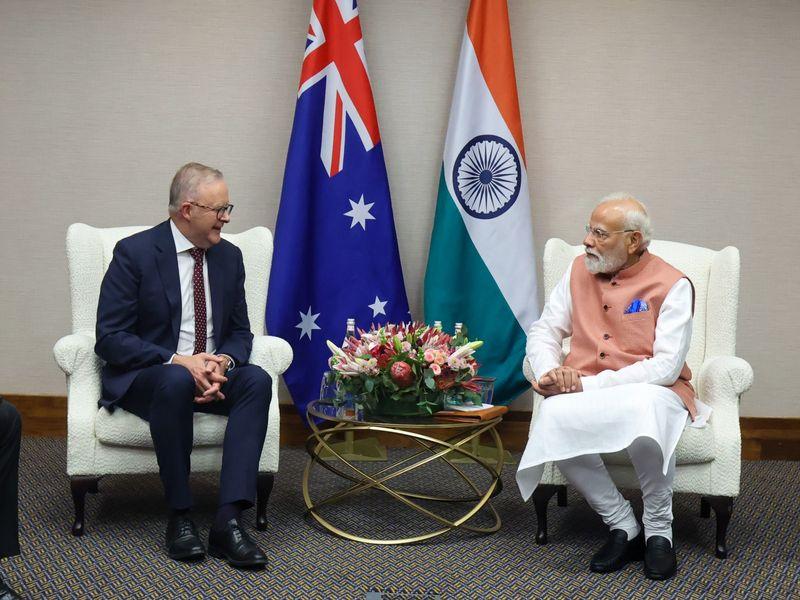
That contradiction has been a source of political friction for years. Now, it has exploded back into the national spotlight, triggered by a landmark agreement struck between Australian Prime Minister Anthony Albanese and Indian Prime Minister Narendra Modi. The deal will expand Australian uranium exports to India, supporting its fast-growing civilian nuclear program — and reigniting one of Australia’s most divisive debates.

Main Events
The announcement came following high-level talks between the two leaders, billed as a major step forward in the Australia–India Comprehensive Strategic Partnership. Under the terms, Australia will supply uranium to India for use in its civilian nuclear power plants, with all shipments subject to oversight by the International Atomic Energy Agency (IAEA) to ensure the material is used only for peaceful purposes.
Government and Supporters’ View
The Albanese government frames the agreement as a triple win: economically, strategically, and environmentally.
- Economic benefit: It opens a new, long-term market for Australia’s mining sector, creating jobs and export revenue while strengthening ties with one of the world’s largest and fastest-growing economies.
- Strategic alignment: India is now one of Australia’s closest partners in the Indo-Pacific region. The deal deepens cooperation between two major democracies on trade, security, and technology at a time when regional competition is rising.
- Climate and energy goals: Ministers argue that expanding nuclear power in countries like India helps reduce reliance on coal and other fossil fuels, cutting global emissions while meeting rising demand for electricity.
Political Opposition and Criticism
Within hours of the announcement, critics seized on what they call the central inconsistency of the policy. Former Deputy Prime Minister Barnaby Joyce — a long-time advocate for domestic nuclear energy — described the decision as “moronic.” His argument is direct: If Australian uranium is safe enough to generate electricity in India, France, or Japan, why is it not safe enough to generate power for Australian homes and businesses?

Joyce and his allies claim the government is denying Australians access to a proven, low-emission energy source used by more than 30 countries worldwide. They point to modern reactor designs that produce far less waste than older technology and can operate continuously for months, providing stable power to complement variable renewables like wind and solar.
On the other side of the argument, the Labor government and its supporters stand firm. They argue:
- Cost and timeline: Building nuclear power stations requires tens of billions of dollars in upfront investment, complex regulatory reform, and at least 10–15 years before the first unit comes online.
- Better alternatives: They maintain that Australia’s abundant solar, wind, hydro, and battery storage resources can deliver reliable, affordable, zero-emission energy faster and more cheaply than nuclear.
- Policy consistency: The government notes that selling fuel is not the same as building reactors — each country sets its own rules based on its own geography, grid, and economic conditions.
Key Facts
- Agreement: Australia will expand uranium exports to India, under IAEA safeguards, for civilian energy use.
- Economic value: Strengthens export income and long-term contracts for Australia’s uranium mining industry.
- Strategic goal: Reinforces partnership with India amid shifting Indo-Pacific geopolitics.
- Domestic policy: Australia currently prohibits nuclear power generation, a position Labor has reaffirmed.
- Debate trigger: Critics argue the deal highlights a contradiction; supporters say it is consistent with both trade and climate goals.
- Global context: Nuclear power provides around 10% of the world’s electricity, and is being reconsidered in many nations as part of net‑zero plans.
2. My Professional Perspective
Having reported on energy policy, mining, and climate politics across Australia and the Asia‑Pacific for three decades, I can tell you this: The real story here is not just about uranium or trade — it is about what kind of future Australia wants to build, and what it is willing to rule out.
What Most Observers Overlook
At first glance, this looks like a simple trade‑off: economic gain abroad vs. political principle at home. But three deeper points are often missed.
First, the contradiction is more political than technical. It is perfectly possible — and quite common globally — for a nation to export fuel without operating its own reactors. Canada, for example, sells uranium widely while using nuclear power domestically; Kazakhstan exports most of its uranium but generates very little nuclear electricity. The real question is not “Can we sell it if we don’t use it?” but “Why have we ruled it out entirely?” That is where the argument shifts from policy to ideology.

Second, the timing of the debate matters. When Australia’s nuclear ban was formalised decades ago, it was based largely on concerns about waste management, cost, and the availability of cheaper alternatives. Today, those assumptions are being tested: energy prices have risen sharply, grid reliability has become a major political issue, and many countries are bringing nuclear back into their climate plans. The debate is no longer “nuclear or renewables” — it is increasingly “what mix gives us the most stable, affordable, and low‑emission power?”
Third, the deal changes the conversation, not just the trade figures. By agreeing to supply India, Australia has implicitly endorsed nuclear energy as a legitimate part of the global low‑carbon transition. It becomes harder for politicians to say “this technology is too risky or too expensive” while simultaneously selling the fuel that makes it work. That inconsistency is what gives Barnaby Joyce and his supporters their strongest political ammunition.
The Deeper Meaning Behind the Debate
This story reveals two competing visions for Australia’s future.
- One vision sees Australia as a resource supplier only: Dig it up, sell it overseas, and let others use it. In this view, Australia’s energy future lies entirely in its vast renewable potential — sun, wind, and water — and nuclear power is an unnecessary distraction that would slow down the transition.
- The other vision sees Australia as a nation that should use its own resources to secure its own future: If it has the fuel, the expertise, and the goal of net‑zero emissions, why not build a diverse energy system that includes nuclear as well as renewables?
It also exposes a wider truth about climate policy: As countries try to cut emissions while keeping the lights on, there is no single “right” path. Nations are choosing different mixes based on their geography, politics, and economy. For Australia, the decision to exclude nuclear was once seen as clear‑cut; now it looks like a choice that comes with its own costs and trade‑offs.
Why This Matters Beyond Politics
The outcome of this debate will shape more than just power bills:
- Energy security: A more diverse energy mix reduces the risk of blackouts or price spikes when wind or solar output drops.
- Industrial future: Heavy industries such as steel, aluminium, and hydrogen production require reliable, high‑temperature power — something nuclear can provide alongside renewables.
- Climate targets: Whether nuclear helps Australia reach its 2050 net‑zero goals faster, or whether the investment required would be better spent elsewhere, remains a central question.
Unanswered Questions
As the discussion unfolds, these are the critical questions still waiting for clear answers:
- If Australia accepts nuclear as safe and useful in other countries, what specific barriers make it unsuitable here?
- Would domestic nuclear generation actually lower or raise long‑term electricity prices?
- Can the industry be regulated safely and affordably, given Australia’s low population density and vast distances?
- Would including nuclear in the energy plan accelerate or delay the rollout of renewables?

Beyond the Headline
In the end, this uranium deal does two things: It strengthens Australia’s trade and strategic position, but it also tears the cover off an argument that has been simmering for years.
It forces voters and leaders to ask a simple but profound question: Are we making a choice based on evidence and practicality — or are we sticking to an old rule just because it is familiar?

3. Conclusion

The agreement to supply uranium to India is more than just another export deal. It is a mirror held up to Australia’s energy policy, showing both its strengths and its contradictions.
On one hand, it opens new markets, builds alliances, and contributes to global efforts to cut emissions. On the other, it highlights a line in the sand that many now question: We trust this fuel to power the world, but not ourselves.

The Albanese government has defended its position, and it has the support of many who believe renewables alone are the best way forward. But the voices calling for change are growing louder — and the arguments they raise cannot be ignored forever.
As Australia looks ahead to decades of energy transition, this debate will only intensify. And at its heart, it comes down to one simple choice: Will Australia continue to watch its own resources power other nations’ futures — or will it finally decide what kind of energy future it wants for itself?