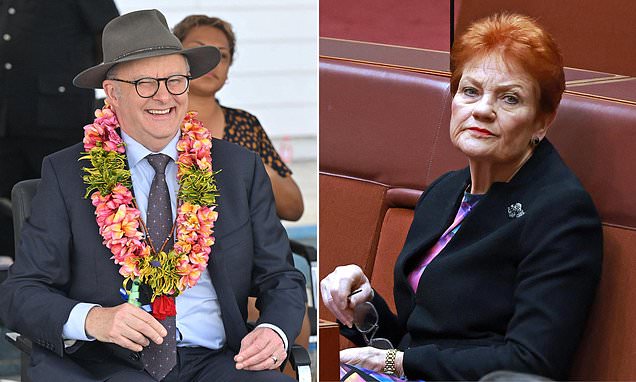
Fresh polling blow for Pauline Hanson as One Nation support slips again after her controversial speech. u1

Poll Slump: One Nation Support Drops Sharply After “Monocultural” Speech — What the Numbers Tell Us
Just weeks after Pauline Hanson delivered a widely reported address at the National Press Club in June, her party One Nation has suffered a clear reversal in public support. The latest results from Roy Morgan show the party’s primary vote falling for the second consecutive week, marking a significant decline from its recent highs.
The Poll Numbers
The survey was conducted between June 29 and July 5, 2026, interviewing 1,584 Australian voters. Key findings include:
- One Nation: Down 3.5 points to 22.5% — following a 5.5-point drop the previous week. Total decline from its peak of 31.5% is now 9 percentage points in just two weeks.
- Labor: Steady at 28%, remaining the largest party nationally.
- Coalition: Unchanged at 21.5% (Liberals 19%, Nationals 2.5%).
- Greens: Up 1 point to 14%.
- Independents and other parties: Up 2.5 points to 14%.
The drop is broad-based: Roy Morgan reports One Nation’s support has fallen at least 10 points across all major capital cities and in Australia’s three most populous states — New South Wales, Victoria, and Queensland.
The Turning Point
The decline coincides directly with Hanson’s National Press Club appearance, where she argued that Australia “cannot be multicultural” and must instead become a “monocultural society” built around a single shared identity. The speech drew immediate attention, both from supporters who welcomed the clarity of her message and from critics who described it as divisive and out of step with Australia’s modern reality.

Other Polls Confirm the Trend
This is not an isolated result. Two other recent surveys tell the same story:
- Newspoll: Labor up 3 points to 33%, One Nation down 2 points to 29%, Coalition at a record low 17%, Greens at 13%.
- RedBridge Group / Financial Review: Labor up 2 points to 30%, overtaking One Nation which fell 2 points to 29%, Coalition at 18%, Greens at a record high 14%.
In terms of projected outcomes, Roy Morgan estimates that if a federal election were held today, Labor would win a majority government, regardless of whether One Nation or the Coalition emerged as the main rival in marginal seats. On the traditional two-party preferred measure, Labor leads 55–45, an increase of 1.5 points, and even using 2025 preference flows, Labor still holds a solid lead at 54–46.
After months of rising numbers that sparked debate about the party’s potential influence, One Nation now faces a clear correction — and the question of whether its recent peak was a temporary surge or a lasting shift in Australian politics.
My Professional Perspective
After three decades covering elections and political cycles across the English-speaking world, I have learned one rule above all: Polls are not just numbers — they are snapshots of how voters react to messages, and how those messages land in the real world. This sharp fall for One Nation tells us far more than who is leading or trailing right now. It reveals three critical truths about Australian politics that are easy to miss in the daily noise.
What Most Analysts Are Overlooking
First, we often confuse protest support with endorsement of policy. One Nation’s rise earlier this year was driven overwhelmingly by frustration: frustration over the cost of living, housing shortages, and the feeling that the major parties had lost touch. Many voters were not saying “We agree with every policy” — they were saying “We want someone who sounds like they care.”
Hanson’s Press Club speech changed that. By putting forward a clear, hardline position on multiculturalism, she stopped being a general voice of discontent and started being a specific advocate for a controversial vision of Australia. For many voters who had supported her as a protest, that clarity was a line they were not willing to cross. The drop is not a rejection of all her concerns — it is a rejection of this particular solution.
Second, the decline is geographically telling. Falling support in Queensland, New South Wales, and Victoria — the states where One Nation had made its biggest gains — suggests the message resonated most strongly in regions already feeling economic strain, but lost ground once the conversation shifted from “costs and jobs” to “culture and identity.” It is a reminder that while economic anxiety can open doors, cultural division can close them just as fast.
Third, look at where the lost votes are going. They are not returning in large numbers to the Coalition — which remains stuck at historic lows. Instead, they are spreading to Labor, the Greens, and independents. This confirms that the shift is not a swing back to the old two-party system; it is a sign of a fragmented electorate that wants solutions, not just slogans.
The Deeper Meaning: Identity vs. Economy
The core of this shift is a tension that runs through almost every Western democracy today: When does the conversation about “who we are” help — and when does it get in the way of solving “what we need”?
Hanson’s argument was simple: “If we have one culture, we will have unity, and with unity we will solve our problems.” But the poll results suggest many Australians see it differently. Their view appears to be: Multiculturalism is not the cause of our economic difficulties — it is part of what makes Australia strong and prosperous.
Research across decades shows that nations with open, diverse economies tend to grow faster, attract more investment, and fill labor shortages in healthcare, construction, and agriculture. To many voters, linking the cost of groceries or housing prices to cultural diversity feels like a misdiagnosis. It changes the conversation from “How do we fix our economy?” to “Who do we blame?” — and when that happens, many voters step back.
Why This Matters Beyond the Polls
This story matters because it answers a question raised in our earlier analysis: How far can protest support go before it hits a ceiling?
One Nation’s experience shows that ceiling is real. You can win support by pointing out problems, but you cannot sustain it by offering solutions that challenge the national identity most people have come to accept. Australia’s identity today is not just “white, Anglo, and rural” — it is urban, suburban, regional, Indigenous, migrant, and mixed. It is multicultural by history, by law, and by daily life. Attempting to redefine it as “monocultural” asks voters to reject a reality they live every day.

At the same time, the fact that Labor has only stabilized rather than surged shows the challenge for the government. It has benefited from One Nation’s fall, but it has not yet won back the trust of those who are deeply dissatisfied. The discontent that lifted One Nation has not disappeared — it has just moved into a holding pattern.
The Unanswered Questions
This shift leaves us with four key questions that will shape the coming years:
- Can One Nation rebuild its support without doubling down on cultural issues? If it returns its focus to living costs and jobs, could it recover? Or will the “monocultural” label stick?
- Will Labor use this window to deliver real change? Rising in polls is easy; fixing housing, energy prices, and wages is hard. If it fails, the protest vote will simply find another home.
- What does this mean for the Coalition? Stuck at just over 20%, it is being squeezed from both sides. Can it offer a clear vision that is neither extreme nor bland?
- Is multiculturalism now settled as part of Australia’s future? This poll suggests yes — but only if the nation can deliver prosperity and fairness for everyone, regardless of background.
Conclusion
The sharp fall in One Nation’s support is more than a temporary dip in the numbers. It is a clear signal from Australian voters: They want change, but they do not want to change who they are.
Pauline Hanson’s speech gave the country a clear choice: to move toward a narrower, monocultural vision, or to keep building a diverse nation while fixing its problems. The early polling verdict is in: Australians want the second path. They want security, affordability, and opportunity — but they are not willing to trade their identity as a welcoming, multicultural society to get it.
Yet this is not the end of the story. The frustration that fueled One Nation’s rise remains. If the major parties ignore the reasons voters looked elsewhere, the cycle will repeat itself, and another political force will emerge to capture that same energy.
So here is the question we must ask ourselves, beyond the headlines and the numbers: Can Australia remain a strong, united, and prosperous nation while staying true to its multicultural character — and if so, what policies and leadership will actually deliver that future?