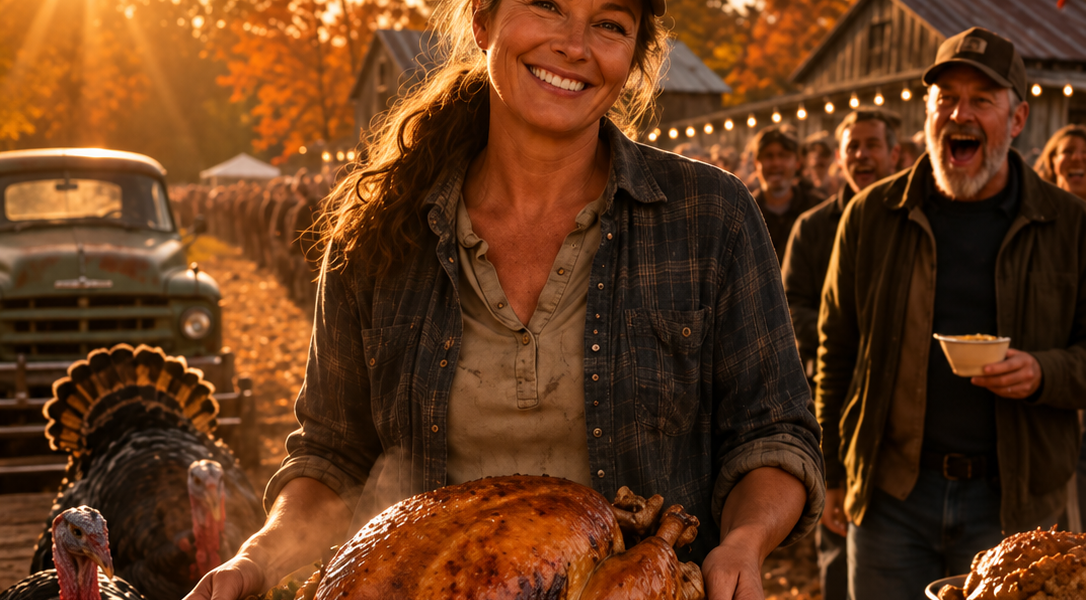
She Bought 300 Turkeys in the Dead of Summer — The Whole County Laughed Until Thanksgiving. t1

She Bought 300 Turkeys in the Dead of Summer — The Whole County Laughed Until Thanksgiving
The morning of the auction, there were 300 turkey poults nobody wanted, packed into wire crates under a tin awning behind the feed cooperative in Buck Hollow. And the sun was already climbing high enough that the men leaning against the loading dock had taken off their caps to wipe their foreheads. It was the third week of June, which everyone in the county knew was the wrong week, the wrong month, and very likely the wrong year to be buying turkeys.
Anyone with sense bought poults in March or early April, raised them through the cool of spring, fattened them through the long days of August, and had them ready for the slaughterhouse by the first hard frost. You did not buy turkeys in June. You especially did not buy 300 of them, which was what a misjudgment by a hatchery up in Wytheville had stranded that morning on the concrete behind the co-op, peeping faintly under the heat, waiting for somebody to take pity or take a loss.
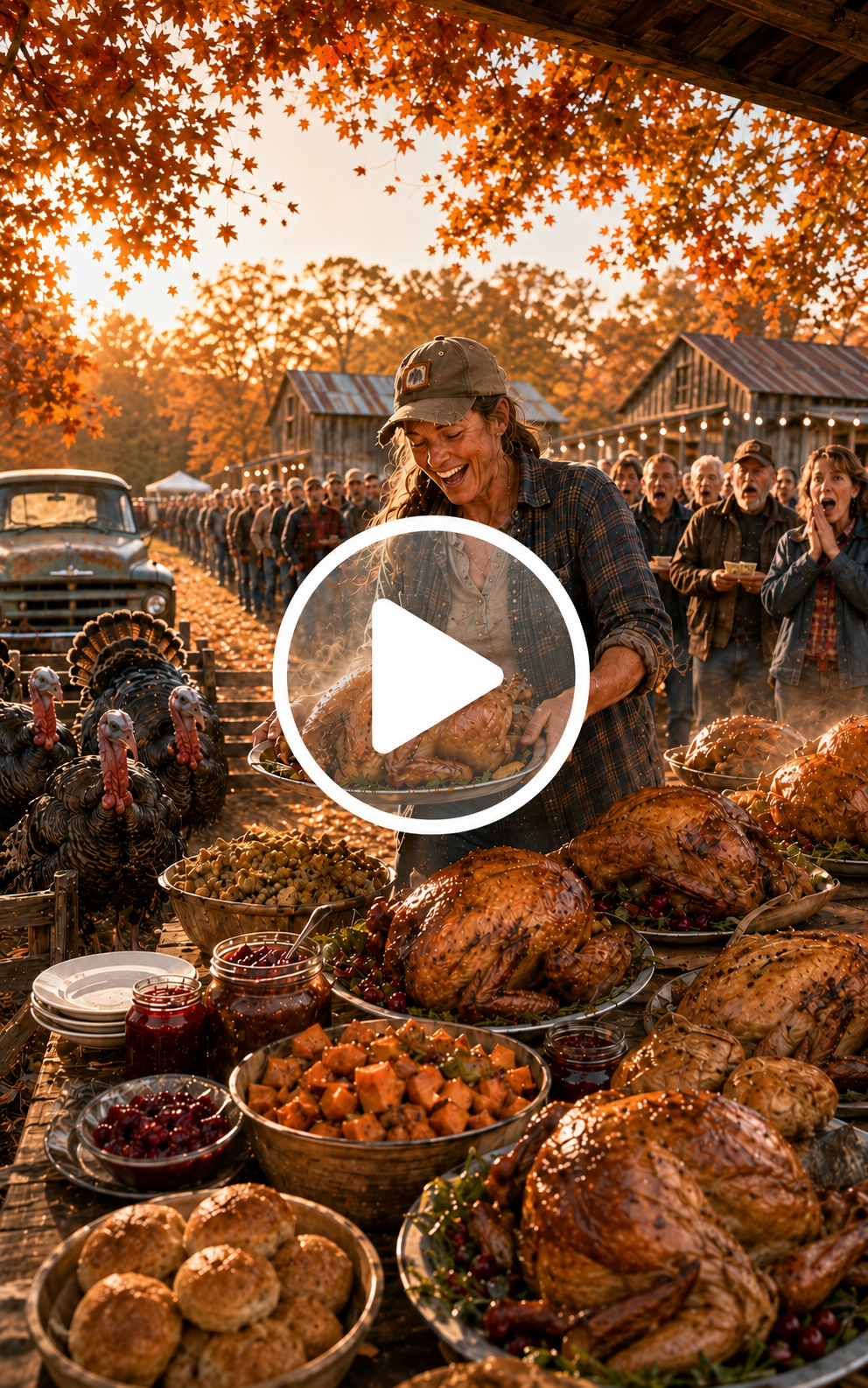
The auctioneer had already given up on the lot. He had tried to break it into smaller pens of 50, then 25, then 10, and watched men shake their heads each time. Too late in the season. Too many at once. Too much feed between now and any holiday that mattered. The poults would eat themselves into a deficit before they were old enough to put weight on.
And any bird raised through the worst heat of July and August in Southwest Virginia was going to be a stringy, panting, half-feathered disappointment by Thanksgiving, if it lived that long. So, when Hattie Boone stepped through the side door of the co-op in a faded blue work shirt and her grandfather’s old canvas trousers and asked, in a voice no louder than necessary, what it would take to buy the whole lot, the room went still in the particular way rooms go still when something is about to be remembered for a long time.
She was 23 years old. She’d been back in the county 9 months. She had walked the 4 miles down from her grandmother’s farm on Pine Branch Road because the truck was, in her grandmother’s phrase, composing its own obituary in the front yard. The auctioneer named a price low enough to be almost insulting to the hatchery.
And Hattie looked at the crates for a long beat without speaking, the way she had a way of doing. And then she said she would take them, all 300, and she would pay in cash by the end of the week. Somebody behind her laughed. It was Donnie Pratt, who ran 400 acres of corn and soy on the river bottom, and had inherited his father’s habit of saying out loud what other men only thought.
He said, loud enough to carry, that little Hattie Boone had just bought herself 300 funerals, and that by August she would be burying them faster than she could feed them. And that he hoped she liked the smell of dead poultry in a heat wave. The men around him chuckled, not unkindly, because in their understanding they were not being cruel.
They were being correct. Hattie did not turn around. She signed the paper the auctioneer slid across the counter, asked if she could leave the crates under the awning until evening when she could borrow a trailer, and walked back out into the sun. Before we go any further into what Hattie Boone did with 300 turkeys in the dead of summer, do me a small favor.
If you like stories about quiet people who see what loud people miss, tap the like button, and down in the comments tell me the town or the county you are watching from, because I read every one of them, and I like knowing where these stories are landing. Now, let’s begin. Hattie had not come home to Buck Hollow because she had a plan.
She had come home because her mother had called in October of the year before to say that Grandma Inez was 84 and had fallen twice in the barn and would not consider under any circumstance leaving the farm and somebody in the family needed to be there. And Hattie was the only one who could be.
She had been working as a line cook in a mid-priced restaurant in Roanoke sharing an apartment with two other women and she had not exactly loved her life, but she had not exactly disliked it either. When the call came, she packed a duffel bag and a milk crate of cookbooks and drove the 93 miles back into the hills without telling her roommates whether she would return.
She had not in the 9 months since given them a definite answer because she did not have one. The farm sat at the head of Pine Branch, 320 acres of mostly woods and steep pasture that had been in the Boone family since before the Civil War and had not in living memory produced enough income to support anyone.
Her grandfather Marcus Boone had run a small dairy on it through the 70s and into the 80s and had gotten out before the bigger consolidations broke the smaller men. And after him, the land had mostly grown timber and memory. Grandma Inez kept a vegetable garden, a few laying hens, and a single ill-tempered milk goat and she received a small pension from her years teaching at the Consolidated Elementary School down in the valley and that was the sum of the farm’s economy when Hattie arrived.
The house was a two-story frame structure painted white sometime in the Carter administration with a wrap-around porch that sagged on the south side and a kitchen that still had the original cast-iron sink. Behind the house stood the old dairy barn, mostly empty its stanchions removed long ago its lower level still smelling faintly of cows after 40 years.
Beyond the barn, half hidden in a stand of locust trees, stood a smaller building that the family called the curing house, though no one currently alive had used it for that purpose. It was a low stone and timber structure with a slate roof, built by Hattie’s great-grandfather in 1911, with thick walls and a packed earth floor and two iron doors.
And inside it remained cold even on the hottest day of August, because it had been dug back into the hillside and was insulated by 12 ft of earth on its uphill side. Innes had shown it to Hattie on the second day she was back, opening the iron doors with a key that hung from a nail behind the kitchen stove. And Hattie had stood in the cool dark for a long beat, breathing the smell of old wood and stone and absence, and had said only that it was a beautiful room.
Innes had said that her father-in-law had built it to hang hams and shoulders and turkeys and whole sides of beef, and that it had not held a piece of meat since 1967, and she had closed the doors and locked them again without further comment. The Polts rode home that evening in the bed of a borrowed stock trailer pulled by Earl Combs’s two-tone Ford, and Earl, who was 61 and had known Hattie since she was small enough to ride on his shoulders, did not say much on the drive up Pine Branch except to ask once whether she was sure about this,
and she said she was, and he nodded and drove. When they unloaded the crates into the old dairy barn, Innes came out onto the porch in her housecoat and her rubber barn boots and stood watching for a long minute without saying anything, and Hattie braced for the lecture, but no lecture came. Innes just walked down off the porch and over to the crates and looked at the small huddled bodies and said, in the same flat voice with which she announced the weather, that they were a sorry-looking bunch.
Hattie agreed that they were. Inez asked what she meant to do with them. Hattie said she meant to raise them. Inez asked, “And she meant for Thanksgiving?” Hattie said, “Yes.” Inez looked at her for a long beat, the way Hattie looked at things, and then she said, “Well, you better get them out of those crates before they cook in there.
” And she turned and went back into the house. And that was the closest thing to either a blessing or an objection that she offered. Earl helped Hattie partition off the lower level of the dairy barn with hog panels and lay down fresh shavings. And they ran a hose from the spring box and set up four galvanized waterers and a long line of feed pans.
And by full dark, the poults were out of the crates and milling under heat lamps that Hattie had bought at the co-op against an account she had opened that afternoon in her own name, against her own credit, against nothing in particular. Earl drove home and Hattie sat on an overturned bucket in the doorway of the barn and watched the small birds for almost an hour, listening to the sound they made, which was not quite a peep and not quite a hum, and was she found oddly calming.
She did not name them. She held that line. She almost held that line. There were two with crooked feet that she ended up calling Lefty and Righty within a week. But the other 298 she kept at a deliberate distance because she knew where they were going and she knew what would happen to her if she forgot. That first night sitting on the bucket, she pulled a small black notebook out of her back pocket and wrote down the date and the number of birds and the price she had paid and the weight of feed she would need to buy. And then she wrote
underneath a single sentence that she did not show anyone and did not herself fully understand at the time. She wrote that her great-grandfather had built the curing house in 1911 for a reason. And she was going to find out what it was. Then she closed the notebook and put it in her pocket and walked up to the house where her grandmother had left a plate of cornbread and beans on the table under a clean cloth.
And she ate standing at the sink looking out the window at the dark shape of the barn against the deeper dark of the hills. The first weeks were the hardest in the way that any first weeks are hardest because Hattie did not yet know what she was doing and the birds did not yet know they were supposed to live.
She lost 11 in the first 10 days, which the man at the co-op told her when she went back for more feed was actually a low number for pullets of that age and that heat. And she should not be discouraged. She told him she was not discouraged, which was true. And she bought four more bags of starter crumble and drove the loan truck back up Pine Branch with the windows open and the radio off thinking about water lines and shade because that was the first problem.
The lower level of the dairy barn was cool enough at night with its thick field stone foundation. But by noon the heat sat in the upper loft and pressed down on the birds. And the heat lamps, which had been necessary the first three nights, became dangerous by the end of the first week. Hattie unplugged them.
She rigged a system of box fans powered off a long extension cord run from the barn’s single working outlet. And she opened the barn doors at both ends to let the breeze move through. And she watched the birds spread out and stop panting and start, slowly, to grow. Then she walked the property. She walked it for 3 days, mornings and evenings, with Inez’s old border collie Ruth at her heels, looking at the steep upper pasture that had not been grazed in 20 years and was thick with the kind of weeds the extension office would have
called undesirable. Pokeweed, ironweed, jewelweed, wild lettuce, blackberry canes, lamb’s quarters, plantain, every kind of wild green and broadleaf that had moved in once the cows left. She looked at it and she thought about what she had read in a thin paperback she had found on a shelf in her grandmother’s parlor, a book published in 1948 by the Virginia Agricultural Extension Service titled simply Turkey Husbandry for the small farm, and she remembered a paragraph that had said that turkeys raised on pasture with
access to insects and forage finished with a flavor and a fat profile that could not be duplicated in confinement. The book had been her grandfather Marcus’s. His name was written inside the cover in pencil. And there were notes in the margins in his sharp upright hand. And on the page that described pastured turkeys, he had underlined three sentences and written beside them in pencil that had faded almost to invisibility, the single word later.
She had no idea what later had meant to him or whether it had ever come. But she took the book out to the upper pasture and she sat on a stump and she read the chapter on portable shelters twice. And on the third morning, she walked back down to the house and asked Inez whether she might have any of Marcus’s lumber left in the loft of the dairy barn.
Inez said there was a good deal of it, oak and chestnut both, some of it cut before the chestnut blight, and that no one had touched it in 40 years, and Hattie was welcome to whatever she could use. So, Hattie spent the better part of a week building two long, low, open-bottom shelters on skids, framed in oak, roofed in salvaged tin, with hardware cloth sides that would let the wind through and keep the hawks out.
And she dragged them up to the upper pasture one at a time behind Earl’s old Massey tractor, which [clears throat] Earl had also lent her. Because Earl was that kind of neighbor, and because, although he had not said so, he was curious. By the second week of July, the poults were large enough to move, and Hattie moved them, 289 of them now, up the hill in batches in the back of the loan truck, and she set them loose inside an electric poultry net she had bought used from a woman in Floyd County who was getting out of the business.
The birds spent the first hour standing in a tight knot in the middle of the enclosure, suspicious of the open sky. By the end of the first day, they had spread out and started pecking at the green. By the end of the first week, they had eaten a visible swath of weeds down to bare ground, and Hattie moved the netting forward by 20 ft, and the birds moved with it, and the cycle began.
Word of what Hattie Boone was doing up Pine Branch reached the feed store regulars within about a week of her purchase, because that was how long it took anything to travel in Buck Hollow when Donnie Pratt had a story to tell, and Donnie was telling this one. He told it at the co-op on Tuesdays, and at the Sitgo on Friday mornings, and at the Methodist men’s breakfast on the first Saturday of every month.
And the story grew slightly each time in the way such stories do. By the end of July, he was telling people that little Hattie Boone was running 300 turkeys loose on a mountainside with no shelter and no fence, that coyotes had already taken half of them, that the rest were going to die of heatstroke before August was out, and that her grandmother was too proud to stop her.
None of that was true, but enough of it sounded plausible that even men who liked Inez, and who had liked Marcus, shook their heads when they heard it. Carl Witten, who ran the feed mill and had known three generations of Boones, said only that Hattie was a quiet one and he would not bet against her yet, which in Carl’s vocabulary was a strong endorsement, but Carl was outnumbered.
The prevailing opinion, voiced most often by Donnie but echoed by others, was that the girl had wasted what little money she had on a lot of doomed birds, and that the kindest thing the community could do was wait for her to learn her lesson and not crow about it when she did. Hattie heard the talk because Inez heard the talk, and because the woman who ran the post office down at the crossroads heard the talk and passed it along whenever Hattie came in to mail something, which was not often.
Hattie’s response to the talk was to nod and to thank the postmistress for letting her know, and to walk back out to the truck without further comment. She did not defend herself. She did not explain the shelters or the netting or the rotational moves or the fact that she had not lost a single bird to a predator since moving them onto pasture.
She let the talk run. In the evenings, after the birds were settled and the waterers were full and the netting was checked for sag, she sat at the kitchen table with her grandmother and ate whatever Inez had cooked, and they talked about small things: the weather, the garden, the goat, the price of propane. One evening in the last week of July, Inez set down her fork and looked across the table at Hattie and said, without preamble, that Marcus had wanted to raise turkeys on pasture in 1979, and had been talked out of it by his
brother, who had said there was no market for such a thing and never would be. Hattie asked what her grandfather had said in return. Inez said that Marcus had said, “All right.” and had not raised the subject again, and had built the curing house anyway, because he was that kind of man who would let an argument go, but would not let an idea go.
Then Inez picked up her fork and went back to eating, and Hattie sat for a long beat with her hands flat on the table, and then she got up and walked out to the curing house in the dusk, and stood inside it with the door open, looking at the iron hooks that ran along the heavy oak beam in the ceiling, and she counted them.
There were 42. She walked back up to the house in the dark, and wrote in her notebook that the curing house could hold 42 birds at a time, and that the first batch would need to come off the pasture by the third week of October if she was going to dry age them properly for Thanksgiving. She did not yet know how she was going to dry age them.
She knew only that the room had been built for it, and that her great-grandfather had known how, and that somewhere, in some box in some attic, the knowledge had to still exist. She found it in the second week of August, in a tin biscuit box on the top shelf of the front room closet, behind a stack of Inez’s old church bulletins.
The box held a bundle of papers tied with brown string, and the papers were in the spiky, careful hand of her great-grandfather, Elias Boone, and they were dated from 1911 to 1934, and they were, as far as Hattie could tell at first glance, recipes. Not recipes, exactly. Procedures. Brining times and salt ratios and humidity notes and observations on the behavior of mold in the curing house in different months of the year.
There was a long entry dated November of 1923 on the dry aging of turkeys which described in patient detail the temperature range required between 34 and 38° F, the humidity range between 70 and 80%, the duration 14 to 21 days for a properly fattened bird, and the changes the meat would undergo, the deepening of color, the concentration of flavor, the tenderizing of the muscle by its own enzymes.
There was a sketch of the curing house in cross-section showing how the cold air settled and moved, and there were notations about which hooks ran coldest and which ran dryest. And there was at the bottom of the page a single sentence that Hattie read three times before she set the paper down. Elias had written that a turkey aged properly in this house in November would be unlike any turkey the eater had ever tasted, and that the eater would not afterward willingly eat any other.
Hattie sat at the kitchen table with the paper spread out around her in the kerosene lamp burning low because the power had gone out in a thunderstorm earlier in the evening, and she read every page in the bundle twice. And then she went and got her notebook, and she copied out the relevant numbers and procedures in her own hand because she did not want to risk the originals out in the curing house.
When she was done, it was past midnight and the storm had passed, and the crickets were loud again outside the open window. And Inez, who had gone to bed at 9:00, came down the stairs in her nightgown with her white hair loose over her shoulders, and stood in the kitchen doorway looking at the spread of papers on the table.
In as said only, you found them. Hattie said she had. In as said she had wondered if anyone ever would. Then she went to the stove and put on the kettle for tea, the way she always did when she could not sleep. And she said without turning around that Elias had been the best butcher and cure in three counties in his day.
And that the knowledge had died with him. Because Marcus had been a dairyman and had not had time to learn it. And that she herself had only watched and had never been allowed to do the work because she had been a girl. And the regret in her voice was so dry and so old that Hattie did not know what to say to it. So she said nothing. She gathered the papers carefully back into the biscuit box and set the box on the kitchen counter.
And she made her grandmother a cup of tea. And they sat at the table together drinking it. And outside the crickets kept on. And the August night cooled slowly toward the kind of pre-dawn that had a hint of the fall already in it. The first turkey went into the curing house on the 18th of October. Hattie had selected it carefully.
A tom of about 19 lb dressed weight, broad-breasted and dark-feathered, raised entirely on pasture and finished on a mix of cracked corn and acorns that Hattie had gathered herself from the white oak grove above the spring. She had slaughtered it in the dairy barn at first light with a sharp knife and steady hands, the way Earl Combs had shown her one afternoon in late September when she had asked him plainly to teach her.
And Earl had taught her without commentary or pity, the way good teachers teach. She had scalded the bird and plucked it and drawn it and rinsed it and let it hang for an hour to drain. And then she had carried it on a stainless tray across the yard to the curing house and hung it from the second hook from the east wall, which Elias’s papers indicated was the coldest hook in the room.
And she had closed the iron doors and locked them and walked away. She did not open the doors again for 3 days. When she did, she did so only to check the thermometer and the hygrometer she had installed on the back wall and to look briefly at the bird which had darkened slightly across the breast and was developing the thin, dry, almost waxy skin that the papers had described.
She closed the doors again. Over the next 3 weeks, she added 40 more birds to the room in batches of five and six as she had the labor to process them. And she developed a rhythm of slaughter and pluck and hang that she could carry out alone in a morning if she started before sunrise. By the second week of November, the curing house held 41 turkeys at varying stages of age.
The oldest at 21 days and the youngest at four. And the smell inside the room when Hattie opened the doors was not the smell of meat, but the smell of something closer to good cheese, mushroomy and clean and concentrated. And she stood in the cold, dark breathing it in and she knew without needing to taste anything that her great-grandfather had been right.
She had not yet sold a single bird. She had not advertised. She had not put up a sign at the end of Pine Branch Road or taken an ad out in the weekly paper or printed business cards. She had, instead, in the last week of September, walked into the kitchen of a restaurant called the Holler Table down in the county seat.
A place that had opened 2 years before and was run by a chef named Vince Merrick who had moved down from Washington because his wife was from the county. And they had wanted to raise their children near her mother and she had asked to speak to him. Vince had come out from the kitchen in his apron and his clogs and had listened to Hattie describe her birds and her curing house and her great-grandfather’s papers and had asked a few short careful questions and had then asked whether she would bring him one bird in mid-November
free of charge so he could cook it and decide. Hattie had said she would. She had said it without enthusiasm because she was not an enthusiastic person but she had said it clearly and Vince who had spent 20 years in kitchens reading the difference between people who could deliver and people who could not had told his sous chef after she left that he thought she would deliver and that if she did they might be looking at something.
On the 12th of November Hattie drove the now running truck down to the Holler table with one of the older toms wrapped in cheesecloth in a cooler in the passenger seat and she handed it across the back kitchen door to Vince and she said only that the bird was 20 days aged and she would be at home if he wanted to call. She drove back up Pine Branch without stopping at the post office or the co-op or the Sitgo and she went straight to the upper pasture to move the netting forward another 20 ft because the birds still on grass were eating their way through
their last rotation of the year and the ground was already starting to firm with the first frosts. Vince called her at 4:00 the next afternoon. He did not waste words. He said he had roasted the bird that morning for his lunch service and had served portions of it to six of his regulars without telling them what it was and that one of them a retired surgeon from up in Roanoke who ate at the Holler table twice a month and considered himself a knowledgeable man had set down his fork after the second bite and asked
quietly what he was eating because he had never tasted a turkey like it in 72 years of eating turkeys. Vince said he wanted every bird Hattie could spare for Thanksgiving week at a price per pound that was nearly four times what a commodity turkey was selling for at the supermarket in town. And he wanted them dressed and aged and delivered to his back door.
And he wanted to know how many she could commit to. Hattie, sitting at the kitchen table with a notebook open in front of her, said she could commit to 35. Vince said he would take all 35 and asked if she had more. Hattie said the rest of her birds were spoken for. They were not. She did not know why she said it.
She thought afterward that it might have been her grandfather’s voice in her. The voice that had said all right to his brother in 1979 and then had gone on and built the curing house anyway. The voice that did not argue and did not boast and did not commit beyond what it knew it could keep. Vince said he understood and that he hoped she would consider him first the following year.
And Hattie said she would. And they hung up. Hattie sat at the table for a long beat after the call ended, her hand still on the receiver, looking at the open notebook and at the number 35 she had written down and at the price per pound underneath it. And she did the multiplication twice in her head before she trusted it.
And then she wrote the total at the bottom of the page. And she underlined it once and she closed the notebook. Inez was in the front room knitting a wool sock for the postman’s grandson who was new in the world and cold in her opinion, no matter how warmly his mother dressed him. And Hattie went and stood in the doorway and watched her grandmother’s hands move for a while without speaking.
Inez did not look up. She asked after a minute whether that had been the chef. Hattie said it had. Ines asked what he had said. Hattie told her the number per pound and the number of birds. And Ines’s hands paused for the length of one stitch and then resumed. And Ines said only that Elias would have been pleased.
And then she went back to her knitting and did not say anything else for the rest of the evening. And Hattie understood that the conversation was over. And that something else, larger and unspoken, had been settled in it. She had told Vince the rest of the birds were spoken for. And within 4 days that statement, which had been a lie when she made it, had become true.
The retired surgeon from Roanoke had gone home and told his wife about the turkey he had eaten at the Holler table. And his wife had told her sister, who lived in Lexington and ran a small wine shop. And the sister had called the Holler table and asked Vince directly where the bird had come from. And Vince, who was a generous man within the limits of his own self-interest, had given her Hattie’s name and number with the caveat that the supply was limited.
The sister had called Hattie on the morning of the 16th and had ordered two birds for her own Thanksgiving table at almost any price. And had then called four of her friends, three of whom called Hattie that same afternoon. By the evening of the 17th, Hattie had taken orders in her plain notebook and pencil for 47 additional birds.
And she had stopped answering the phone because she had only six left to sell once Vince’s 35 were accounted for. And the two for the sister and one for the Holler table’s own staff meal that Vince had asked for separately. And she did not have it in her to keep telling strangers no. She unplugged the phone and she went out to the curing house.
And she stood inside it counting hooks and birds and days until Thanksgiving. And she did the arithmetic again on a scrap of paper, and the arithmetic said what it had said the first time, which was that she could deliver 38 birds at full age by the 22nd of November and another 11 at slightly shorter age by the 24th, and that the remaining demand, whatever it was, would have to wait a year.
She walked back up to the house, and she plugged the phone back in. And the next four calls that came, she answered by saying simply that she was sold out for this year and would be glad to take a name for next year. And the people on the other end of the line, who had been prepared to be turned down and not prepared to be told there would be a next year, gave her their names with a kind of hushed gratitude that Hattie found, when she hung up, slightly funny and slightly sad and altogether bewildering.
Donnie Pratt came up Pine Branch Road on the morning of the 19th of November in his clean Silverado, and he came alone, which was not his usual habit. And he parked at the foot of the drive and walked the last 100 yards to the house with his cap in his hand, which was also not his usual habit. Hattie was in the dairy barn dressing a bird when Inez called out from the porch that she had a visitor, and Hattie rinsed her hands at the spigot and wiped them on her apron and walked out into the yard.
And there stood Donnie at the edge of the gravel looking somewhere past her left shoulder at the upper pasture where the last of the birds were still on grass. He did not waste her time. He said he had heard from his cousin’s wife, who worked at the holler table on weekends, what Vince was paying her per pound, and he said he had come up to tell her two things.
The first was that he had been wrong in June. He said it plainly, the way a man states a fact offered for consideration. He said he had laughed at her at the co-op and he had told the story around the county for months, and he had been wrong. And he was telling her so now because he believed a man ought to when he was.
And that he was not going to make a large production out of it, but he wanted it said. The second thing he said was that he had 200 acres of upper pasture on the back side of his place that he was not using for anything in particular. And that ran cool in summer because of the way the ridge shaded it in the afternoon.
And that if she ever wanted to expand and needed ground, he would lease it to her at a fair price. Or if she preferred, he would partner with her on a flock of his own raising under her direction. And either way, he would consider it a privilege. Hattie listened to him without interrupting, her hands at her sides.
And when he was done, she looked at him for a long beat, the way she looked at things. And then she said that she appreciated him coming up and saying so. And that she was not planning to expand next year, but that she would remember the offer. And that if the year after that she found she needed more ground, she would come find him first.
Donnie nodded once and put his cap back on and walked back down to his truck. And he turned around in the lower field and drove out without looking back. And Hattie watched the truck disappear around the bend of Pine Branch, and then she went back into the dairy barn and picked up where she had left off with the bird on the table.
She did not tell Inez about the conversation that evening. She told her about it 3 days later, almost in passing, while they were drying dishes after supper. And Inez listened and dried a plate and set it on the stack and said only that Donnie’s father had been a decent man underneath his loudness.
And that it sounded like Donnie was finding on way to the same place. And that was the entirety of her commentary on the matter. Thanksgiving week arrived with a hard freeze on the Monday morning that put a skin of ice on the waters and made the last of the pasture birds huddle together in the lee of the shelters. And Hattie was up before 4:00 every morning of that week dressing birds by lantern light in the dairy barn, then loading them into the cooler in the back of the truck two and three at a time and driving them down the mountain to their
buyers. She delivered Vince’s on Tuesday afternoon in three trips. And Vince met her at the back door of the holler table each time and helped her carry the birds into the walk-in. And on the third trip, he handed her an envelope with a check in it written for the full agreed upon amount. And he told her that he had two private clients in Charlottesville who had heard about the birds through the wine shop sister and who wanted to be on her list for the following year.
And Hattie wrote their names in her notebook in pencil at the back where she had started a list that already had 31 names on it. She delivered the two birds to the wine shop sister in Lexington on Wednesday morning, a two-hour drive each way. And the sister insisted on giving her a bottle of wine in addition to the cash.
A bottle that Hattie set carefully on the floor of the passenger side. And that when she got home that evening, she gave to her grandmother who looked at the label without recognition and put it in the back of the pantry behind the canning jars and said it would keep. She delivered the rest of the birds to addresses scattered across three counties on Wednesday afternoon and Thursday morning.
Driving the truck up gravel lanes and down to brick houses on tree-lined streets in the county seat. Handing cheesecloth-wrapped birds across thresholds to people who shook her hand with both of theirs and asked her to please please remember them next year. By noon on Thanksgiving Day, the curing house was empty for the first time since October, and Hattie locked the iron doors and walked back up to the house where Inez had a small turkey of her own in the oven, a hen Hattie had set aside on the 8th of November for exactly this
purpose. Dry-aged 22 days and rubbed that morning with butter and salt and sage from the kitchen garden. And the smell of it filled the kitchen and the front room and drifted up the stairs. And when Hattie walked in and washed her hands at the cast-iron sink, Inez said, without turning around from the stove, that the bird smelled like her father-in-law’s kitchen had smelled when she was a young bride and had first come up to Pine Branch as a stranger in 1953 and that she had not expected, at 84 years old, to smell that smell again in
this life. Hattie dried her hands on the towel by the sink, and she said quietly that she was glad. Inez said she was glad, too. And then she told Hattie to set the table because Earl Combs was coming up at 1:00 and so was the woman from the post office and her husband. And they were all going to sit down together and eat like civilized people.
And Hattie set the table with the good plates that had been Inez’s mothers and the cloth napkins that had been Elias’s wives. And at 1:00 the others came up the drive and they sat down and they ate. And the bird was as Elias had written 75 years earlier, unlike any turkey any of them had ever tasted.
And they ate slowly and they did not speak much during the eating. And afterward, Earl set down his fork and looked across the table at Hattie and said only that her great-grandfather would have been proud. And Hattie nodded and did not trust herself to say anything in return. Inez died in the second week of February in her own bed, with Hattie sitting in the chair beside her holding her hand.
And it was not a hard death, and it was not a sudden one. And it was the kind of death that comes to people who have lived a long time and done their work and are ready to set it down. She had been failing slowly since Christmas, eating less and sleeping more. And in the last week she had mostly slept.
And on the last morning she had opened her eyes once and looked at Hattie clearly and had said in a voice that was still her own voice that the curing house was Hattie’s now and the farm was Hattie’s now and that Hattie was to do with them what she thought was right. And Hattie had said that she would. And Inez had closed her eyes again and had not opened them.
And a little after noon she had stopped breathing between one shallow breath and the next without any fuss, the way she had done everything in her life. The funeral was on a Saturday at the Methodist church down at the crossroads. And the church was full, fuller than Hattie had expected. And afterward a great many people whom Hattie did not know came up to her in the fellowship hall and told her stories about her grandmother that she had not heard before about Inez as a young teacher and Inez as a young wife and
Inez as the woman who had organized the food drive after the flood of 1977 and the woman who had sat up three nights with the postmaster’s wife when the postmaster’s wife was dying of cancer in 1989. And Hattie listened to all of it and shook all the hands and accepted all the casseroles.
And when it was over she drove back up Pine Branch alone in the truck with Ruth the Border Collie on the seat beside her. And she walked through the empty house and out to the curing house and unlocked the iron doors and stood inside it in the cold dark for a long time. And then she locked the doors again and walked back to the house and built a fire in the front room stove and sat in her grandmother’s chair and Ruth lay down on the rug at her feet.
And that was how the second chapter of the farm began, quietly and without ceremony, the way the first one had. She did not expand in the second year. She raised 300 birds again, the same number she had started with, and she sold every one of them by the first of October on deposits taken in the spring. And she raised the price per pound by 15% and no one complained.
And she put the additional money toward a new roof on the curing house and a new transmission for the truck and a small savings account at the bank in the county seat. In the third year, she raised 350, the additional 50 on a small piece of ground she fenced behind the dairy barn, and she hired the postmaster’s grandson, who was 16 by then and looking for summer work, to help her with the moves and the waters.
And she paid him fairly and taught him patiently and did not, in the way of some employers, make him feel that he was a burden. In the fourth year, she raised 400, and she took Donnie Pratt up on his offer of the upper back pasture, not as a partnership, but as a straight lease at the fair price he had named. And Donnie helped her set the fence and did not ask for anything in return except that she’d let him buy two birds at cost for his own family’s Thanksgiving table, which he did.
The waiting list grew each year, and she did not chase it. She did not take on debt, and she did not build a website, and she did not, despite several offers from food writers who had heard about her through Vince or through the wine shop sister, agree to be profiled in any magazine. She said, when asked, that she preferred to let the birds do the talking, and most of the writers respected And the one or two who did not were politely shown the gate by Earl Combs, who by the fourth year had taken to spending most of his afternoons up at
the farm helping with this and that because his wife had died the year after Inez and he did not, he said, care much for the silence of his own kitchen.
Note: Some content was generated using AI tools (ChatGPT) and edited by the author for creativity and suitability for historical illustration purposes.