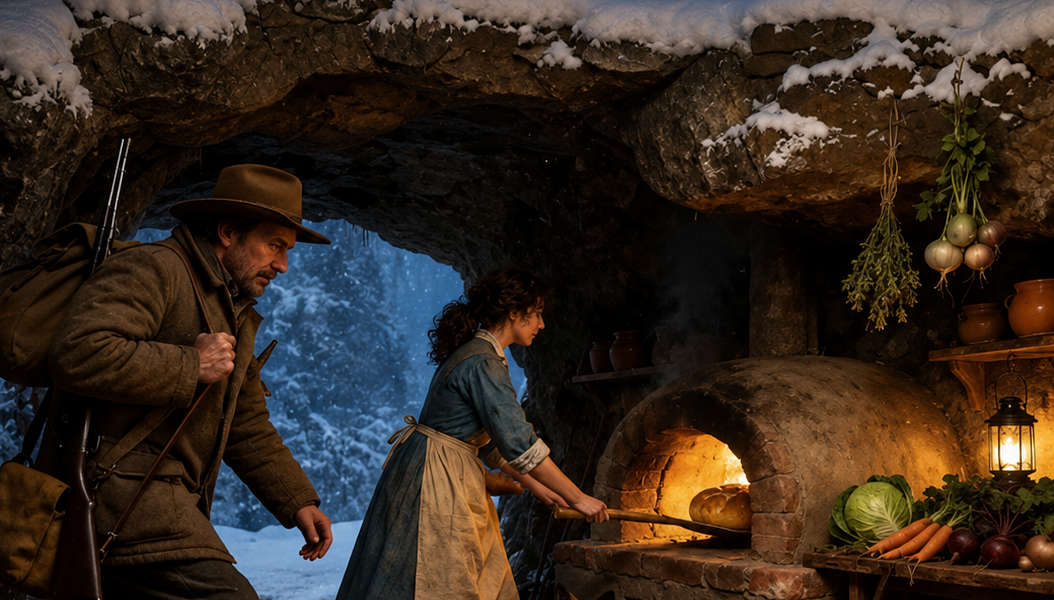
They Left a Widow to Freeze in the Blizzard—Months Later They Found Bread Still Baking. t1

They Left a Widow to Freeze in the Blizzard—Months Later They Found Bread Still Baking
She warned them the roof would fall. She warned them for months. And when the cold came down off the mountains like a closed fist, the man who owned the mill threw her and her little girl out into a storm that killed grown men. And not one person in that town opened their mouth to stop him. They watched a widow and an 8-year-old child walk into the white death, and they were glad it wasn’t them.
But Frost Hollow made a mistake that winter. They counted her dead too soon. Stay with me to the end of this story. And if you’re watching, hit like and tell me in the comments what city you’re watching from, so I can see how far this story travels. The cold came early that year, and it came mean. By the second week of November, the creek behind the Frost Hollow mill had stopped talking.

All summer it had run loud over the stones, loud enough that men shouted to be heard at the loading dock. But now it lay under a skin of gray ice and made no sound at all. And Elena Hawthorne had learned to mistrust quiet things. Quiet was what came before the worst of it. Quiet was the mountain holding its breath.
She stood in the doorway of the grinding room with a sack of seed wheat braced against her hip, and looked up at the roof for the hundredth time that month. There was a dark stain spreading along the third rafter from the north wall. A stain the shape of a man’s spread hand, and it had been the size of a coin in September. She had been watching it the way you watch a sick animal, looking each morning to see if it had grown in the night, and each morning it had.
“It’s worse,” she said. Behind her, Old Pell the Sweeper didn’t look up from his broom. “Roof’s been leaking since before you came. It’s not leaking now, it’s holding water and freezing it. You feel that?” She set the sack down and pointed, though he wasn’t watching. “The cold’s getting under the shingles and the melt’s pooling and freezing in the wood.
Ice gets in a crack, it grows, it splits the crack wider. Every cold night that beam’s getting heavier and weaker at the same time. She wiped her hands on her apron. I’ve said it to Garrison four times. And he’s told you four times you ain’t a carpenter. I’m not a carpenter, Elena said. I’m a person with eyes. Pell made a sound that might have been a laugh and might have been a cough and went on sweeping.
She was 29 years old that winter and she did not look soft anymore, though she had once. Three years of widowhood and frontier work had taken the softness out of her face and put something harder in its place. Something that men in the town read as pride and women read more accurately as stubbornness. Her hair was dark and she kept it bound back tight because loose hair caught in the machinery and she had a thin white scar across the back of one hand from a belt that had snapped in her first month at the mill and laid the skin open.
She’d wrapped it herself and gone back to work the same hour because there was a girl at home who needed feeding and no husband left to do it. Her husband. Tom Hawthorne had been a surveyor. A man who read the ground the way some men read scripture. And he had died of a fever two winters back in a manner so ordinary and so stupid that Elena could still not fully believe it.
No accident, no flood, no fall from a horse, just a fever that came in the night and would not leave. And a town doctor who shrugged and then a grave dug into half-frozen earth that took four men a full day to break. Tom had left her a daughter, a trunk of papers and instruments, and a way of looking at the world that she had not understood she’d inherited until she found herself standing under a mill roof telling a rich man that physics did not care about his opinion. Hawthorne.
The voice came from the front office and Elena knew it before she turned. Harold Garrison filled the doorway between the office and the grinding room the way he filled most doorways, which is to say completely and with the clear sense that the door had been built wrong for not accommodating him. He was a wide man gone soft in the middle with a face that had been handsome 20 years and 40 lb ago and small pale eyes that moved fast and settled on nothing kindly.
You’re standing around, he said. I’m looking at your roof, Mr. Garrison. My roof’s fine. Your roof has a wet beam that’s going to come down inside the month and when it comes down it’s going to come down on the bins. She kept her voice level. She had practiced keeping it level. All your milled flour stacked under the worst of it.
One hard night and you lose the lot. I’m not asking for me. I’m telling you for the flour. Something moved in his face, not concern. Calculation, maybe. The quick ugly math of a man working out whether a thing would cost him and deciding it was cheaper to be insulted than to spend money. You’ve been telling me about this beam since harvest, he said.
You know what I think? I think you like to hear yourself talk. I think a woman with no man to talk to gets in the habit of lecturing whatever’s in front of her and I’m tired of being lectured in my own mill. The grinding room had gone still. Pell had stopped sweeping. Two of the day men by the bins had turned to watch and Elena felt the heat come up her neck, the particular shame of being made small in front of people who would not meet her eye afterward.
I’m not lecturing you, she said. I’m trying to save you money. You’re trying to save your conscience so when it falls you can say you told me. He stepped down into the grinding room and the floor took his weight with a groan. I’ll tell you what’s going to fall, Hawthorne, the temperature. There’s weather coming off the high country, the real thing.
And when it gets here I need bodies I can count on, not a widow who spends half her shift staring at the ceiling and telling me my business. He looked at her and his pale eyes went over her once, head to foot, dismissive. I’ve been carrying you out of charity since your husband died. The town expected it of me. Well, the town can carry you now.
For a moment, Elena did not understand him. The words arranged themselves slowly, like ice forming. You’re letting me go. I’m letting you go. There’s a storm coming. You said it yourself. Then you’d best get home before it does. She thought of 50 things to say and said none of them because she could see in his face that none of them would matter.
That the decision had been made some days ago and the beam was only the excuse he’d been waiting for. She had embarrassed him. That was the whole of it. A woman had stood under his roof and been right about it and he could not abide being instructed by a person he was supposed to be better than.
And so he would put her out into the cold to prove that he could. My wages, she said, I’m owed through Saturday. You’re owed through today and I’ve docked you for the seed wheat you spilled last week. I didn’t spill any seed wheat. My book say you did. He turned his back on her, which was its own kind of answer, and walked back toward his office.
And at the door he stopped and said without turning around, Take whatever’s in the spoil bin if you want it. The town can say I sent you off with something. The spoil bin was where they threw the sweepings and the sour grain and the bags that had taken water and gone musty. He was offering her garbage and telling her to be grateful for it. Pell would not look at her.
The day men by the bins had found something to do. And Elena Hawthorne stood in the middle of the grinding room for one long moment with her wages short and a storm coming and a girl at home who would ask her tonight what they were going to eat. And she made herself breathe and she made herself think because thinking was the only thing she had ever owned that no one could take from her.
She went to the spoil bin. She took the sour grain. She took it because Tom had taught her that a thing other men called worthless was only a thing they hadn’t learned to use and because she was not too proud to feed her child from a garbage bin if the garbage would keep her alive. Then she She out into the cold and the first flakes were already coming down.
Troy. The town was not a large town. Frost Hollow sat in a notch of the lower mountains where two old trails crossed, and it had grown up around the crossing the way mold grows on bread in patches that didn’t quite connect. The mill and the mercantile and the smithy clustered near the creek, the church and the meeting hall up the rise, and then 20 or 30 houses scattered out along the trails wherever a man had found ground flat enough to build on.
In good years 150 souls lived there. It had not had a good year in a while. Elena walked the trail toward home with her shawl pulled up over her head and her short wages folded into her glove, and she passed people as she went, and they knew. That was the thing about a town that size. News moved faster than a person could walk, and by the time she reached the mercantile, Garrison’s letting her go had already arrived ahead of her, and the people on the boardwalk had arranged their faces into the careful blankness
of folks who did not want to be drawn into another person’s trouble. Elena. That was Martha Coyle, the storekeeper’s wife, a thin woman with a kind face and no spine to speak of. She stood in the doorway of the mercantile with her arms wrapped around herself against the cold. Elena, I heard I’m so sorry. “Are you?” Elena said.
She didn’t mean it cruel. She was just tired. Garrison’s a hard man. >> [clears throat] >> Everyone knows it. “Everyone knows it.” Elena repeated. “And everyone works for him or sells to him or owes him. So, everyone knows it and no one says it.” She stopped walking and faced the woman, and the snow was coming down between them now in earnest, fat slow flakes turning the boardwalk white.
“Martha, I need credit just to get through the storm, flour, salt, lamp oil. I’ll pay it back the minute I find work.” Martha’s face did something complicated. “I’d have to ask Daniel.” Then ask him. He’s not Elena, he’s not here. He’s gone up to the Tully place to Then give it to me on your own word and tell him when he’s back.
And there it was, the small failure. The one Elena would remember longest. Martha Coyle looked at the snow and looked at the warm lit interior of her store, and looked at Elena and the girl who waited at home. And she said, “I can’t. I’m sorry. Daniel keeps the books. If I give out credit and he doesn’t approve it, it comes out of I just can’t.
You understand?” “You I understand,” Elena said. And she did. That was the worst part. She understood completely. The woman was not cruel. She was only afraid. Afraid of her husband’s ledger and of Garrison’s displeasure and of being the one who stuck her neck out. And her fear was a small, ordinary thing that everyone in that town shared, and it was going to put a child into a blizzard.
She walked on. Um, Ivy was waiting at the window. The Hawthorne place was the last house but one on the North Trail, a single-room cabin with a lean-to for the mule and a small barn that Tom had started and never finished. And Elena had kept it together with her own hands these 2 years, patching the chinking, splitting the wood, doing the work of two people because there was no one else to do it.
The cabin was warm when she came in, at least, because Ivy had kept the fire fed, and that was something. The girl was 8 years old and small for it, with her father’s serious gray eyes and her mother’s dark hair, and she had the unsettling habit, in a child, of watching a grown person’s face to learn what was true rather than listening to what they said.
“You’re early,” Ivy said. “I am.” Elena hung her shawl by the fire and crouched to warm her hands, and she felt the girl come and stand beside her, close but not touching, watching. “Mr. Garrison let me go today. Let you go where? Let me go from working. I don’t work at the mill anymore. Ivy considered this. Because of the roof. You remember the roof? You talk about it every night.
The girl said it without accusation, just stating a fact, and Elena almost laughed despite everything. Because of course she did. Of course the child had heard her mother muttering over supper about a beam, the way other children heard their mothers pray. Is the roof going to fall? Yes. On Mr. Garrison? Probably not on him.
He’s careful about where he stands. Ivy nodded slowly, filing this away, and then she said the thing that children say, the simple terrible question that adults learn to dance around and children ask straight out, “What are we going to eat?” Elena looked at her daughter in the firelight, and outside the wind had begun to pick up.
A low building moan that came down out of the high country and rattled the shutters. And she made a decision that she would spend the rest of her life not regretting, though she could not have known that then. She had two choices. She could stay in this cabin and wait, and beg the town for charity it had already refused her, and watch her stores run down through a winter that had only started, and hope that someone’s mercy outlasted the cold.
Or she could trust the one thing her husband had left her that no one else in Frost Hollow had ever bothered to understand. She went to the trunk. Tom’s papers filled half the trunk, and Elena had read them all, some of them many times. In the long evenings after the girl had gone to sleep, because reading her dead husband’s handwriting was the closest thing to talking to him she had left.
Most of it was survey work, plats and measurements, and the dry careful notes of a man whose job was to tell other men where their land ended. But there was one bundle she came back to, tied with a faded blue ribbon, and it was not survey work at all. It was the work Tom had done for himself, on his own time, the thing he’d been chasing the last year of his life.
Tom Hawthorne had believed that the mountains around Frost Hollow were not dead. Most people thought of mountains as just rock, cold and inert. And in the deep of winter, that was how they seemed. But Tom had spent two summers walking the high ravines with his instruments, and he had found things that did not fit.
Springs that ran warm in January, patches of ground where the snow never quite held. A ravine, three days walk to the northeast, where he had measured the soil temperature in the dead of a December, and found it, in his own underlined words, absurd. Warm enough to grow a man’s crops in the dark of the year, if a man knew how to use it.
He had called it Ember Hollow in his notes, a private name. And he had drawn a map. And he had written beside the map a single line that Elena had read so many times she knew it the way she knew her daughter’s face. The mountain keeps a fire under the snow. A man could live there who knew how to listen to the ground. He had meant to take her there.
He had talked about it the last summer of his life, half a dream and half a plan. That they would homestead the warm ground, that he would prove his theory and patent the survey, and they’d never want for anything again. And then the fever had come, and the dream had gone into the trunk with everything else.
And Elena had filed it away as the kind of hope a grieving woman could not afford. She unfolded the map now on the cabin floor, and Ivy crouched beside her, and the wind screamed in the chimney. “That’s Papa’s drawing,” Ivy said. “It is.” “What’s Ember Hollow?” “A place your father found.” Elena traced the route with her finger, the way Tom had marked it.
Northeast along the old game trail, up the long ridge, down into the watershed of a creek he’d named for nobody. And then the ravine, drawn as a narrow gash in the rock with three small marks beside it that Elena had finally understood meant warm. “He said the ground there is warm, even now, even in the cold. Ivy looked at the map for a long time in the serious way she had.
Is that true? And here was the question, wasn’t it? Here was everything. Because Elena did not know if it was true. She had never been there. All she had was the word of a dead man who had also believed that last fevered winter that he was going to get better, and a map drawn by a hand she would have followed anywhere when it was warm and living and was now 2 years in the ground.
“I don’t know,” she said, because she would not lie to the girl. She had decided long ago that she would never lie to the girl. That whatever else the world took from them, Ivy would always know that her mother told her the truth. “I don’t know if it’s true, but your father was the most careful man I ever knew. He didn’t write down things he hadn’t measured, and he wrote down that the ground there is warm.
” She folded the map. “And we can’t stay here, so we’re going to go and see.” “In the snow?” “In the snow.” Elena took her daughter’s face in both hands and felt how cold the girl’s cheeks were even by the fire, and felt the wind shake the whole cabin and made her voice steady because the girl needed steady more than she needed comfort.
“It’s going to be hard, Ivy. I won’t tell you it isn’t. It’s going to be the hardest thing we’ve ever done. And there’s a chance, I want you to hear me. There’s a chance we don’t make it. But if we stay here, I know how that ends. I’ve watched winters here. I know what the town does when the food runs short, and it isn’t share it with a widow who got herself put out of the mill.
” She breathed. “Your father found us a way. I’m choosing to believe him. Will you trust me?” The girl looked at her for a long moment with her father’s gray eyes, and then she nodded once and said, “I’ll trust you.” And there was a steadiness in it, an old soul’s calm that frightened Elena more than crying would have.
No child of eight should have learned to be that calm about her own death. The frontier did that. It made the young ones old. They began to pack. It is one thing to decide to walk into a mountain blizzard. It is another to do it. And Elena, who had survived two frontier winters and watched a third coming, knew enough to be properly afraid. And her fear made her careful.
And her care was the only thing that gave them a chance. She did not pack the way a panicked person packs. She made herself slow down. She built two piles on the cabin floor. One of things that could keep them alive. And one of things she loved. And she made herself understand that the mule could only carry so much.
And that every pound of memory was a pound of survival left behind. Tom’s instruments. Her mother’s quilt. A wooden horse her husband had carved for the girl. She put them all on the second pile. And then she put most of the second pile back in the trunk. And she hated herself a little. And she did it anyway because love would not keep a child warm at 20 below.
What she took was this. The sour grain from the spoiled bin because it could still be ground and would still feed them. Her flour, what little she had, and her salt, and the half crock of lard. A side of bacon and a bag of dried beans and the string of withered apples from the rafters. The lamp oil and both lamps. Two axes.
The small one and the felling axe. Tom’s good knife and her cooking knife. The flint and steel and a tin of matches wrapped in oilcloth against the wet. Every blanket and quilt in the house and both their winter coats and the oilcloth tarp off the wood pile. Rope. A coil of wire. A handsaw. The cooking pot and the skillet and the kettle. Needle and thread and an awl.
And in a small clay crock packed careful in the middle of everything where it would stay warmest, the The thing she would not have left behind if she’d had to carry it in her own two hands the whole way, her sourdough starter. It did not look like much. It looked like a crock of gray paste bubbling slow and sour, and a stranger would have thrown it out for spoiled food.
But Elena had kept that starter alive for 6 years. It had come west with her, fed and tended across a thousand miles, kept warm against her body when the cold threatened it, a living thing she’d carried like a coal from a fire she could not let go out. As long as she had the starter, she could make bread.
And bread was life. And a woman who could make bread from nothing but flour and water and patience was a woman who could not entirely be killed by a winter. Is that the bread? Ivy asked, watching her pack the crock. This makes the bread. This is the start of it. Elena nestled it down deep in the mule’s pack surrounded by blankets.
You keep something alive long enough, it pays you back. Remember that. Last, she packed for the animals because they were not coming through this without the animals, and she knew it. The mule was a stubborn slab-sided gray thing named Job, who had hauled for them 2 years and hated everyone equally, and Elena loved him with the practical love you have for a creature your life depends on.
She grained him and packed what grain remained, and she draped the spare quilt over his back under the load to keep him from chilling. And the dog, the dog was Tom’s dog really, a big rough-coated mongrel called Bracken, who had grieved the man as hard as either of them had, lying for weeks on the grave until the snows came, and who had transferred his whole heart to the girl in the years since.
He was no use as a hunter and middling as a guard, but he had a chest like a barrel and a coat like a bear, and Elena had watched him sleep in snowbanks by choice. He would not slow them down. He might even keep the girl warm at night, and that was worth more than gold. By the time she had it all loaded, the storm become the real thing, the thing Garrison had been afraid of, and Elena stood in the doorway of the only home her daughter had ever known and looked out into a white nothing where the world had been.
“We can’t leave in this,” Ivy said. And it was the first time the child’s voice had cracked. “No, we’ll wait for the break.” Elena pulled her back inside and shut the door against the howl. “Every storm breaks for a little while before it builds again. Your father taught me that. We’ll wait and we’ll sleep if we can, and when it eases we go fast and we go far, and we don’t stop until we’re up over the first ridge where the wind can’t reach us.
” She built the fire up high because the wood didn’t matter anymore. They weren’t coming back for it. “Eat now. Eat all you want. We’re not carrying what we can put inside us.” They ate. It was the strangest meal of Elena’s life. The two of them in the firelight eating like it was a feast while the storm tried to tear the roof off.
Bacon and bread and the last of the good butter and three of the withered apples each. And at some point Ivy began helplessly to laugh because it was absurd, because they were stuffing themselves like royalty in a cabin they were about to abandon to die or to live. And Elena laughed, too, and for a moment the fear went somewhere else and they were just a mother and a daughter warm and fed with a fire going.
“Mama.” Ivy’s eyes were heavy with food and warmth. “If we die out there, will it hurt?” Elena’s throat closed. She made it open again. “We’re not going to die out there.” “But if we do?” “The cold makes you sleepy at the end. That’s all I know. It doesn’t hurt the way you think. You just get tired.” She pulled the girl against her side.
“But we’re not going to find out because your father didn’t draw careless maps and your mother doesn’t quit. Now, sleep. I’ll wake you when it breaks.” The girl slept. The dog slept against her and the mule stamped in the lean-to, and Elena Hawthorne sat awake by the fire with a map in her lap and her husband’s voice in her head.
The mountain keeps a fire under the snow. And she listened to the wind, and she waited for it to ease. But, it eased a little before dawn. Elena had not slept. She had sat the whole night listening to the storm’s voice change, had heard it climb to a scream around midnight and hold there for hours.
And then, in the gray hour when the night was thinking about becoming morning, she heard the pitch of it drop. The wind didn’t stop, but it stepped back the way a wave draws back before the next one, and she knew that was her window and that it would not be a wide one. “Ivy, up. It’s time.” The girl came awake hard, the way frightened children do, all at once, with her eyes wide.
And Elena had her dressed and fed and out the door faster than she’d have believed, because there was no time to be gentle. The snow had stopped falling for the moment, but it lay deep and new over everything, knee-deep on the flat and deeper where it had drifted. And the cold when they stepped into it was a living thing that reached down Elena’s throat and gripped.
She did not look back at the cabin. She had decided she would not, because looking back was for people who thought they might return. And she could not afford to think that. She put the girl up on the mule wrapped in three blankets with only her eyes showing, and she took Job’s lead in her gloved hand, and she whistled the dog up, and she set out into the white with her husband’s map memorized and folded against her heart.
And behind her the fire she’d left burning sent up a thin gray thread of smoke that the wind tore apart before it cleared the chimney. They went north, then northeast, along the game trail Tom had marked, and the going was every bit as hard as she’d promised the girl. The trail climbed. The snow grabbed at her legs.
Job balked at the steep places, and she had to coax him, curse him, throw her own weight against his to keep him moving, and the cold sat on the whole world like a weight. And within an hour her face had gone numb, and within two she had stopped being able to feel her feet inside her boots. And still she walked, because the only thing worse than walking was stopping.
Mama, I can’t feel my hands. Make fists, open them, close them. Don’t let them go still. Elena did not stop walking. Wiggle your toes in your boots. Keep them moving. Pain’s good. Pain means you can still feel them. It’s when they stop hurting you have to worry. They climbed all that first morning. Once crossing an open slope where the wind had a clear run at them, the gust came so hard it staggered the mule and nearly took the girl off his back.
And Elena threw herself against Job’s flank and held the child on by main force. Screaming words she didn’t hear herself say into the white. And the dog pressed against her legs and braced. And the three of them stood like that against the wind until it eased enough to move. When it passed, Elena found she was crying.
The tears freezing on her face, and she scrubbed them away with her glove because frozen tears could damage the skin, and she could not afford damaged skin. By midday they had made the first ridge. It was the thing Elena had been walking toward all morning. The place Tom’s map showed the trail cresting and turning down into the next watershed.
And she had told herself that if they could just make the ridge the worst of the wind would be behind them. And for once a hope of hers proved true. The ridge ran east and west and broke the wind. And on the lee side of it, in the shelter of a stand of black pines bent permanently sideways by years of weather, there was a pocket of stillness, almost warm by comparison, where the air did not move and the snow lay soft and undisturbed.
Elena got the girl down off the mule and into the shelter of the pines and made her move, walk in circles, swing her arms, while she herself broke out the small axe and cut pine boughs for a bed and got a fire going in the lee of a fallen log with hands that barely worked. It took her four tries. The first three, the wind found a way in and killed the flame, and on the third failure, she sat back on her heels and felt despair come up in her like cold water.
The certain knowledge that she had killed them both, that the map was a dead man’s dream, and she had marched her child up a mountain to freeze for it. And then Ivy, beside her, cupped her small mittened hands around the next attempt without being told, made a little wall of herself against the wind, and the flame caught and held and climbed.
And Elena looked at her daughter making a shelter of her own body for a fire, 8 years old, and understood that whatever happened, she had not raised a child who quit. “Good,” Elena said. Her voice broke on it. “That’s good, baby. That’s exactly right.” They fed the fire and they thawed and they ate, and Elena melted snow for water in the kettle and watered the mule from her cupped hands and let the dog crowd in close to the flames.
And for an hour, the small camp in the pines was the whole of the warm world, a coal of life on the side of a mountain that wanted them dead. While the girl rested, Elena took out the map. She had brought them where Tom said to bring them. The ridge was here. The bent pines were here. The trail turning down into the next valley was here.
All of it just as he’d drawn, and that was its own kind of miracle. That a man 2 years dead could reach out of the ground and steer her up a mountain in a blizzard, that his careful pencil marks were proving true one by one. It meant the rest of it might be true. It meant Ember Hollow might be real. “Two more days,” his map said. “Down into the watershed, follow the nameless creek up the far side, and there, the narrow gash in the rock, the three small marks that meant warm, the place where the mountain kept its fire. Two more days.
In this, Elena looked out from the shelter of the pines at the country they had left below. The long white slope falling away toward the valley where Frost Hollow lay hidden under its smoke and its snow. The town that had watched her go and said nothing. The mill with its rotten beam waiting to fall. The people who had already, she had no doubt, begun to speak of her in the past tense.
Poor Elena, the widow, took her girl up the mountain in the storm. What a shame. What a waste. Somebody should have stopped her. She felt no anger looking down at it. She had burned through the anger somewhere on the climb. What she felt was harder and colder and more useful than anger. She felt finished with them.
“They think we’re dead.” She said aloud, not to the girl, who was dozing, but to the wind and the white and her husband’s map and the long slope falling away to the town below. She folded the map and put it back against her heart. “Let them.” And she banked the little fire to save the wood and woke her daughter gently and got her up onto the mule and took the lead rope in her ruined hand and turned her back on Frost Hollow and walked down off the ridge into the next valley, deeper into the white, toward a warm place a dead man
swore was waiting. Two women and a mule and a dog and a crock of living bread walking out of the world they knew and into a country that had no name. While behind them and below them, the town that had thrown them out settled in for a long hard winter, certain it had seen [clears throat] the last of Elena Hawthorne. It had not.
But it would be a while yet before any of them learned how badly they had misjudged the widow they sent to the snow. And longer still before they understood that the woman they’d counted as dead was, at that very moment, walking toward the one thing that would one day stand between Frost Hollow and starvation.
The snow began to fall again as they reached the valley floor. Elena pulled her shawl tighter, checked the girl, whistled up the dog, and kept walking. The valley below the ridge was a different kind of cold. Up on the exposed slope, the wind had been the enemy, the obvious one, loud and violent and direct.
Down here among the trees, it was quieter, and the quiet made it worse somehow, made it patient. The cold sat in the air without moving, thick and personal, the kind that found every gap in a coat and worked its way through methodically. Elena had stopped feeling her feet below the ankles somewhere in the first hour of the descent, and she had gone through the stages of worrying about it, and decided that worry used fuel she didn’t have, and that as long as she could still move her toes inside the boot, she would keep moving and deal with the feet
later. The nameless creek Tom had marked on his map was frozen solid, which she had expected, and she followed it northeast the way his notes said to, using it more as a landmark than a trail. The ice was reliable enough to walk on in places and treacherous in others, and she learned to test it with the ax handle before committing weight, a lesson that cost her nothing the first time, and would have cost her everything the second if she hadn’t learned it.
In one stretch, the ice had bowed under some unseen current and gone thin and gray instead of white, and she took them wide around it through thigh-deep snow, hauling Job by the rope while the mule planted all four feet and stared at her with his long stupid face and refused to believe this was a good idea.
“Move,” she told him. She put her shoulder against his neck and pushed. “I am not carrying you. Move.” Job moved with the put-upon dignity of an animal who wanted it known that he was cooperating under protest, and they went wide around the gray ice, and when they came back to the creek bank on the far side, Elena stopped and pressed her forehead briefly against the mule’s neck and breathed.
“Good boy,” she said against his coarse hair. Job stood still and let her. Ivy watching from the mule’s back said nothing and Elena was grateful. The girl had learned something in the past day that most adults took years to learn, which was that there are moments when the most useful thing you can do for a person is be quiet and let them hold themselves together.
She was her father’s daughter, Elena thought. Tom had known that, too. They made camp the second night in the shelter of a downed spruce whose root ball had toppled and left a wall of earth and frozen roots 8 ft high on the windward side. Elena dug out the snow from the lee side of it with the small axe and her own hands until there was a depression she could make livable.
Lined it with pine boughs. Got the fire going on the first try this time because she’d learned and fed them beans cooked until the last of the water had gone soft in them because soft food was warm food and warm food was heat and heat was the only currency that mattered up here.
Ivy ate and then looked at her bowl a while before she spoke. How much farther? One more full day if the map’s right, maybe less. Elena refilled her own bowl because she needed the fuel even though she wasn’t hungry. Hunger had stopped feeling like hunger somewhere around noon and become something duller, a general flatness, a body running low.
Go slow on the water tonight. Melting snow costs wood and we need wood for morning. I know. Ivy pulled her bowl close. The firelight made her face orange and put shadows where no shadow should be on a child’s face. Mama, what if it’s not there? Elena looked at her across the fire. The hollow. What if Papa was wrong? She could have said he wasn’t wrong.
She could have made her voice certain in the way a mother’s voice can be made certain to protect a child from what is true. But she had promised the girl honest and Ivy would know the lie anyway. She always knew. And a lie caught here in the cold with a day left on an old dead man’s directions, would cost them both something they couldn’t afford to lose.
Then we find a way to make it work with what we have, Elena said. The old pine woods another 2 miles east. I saw them on the ridge before we came down. Enough wood to last the winter if we’re careful. We can build shelter in the trees and we can trap if we have to and we can stretch what we’ve got. She said all this evenly, planning out loud, the way she’d always thought by putting it into words and listening to whether it sounded survivable.
It won’t be good, but it’ll be possible. And possible is enough. Ivy looked at her for a long time. You’ve already thought this through. I think about everything. That’s my trouble. The girl almost smiled. Papa said that. He said you had a mind that wouldn’t sit still. He was right. Elena drank the last of her broth.
He was right about most things. Except the fever. He was wrong about the fever. She said it without bitterness, just fact, and the fire cracked between them, and the dog pressed himself against the girl’s legs, and outside the small circle of their light, the dark hung thick and close and full of cold. They slept tangled together under everything they owned.
Elena smelled it before she saw it. She had been walking since before full light, Ivy up on the mule following the frozen creek as it bent northeast the way Tom’s map said it would. And the morning had been like the morning before except colder and more familiar. The body learning now what cold meant and moving through it with a grim efficiency that was not strength so much as habit, the way a person gets down from a high place by not looking at the drop.
She was watching her feet and watching the ground and watching the creek, and she was not watching much of anything hopefully when she caught it. Water. Open water. The mineral smell of it, clean and distinct under the iron smell of snow. She stopped walking. Bracken raised his head and looked at her.
“You smell that?” she asked the dog, which was absurd, and she did it anyway, and he turned his big head and looked east along the creek, and then he moved. He did not run. He was too old and too sensible to run. But he walked fast, the particular purposeful walk of a dog who has decided something, and Elena followed him, nearly pulling Job off his feet to keep up. The ravine was not dramatic.
She had expected something dramatic, some geological announcement, a cliff or a crack or a rush of steam. What she found was more like a persuasion. The creek narrowed and bent between two shelves of rock, and the rock was dark, darker than it should have been, wet dark, and the snow along the creek banks thinned and then disappeared, and the ice on the water went from solid to rotten to open water over the space of 50 ft.
And the air the air was different, not warm, not yet, not by any honest measure, but less. The particular malice of the cold backed off a degree and then another. And then she was standing where the two rock shelves pinched together into a narrow entrance barely wide enough for the mule.
And on the other side of it she could see a wider space, a ravine opening up in the rock, and from it came steam, a faint thread of it rising from the ground in the thin morning light. “Mama.” Ivy was up on the mule looking through the gap in the rock, and her voice had something in it that Elena had not heard in two days, something young. “Mama, is that it?” Elena could not speak yet.
She was trying to run Tom’s map against what she was seeing, trying to be precise, trying to be the careful person she had always been and not the desperate one she was. And the map matched. The shape of the rocks matched. The bend in the creek, the direction, all of it matched. And the steam was real.
She could see it, and she thought, “Tom, you meticulous, wonderful man, you were right. You were exactly right.” And that thought nearly unmade her. She made herself breathe. “That’s it,” she said. Her voice was steady. She did not know how. Let’s go see what your father found. What Tom had found, and what Elena had inherited, was not a paradise.
She needed to understand that right away, because a person who walked into a difficult situation expecting paradise would make mistakes that a person expecting difficulty would not. The ravine was real, and the warmth was real, and both of those things were more than she had deserved from a winter that had been trying to kill her for 3 days.
But it was also a 40-ft wide gash in the rock face, open to the sky in places, enclosed with a ledge in others, floored with rubble and old leaf drift, and the thin pale grass of a place that never got full sun. With the creek running through the middle of it, and two small vents in the rock wall on the southern side from which warm air breathed out in steady, thin puffs, like a living thing’s exhalation.
Elena stood in the middle of it and turned a full, slow circle, and inventoried what she had. The warmth was real. Not summer. Nothing like summer. But a pocket of air that ran maybe 20° above the open mountain, which was the difference between surviving and not. The ground was workable. The creek kept running, which meant water.
The ledge overhang on the north wall was 6 ft deep and 30 ft long, and had been sheltered so long that the rock beneath it was dry and furred with ancient moss. The ravine walls cut the wind entirely. Above her, the sky was a narrow, pale band, and the snow was falling again up on the open mountain.
But in here, it was catching on the rock walls and falling in small, defeated trickles, and melting where it touched the warmer ground near the vents. “It’s smaller than I thought,” Ivy said from the mule’s back. “It’s enough.” Elena was already moving, measuring distances with her eye, thinking in the practical way Tom had taught her without knowing he was teaching her.
This fits here, that goes there. What does the wind do? Where does the water go when the snow melts? “Get down. I need Job for hauling.” She built the shelter first because the shelter was everything. She used the axe to cut poles from the dead timber piled at the ravine’s edge. The sheltered walls had trapped decades of fallen wood, which was a gift she had not expected.
And she lashed them to stakes driven into the soft earth near the vents with the wire from her pack. And she hung the oilcloth tarp as a windbreak on the open side. And inside that she stacked the gear and the blankets. And by the time she was done, the shelter was ugly and low, and nothing a person with choices would sleep in. But it held warmth the way a cupped hand holds water.
And when she put Ivy inside it with the dog pressed against her, and the gear piled around for mass, the child stopped shivering within 20 minutes. And Elena stood outside watching that happen, and felt something unwrap in her chest that had been wound tight for 3 days. “Better?” she asked. “Better,” Ivy said. From inside the shelter, the girl’s voice was muffled and small, and tired in the best way.
The tiredness of a body finally warm enough to admit how exhausted it was. “Mama, my feet hurt.” “That’s good. Hurting means the blood’s coming back.” Elena pulled off her own boot and looked at her foot, which was white and waxy in two of the toes. And she chafed it between her hands until the color came back.
Which hurt badly enough that she had to keep her teeth together to stay quiet about it because she did not want the girl to hear and worry. The toes came back. All of them came back. She put her boot on and went and did the same for the girl. And Ivy made a sound like a small animal at the pain of it, and Elena held her feet and kept working, and neither of them talked about how close it had been.
Um The first 3 days were wrong in ways she hadn’t predicted. The shelter was too cold at night despite the vents because she had built it too far from them. She spent an entire day taking it apart and moving it 6 ft south, which used time and wood and patience she did not have extra of.
And when it was rebuilt, it was better, but the floor was damp from ground seep, and she spent the next day cutting more boughs and layering them thick until the damp stopped reaching them. The cooking fire she’d built near the entrance through smoke in the wrong direction when the morning air moved differently than the afternoon air, and she had not thought about airflow, and she spent one night coughing before she thought it through and rebuilt the fire ring with a flat stone wind baffle to redirect the draw.
She burned her first two attempts at bread because the stone she’d set for an oven surface was too thin and conducted the heat wrong, and the bread turned black on the bottom and raw in the middle. And she stood looking at the second ruined loaf while Ivy ate dried beans again and didn’t complain. And Elena thought grimly, “I will solve this.
” And she solved it by splitting a thicker piece of sandstone from the ravine wall and using that instead. And the third loaf came out better, not good, but better. “You didn’t eat it,” Ivy said, watching her look at the loaf. “I’m not hungry.” “You’re always hungry. You just don’t say it.” Elena looked at her daughter. “It came out flat.
” “The yeast isn’t working right in this air.” “But it’s not burned.” “No.” “And it doesn’t smell bad?” “No, it smells fine.” “Then eat it.” Ivy tore off a piece and pushed it across to her. And it was not the gesture of a child being generous, but the gesture of someone telling you to stop being foolish and take care of yourself.
And Elena took the bread and ate it, and it was dense and a little sour, and nothing like what she could make on a proper stove. And it was also the best bread she had eaten in memory, and she sat there in the low shelter chewing it and looking at the warm air breathing from the rock vents, and listening to the dog turn in circles before he lay down.
And she felt something that it took her a moment to name, possible. She felt possible. The vents, she learned by watching, were not constant. They breathed more in the mornings and less in the afternoons, and at night they slowed to barely a thread. She learned to bank the fire before the vents slowed, to build up coal bed deep enough to hold through the cold hours.
And once she understood the rhythm of it, she could keep the shelter above freezing through the whole night if she was careful with the wood. She dug a second fire ring near the south vent and used it for cooking only, and used the shelter fire for heat only, and keeping them separate meant she could control each one better.
She started keeping notes the way Tom had kept notes in the blank pages at the back of his survey book that he’d left empty, writing down temperatures and times and what worked and what had failed and why, because she would need to know all of this again later, and her memory was good, but not good enough to trust with things this critical.
The fresh water from the creek was the other gift. She could melt snow anywhere on the mountain, but meltwater took wood and time, and here she had running water year-round, which meant she could use the wood for warmth instead. She found where the creek pooled in a natural bowl of rock near the south wall, and she cleared the loose stone around it and built up the edges a little so debris wouldn’t wash in, and that became the water source, and she treated it as a clean thing and kept the camp waste well downstream of it, because a person who
gets sick from dirty water up here dies, and she would not let them die from something she could prevent. By the end of the first week she had a shelter that held heat, a consistent water source, a workable kitchen fire, and bread she could eat without apology. By the end of the second week she had done something she hadn’t planned on.
She had planted. It was Ivy who pointed it out. The girl had been watching the area near the warmest vent where the ground was not only unfrozen, but actually soft. And she called her mother over one afternoon and crouched down and pressed her palm flat to the earth and said, “Feel it.” Elena crouched and felt. The ground there was warm.
Not body warm, not comfortable, but decisively above freezing. The kind of ground where something might grow if it had the right encouragement. She sat back on her heels and thought about the spoiled grain from the mill. The sour swept stuff that Garrison had offered her as charity and she’d taken as a resource.
And she thought about the dried beans. And she thought about the withered apples that had seeds in them still. “You’re thinking the thing I’m thinking.” Ivy said. “Maybe we should try.” The season’s wrong. It’s a deep winter. But the ground’s warm. The ground’s warm and the light’s wrong and I don’t have real soil. I have gravel and leaf mold.
Elena pressed her hands into the ground and broke it apart to look at it, which was half decent actually, loose and black under the surface where the root mass of old dead plants had composted into something useful. “But yes, we should try.” She looked at the girl. “You understand that if things don’t grow, we lose the seeds.
And if we don’t try, we don’t have any vegetables in spring anyway.” Ivy said this with the particular logic of a child who has been listening to adults reason through problems and has learned to think in consequential lines. And Elena looked at her and felt the specific ache of a mother watching her child become more than she’d been before.
“That’s right.” Elena said. “That’s exactly right.” They planted what they had. The dried beans first in a shallow trench near the vent wall where the warmth was most consistent. The apple seeds in a line along the base of the south-facing rock where what thin sun reached the ravine would hit them longest. A scattering of the sour grain on the prepared ground, not as a crop exactly, but as an experiment to see what the conditions would do with a simple thing.
Most of it failed. The beans she’d planted in the first trench came up yellow and leggy, starving for light, and she pulled them and replanted them at the edge of the ravine where the thin strip of winter sky overhead gave more. And half of those died, too. But the other half held on, stunted and pale, but alive.
Their roots touching the warmth of the vent-heated earth, and deciding that was enough reason to stay. The apple seeds did nothing for 2 weeks, and then two of them split open and produced the tentative white thread of a root, and Elena covered them back up and left them alone and watched. The grain sprouted in a wild mess that she had to thin.
And what was left after thinning was eight small plants that looked ridiculous and determined in equal measure. Winter wheat pushing up from mountain rubble in February because she had asked it to. “Is that normal?” Ivy asked, looking at the small green shoots. “Not even a little bit.” Elena said. “Is it going to work?” “I have no idea.
” She was already troweling around the base of the nearest one, checking the root depth, pressing the soil back in. “But look at it. Look at it trying.” The girl looked. And for the first time since they had left Frost Hollow, the expression on her face was not endurance. It was wonder. The ordinary, uncomplicated wonder of a child watching a growing thing, and Elena had to look away because it was too much for her in that moment.
Too much like everything being okay when everything was not okay. When there were still months of winter left and limited stores and a mule to keep alive, and a thousand ways for this to go wrong that she thought about every night while her daughter slept. But the wheat was growing. The bread was edible now. The shelter held through the night.
And there was one more thing she had not let herself name yet, a thing she had noticed over two weeks of watching the ravine, learning its rhythms and its rules, a thing that lived in the space between what she’d expected and what she’d found. She had expected to survive here. She had not expected, not even in the most private corner of her practical mind, to build something.
But the overhang on the north wall was dry and sheltered, and it went back further than she’d first measured, nearly 12 ft deep and 8 ft high at the entrance, and the floor of it was level and packed hard. And when she held her lamp up inside it, the light showed a space that was not a cave exactly, but was not a simple overhang either, something in between, a natural structure that needed human thought applied to it, a room that had been waiting for walls.
Elena stood in it one evening while Ivy slept and Job stood placidly in his corner of the ravine, and the small fire sent light moving over the walls, and she put her hand flat against the rock and felt it, cool on the surface but not cold. The deep mountain warmth Tom had measured bleeding through from somewhere beneath, and she thought, “This isn’t just shelter.
This is a foundation.” And a thought she had absolutely no business thinking in February in a mountain ravine with a child and a mule and dwindling stores spoke itself clearly in the back of her mind, quiet and certain as her husband’s handwriting. We could stay. She stood there a long time with that thought, testing it the way she tested ice, tapping it for soft spots, looking for the places it would give way.
She found fewer than she expected. The warmth was reliable. The water was reliable. The wood supply in the ravine alone was months’ worth, and the slopes above would have more once the snow cleared. If the wheat grew, even a fraction of it, she had seed for a real planting come spring. The starter was alive. She could bake bread.
She could build walls from the stone that lay everywhere in the ravine. She had seen Tom build a dry stone fence once, and she knew the principle of it, stone on stone with the weight distributed so the thing held itself. She could improve the drainage. She could figure out the airflow.
She could learn what the ravine could do. You figure out how a thing works, Elena Hawthorne, and then you make it work for you. Tom had said that, not about anything in particular, just about life in general. The general principle of a man who trusted observation over hope. She went back to the fire and picked up the survey book and opened to a blank page.
She drew a rough map of the ravine from memory and marked the vents, and marked the overhang, and marked where the water pooled, and marked where the light fell longest in the hours she’d watched it. Then she started writing in the cramped practical hand she’d learned from watching Tom, what she wanted to build and how she thought to build it and what she would need. She wrote for 2 hours.
When she stopped, she had three pages of notes and a plan that was probably too ambitious and definitely the only thing she was going to think about for the rest of this winter. And she sat looking at it in the firelight while the mountain breathed warm air from the rock and the snow fell somewhere far above on the open slopes.
And she felt, for the first time since the day Garrison had turned his back on her in the grinding room, like herself. Not safe. Not warm enough. Not out of danger. Just herself. Elena Hawthorne. Thinking her way through a hard problem in the dark. Which was the only thing she had ever been genuinely good at. And now she had a problem worth being good at.
She closed the book and banked the fire and lay down beside her daughter. And for the first time in weeks, she slept without waking. The walls went up in March. Elena had not planned to build in March. She had planned to build in spring when the light was better and the cold had backed off enough to work without gloves.
But the cold did not back off in March. It made one more push, hard and mean, the last breath cruelty of a winter that had been losing ground and knew it. And the push was what decided her. The overhang was good. The overhang had kept them alive. But it was open on one side to whatever the mountain sent down, and she had spent enough nights lying awake listening to the wind find the gaps in the oilcloth tarp, and thinking about what happened if the tarp gave way.
She started with the easiest wall, the short south end, because it was only 8 ft wide and the rock there ran in rough natural courses that stacked without much fitting. She had no mortar. She had no training. What she had was the memory of watching Tom build a drystone fence along the survey boundary of the Collier farm 3 years back, talking the whole time about weight distribution and the way a well-built dry wall holds itself by gravity rather than adhesion, each stone locking the one beneath it, the mass of the thing becoming its own argument for
staying up. She heard his voice the whole first day, which was strange comfort and a strange torment. “You want the biggest stones at the base, not because they’re pretty, but because you can’t correct a lean once you’re three courses up. So, get the foundation honest or start over.” She started over twice on the south wall.
The first time the base ran out of plumb by a quarter inch over 8 ft, and she took it apart stone by stone, which took longer than building it had. The second time one of her anchor stones split when she set the third course on it, some crack in the rock she hadn’t seen. And she had to source a replacement from further up the ravine, hauling it down with the rope and Job’s help, scraping her knuckles to blood on the rough stone.
And when she finally got the fourth course set and stepped back and looked at what she’d built, she said a word she would not have said with the girl present. Not because the wall was wrong, but because it was right. Genuinely plumb and tight and right. And she had not let herself believe it would be until she saw it. Ivy came to look.
She stood with her hands on her hips in a posture so much like Elena’s that it was startling, and she looked at the wall for a long moment. “It’s good,” the girl said. “It’ll do.” Elena flexed her hands, which had stiffened from the cold in the work. “Go check the beans.” “I already checked the beans.” “Check them again.
” “Tell me if the far end of the row looks different from the near end.” “You just want me to do something so you can look at the wall longer without me watching you look at the wall. Elena turned to look at her daughter. Ivy looked back with her father’s expression, the one that meant I know exactly what you’re doing.
“Go check the beans,” Elena said. Ivy went. Elena looked at the wall. The long wall, the open face of the overhang, 30 ft, the one that mattered, took her most of 3 weeks. She built it in sections from the south end north, filling in the gap between the overhang lip and the ravine floor, and she left a door frame opening in the middle because she had thought about it and decided a door was worth the structural complication.
The opening cost her 2 days of extra work to frame with upright stones and a lintel, a slab she and Ivy moved together with the pry bar, moving it 3 ft in 40 minutes and being absolutely still for 5 minutes after, breathing. And when it was done, she hung the oilcloth tarp across it as a door, weighted at the bottom with stones.
And the first night she spent inside a structure with four walls and an overhang for a roof and a weighted tarp for a door was the first night she was warm enough to sweat. She lay in the dark sweating and thought, “This is the problem with building something. Once you’ve done it, you immediately see everything wrong with it.
” The floor was uneven. The north corner leaked cold air from a gap she hadn’t found yet. The tarp door let in too much draft when the night wind changed direction. The fire ring was in the wrong place relative to the air flow and the smoke was going sideways instead of up and she had been dealing with that by leaving a gap at the top of the north wall.
But the gap led in cold and she needed to figure out a flue, a real flue, something she had never built. And just thinking about the flue made her tired in a specific way that was almost pleasant, the tiredness of a problem not yet solved. She built the flue in April. She got it wrong twice and right on the third attempt constructing it from flat stones stacked into a channel that ran up through the top of the north wall and angled outward.
And the first time it drew properly, she stood and watched the smoke go straight up and out and disappear and felt an emotion she couldn’t entirely name. Something between pride and grief because Tom would have known how to build the flue on the first try and she had arrived at the answer through failure and failure and then finally getting it right and both things were true.
That she’d built it herself and that she wished he was here to see it. It works, Ivy said from the doorway. It works, Elena agreed. You’re sad. No. Yes. A little. She looked at the girl who had turned nine somewhere in these weeks without ceremony because there had been nothing to make a ceremony of except the bread Elena had shaped into a round with a candle stub on top that they’d both pretended was a cake.
I keep thinking things your father would say. Like what? Like if you’d used a wider throat on the intake you could have improved the draw. That’s the kind of thing he’d say. She almost smiled. Then I’d say that the throat is the right width and he should go and calculate something and he’d calculate it and come back and tell me I was right.
Ivy was quiet for a moment. Do you miss him like that? Not sad miss. Just like he’s just in the other room. Elena looked at her. Yes, exactly like that. She put her hand on the warm top stone of the new flue. How do you know what that feels like? Because that’s how I miss him, the girl said. And then she went inside, matter-of-fact, done with the conversation, the way she ended every conversation that had gone to the edge of being too much.
And Elena stood at the flue for another minute before she followed. Spring came to Ember Hollow differently than it came anywhere else Elena had known. In Frost Hollow, the spring was loud, meltwater running in sheets off the mountain, mud season making the trails impassable, the whole valley going from white to brown to a chaotic wet green in a month.
Here in the ravine, the change was subtler. The geothermal warmth had always held the cold slightly back, and so the shift was less a dramatic arrival than a gradual permission. The light lasting longer in the strip of sky overhead, the thin pale shoots in the garden bed deepening their color, the creek running faster and higher as the snowpack above began quietly to give up.
Elena was ready for it. She had been planning for it since February. The garden bed she’d started in the shelter of the south vent was bigger now, turned and improved and expanded twice. She dug in old leaf mold from the pile that had accumulated over decades against the ravine’s east wall, black and crumbly and rich in the way only very old organic matter gets, and she’d layered it with creek sand for drainage and worked it until the mix was something she would actually call soil.
The beans she’d nursed through winter had produced, not abundantly, but honestly, enough dried beans to replant the whole bed twice over and still have seed to spare. She’d replanted in March, two rows wider, and they were climbing now, running up the stick frame she’d built for them.
The wheat was the thing she was proudest of and most uncertain about. Eight plants in February had become, through careful tending and complete luck about the light hitting just right through a gap in the ravine’s east wall each afternoon, 16 plants by March. She’d thinned and transplanted, and the transplants had survived at about a 50% rate, which she’d counted as a victory.
By April, she had enough of a wheat patch to justify calling it a wheat patch. And if it matured the way she calculated it would, she would have enough seed grain for a real planting above the ravine in summer, where the light would be full and the growing season actual. She could make flour.
Not enough to live on, but enough to keep the starter alive. Enough to bake when she needed to. Enough to understand the rhythm of it. This particular ground and this particular grain and this particular stone oven she’d built into the south wall of the shelter with a firebox and a proper throat, so the heat moved through it the way heat should.
The bread she made in April was the first bread she was genuinely pleased with. It had crust and crumb and the right dense chew of good sourdough, and it smelled the way bread was supposed to smell. The warm, clean, sour yeast smell of something alive that has been cared for long enough to give something back. She pulled it from the oven and set it on the stone shelf to cool and stood back and looked at it the way she had stood back and looked at the wall.
The same mix of exhaustion and satisfaction and already seen what needed to be improved. Ivy came and looked at it, too, as she always did. She was a child who understood, somehow, that these moments of completion deserved witness. “That’s the best one,” the girl said. “The crust cracked on the left side.” “Because the left side is closer to the flue.
” Elena looked at her. “How do you know that?” “I watched you look at it the last six times.” Ivy tore the heel off. Elena had not offered it. The girl had just decided and bit into it and chewed with the judgment of a person who had been eating Elena’s experiments for months and knew the full range of what was possible.
It’s good, Mama. It’s really good. Elena took a piece. It was good. It was better than good. The sourness was exactly right. The depth of it, the way it cut through the density of the crumb. And for a moment, she was standing in her kitchen in Frost Hollow, making bread on a Saturday morning with Tom still asleep in the other room, and Ivy still small enough to sit on the counter and watch.
And then she was here, in a stone room in a mountain ravine, with the wheat growing in the weak spring light, and the creek running high outside, and her daughter [clears throat] chewing bread with unselfconscious pleasure. And both of those things were her life. And one of them was gone, and one of them was real, and the real one was enough.
It had to be enough. And most days, now, it was. Um, it was [clears throat] the dog who heard him first. Brecken had been lying in the doorway in the late afternoon sun. Not warm sun, not yet, but the kind of April sun that feels warm on black fur. When he lifted his head, not the short-eared alert of hearing a bird or the creek running a new direction, the slow intent raise of a dog that has heard something with a human weight to it.
Elena was at the garden bed. She had a stick for a trowel, and she was checking soil depth around the bean roots, a task she did daily because the roots were telling her things about drainage that she wanted to understand before she expanded the bed again. She saw the dog’s head come up, and she went still. “Ivy,” she said quietly.
The girl was inside. “What?” “Stay inside. Don’t come out.” She picked up the axe that lived near the door now, always, because there were things in these mountains that would come into the ravine in late winter, driven by hunger, and she had learned not to be caught without something to answer with. She moved to the entrance of the ravine, the narrow gap between the rock shelves, and she stood in the shadow of the near shelf and looked out.
The man was on the slope above the creek picking his way down through the snowmelt debris and he was moving like a man who had been moving for a long time and was not sure where he was going but had committed to finding out. He was big, broadly made in a frontier courier’s coat worn to gray at the seams with a packed mule behind him that looked about as tired as he did. He hadn’t seen the ravine yet.
He was looking at the creek. Elena watched him for the time it took him to pick his way down to the creek bank and crouch to look at the water and in that time she read him. The way he crouched, the way the pack was loaded, the way his mule’s feet landed, the way he looked at the water with purpose rather than panic.
Not a desperate man, not a predatory one, a man doing a job in a place he had not expected to find anything. Then he looked up. He looked directly at the gap in the rocks and at Elena standing in the shadow of it with an axe in her hand and for a long moment neither of them moved. Ma’am, he said. He did not reach for anything.
He did not stand. He stayed crouched by the creek with his hands visible which told her something useful. State your business, Elena said. Elias Mercer, frontier courier out of the Ridgecroft relay station. He had a voice built for carrying across distance, deep and unhurried. I’ve been cutting through the high country since last week.
Got turned around in a bad stretch above the ridge. He looked at the gap in the rocks, at the steam that Elena now realized was visible above the ravine in the cold afternoon air, thin as threads but there. I was following the steam. Figured warm ground meant shelter and shelter meant I could get my bearings. He paused.
I wasn’t expecting anyone. No one comes up here. No, ma’am, they don’t. His eyes moved careful and steady reading her the same way she’d read him. That axe settled? It’ll stay where it is until I know more about you. >> Fair. >> He stood up slowly, keeping his hands out from his body, and came to a standstill at the creek bank.
He was younger than he’d looked crouched down, somewhere in his 30s, with a weathered face and pale direct eyes that seemed accustomed to squinting into distances. >> I’m not looking for trouble. I’m looking for a place to get my mule dry and my fire lit, and then I’ll move on. An hour, maybe two. He glanced at the steam again.
Is it Is there warmth in there? >> There’s warmth in here. >> You took that in. You’ve been here a while. >> Long enough. >> How long? >> She looked at him. The question was not rude. It was the question of a man trying to understand what he was looking at. “Since November,” she said. Something moved in his face.
Not the performative surprise of someone making conversation, but the genuine kind. The recalibration of a man who has walked into something his assumptions could not account for. >> “November,” he repeated. That was That was the bad storm. The storm at the start of the winter. It was. And you He stopped. Looked at the entrance gap, at the warm steam, at her, at the axe.
You built something in there. It was not a question. Elena studied him for another moment, and the dog had come to stand at her leg, pressing against her calf. And that was its own kind of answer. Bracken didn’t press like that when he was worried. He pressed when he’d made his decision and was telling her his decision.
>> “Come look,” she said. “Leave the mule at the entrance.” Bull. She watched his face. She had thought, in a distant way, about what it would be like when someone found this place. She had thought it more since the garden started producing and the walls went up and the bread got good. Thought about it the way you think about a thing you don’t fully believe will happen.
She had imagined various versions of it, none of them quite accounting for the specific experience of watching a grown man walk through her doorway and go quiet. Elias Mercer was not a man who went quiet easily. She could see that in the way he’d handled himself at the creek.
The even voice, the steady hands, the complete absence of the nervous talking that frightened people did. He was a man who had been places and seen things and had learned to keep his face mostly his own. And he walked into the stone room she had built inside an overhang in a mountain ravine, and he went quiet for nearly a full minute.
He looked at the walls. He looked at the flue and traced it with his eyes from the firebox up through the stone to where it angled out. He looked at the garden bed, the beans on their stick frames, the wheat in its patch of afternoon light. He looked at the shelf where the bread cooled. He looked at Ivy, who had come out of the back of the shelter and was watching him with the calm assessment that was her default with strangers.
“How old are you?” he said to the girl. “Nine,” Ivy said. “How old are you?” “34.” He looked back at Elena. “You built the walls?” “I built the walls.” “The flue, too?” “Third attempt.” He nodded, the short specific nod of someone who has built things and knows what third attempts mean. “The garden.” He crouched down near the bean rows, not touching, looking.
“February, March?” “Started in February, first planting failed. This is the third.” He looked up at her. “What failed?” “Light was wrong for the first position, drainage for the second.” “Took me a week to figure out the drainage. There was a seep I hadn’t mapped under the east end of the bed.” “And the wheat? Started from the spoiled grain from the Frost Hollow Mill.
” She said the name flatly, watching for any reaction, and she got one, a small shift in his expression. He knew the name. “Started with eight plants, managed 16 by March. If it matures, I’ll have enough seed for a proper planting above the ravine in summer. He stood up. He looked at the bread on the shelf, and she could see him deciding whether to ask.
And then he asked, “May I?” She cut him a piece. He ate it, and he was quiet again. And she watched him be quiet about the bread the same way he’d been quiet about the walls, with a seriousness that was not performance. “Mrs. Hawthorne,” he said. He had not used her name until now, which meant he knew it, had known it from before the creek.
You’re from Frost Hollow. I was. I run the courier route through there every 6 weeks. He said it carefully, the way a man says a thing he knows he needs to say, but isn’t sure how it will land. I was there in November, just before the storm. Elena looked at him steadily. Then you know why I’m here. I know what I heard.
Garrison let you go. He turned the piece of bread in his hands. The whole town. I heard that the whole town watched. The whole town watched. He looked at the walls. He looked at the garden. He looked at the flue she had built on the third attempt, drawing clean above the stone room, and he looked at the bread in his hand, and she could see him putting the picture together the way an honest man puts a picture together, which is slowly and without flinching from what it shows him.
“I need to tell you something,” he said. She had expected this. Not the specific words, but the shape of it, the weight of it. “Tell me. The mill roof came down in January.” Elena was still. Outside the creek ran over its stones. The beans moved faintly in the slow air from the vents. “The beam,” she said.
“The center beam and two of the adjoining ones. The weight of the snow, they said, but people who know said it had been failing since fall.” He set the bread down on the shelf as though handling something that needed to be set down right. Took out the whole north section. The flour bins were under it. The flour bins She heard her own voice come out flat and strange.
All that flour all those months of milled grain, the town’s winter stores, the backup against bad weather and worse times. All of it? Most of it. What wasn’t crushed got wet when the roof opened. He paused. Nobody was under it when it came down. That was the one good thing. “That was the one good thing.” Elena repeated. And there was something in her voice she had to control, not satisfaction.
She was careful to check herself, to make sure what she felt was not satisfaction, but something near to the grim recognition of a person who has been telling the truth to people who would not hear it, and has now been proven right in the worst possible way. “When did it happen?” “Second week of January, just after the second big storm.” He looked at her directly.
Bross Hollow’s been short since. The communal bakery’s been trying, but they haven’t got the flour, and the cold came back hard in February. Families are eating thin. He stopped. Let that sit. I’m not telling you this to make you feel anything in particular. I’m telling you because it’s what’s true.” Elena looked at him for a long time.
The afternoon light in the ravine had shifted the way it did this time of year, the strip of sky overhead going from white to a pale gold. And in that light the bean plants threw long thin shadows across the soil she’d built from leaf mold and creek sand and patience. And the bread on the shelf smelled warm and clean.
And Ivy had come to stand beside her without being asked, just beside her, the way the girl did when she sensed her mother thinking through something that mattered. “How thin?” Elena said. “Thin enough that nobody’s going to be picky about where their bread came from.” Mercer said quietly. “That’s not a suggestion. It’s just what’s true.” She looked at the bread.
She looked at the garden. She looked at the winter stock she’d laid up against the back wall of the shelter, the dried beans and the salt and the grain she’d been hoarding with the discipline of a woman who had spent months learning exactly how little you could live on and stay functional. And she looked at the wheat beginning to head up in the patch of afternoon light and she did a calculation that was not simple and not comfortable and arrived at an answer that surprised her less than it probably should have. She had
been a widow who got herself put out in a storm and the whole town had watched. She had been a woman telling the truth that no one wanted to hear. She had been, in the private accounting of Frost Hollow, the cautionary tale of what happened when you had no one to protect you. The story people told to make themselves feel safer by comparison.
And here was what that woman had built. Walls. A flue that drew right on the third try. Bread from spoiled grain and a sourdough starter kept alive through a mountain winter in a clay crock packed in blankets. A wheat patch that shouldn’t have grown and had grown anyway because she’d asked it to and watched it the way you watch something you cannot afford to lose.
And below the mountain, the people who had watched her go were eating thin. She turned and looked at her daughter. Ivy looked back. The girl’s face said nothing because the girl had learned to let her mother make her own decisions. But her eyes were her father’s eyes and Tom Hawthorne’s eyes had always said the same thing regardless of the question.
You already know what the right thing is, Elena. You’ve always known. The question is only whether you’ll do it. Mr. Mercer, Elena said. Ma’am? Can you carry weight on that mule of yours? He looked at her steadily. Looked at the bread. Looked at the stock against the wall calculating the way she’d calculated.
Yes, he said. Then, here’s what I’m going to need from you. She turned to the shelf and picked up the bread. The good loaf, the one she’d gotten right, and set it in front of him. Eat and then listen. Because I’m going to tell you which families in Frost Hollow are going to get this first, and I need you to understand why the order matters.
He sat down on the stone bench he’d built against the south wall, and he ate, and he listened, and the creek ran outside, and in the patch of afternoon light the wheat stood in its rows reaching toward a strip of pale spring sky. Mercer left the next morning with three loaves wrapped in oilcloth and a sack of dried beans tied across his mule’s back.
Elena had given him a list, not written down. She had thought about writing it down and decided against it because a written list could be shown around and questioned and picked apart. And what she needed was for the food to arrive quietly, without announcement, without the weight of her name on it that would make people refuse it out of pride or guilt or both.
She had given him the list by talking, standing in the ravine entrance in the thin morning before the light had fully come, telling him which houses and which families and why the order mattered. Pell first, she’d said, the old sweeper. He’ll be too proud to ask for anything and too honest to pretend he’s fine.
He lives in the small place behind the smithy, the one with the green door. He’s got a bad knee in winter, and he won’t have been able to haul wood the way he should. Mercer had listened with the stillness of a man who understood that some information needed to be carried exactly as it was given, without rearranging.
Then the Ryker family, they’ve got four children and the husband’s got a drinking problem he can’t quite beat, and what that means in a hard winter is that the children go short while he figures himself out. The wife won’t tell anyone. She’d rather starve quietly than let the town know her business. Elena had paused.
Take the bread to the wife. Don’t take it when he’s home. And the third loaf? She had been quiet for a moment. Martha Coyle, the storekeeper’s wife. She said it without the bitterness she’d expected to feel. What she felt instead was something more tired and more human than bitterness. The understanding that Martha Coyle had been afraid and that being afraid and being cruel were not the same thing and that a frightened person in a hard winter was still just a person who was cold.
She turned me away. But she did it scared, not mean. There’s a difference. Mercer had looked at her steadily. You want me to say where it came from? Not yet. Just say a traveler came through with more than he needed and thought of the town. That’s true enough. You are a traveler and you did come through. And when they ask more than that? They’ll ask. People always ask.
Tell them you can’t say more than you know. She had looked out at the creek running high and cold in the early morning. I’ll tell you when it’s time for more than that. He had nodded, untied his mule and gone. She had watched him pick his way up the creek bank and disappear around the bend and then she had stood there a moment in the entrance gap listening to the water and the birds that had begun coming back to the ravine in the warming weeks.
And then she went back inside and started baking again because the only way forward was to keep making more of the things she had to give. The second delivery was bigger. Mercer came back 12 days later at a time she had not expected him and he brought something she had not asked for. Two empty flour sacks, clean ones, and a block of salt and he set them inside the door without explanation.
I didn’t ask for those, Elena said. I know. He unslung his coat and hung it on the peg she’d set into the wall near the door, which told her without words that he intended to stay a while. Consider it a trade for the first delivery. The people who got the bread wanted to give something back and didn’t know how, so I told them a traveler always needs salt and good sacks and they produced those inside an hour.
Elena looked at the salt. Salt was weight. Salt was weeks of preserved meat, of cured beans, of kept vegetables. Salt was the thing she had been rationing most carefully since January. “Sit down,” she said. “Tell me what it’s like down there.” He sat on the stone bench and told her. He did it methodically and without embroidery, the way he seemed to do most things, and what he described was not quite disaster, but was close enough to see from where Frost Hollow stood.
The flower shortage had hit the communal bakery hardest. The bakery that the whole south end of town depended on, the older families, the ones without their own millstones or their own winter wheat. And the bakery had reduced its hours and then reduced what it offered and was now making one kind of bread instead of three and running out of that by midday.
People were supplementing with cornmeal and dried goods, but the dried goods were running thin, too, and cornmeal got old fast in a hungry belly. There had been a meeting at the hall about rationing, which Garrison had chaired, and it had gone badly because three families had stood up and said they wanted to know why the mill roof had collapsed when several people had apparently warned that it might, and Garrison had dismissed the meeting early, and the question had not been answered. “Who stood up?” Elena said.
“The Ryker wife was one of them.” Elena was quiet for a moment, thinking about a woman she had never liked much and who had never liked her much. A proud, unhappy woman married to a man who drank, standing up in the meeting hall and asking the question that no one wanted to ask. “She’s braver than I gave her credit for.
” “She got the bread,” Mercer said simply. “Maybe that did something. Or maybe she was always brave and just needed something to stand on.” Elena looked at the fire. “What did Garrison say when she asked?” “He said structural failures happen and that blaming a dead winter on one man was the kind of thinking that divided communities, and then he ended the meeting.
” “And the people let him end it?” “Most did.” “Some didn’t look happy about it.” Mercer leaned forward, his elbows on his knees, in a posture she’d come to recognize as him thinking in real time. He’s worried, I think. I saw his face when Mrs. Reiker stood up. He’s not a man used to being questioned in public.
He was managing it, but it cost him something. Elena picked up a stick and turned it in her hands, which was what she did when she was working through something, the physical motion helping the thinking. “He’s going to need to be more than worried,” she said. “He’s going to need to account for it.” “What does that mean?” “It means this winter isn’t over.
It means this town is going hungry because he wouldn’t fix a beam that a woman told him was going to fall, and eventually people are going to stop accepting his version of events and start asking about hers.” She set the stick down. “But that’s not why I’m sending bread. I want you to understand that.
It’s not to expose him.” “Then why?” She looked at him, and the question was direct enough that it deserved a direct answer. “Because children don’t deserve to go hungry for what their fathers believe about widows. Because Pell is old and his knee hurts, and he swept that mill floor for 20 years, and no one’s going to take care of him if I don’t think about it.
Because Martha Coyle was afraid, and afraid people can still change.” She paused. “Because I’m not willing to be the kind of person who watches children go thin when I have bread to give, even if their town watched me walk into a blizzard and said nothing.” Mercer looked at her for a moment, then he looked at his hands. “I’ll need a bigger list,” he said.
“I know. That’s why I’ve been baking every day since you left.” She had been. The stone oven had run nearly without pause for 12 days, and the shelf held eight loaves now, and she had ground the first of the dried beans into a rough flour she’d been mixing with the wheat flour to stretch it, and the result was a denser bread that held together well and kept for days.
Not the bread she was proud of. The bread you made when feeding people mattered more than impressing them, which was a different and more important skill. She showed Mercer the mixing ratio she’d worked out, and he listened and nodded, and she could see him storing it in the same internal place he’d stored the delivery list.
“You should write some of this down,” he said. “I’m writing all of it down.” She went to the back shelf and brought out Tom’s survey book, nearly full now. The blank pages she’d been filling since February covered in her cramped close handwriting. Every ratio, every temperature, every failure and what caused it, every solution.
She handed it to him, and he took it carefully, the way you take something that obviously belongs to someone and has been earned. He read for a moment. “This is a lot,” he said. “It’s been a lot of winter.” He handed it back. “People would want to read this, farmers, anyone trying to get through a winter like this one.
” “Eventually,” she said. “Not yet.” Tat. The third delivery was when things changed. Mercer had taken to varying his route slightly, coming and going from Frost Hollow at different times, so that no one could track his schedule too precisely, because a courier with a predictable pattern got predictable questions, and he needed the questions to stay general. He’d been careful.
But Frost Hollow was a small town, and small towns notice the things that small towns notice. And by the third delivery, people had connected the mysterious food appearing to the courier who kept passing through, and a man named Devlin, who worked delivery and made it his business to know everyone else’s, had waited for Mercer outside the livery door and asked him straight out.
“You’re carrying it in from somewhere,” Devlin said. He was a compact, sharp-eyed man in his 50s who had grown up on this mountain and read it the way other men read newspapers. “The bread’s not commercial. I’ve eaten commercial bread my whole life, and I know what it tastes like. This is home baked. This is sourdough from a live starter, and not just any starter, good one, old one, well kept.
” He looked at Mercer without blinking. “The only person in this town who had a starter that old was Elena Hawthorne, and Elena Hawthorne is dead. Mercer had said nothing. Or she’s not, Devlin said. He watched Mercer’s face, which gave him nothing, and nodded slowly. That’s the one, isn’t it? When Mercer told Elena this, sitting on the stone bench with a cup of creek water in his hands, she listened to the whole account without interrupting.
And when he finished, she sat with it for a moment. Devlin, she said. He’s a sharp man. Sharp enough. Does he talk? He talked to me. He’ll talk to others. I think he already has. He didn’t seem like he was carrying it quietly. Mercer looked at her. Mrs. Hawthorne, I’ve been trying to do this the way you wanted, slow and quiet and without your name on it, but I think the name is coming out regardless.
Elena set down her own cup. She had known this was coming. She had known [clears throat] it with increasing certainty over the past weeks. The way you know a storm is coming when the air changes, even before the clouds do. And she had been deciding, in the slow deliberate way she decided everything, how she felt about it. Let it, she said.
You’re sure? I’ve been sure for a few days. I was waiting to say it. She looked at the walls she had built, the flue that drew clean, the garden with its beans climbing their frames, and the wheat heading up in the afternoon light. If Devlin knows, then Garrison knows or will know.
And I’d rather Garrison hear it from someone who can tell it straight than have it go around the town sideways and arrive at his door in a shape I can’t control. Mercer was quiet for a moment. What do you want him to know? Everything. She said it without heat. I want him to know that the widow he put out in November is the reason his town has bread.
Not because I want him to feel bad. I don’t care what he feels, but because the truth has a use. The truth, in this case is that the person he dismissed didn’t die. She went up the mountain and she built something and she fed the people he let go hungry. That’s a fact and facts have weight and a town that’s angry and ashamed and hungry needs something to push against so it doesn’t tear itself apart from the inside.
She looked at Mercer. Right now they’re pushing against each other. Let them push against the truth instead. He looked at her for a long time. Then he said, “You’ve been thinking about this for a while.” “Since February,” she said, “when I started writing things down.” The truth moved through Frost Hollow the way any true thing does in a small town.
First in whispers, then in conversation, then in the open unstoppable air of a thing that everyone knows and no one can pretend not to know anymore. Devlin told the Reiker wife. The Reiker wife told Martha Coyle, who sat down and did not speak for several minutes and then asked three questions in a row about the bread she’d been eating.
And when she understood that the bread was Elena’s bread, baked from Elena’s starter in a stone oven Elena had built herself inside a mountain ravine, where Elena had been living since November, she began to cry in a way that surprised everyone present, including herself. Old Pell heard it in the street and stood still in the middle of the path until someone touched his arm.
He said, “I knew the beam.” And then he said nothing else for the rest of that day. The town meeting that had been postponed, the one Garrison had ended early rather than answer Mrs. Reiker’s questions, reassembled itself without anyone formally calling it. It simply gathered the way crowds gather around necessary things in the meeting hall on a Tuesday evening with no notice posted and no agenda set.
And Garrison arrived to find three quarters of Frost Hollow already seated and waiting. And the faces that turned to him when he walked in were not the faces of people who were going to be managed. He stood at the front of the hall and looked out at them, and Elena was not there to see it, but Mercer was. And he described it to her afterward.
The way Garrison read the room and understood, in the way powerful men understand when the terms have changed, that he was not going to be able to chair this the way he’d chaired the last one. “He looked old,” Mercer said. “That’s the only word for it. He walked in and saw what was in their faces, and he looked like he aged 10 years standing there.
” “What did he say?” “He didn’t say anything for a long moment. Then Mrs. Ryker stood up and said, ‘We know about Elena Hawthorne.’ And the room was very quiet, and Garrison said, ‘What about her?’ And she said, ‘She’s alive. She’s been alive since November. She built a home in the high country, and she’s been sending food down the mountain to us while we’ve been short, and you put her out in the storm in November and told us she chose to leave.
‘ Elena looked out the ravine entrance at the creek, which was running clear and fast now in the late spring warmth. “He told them I chose to leave?” “He told them you’d made your own decisions, and he couldn’t be responsible for them. He said you’d been warned about the conditions and gone anyway.” Mercer’s voice was flat, reporting. “Nobody believed him.
They might have believed him in December. They didn’t believe him now.” She was quiet for a moment. “What happened?” Devlin stood up and read out the names of every family that got bread and asked Garrison if that looked like a woman who’d made her own decisions and left. And Garrison said he hadn’t known, and Devlin said, ‘You knew she was gone, and you knew why she was gone, and that was enough for you.
‘ And Garrison he had nowhere to go with it. He’s not a stupid man. He understood that the room was done with him. Elena thought about Harold Garrison, a man she had worked for and warned and been dismissed by, and she tried to find in herself the satisfaction she might have expected at the image of him standing in that hall with his authority running out from under him like water.
She could not quite find it. What she found instead was something flatter and more tired. The recognition that Garrison had done what small frightened men do, which was protect himself at the cost of someone easier to afford, and now the bill had come back to him with interest, and none of that was satisfying, really, in the way you hoped revenge would be.
It was only true. “Is he going to be a problem?” she asked. “For you?” “I don’t think so. He has enough of a problem being himself right now.” Mercer leaned back against the wall. “The town’s asking for an accounting of the mill maintenance records, for a proper look at what he knew and when he knew it. I don’t know where that goes, but it’s moving.
” “That’s the town’s business,” Elena said. “Not mine.” He looked at her. “You could come down, you know that. You don’t have to stay up here.” She looked at him, and then she looked around the ravine at the walls she’d built and the garden she’d grown, and the oven that made real bread now, not just edible bread, and the survey book on the shelf full of things she’d learned by paying attention to every mistake.
And she thought about Frost Hollow in the spring, the mud and the noise and the small airless rooms and the looks on people’s faces that she would have to navigate every day, the pity and the guilt and the complicated accounting of what they owed her and what she owed them. “I’ll come down when I’m ready,” she said.
“And when I come down, it’ll be to do something, not to let feel better about what they did.” “What do you want to do?” The question sat in the air. Ivy had come out of the back of the shelter and was crouching by the bean rows, doing the careful daily inspection that Elena had taught her, checking root exposure, pressing the soil back where it had shifted, pinching off the yellowed leaves with focused seriousness.
A 9-year-old girl maintaining a garden in a mountain ravine in May, doing it right because she’d learned to do it right. And Elena watched her and thought about everything she’d written in Tom’s survey book and everything she still had to learn and the wheat that would be ready to harvest in another month and what she would do with the knowledge if she kept it only for herself.
“I want to build something worth showing them.” she said, “not to impress anyone because it matters.” She stood up and picked up the stick she used for a trowel. “Come back in 3 weeks. Bring empty sacks if you can get them. I’m going to have more grain than I can use by myself and I need it to go somewhere.” Mercer stood and put his coat on and at the door he stopped.
“They’re going to want to come up here.” he said, “some of them to see it.” “I know.” “What do I tell them?” Elena looked at the ravine, at the light in the strip of sky, at the walls that had cost her her hands and her winter and her certainty that she couldn’t do it, at the garden and the oven and the flue that drew clean on the third try and the bread on the shelf and the girl at the beans and the mule standing placid in his corner and the dog lying in the patch of afternoon sun he’d claimed in March and hadn’t given up since. “Tell them to wait.” she said.
“Tell them when I’m ready they’ll know. And tell them” she paused. “Tell them to bring their hands, not to watch. If they want to see what I built, they can learn how I built it. That’s the only tour I’m offering.” Mercer almost smiled. “I’ll tell them.” He left and the ravine went quiet and Elena crouched down beside her daughter at the bean rows and the two of them worked through the afternoon without speaking much because there was too much to do and the light was good and the ground was warm and it was enough for
now to be here working, alive, waiting for what came next on their own terms. They came on a Saturday in June which Elena had not planned but which was what happened when you told a town to wait and the town waited as long as it could and then stopped waiting. Mercer had warned her the day before.
He’d ridden up the creek trail faster than his usual pace, which he recognized now as his signal that something had shifted and he’d come through the ravine entrance while she was turning the wheat patch with a stick. The stalks had matured and she’d cut them and was working the root mass back into the soil for the next planting.
And he’d said without preamble, “Tomorrow, some of them are coming tomorrow.” Elena had straightened up and looked at him. “How many is some?” “I don’t know. Devlin’s coming. The Ryker wife. Pell, though, I don’t know how he’ll manage the climb with the knee. Martha Coyle said she was coming and then said she wasn’t sure and I think that means she’s coming.
” He paused. “A few others. Maybe eight. Maybe more.” “Garrison?” “No.” She nodded. She had expected that. Garrison had gone quiet since the meeting, which was its own kind of answer about a man who had run things by noise and authority for so long that silence was the only retreat he had left.
The town’s accounting of the mill records was ongoing and Mercer had told her that Garrison had stopped coming to the communal meetings, which meant that Frost Hollow was slowly, awkwardly learning to run itself without him, which was the kind of growing pain that hurt but was necessary, like a badly set bone being rebroken to heal right.
“Tell them to bring boots they don’t mind wrecking,” Elena said. “The trail up from the ridge is still muddy from the snow melt. And tell them I meant what I said about the hands.” “I told them.” “Tell them again.” He almost smiled. He had been almost smiling more often in the past weeks, which she had noticed without remarking on.
He came and went on his courier route and each time he came back to the ravine it was for longer and with less stated reason, and she had let that be what it was, which was something she didn’t have the time or the vocabulary to name, a thing that existed in the space between the practical and the not.
And she was 30 years old and had been a widow for two of them and she was not going to rush any part of it. “I’ll tell them again.” he said. After he left, she spent the afternoon not cleaning up the ravine because cleaning up was the wrong impulse, and she knew it. The wrong message. She was not receiving guests.
She was not presenting something for their approval. She spent the afternoon doing exactly what she did every afternoon, which was work. Turning the soil, checking the bean roots, starting the evening bread, noting in Tom’s survey book the soil temperature near the north vent versus the south, which had diverged this week in a way she wanted to understand before she expanded the garden.
Ivy, watching her work, said, “Are you nervous?” “No.” “You’re writing smaller than usual.” Elena looked at her handwriting in the book and found that the girl was right. The letters were cramped and close. The handwriting of a person thinking about too many things at once. “Maybe a little.” she said. “About seeing them? About them seeing this and not understanding what they’re looking at.
” She closed the book. “There’s a difference between people coming to see a thing and people coming to understand it. One of those is useful. One of them is just a visit.” Ivy turned this over. “How will you know which they are?” “By what they ask.” Elena said. “People who want to understand ask how. People who just want to see ask if.
” They arrived in the mid-morning when the light came down the ravine at its best angle, which Elena would later think was either coincidence or the mountain having a sense of occasion. She heard them before she saw them. Boots on the creek stone, the murmur of voices, the particular hush that falls over a group of people who have been talking for 3 miles of uphill trail and have now run out of words because they have arrived somewhere that requires more than words.
She stood in the ravine entrance and watched them come through the gap in the rock shelves. Eight people. Devlin first because Devlin was always first. Then the Ryker wife, whose name was Nora, a straight-backed woman with calloused hands and a face that did not give much away. Martha Coyle behind her, a little breathless from the climb, her hands already pressed together in front of her in the nervous way she had.
Old Pell, slower, leaning on a stick, his bad knee making him work for every step, but making no complaint about it. Three others she knew by sight from the mill and the town. A young farmhand named Cass, a middle-aged woman called Bertha, who had run the communal bakery, and a man named Ridley, whose family had farmed the South Valley for 20 years.
And last, half a step behind the rest, a young woman Elena didn’t recognize, who turned out to be the Ryker’s eldest daughter, 14 years old and carrying a notebook. They came through the entrance and they saw it, and they went quiet the way Mercer had gone quiet, though the specific quality of their quiet was different from his.
Mercer’s quiet had been a man recalibrating. Theirs was something raw. They stood in a loose cluster just inside the entrance, and they looked at the walls and the garden and the flue and the oven and the shelf of bread and the wheat patch that was ready for its second planting, and nobody said anything for a long moment that went on long enough to have weight.
Nora Ryker broke it. She was the kind of woman who broke silences because she had learned that waiting for other people to do it meant the useful thing never got said. “You built the walls,” she said. Not a question. “I built them,” Elena said. “Stone on stone, no mortar. Dry stone. It holds by weight distribution.
The key is the foundation. If the base is level, the rest follows.” Nora looked at the walls for another moment. Then she looked at Elena with the direct appraising look of a woman who had been through her own version of hard and knew how to read someone else’s. “Show me,” she said. Elena showed her.
She had not planned a route or a speech. What she did was what she always did, which was start with what was most fundamental and build from there. “The walls first.” She walked Nora and the others along the long wall and explained the foundation, crouching to show the base stones and how she’d set them, how the weight sat, where she’d made mistakes on the first two attempts, and what the mistakes had taught her.
Devlin crouched beside her and ran his thumb along the joint between two stones with the focus of a man who built things and wanted to understand the technique. And he asked the kind of question that told her immediately that he was one of the ones who had come to understand. “What’s the widest span you can bridge without a lintel?” he asked.
“I haven’t tested the limit. The door frame is 4 ft and it’s held fine. I’d be cautious above six without more mass on the uprights.” She stood. “The lintel stone was the hardest piece. Ivy and I moved it on a pry bar and it took 40 minutes for 3 ft.” He nodded, measuring the lintel with his eye.
Martha Coyle had gone to the garden without being directed, and she was crouching over the bean rows when Elena came to her, and when she looked up, her face had something on it that Elena had not known how to read from a distance, but up close was clearly shame, working its way through the features of a woman who had been carrying it since November and was only now in the presence of the thing she’d been ashamed of.
“Elena.” she said. “Martha, I didn’t” She stopped. She was not a woman who found the direct thing easily, and Elena could see her looking for the indirect path and not finding one. “I should have helped you in November when you asked.” Elena looked at her. She had thought about this conversation many times in the long nights of the winter, and she had imagined herself saying various things, some of them fair and some of them not.
What came out was not any of the things she had imagined. “I know why you didn’t.” she said. “I understood it then, too. It doesn’t mean it wasn’t wrong. Both those things are true.” Martha looked at her. “I’m sorry.” “I know you are.” Elena paused. “What would help me more than sorry is if you looked at the drainage channel along the east bed and told me if you see a problem with it.
” “You had that kitchen garden for 15 years. You know more about drainage than I do.” Martha blinked and then something in her face changed. The shame still there, but no longer the only thing, and she turned to the drainage channel with an expression that was almost grateful for the somewhere to put herself.
“That slope there,” she said after a moment. “The east end is collecting. See how the soil’s darker? The water’s not moving fast enough through the channel.” “I’ve been watching that. What would you do?” “Dig it 6 in deeper and pack the sides with stone. The loose earth on the sides is what’s slowing the draw.
” She looked at Elena. “Do you have stone to spare?” “I have as much stone as this mountain does,” Elena said. “Come back when you can work.” Old Pell had sat down on the stone bench against the south wall and was watching all of it from a distance. His bad leg stretched out in front of him, and when Elena came to him, he did not say sorry, and he did not look ashamed, and she was more grateful for that than she could easily say.
He just looked at her the way he’d always looked at her, with the same level gaze he had for everything, and he said, “The bread.” “What about it?” “The bread that came down.” “Devlin said it was your starter.” He looked at the oven. “The one you’d kept for 6 years.” “The same one.” He nodded. He was quiet for a moment.
“I told Garrison about the beam,” he said, “in October.” “Not just you.” “I went to him myself and told him the north wall was taking water.” Elena looked at him. This was new. “You did?” “He told me to sweep my floor and leave the building to men who built things.” Pell said it without bitterness, in the voice of an old man reporting facts about things that had already become the past.
I should have said it louder, at the hall meeting, or in the street. He looked at his hands. I was 63 years old, and I needed the work. And I told myself those were reasons. “They were reasons,” Elena said. “They weren’t good enough ones.” “No,” she agreed. “They weren’t.” She sat down beside him on the bench. “But you’re here now.” “I’m here now.
” He looked at the ravine, at all of it. “What do you need from an old man who can’t lift stone?” “Can you knit?” He stared at her. “What?” “Can you knit or weave, anything with your hands while you’re sitting?” “My wife taught me to braid rope back when we had horses.” “I need rope,” Elena said immediately.
“I always need rope, and I’ve been making it badly. Sit here, stay warm, and braid rope, and you’ll be more useful to me than three people hauling stone.” Pell looked at her for a moment with something she could not quite name, and then he said, “All right.” in the voice of a man who has been given something he did not expect.
It was the Riker girl, the daughter with the notebook, who asked the question that Elena had been waiting for. Though she had not known she was waiting for it until it came. The girl’s name was Clara, and she had been moving through the ravine all morning with her notebook open and her pencil going, not drawing, but writing.
And she had been quiet in the focused way of someone who is listening hard enough to write down what they heard. She was 14 and serious in the way some 14-year-olds are. Not the seriousness of a child performing maturity, but the real kind, built from having watched her mother manage a household under difficult circumstances, and having learned early that the world did not automatically arrange itself in your favor.
She came to Elena while the others were at various points around the ravine. Devlin, at the south wall, measuring joints. Nora, at the oven asking Ivy about heat distribution. Birta, the bakery woman, at the grain store with a look on her face that Elena recognized as a professional making calculations. And she opened her notebook to a page covered in small writing, and she said, “Can I ask something?” “Go ahead.
When you got it wrong, the first walls, the drainage, the flue, did you know you could fix it, or did you just try anyway?” Elena looked at her. The question was more precise than most adults would have asked, and it pointed at something real. “I tried anyway,” she said. “I usually had an idea of what was wrong, but I wasn’t certain until I’d fixed it and seen if it held.
Sometimes the fix was what taught me what the problem actually was.” Clara wrote something. “So, you didn’t know you could do it?” “No, not any of it.” She paused because she wanted to be accurate, and this mattered. “I knew I had to. That’s different from knowing you can. Knowing you have to means you try everything until something works.
Knowing you can” She thought about it. “I’m not sure that comes until after, after you’ve already done it.” Clara looked at what she’d written. “My mother said you warned the mill about the roof.” “I did.” “And they didn’t listen.” “They didn’t.” “Does that make you angry?” Clara looked up, direct. “That you were right, and they didn’t listen, and then people got hungry because of it?” Elena considered lying about this and decided against it.
“Yes. When I let myself think about it directly, yes, it makes me angry.” She met the girl’s eyes. “But anger is expensive. It costs time and thought and energy that I needed for other things. So, I told myself I’d be angry later, when I could afford it.” She looked at the ravine walls. “I’m still putting it off.
” Clara almost smiled. “Does that work?” “Better than the alternative.” Elena glanced at the notebook. “What are you writing all this down for? The girl looked mildly surprised as though the reason were obvious. “Because someone should,” she said. “Because you know things and if you don’t write them down, they only exist in one person’s head and one person can only be in one place at a time.
” She looked at the wall. “My mother says a thing that lives in only one person dies with them.” Elena was quiet for a moment. She thought of Tom’s survey book, nearly full, sitting on the shelf inside. She thought of her husband talking himself through a dry stone fence in the late summer light, not knowing he was teaching her something she would need.
“Your mother’s right,” she said. “What’s your handwriting like?” Clara showed her a page of the notebook. The handwriting was small and clear and consistent, the kind that reproduced accurately what had been heard. “Come back next week,” Elena said. “Bring more paper.” The afternoon went long in the way of days that are doing more than one thing at once.
People work to had come to look, which was what Elena had asked for and what she had needed to see, that the looking and the doing could happen together, that these were not people who had come for a spectacle and would leave unchanged. Devlin set three stones into the south wall’s weakest section and fit them so well that Elena had to look twice to see where the repair ended.
Berta examined the grain stores and asked careful, methodical questions about moisture control that told Elena the bakery woman had been thinking about these problems for months from the other side. Nora Riker spent an hour at the oven with Ivy and at the end of the hour, she knew the firebox and the throat and the draw the way she knew her own kitchen and she said to Elena quietly, “I can build one of these.
Given the materials.” “I know you can,” Elena said. “That’s why I showed you.” Martha Coil dug out the drainage channel 4 in and packed it with flat stone and the runoff moved cleanly through it within the hour and she sat back on her heels and looked at it with the satisfaction of a woman who had been given a real problem and solved it and Elena thought, “There you are.
There’s the person you’ve been when you weren’t being afraid.” Pell braided rope. He sat on the bench in the warm afternoon and his hands moved the way old hands move at familiar work, sure and unhurried. And by the time the afternoon light started to go, he had 30 ft of tight clean braid that was better than anything Elena had managed on her own.
They gathered near the oven at the end of it, not because anyone called them together, but because the oven was warm and the bread Elena had pulled from it was there and bread is what people move toward. She cut it and passed it around and nobody said much for a while because the bread did not require commentary. It was Devlin who said finally what the group had been working toward all day.
He said it looking at the ravine walls, at the garden in the last of the afternoon light, at all of it. “This needs to be written down properly.” He said, “Not just for here, for the town, for the next winter.” “Clara’s working on it.” Elena said. “Good.” He looked at her. “And you, are you coming down?” The question had been in the air all day, underneath everything else, and now it was out and the group had gone quiet in the way of people who want to hear the answer but are not sure they have the right to ask for it. Elena looked at
the ravine, at the walls she had built wrong and right and wrong again and finally right, at the garden that had failed twice and held on, at the oven that had burned two loaves and then made bread she was proud of, at Tom’s survey book on the shelf full of every mistake and every fix, a record of a winter’s worth of paying attention, at Ivy sitting cross-legged [clears throat] near the wheat patch talking to Clara, the two girls bent over the notebook together, the elder one writing what the younger one said about soil temperature
and seed depth and the particular stubbornness of a wheat plant in February that has decided it will not die. She had asked herself the coming down question many times. In the long nights, in the tired afternoons, in the mornings when the ravine felt small and the strip of sky felt narrow and she missed, not Frost Hollow exactly, but the idea of not having to do every single thing by herself.
The idea of a community that was more than two people and a dog and a mule. But she also knew what she knew, which was that you do not leave a thing you built by going back to what you left. You carry it with you or you lose it. I’ll come down when there’s a reason to come down, she said. Right now the reason is here. She looked at the group.
But here doesn’t have to stay only here. That’s what I want you to understand. She stood up. The wall technique, the drainage design, the oven, the airflow logic for the flue, the grain mixing ratio for the bread, the winter planning sequence, what to plant first, how close to the warm ground, how to read the light angles for a north-facing slope, all of it is in the book.
She went inside and came back with Tom’s survey book and she held it for a moment before she set it on the stone shelf where everyone could see it. Claire is going to copy it out properly. Every method, every failure, every fix, and then every person here is going to take a copy home and put it somewhere it won’t get wet.
Nobody said anything because the next hard winter is coming, Elena continued. Not this year, maybe not next, but it’s coming and when it comes Frost Hollow needs to know more than it knows now about food storage, about building with what the mountain gives you, about what the ground can do if you watch it carefully enough. She looked at them one by one, the way she’d learned to look at a problem, directly, without flinching from what was true.
You came up here because you felt like you owed me something. I understand that, but I’m not interested in what you owe me. I’m interested in what you know how to do after today. Nora Riker was looking at her with an expression that was hard to read, and then she said, “The oven.” “If I build one in the south end of town near the bakery, can Berta use it?” “Berta should build her own,” Elena said, “so she knows every stone of it.
” Berta, who had not spoken much all day, looked up. “I’ve never laid stone.” “I hadn’t either,” Elena said. “November 9th, I hadn’t laid a single stone. January, I had four walls and a floor.” She looked at the woman. “You’ve been managing a communal bakery for how many years?” “11.” “You’ve been managing airflow and heat distribution for 11 years, and you just didn’t know that’s what you were doing.
The oven is the same problem as the bakery, bigger version.” She paused. “Come back. Bring someone who can help haul stone. Uh I’ll walk you through the foundation.” Berta looked at the oven for a long moment. Then she said, “All right.” They left when the light went thin and the mountain cold started to come down, which happened faster in the ravine than in the open, the walls holding the chill once it arrived.
Elena walked them to the entrance gap, the whole group, and she stood in the gap while they made their way down to the creek trail, and she watched them go. Devlin first, already talking to the farmhand Cass about stone sourcing. Berta behind them, her head down, working something through. Nora and Martha side-by-side, not talking, but the kind of side-by-side that means something.
Old Pell last, his rope work coiled over one shoulder, picking his way carefully with the stick. Clara looked back once and raised her notebook, which Elena understood as a promise. Mercer was last of all. He had helped without calling attention to it all day, doing the kind of work that didn’t get noticed until it was done. Hauling water, steadying loads, keeping the fire fed when everyone else was somewhere else.
He stopped in the entrance gap beside her, and they watched the group make their way down the creek trail, getting smaller, voices fading. “You didn’t come down with them,” he said. “No.” “Did you think about it?” “Yes.” He was quiet for a moment, in the way he was quiet when he was deciding whether to say the next thing.
“Elena.” “Mercer.” “Do you want to stay here because it’s the right place to be, or because going back down means being around the people who” He stopped. Started again. “Because those are different reasons, and they lead different places.” She looked at him. It was a fair question, fair and uncomfortable in the way of questions asked by people who have been watching you long enough to see past what you say.
“Both, probably,” she said. “I’m not going to tell you I’ve got it sorted out cleanly.” “That’s honest.” “I try to be.” She leaned against the rock of the entrance gap. “There’s work here that I want to finish, the summer planting above the ravine, figuring out what the south vent does differently in warm months, getting the grain yield high enough that I have real surplus.
” She paused. “And there’s the other thing, too, the thing you’re asking about, and I’m not ready to look at that one directly yet.” “Okay,” he said, simply, not pressing. She looked at him sideways. “You’re going to keep coming back.” “I run the courier route. It comes through here now, officially. I mapped it in last month.
” He said this without looking at her, looking down the creek trail where the last of the group had disappeared around the bend. “Ridgecroft approved the deviation. It’s in the records.” Elena was quiet for a moment. “You mapped a courier route through a mountain ravine that no one knew existed.” “Someone knows it exists now.” She looked at him.
He looked at her, and the almost smile was present and no longer quite as almost. She looked away before she did something about that, because there was still too much to do before she could afford to be a person who did things about almost smiles. “Come for dinner on Thursday,” she said. “I’m trying a new grain ratio in the bread, and I need an honest opinion.
” “I’ll be here Thursday,” he said. He went down the trail. She stood in the entrance gap a while longer, listening to the creek and the birds settling in for the evening, and then she went back into the ravine. Awesome. That night, after Ivy was asleep, Elena sat by the fire and opened Tom’s survey book to the last written page.
The book was nearly full. Every blank page she’d had given over to the winter’s education, and she held it in both hands and looked at the handwriting, her own and Tom’s. The same book started for one purpose and used for another, the way most things ended up being used for something other than what they were made for.
She thought about what Nora Riker would build in the south end of town. She thought about Bertha’s face when she’d said, “You’ve been managing airflow for 11 years.” She thought about Clara’s notebook, the girl writing down things that needed to exist somewhere outside a single person’s head. She thought about Frost Hollow in the next hard winter, which was coming.
She knew it the way Tom had known things about the ground. Not by wishing, but by paying attention. She thought about what a town that understood its own winters could do that a town that didn’t could not. She thought about the difference between a community that survived because it got lucky and a community that survived because it had learned something.
She was not sure she would be in Frost Hollow for that winter. She did not know yet where she would be, what shape her life would take in the years after this one. There were things she had not resolved and people she had not finished accounting with, and a piece of herself she had set aside in November to deal with later, and later was starting to be now, but the knowledge would be there.
In Clara’s careful handwriting in the copies that would go home with Devlin and Berta and Nora and the others. In the oven Berta was going to build stone by stone, learning what the heat did by watching it. In the drainage channel Martha Coyle had dug out and packed right. In 30 ft of rope old Pell had braided on a bench in the warm afternoon because his hands knew a thing that was still useful.
She turned to the last blank page in the book. She picked up her pencil and she wrote not the careful technical notes she’d been keeping all winter, but something different. Something she had not planned to write and wrote anyway because it wanted to be written. The mountain does not care about you, she wrote.
That’s the first thing to understand. It’s not cruel and it’s not kind. It’s just what it is, cold and steep and without any interest in whether you make it. The cold is going to do what the cold does regardless of what you deserve or what you’ve suffered or who wronged you on the way up. You can be angry at the mountain and it will continue to snow.
You can feel sorry for yourself and it will continue to be cold. The only thing that works is paying attention. She looked at what she’d written, crossed out one word, kept the rest. The second thing, she wrote, is that failure is not the same as being wrong. I built the first wall wrong.
I built the drainage wrong. I built the flue wrong twice. Each time I started over and I understood more about the problem than I had before. The mistake was not the failure. The failure would have been to stop. The wall is standing. The flue draws clean. The bread is good. None of that happened despite the failures. It happened because of them.
She stopped. The fire had burned down to a coal bed, steady and deep, and the ravine was quiet around her. The creek running soft over its stones. Ivy breathing even in her sleep. The dog a warm weight against the wall. The mountain held the cold outside the walls she had built and the warmth inside them moved through the air the same way it had since before any person had come to this place.
The third thing, she wrote slowly, and then she stopped and thought about it for a while before she continued. The third thing is that the people who stand by while someone is wronged are not separate from the wrong. They are part of it. I know that now the way I know how stone stacks, not because someone told me, but because I tested it.
And I know something else about those people, which is that most of them are not cruel. They’re afraid. And afraid people can change if you give them something better to do with their fear than stand still and watch. She looked at that for a moment. It felt true, and it felt insufficient, and she left it because most true things were both.
She closed the book. Outside the ravine, the mountain was cold and dark and going about its ancient business entirely without reference to the people who lived at its feet and argued about flour and roofs and who deserved what. The creek ran under the stars. The wheat stood in its rows. The oven held the day’s heat in its stones the way a good oven always does, slow and steady, giving back what it was given.
Elena set the book on the shelf beside tomorrow’s bread and looked at it there. Her husband’s handwriting and her own, a winter’s worth of paying attention bound in worn cloth. Then she lay down beside her daughter and closed her eyes. And for the first time in as long as she could remember, she did not make a list in her head of what needed doing tomorrow.
Did not calculate stores or assess risk or plan for the 12 things that could go wrong and how she would address them. She just lay in the dark and listened to the creek and the breathing of her child and the very faint sound of the warm air moving from the mountain’s deep patient interior out into the night. The mountain did not care. That was true.
But she was still here, and the walls were standing, and the bread was good, and that was enough. That had always been enough. She had just needed the winter to teach her how to see it.
Note: Some content was generated using AI tools (ChatGPT) and edited by the author for creativity and suitability for historical illustration purposes.