
Nigel Farage Unveils Sweeping Migration Crackdown: Why Reform UK’s Detention Proposal Is Fueling One of Britain’s Fiercest Political Battles
Immigration has long been one of the defining issues in British politics, but few recent proposals have generated as much immediate controversy as Nigel Farage’s latest pledge.
Standing in East Sussex, the Reform UK leader declared that if his party entered government, one of its first actions would be to fundamentally change how Britain handles people who arrive in the country illegally to claim asylum.
His proposal is simple in principle but profound in its implications.
Rather than allowing asylum seekers housed in military barracks to move freely into surrounding communities while their claims are processed, Farage says those facilities should operate as secure detention centres.
Supporters describe the idea as restoring control to Britain’s immigration system.
Critics argue it would fundamentally alter the country’s approach to asylum while raising serious legal and humanitarian questions.
Whatever one’s political position, the announcement signals that immigration is once again becoming one of the central battlegrounds of British politics.
And the debate extends far beyond military barracks.
It touches questions of sovereignty, public safety, international law, taxpayer spending, and Britain’s future relationship with global refugee obligations.
Reform UK’s Proposal
Speaking during a visit to Crowborough in East Sussex, Nigel Farage pointed to a nearby military barracks currently housing around 400 asylum seekers.
Under a Reform UK government, he said, facilities like this would no longer function simply as accommodation centres.
Instead, they would become secure detention sites.
Farage argued that migrants arriving illegally should remain within those facilities until they either leave the United Kingdom voluntarily or are removed by the authorities.
His comments reflected a broader Reform UK commitment to ending what the party describes as incentives encouraging illegal migration.
The proposal represents a significant departure from the current asylum system, under which many applicants are housed in hotels, shared accommodation, or designated reception centres while awaiting decisions on their claims.
A Much Wider Immigration Strategy
The detention proposal forms only one part of a far-reaching immigration platform.
Reform UK has pledged legislation making asylum claims from individuals arriving illegally automatically inadmissible.
According to the party, this would clear the way for either deportation or voluntary departure rather than consideration of asylum applications within Britain.
To implement that objective, Reform proposes establishing a dedicated “UK Deportation Command.”
The organization would oversee the removal of up to 600,000 migrants over a five-year period.
The party also advocates a substantial expansion of immigration detention capacity.
Current removal centre capacity would increase approximately tenfold to around 24,000 places within eighteen months.
Farage argues such expansion is necessary if Britain is to enforce immigration decisions effectively rather than allowing unsuccessful applicants to remain indefinitely.
International Legal Challenges
One of the most controversial aspects of Reform UK’s proposals concerns international law.
The party says it would withdraw the United Kingdom from the European Convention on Human Rights (ECHR).
It also proposes leaving the 1951 Refugee Convention.
Farage acknowledged that such decisions would almost certainly generate prolonged legal disputes.
He openly predicted significant courtroom battles over implementation.
According to his comments, Conservative MP Danny Kruger has been involved in examining possible legal pathways for introducing such reforms rapidly.
Whether those proposals could ultimately withstand judicial scrutiny remains uncertain.
Any attempt to withdraw from longstanding international agreements would almost certainly provoke constitutional, political, and diplomatic challenges extending well beyond immigration policy itself.
Deportation by Charter Flights
Reform UK also proposes dramatically increasing removals through dedicated charter flights.
The party’s plan envisions five deportation flights operating every day.
The objective would be returning migrants whose claims have been rejected or deemed inadmissible to their countries of origin.
Farage argues that visible enforcement is essential if Britain hopes to discourage future illegal crossings.

Supporters contend that deportation only acts as a deterrent when it is both swift and consistent.
Opponents question whether such operational capacity is realistically achievable given legal appeals, documentation requirements, diplomatic agreements, and practical difficulties involved in arranging removals.
Voluntary Departure Payments
Another aspect of Reform’s policy involves financial incentives for voluntary departure.
Farage criticized government proposals offering significantly larger incentive payments.
Instead, he suggested offering migrants approximately £1,000 to return voluntarily and rebuild their lives in their countries of origin.
He argued that considerably larger payments risk encouraging additional migration by creating financial incentives.
Current arrangements already allow certain migrants leaving voluntarily to receive financial assistance under specific circumstances.
The debate therefore centres not on whether voluntary departure schemes should exist but on how generous those incentives should be.
Supporters of higher payments argue they may ultimately reduce long-term accommodation costs.
Critics counter that large incentives undermine public confidence in immigration enforcement.
Framing Immigration as a National Emergency
Farage presented immigration not simply as an administrative issue but as a national emergency.
He linked illegal migration to concerns surrounding national security, public safety, and social cohesion.
During his remarks, he referred to terrorism as well as serious sexual offences, arguing that cultural differences among some migrant populations deserve greater public discussion.
Those comments are among the most controversial aspects of his speech.
Supporters argue politicians should openly discuss public safety concerns without fear of political criticism.
Opponents caution against making broad generalizations about migrants or linking immigration to criminality without careful use of evidence and context.
The debate reflects one of the most polarizing aspects of contemporary immigration politics.
Practical Challenges
Farage acknowledged that implementing his proposals would not be straightforward.
He accepted that some individuals would inevitably disappear into Britain’s informal economy rather than comply with removal procedures.
However, he argued this problem already exists under the present system.
His response emphasized political determination.
According to Farage, demonstrating governmental intent is itself an important component of effective immigration policy.
In his view, consistent enforcement changes expectations over time.
Whether such enforcement could achieve the scale Reform proposes remains a matter of considerable debate among immigration specialists.
Labour Rejects the Proposal
The governing Labour Party sharply criticized Reform UK’s plans.
A Labour source dismissed the proposals as unrealistic, arguing that large-scale deportation targets fail to account for practical and financial realities.
Officials questioned whether voluntary departure payments at the level proposed by Reform would persuade significant numbers of migrants to leave.
They also argued that expanding detention facilities and sustaining mass removals would likely involve substantial public expenditure.
Labour has instead committed to ending the use of asylum hotels while relocating asylum seekers into larger reception facilities, including military barracks and houses in multiple occupation distributed across the country.
The government argues that this approach reduces accommodation costs while maintaining legal processing of asylum claims.
The Scale of the Current Challenge
The political debate takes place against the backdrop of a substantial asylum backlog.
Approximately 170,000 asylum seekers are currently awaiting initial decisions or appealing previous rulings.
Many remain housed in temporary accommodation funded by the state.
The continuing pressure on accommodation capacity has contributed significantly to public debate over immigration policy, local services, and government spending.
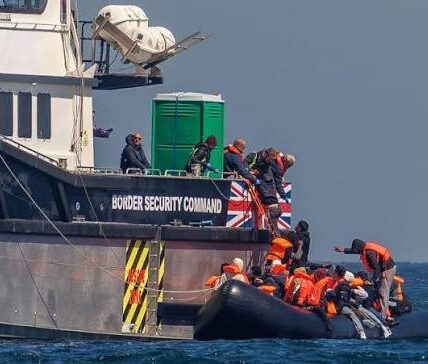
Successive governments have struggled to reduce waiting times while managing increasing numbers of small-boat arrivals across the English Channel.
This continuing challenge explains why immigration remains one of the most politically significant issues facing Westminster.
My Professional Perspective
Having covered immigration policy, border security, and British elections for more than three decades, I believe the most significant aspect of Nigel Farage’s latest proposal is not the detention centres themselves.
It is the shift in political language.
For many years, British governments largely debated immigration in terms of administration.
Processing times.
Accommodation costs.
Border management.
Legal appeals.
Farage instead frames the issue as an emergency requiring extraordinary governmental powers.
That represents a fundamental change in political framing.
Whether voters ultimately agree with his proposals or reject them, they are increasingly being asked to choose between two very different philosophies of immigration control.
One emphasizes reform within existing legal frameworks.
The other argues that existing legal frameworks themselves prevent effective enforcement.
Another overlooked aspect concerns implementation.
Large policy announcements often appear straightforward during political campaigns.
Governing is considerably more complex.
Detention facilities require staffing, legal oversight, healthcare provision, security infrastructure, and compliance with domestic and international legal obligations.
Mass deportations depend upon diplomatic cooperation from receiving countries, travel documentation, transport logistics, and the resolution of legal appeals.
These operational realities do not necessarily invalidate political proposals.
But they do determine whether ambitious promises can become practical government policy.
There is also a broader political calculation.
Farage’s proposals appear designed not only to present Reform UK’s own immigration platform but also to influence the wider national conversation.
British political history demonstrates that smaller parties can shape debate even without forming government.
When public concern over immigration rises, larger parties often adjust their own positions in response.
In that sense, the proposal’s political significance may ultimately extend beyond whether every individual measure is implemented.
Finally, this debate illustrates a deeper tension facing many Western democracies.
Governments must balance border security, humanitarian responsibilities, international legal commitments, public confidence, and economic realities simultaneously.
Each objective is legitimate.
The difficulty lies in achieving all of them at once.
That balancing act—not any single speech or policy announcement—will continue defining Britain’s immigration debate for years to come.
Conclusion
Nigel Farage’s latest immigration proposals represent one of Reform UK’s most ambitious policy packages to date.
From converting asylum accommodation into secure detention centres to expanding deportation capacity, withdrawing from international human rights agreements, and increasing removal operations, the proposals would fundamentally reshape Britain’s immigration system if implemented.
Supporters argue these measures would restore border control, strengthen public confidence, and deter illegal migration.
Critics contend they raise serious legal, financial, and humanitarian concerns while questioning whether they could realistically be delivered.
With around 170,000 asylum cases still awaiting resolution and immigration remaining among the country’s most politically charged issues, the debate is unlikely to fade anytime soon.
Ultimately, the question facing Britain is larger than one party or one policy.
It is whether the country can build an immigration system that is both effective in enforcing the law and capable of meeting its legal and humanitarian responsibilities.
As political divisions deepen and public expectations grow, that challenge may become one of the defining tests of British government in the years ahead.