
The Letter Hidden Beneath the Chapel Floor
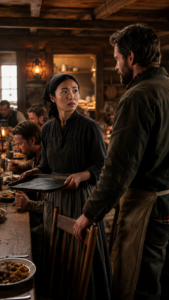
No one in Dry Creek remembered exactly when the chapel bell stopped ringing.
Some said the rope had snapped during a summer storm. Others swore the old preacher simply vanished one moonless night, leaving the tiny frontier church to gather dust beneath the endless Wyoming sky. But every child born in that valley grew up hearing the same warning whispered around supper tables and campfires:
“Never stand inside the chapel after sunset. The floor remembers names that men have tried to bury.”
Most folks laughed at the story.
Until the bones appeared.
The spring thaw had barely loosened the frozen earth when a pair of ranch hands pried open warped floorboards to repair the chapel. They expected rotten timber and mice. Instead, they uncovered a rusted cavalry saber, a woman’s silver wedding ring, and beneath them both, a leather pouch sealed with dark wax that somehow had survived thirty years underground.
Inside rested a single letter.
It bore no address.
Only six words, written in faded black ink.
“If Elias Boone returns, tell him I lied.”
By sundown, every soul in Dry Creek had heard about the letter.
By sunrise, the man it named rode into town.
No one recognized the gray-haired stranger at first. His shoulders still carried the straight posture of a cavalry scout, but time had carved deep lines into his weathered face. A faded buffalo coat hid an old bullet scar beneath his left arm, and his saddle carried more dust than luggage, as though he had crossed half the continent chasing something too stubborn to die.
He introduced himself with only three quiet words.
“My name’s Elias.”
The blacksmith dropped his hammer.
The widow who kept the boarding house forgot the coffee boiling on the stove.
An old Comanche tracker standing outside the mercantile slowly removed his hat, his expression not surprised but saddened, as though he had spent decades hoping this day would never arrive.
Because everyone over sixty remembered the same story.
Elias Boone was supposed to be dead.
He had disappeared during the Red Bluff Massacre nearly three decades earlier, along with twelve cavalrymen, a wagon carrying Army payroll, and the preacher’s young daughter, Clara Whitmore.
The Army blamed outlaws.
The newspapers blamed raiders.
The town blamed Elias.
Only the missing bodies had never agreed with any version of the truth.
Now the man accused of stealing twenty thousand dollars in gold—and murdering the woman he was said to love—had quietly ridden back into the very town that had buried his name without ever burying his body.
No one welcomed him.
No one reached for a handshake.
Instead, every window along Main Street seemed to close one after another, as if the town itself were afraid of what daylight had finally delivered.
Elias noticed.
He said nothing.
His eyes lingered on the abandoned chapel sitting alone above the hill.
For just a heartbeat, grief replaced the calm on his face.
Then it disappeared.
He asked only one question.
“Who found the letter?”
The silence that followed felt heavier than thunder.
Because the truth was something Dry Creek had protected for thirty years—not with guns, but with fear.
And somewhere beneath the chapel floor, hidden deeper than the first discovery, waited another secret no one alive was prepared to uncover.
Not even the man who had spent half his life searching for it.
Elias rented the smallest room in the boarding house without bargaining over the price. That alone unsettled Mrs. Granger. Men who wandered the frontier either counted every coin or flashed too many of them. Elias did neither. He paid in worn silver dollars whose dates reached back to the war, thanked her politely, and carried his own saddle upstairs.
From the window of his room, he could see the chapel standing against the crimson glow of sunset. Its white paint had long since surrendered to wind and dust. The bell tower leaned slightly west, as though exhausted from decades of holding secrets too heavy for timber. Every few minutes his eyes drifted back to it, not with fear but with recognition. It looked like an old friend who had survived a terrible mistake, promising that whatever waited inside had not finished speaking.
The next morning, before the town had fully awakened, Elias climbed the hill. Dew clung to the prairie grass, and meadowlarks called from weathered fence posts. He paused before opening the chapel door, laying one rough hand against the faded wood. Thirty years vanished in an instant. He could almost hear children singing hymns, Clara laughing as she arranged fresh wildflowers near the altar, and Reverend Whitmore reminding him that even broken men deserved another chance. Those memories carried warmth, yet beneath them lingered something colder, as if another voice whispered that memory itself could become the greatest liar.
Inside, sunlight spilled through cracked stained glass, painting faded colors across warped floorboards. Workers had already nailed fresh planks over the place where the leather pouch had been found. To everyone else, the repairs marked the end of an old mystery. To Elias, they marked its beginning. He knelt slowly, pressing his fingertips against the wood. The floor felt solid, but something about the spacing of the boards stirred a memory buried deeper than the letter itself.
“You remember.”
The voice came softly from behind him.
Elias turned.
An elderly man stood near the doorway holding a broom. His back was bent with age, but his blue eyes remained sharp.
“Mr. Mercer,” Elias said quietly.
The old caretaker smiled with sadness.
“I wondered if you’d know me.”
“I’d know those eyes anywhere.”
Mercer chuckled once, though there was no joy in it.
“I was hoping you’d stay gone.”
“So was I.”
The honesty surprised them both.
Mercer rested both hands on the broom handle.
“You shouldn’t have come back.”
“I didn’t have a choice.”
“You always had one.”
Elias shook his head.
“Not after the letter.”
The caretaker’s expression changed ever so slightly. It wasn’t fear. It was resignation, the look of a man who had watched a storm approach for years and finally heard the first thunder.
“You read it?”
“I’ve read those six words a hundred times.”
“And?”
Elias looked toward the altar.
“Clara never lied.”
Mercer’s grip tightened around the broom.
“Then someone wrote her words.”
Neither man spoke for several seconds. Outside, the wind rattled dry cottonwood leaves against the windows.
Finally Mercer sighed.
“You’re asking the wrong question.”
Elias frowned.
“I am?”
“The letter isn’t asking who lied.”
The old man pointed toward the repaired floor.
“It’s asking why.”
Those words settled into the silence like a stone sinking into deep water. Elias realized the mystery had shifted. For thirty years he had searched for the people responsible for the massacre. Yet perhaps the greater secret was why someone wanted history rewritten after everyone involved had vanished.
Before he could ask another question, hoofbeats thundered outside.
Three riders stopped hard in front of the chapel.
Leading them was Sheriff Daniel Cross.
He climbed from his horse slowly, removing his gloves one finger at a time.
“You’ve caused enough excitement for one morning,” he called.
“I only walked into a church.”
“You walked into a grave.”
Elias stepped outside.
The sheriff studied him carefully.
“I remember the wanted posters.”
“I remember the men who printed them.”
Cross folded his arms.
“Folks are nervous.”
“They should be.”
The sheriff raised an eyebrow.
“You admit it?”
“I admit the truth has finally caught up.”
Cross expected denial, excuses, perhaps anger. Instead he found something far more unsettling—a man who seemed completely prepared to face whatever waited ahead.
“What do you want?” the sheriff asked.
Elias answered without hesitation.
“I want the names of everyone still alive who was here the day Clara disappeared.”
The sheriff’s jaw tightened.
“There are only five.”
“And how many refuse to speak?”
Cross looked toward the town below.
“All of them.”
That evening the streets buzzed with whispers.
Some insisted Elias had returned for hidden gold.
Others believed he had come seeking revenge.
Children dared one another to ride past the abandoned cemetery after dark, claiming lantern lights moved among the graves where no one stood.
Meanwhile Elias sat alone beneath the porch of the boarding house, cleaning a battered Colt revolver he had not fired in years.
A small girl carrying a basket of apples approached him carefully.
“Mister?”
He looked up.
“Yes?”
“My grandpa said this belongs to you.”
She handed him a tarnished silver pocket watch.
His breath caught.
The watch had stopped at exactly 4:17.
The same minute the massacre began.
He turned it over.
Scratched into the back were two initials.
C.W.
Clara Whitmore.
Elias stared at the watch for a long time before asking the child where she’d found it.
“My grandpa gave it to me.”
“Who’s your grandpa?”
She pointed across the street.
Old Mercer.
But when Elias looked up, the caretaker was gone.
Only the empty doorway of the chapel remained visible atop the hill.
Inside his coat pocket, the broken watch suddenly felt heavier than gold.
Because he remembered something no one else could possibly know.
Clara had buried that watch herself.
And if it had somehow returned…
Then someone else had survived Red Bluff besides Elias.
That night, sleep never found Elias Boone.
The broken pocket watch lay on the table beside his bed, its cracked crystal catching the pale glow of the moon. Every few minutes he picked it up, turning it over in his calloused hands as if another answer might appear beneath the scratches. Time had stopped at 4:17, but memory had not. Memory refused to remain buried.
Thirty years earlier, Clara had laughed as she tucked the watch beneath the roots of an old cottonwood outside Red Bluff Crossing.
“If either of us comes back,” she had teased, “the one who finds it buys supper.”
He remembered pretending to grumble.
“You always choose expensive restaurants.”
She had smiled.
“That’s because you’re terrible at saying no.”
It had been the last time either of them laughed without looking over a shoulder.
The memory ended there—not because nothing followed, but because everything afterward had become smoke, gunfire, and screaming horses.
Someone had dug up that watch.
Someone who knew exactly where Clara had hidden it.
Which meant the secret was never about stolen gold.
It was about the people who had known where to look.
Before sunrise Elias saddled his horse and rode toward Red Bluff Crossing, fifteen lonely miles west of Dry Creek. Few travelers used the old trail anymore. New rail lines had stolen the stage routes, leaving only broken wagon ruts stretching through endless prairie. The silence felt unnatural, as though the land itself expected him to remember something it had patiently guarded for decades.
Around noon he reached the crossing.
Nothing remained except crumbling stone foundations, scattered wagon wheels half buried in weeds, and the blackened chimney of what had once been a stage station.
Nature had spent thirty years trying to erase the tragedy.
It had failed.
Elias dismounted beside the old cottonwood.
Age had split the enormous trunk almost in half.
He knelt beneath its roots.
Fresh shovel marks scarred the earth.
Not years old.
Weeks.
Someone else had been here.
His heartbeat quickened.
Digging carefully with his hands, he uncovered the empty tin box where Clara had hidden the watch all those years ago.
Empty.
Except for one folded scrap of yellow paper.
Only four words appeared on it.
“You finally remembered.”
No signature.
No explanation.
Just another invitation into a mystery that seemed determined to stay one step ahead of him.
A rifle clicked behind his back.
“Don’t move.”
The voice belonged to a woman.
Calm.
Confident.
Not young, yet not old.
Elias slowly raised his hands.
“I wasn’t planning to.”
“You’ve always been stubborn.”
His eyes narrowed.
“I know that voice.”
“You should.”
She stepped into view.
Gray dust covered her long riding coat, and the brim of her weather-beaten hat shaded most of her face. A Henry rifle rested steadily against her shoulder.
Then she lifted her chin.
For one impossible heartbeat, the years disappeared.
Not Clara.
But her younger sister.
Sarah Whitmore.
The last time Elias had seen Sarah, she had been sixteen years old.
Now silver threaded through her dark hair, and the innocence of youth had been replaced by the steady gaze of someone who had survived disappointments too numerous to count.
“I attended your funeral,” Elias said quietly.
Sarah gave a humorless smile.
“I attended yours.”
Neither laughed.
Instead, the wind moved gently through the cottonwood branches above them, sounding almost like whispered voices.
Sarah lowered the rifle only an inch.
“You shouldn’t have come back.”
“So everyone keeps telling me.”
“This time they’re right.”
Elias held up the folded note.
“Did you write this?”
“No.”
“The letter under the chapel?”
“No.”
“The watch?”
Again she shook her head.
“But I know who did.”
Hope surged through him.
“Who?”
Sarah looked toward the distant hills.
“The only man who profited from everyone believing you were dead.”
“The sheriff?”
“No.”
“The Army?”
“They were fooled too.”
“Then who?”
Her answer came so softly the wind almost carried it away.
“Reverend Whitmore.”
Elias stared at her.
“Clara’s father?”
“He wasn’t the man you thought he was.”
“No.”
“He wasn’t.”
Sarah’s eyes filled with sorrow rather than anger.
“My father spent twenty-five years convincing this town he was protecting innocent people.”
She paused.
“He was protecting a fortune.”
Elias felt the ground shift beneath everything he believed.
“The payroll?”
Sarah nodded.
“There never was an Army payroll.”
Silence.
Only the distant cry of a hawk echoed across the empty valley.
“What do you mean?”
“The wagons carried something far more valuable.”
“What?”
She hesitated.
“The original land treaties.”
Elias frowned.
“I don’t understand.”
“Neither did the soldiers escorting them.”
Sarah looked directly into his eyes.
“Those papers proved thousands of acres across this valley had been stolen through fraud.”
Elias slowly stood.
“The ranches…”
“Were built on land that never legally belonged to them.”
“The town knew?”
“No.”
“My father did.”
Every answer created three more questions.
“If that’s true…”
Sarah finished the thought for him.
“Then whoever destroyed the convoy wasn’t stealing money.”
“They were destroying evidence.”
She nodded once.
“And Clara found out.”
The world seemed to fall silent.
Not because the revelation explained everything.
Because it explained almost nothing.
If Clara had uncovered the truth…
Why had she disappeared?
Why had her father allowed the town to believe Elias murdered her?
And why, after thirty years, had someone begun leaving clues instead of simply destroying them?
Sarah looked toward the western ridge.
“We don’t have much time.”
“For what?”
“They’re watching.”
Elias instinctively reached for his revolver.
“Who?”
She didn’t answer immediately.
Instead she pointed toward the hill overlooking the crossing.
A flash of sunlight reflected from polished glass.
A spyglass.
Someone was observing them.
The figure disappeared almost instantly behind the rocks.
Sarah mounted her horse in one smooth motion.
“They know you’ve started asking the right questions.”
“Who are they?”
“There were five people at Red Bluff.”
“I know.”
She shook her head.
“No.”
“There were six.”
Before Elias could speak again, she wheeled her horse toward the canyon trail.
Then she looked back one final time.
“The sixth person never died.”
She spurred her horse into a gallop.
Elias remained standing beneath the old cottonwood, watching the dust settle behind her.
His pulse pounded in his ears.
For thirty years, every version of the story had insisted only one survivor escaped the massacre.
Him.
Now he knew that had been another carefully buried lie.
Somewhere in the vast Wyoming wilderness lived a sixth witness.
The only person alive who had seen every betrayal with their own eyes.
And judging by the clues appearing one after another…
That unseen witness had finally decided the truth was ready to come home.
Note: Some content was generated using AI tools (ChatGPT) and edited by the author for creativity and suitability for historical illustration purposes.