The night they brought her in, the wind had already decided the shape of everything that would follow. t1

The night they brought her in, the wind had already decided the shape of everything that would follow.
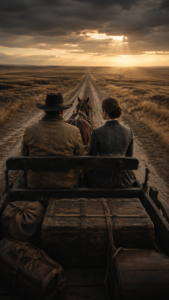
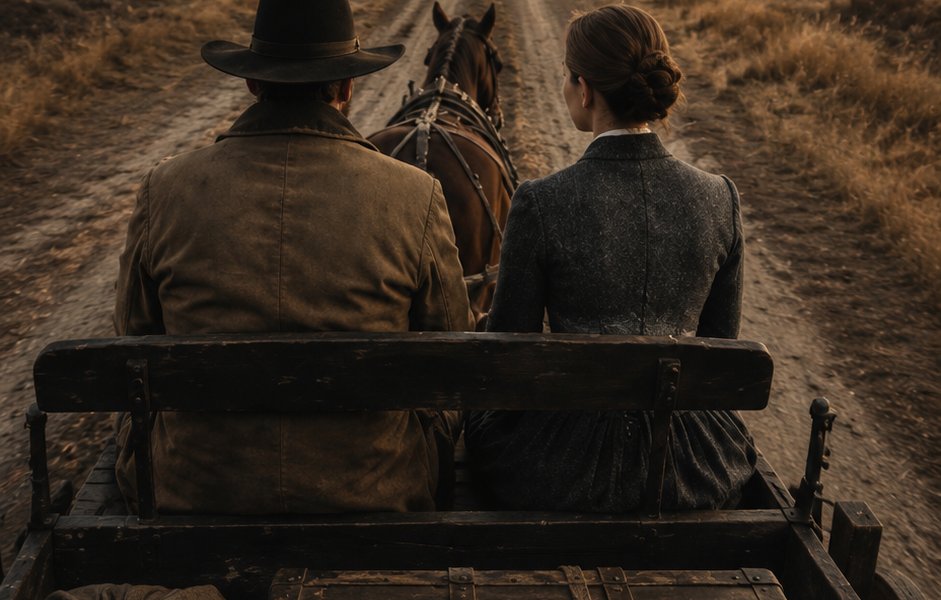
It wasn’t a wind you heard first—it was one you felt in your bones, like the land itself was shifting its weight to see what kind of men would stay standing. The wagons coming down off the ridge didn’t creak the way wagons should; they sounded strained, as if the wood had learned something it didn’t want to repeat. And in the middle of it all, wrapped in a gray wool coat too big for her shoulders, sat a girl who never once looked back at the road she was leaving behind.
Nobody knew her name. Not truly. The paper said one thing, the escort said another, and the child never corrected either. That alone should’ve been warning enough for a place like Hollow Creek, where silence usually meant trouble was just waiting for the right moment to speak. But what made men uneasy wasn’t her silence—it was the way she watched. Not at people. Through them. Like she was counting something invisible only she could see ticking down beneath their words.
Old ranchers would later swear she never blinked at the wrong time. That she once turned her head seconds before a horse collapsed in a stampede half a mile away. That she could feel storms before clouds formed, as if the sky had learned her name and whispered it in advance. And yet, on that first night, all anyone saw was a thin child standing beside a broken trunk, staring at a lantern that flickered like it was trying to remember how to burn.
The man who brought her—if you could call him that—never explained why he stopped at Hollow Creek instead of taking her onward. Some said his horse went lame. Others said he heard something in the wind that made him change his mind mid-road. A few swore he never planned to pass through at all, that the girl simply appeared where she wasn’t supposed to be, like the land itself had decided to test him.
What is certain is this: when he left the next morning, he left without her, and without ever looking back at the house she now stood in front of. And that alone would have been strange enough to bury in rumor… if it weren’t for what the girl said before sunrise.
She spoke only once that first night. Just three words, spoken toward the dark pasture beyond the fence line, words so calm they felt borrowed from somewhere older than language itself.
“Don’t trust south.”
No one understood what she meant. Not then.
Not before the first cow died facing north.
Not before the creek changed direction for half a day without explanation.
And not before Hollow Creek learned that some warnings are not warnings at all—but confessions waiting to happen.
They called the place Hollow Creek because the water only told the truth when it felt like it. Most years, it ran shallow and obedient, a thin silver scar through dry country that pretended not to need it. But in certain seasons—seasons nobody ever agreed on afterward—it moved like it remembered something dangerous beneath the soil and wanted out.
The ranch house sat like it had been placed there by mistake. Boards weathered gray, nails pulled just enough to suggest fatigue. The kind of place men built when they believed permanence was a matter of effort rather than permission. Behind it stretched pastureland that always looked one season away from giving up entirely, no matter how much care it received.
The girl was given a room above the kitchen. No one asked if she wanted it. No one asked anything at all. That was the way Hollow Creek worked: questions were considered a form of weakness, and answers were usually just ways of avoiding responsibility.
She did not unpack.
She placed the broken trunk by the wall and sat on the floor beside it until morning, as if waiting for something inside the boards to speak first.
And when the first light came through the thin window, she was already gone.
Not outside.
Not away.
Just… no longer where she had been.
They found her standing at the north fence line, barefoot in frost so thin it hadn’t decided whether to exist yet. Her eyes were fixed on the horizon in a way that made the foreman uneasy, as though she were listening to something approaching from a distance no one else had access to.
“You’ll freeze,” he said.
She didn’t look at him. “Not yet.”
That was the second time she spoke.
And somehow, it felt more final than the first.
By the third day, the ranch began adjusting around her without permission.
It started small. A horse refusing to cross a specific patch of ground she had stood on earlier. A dog refusing to bark at her, even when strangers came near. A storm that split cleanly around the property line as if it had been redirected by invisible hands.
Men don’t like patterns they didn’t create. It unsettles them more than danger.
So they did what men always do when something refuses to explain itself: they began to talk.
“She’s touched,” one said.
“She’s educated wrong,” said another.
“She don’t belong,” said a third, which was the closest thing to agreement they ever reached.
Only the old ranch cook—who had seen enough winters to stop trusting certainty—said nothing at all. He watched her instead. Quietly. Carefully. The way a man watches water when he knows it has already decided whether to drown him.
Because there was something about her silence that didn’t feel empty.
It felt full.
Like something was speaking through it, just not in any language anyone else had learned yet.
The first real sign came on a Tuesday that looked no different than any other day Hollow Creek had ever produced.
The sky was low, the wind steady, cattle grazing like nothing in the world had ever required their attention. The girl stood on the porch with her hands in her coat pockets, watching the southern pasture with an expression that suggested she was waiting for someone to arrive who had never been invited.
At exactly noon, she spoke again.
“Move them.”
No explanation. No urgency. Just instruction.
The foreman laughed.
“No storm coming,” he said.
The cook didn’t laugh. He was already looking at the horizon like it had changed shape without permission.
The girl finally turned her head slightly—not toward the sky, but toward the ground.
“That’s why,” she said.
And then she walked away.
By sundown, the southern pasture flooded for the first time in twenty-seven years.
Not gradually.
Not naturally.
All at once, like the earth had opened a memory it could no longer contain.
The cattle that had stayed behind didn’t die quickly. That was the part nobody forgot. They stood in rising water as if waiting for instructions that never came, as if the land they trusted had simply stopped speaking to them.
And the girl never once looked back.
After that, they stopped questioning her.
Not because they believed her.
Because they were afraid of what happened when they didn’t.
Still, fear has a way of turning into dependence when it survives long enough. By winter, they were watching her more than the weather. By spring, they were waiting for her before making decisions they used to call their own.
She never claimed authority.
She never took it either.
It simply gathered around her like iron filings to a magnet no one could see.
And through it all, she kept returning to the north fence line, standing in the same place for hours at a time, as if listening to something buried beneath the soil that only she could hear breathing.
One evening, the cook finally asked her what she was waiting for.
She didn’t answer at first. Then, softly, almost gently, she said:
“It’s already here. It just hasn’t happened yet.”
That was the moment he understood the worst part.
She wasn’t predicting the future.
She was remembering it.
The winter that followed was wrong in ways no one could explain afterward without sounding like they were lying.
The wind changed direction for three days straight without shifting temperature.
The creek froze in motion rather than stillness, ice forming in patterns that resembled writing.
And the cattle began gathering at the north pasture without being driven there, as if something beyond sight had started calling them home.
Men started sleeping with their boots on.
No one said why.
They all knew.
The girl had stopped speaking entirely.
She would stand in the yard at night, looking at the sky like it was a ledger she was reviewing line by line, occasionally closing her eyes as if confirming something only she could verify.
One night, the cook followed her at a distance.
He didn’t mean to.
He just needed to know if she ever slept.
She walked to the creek.
Stopped.
Waited.
Then said, without turning:
“You’re late.”
The cook froze.
There was no one else there.
Except—
The wind shifted.
And for half a second, he heard something beneath it. Not sound. Not voice. More like recognition.
As if the land itself had answered her.
Spring did not arrive so much as surrender.
When it came, it came unevenly, like a decision made under pressure. Snow melted in places it had no right to melt first. Grass returned in circles rather than spread. And the north fence line—the place she always stood—grew greener than anywhere else on the ranch, as if something unseen had been feeding it in secret.
That was when the first outsider arrived.
A surveyor from the railroad company.
He said he was measuring land rights.
He said he was not there for anything unusual.
He said many things that turned out not to matter.
Because the moment he saw the girl standing at the fence line, he stopped speaking entirely.
He stayed three days.
On the third day, he left without completing his work.
When asked why, he only said:
“That land already belongs to her. It just hasn’t caught up yet.”
No one understood what that meant.
Except the cook.
And he never repeated it.
The truth—whatever truth means in a place like Hollow Creek—only revealed itself slowly.
Not in words.
In patterns.
In the way storms avoided the ranch by narrow margins.
In the way cattle stopped dying without cause.
In the way the girl began aging slower than she should have, or perhaps just differently than time expected.
And in the way she sometimes looked at people with an expression that suggested she recognized them from events they had not yet lived through.
Years passed like that.
Not peacefully.
But inevitably.
Until one evening, long after most men had stopped calling her a girl, she stood at the north fence line one final time.
The cook—old now, slower now, still alive only out of habit—came to stand beside her.
Neither spoke for a long time.
Then he asked the only question he had ever truly wanted answered.
“What are you listening to?”
She didn’t look at him.
Not at first.
When she finally did, her eyes were not distant anymore.
They were… finished.
“I was waiting for it to change,” she said.
A pause.
Then softer:
“It already has.”
The wind stopped.
Not faded.
Stopped.
And in the silence that followed, the cook understood something he had been avoiding for most of his life.
The land had never been unpredictable.
It had been patient.
And she had been the only one who could hear what it was waiting to become.
The girl—no longer girl, no longer anything easily named—took one last look across the pasture.
Then she stepped beyond the fence line.
And did not return.
They say Hollow Creek still stands.
The ranch, the fence, the broken lantern by the gate.
Men still pass through and feel uneasy for reasons they cannot explain.
Some swear they see a figure at the north pasture in the early morning mist.
Others say the creek still changes course when no one is watching.
But the cook—before he finally went quiet himself—left one thing behind.
A single line written in ink so faded it almost refused to exist:
“She wasn’t predicting the land.
She was finishing what it started.”