
Poland vs. Brussels: The Growing Migration Rift Reshaping Europe’s Political Future
A growing confrontation between Poland and the European Union has once again brought migration policy to the center of Europe’s political debate, exposing deep divisions over sovereignty, border control, and the future direction of the European project.
What began as another disagreement over migration management has evolved into something much larger—a struggle between competing visions of Europe itself.
On one side stand leaders who argue that migration policy should remain primarily the responsibility of individual nation states.
On the other are those who believe that a common European response is essential for maintaining stability across the continent and preserving the integrity of the Schengen free-movement area.
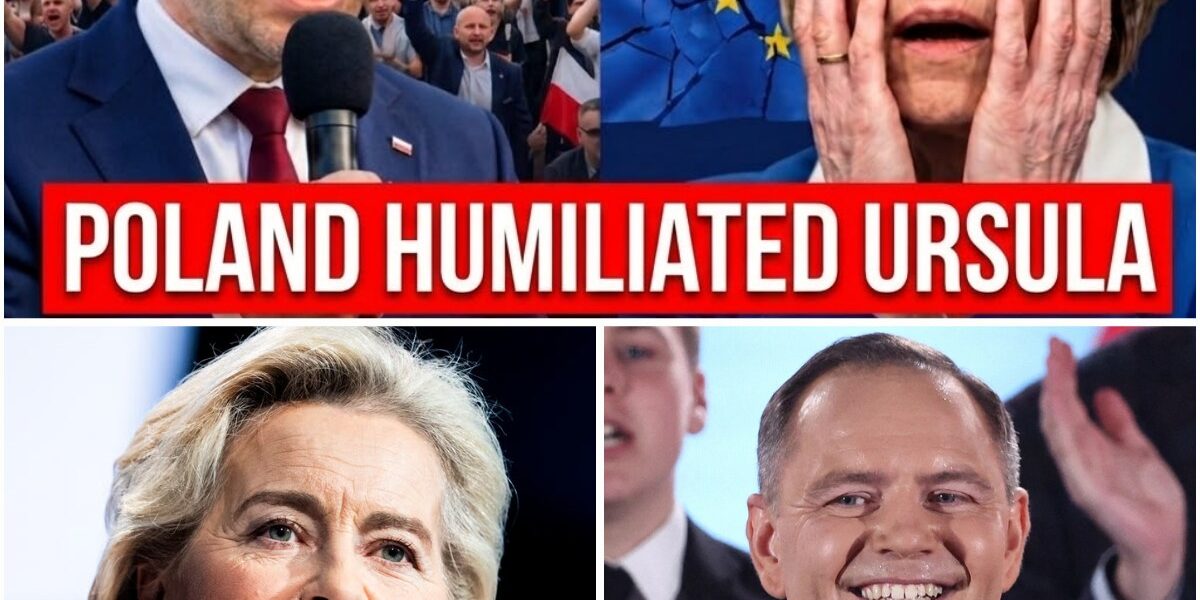
The latest controversy emerged following reports surrounding comments attributed to Polish President Karol Nawrocki during discussions connected to a European summit.
According to various accounts, Nawrocki criticized aspects of Germany’s migration policy and questioned the role of the European Commission in promoting shared migration responsibilities among member states.
Although interpretations of the remarks vary, the controversy has reignited long-standing tensions between Warsaw and Brussels.
At the heart of the dispute remains one of the most consequential political decisions in modern European history.
The Shadow of 2015
To understand the current disagreement, it is necessary to revisit the migration crisis of 2015.
That year, under the leadership of former German Chancellor Angela Merkel, Germany accepted large numbers of migrants and refugees fleeing conflict, instability, and humanitarian crises.
The decision was praised by supporters as a humanitarian response to an extraordinary emergency.

Critics argued it was implemented too rapidly and without sufficient consultation with other European nations.
More than a decade later, the consequences of that decision remain a subject of intense political debate.
Supporters point to successful integration stories, labor market contributions, and Germany’s humanitarian leadership.
Critics point to integration challenges, political polarization, housing pressures, and security concerns.
The debate has never fully disappeared.
Instead, it has evolved into one of the defining political fault lines of contemporary Europe.
Poland’s Alternative Approach

Poland chose a markedly different path.
Successive Polish governments have generally pursued more restrictive migration policies regarding arrivals from outside Europe.
Many Polish politicians argue that maintaining strong border controls and national authority over migration decisions is essential for preserving security and social stability.
This position has found support among significant portions of the electorate.
Polish leaders frequently contend that countries should retain the sovereign right to determine who enters their territory and under what conditions.
The dispute has intensified as the European Union has sought to develop more coordinated migration mechanisms.

Supporters of greater EU cooperation argue that migration pressures affect all member states and therefore require collective solutions.
Opponents view mandatory redistribution systems and centralized decision-making as infringements on national sovereignty.
The Role of Brussels
Much of the criticism from migration-skeptical politicians is directed toward the European Commission, led by Ursula von der Leyen.
For critics, Brussels increasingly symbolizes political centralization and the transfer of authority away from national governments.
Supporters of the Commission reject that characterization.
They argue that shared challenges—including migration, security, energy policy, and economic competition—require coordinated responses that individual states cannot effectively manage alone.
This disagreement reflects a broader debate that extends far beyond migration.

It concerns the future structure of the European Union itself.
Should Europe become more integrated politically?
Or should member states retain greater independence over major policy areas?
The answer remains one of the most significant unresolved questions facing the continent.
Migration and Political Realignment
Migration has increasingly become a catalyst for political change across Europe.
Parties advocating stricter immigration controls have gained support in several countries, reflecting voter concerns about border security, integration, housing pressures, and public services.
In Germany, debates over migration have contributed to the rise of political movements challenging traditional parties.
Similar developments have occurred in multiple European nations.

Meanwhile, governments that support broader European cooperation argue that migration challenges cannot be solved through national policies alone.
They warn that fragmented approaches risk creating new border disputes and weakening European unity.
This clash of perspectives has transformed migration into one of Europe’s most politically sensitive issues.
Ukraine and a Different Migration Experience
One important aspect often overlooked in migration debates is Poland’s response to the war in Ukraine.
Since Russia’s full-scale invasion in 2022, Poland has received large numbers of Ukrainian refugees fleeing the conflict.
The country became one of the primary destinations for displaced Ukrainians seeking safety.
Many observers note that Poland’s experience with Ukrainian refugees differs significantly from its approach to broader migration policy.
Polish authorities have highlighted high employment rates among Ukrainian refugees and relatively successful labor market integration.
However, economists caution against simplistic comparisons.
Different refugee populations, labor markets, welfare systems, and cultural circumstances create distinct challenges and outcomes.
Nonetheless, the Ukrainian experience has become a central element in Poland’s argument that migration policy should remain flexible and tailored to national circumstances.
Security and Sovereignty
The migration debate is also increasingly connected to broader security concerns.
Poland has emerged as one of NATO’s strongest military contributors and has invested heavily in defense capabilities.
Political leaders frequently frame migration control as part of a wider national security strategy.
Supporters view this approach as prudent and necessary.

Critics argue that linking migration too closely to security risks oversimplifying complex social and humanitarian issues.
Regardless of perspective, security considerations now play a major role in migration policymaking across Europe.
My Professional Perspective
After covering European politics, migration crises, and international institutions for decades, I believe this story is frequently misunderstood.
Many observers view the dispute as simply another disagreement about immigration.
In reality, migration has become a proxy for a much larger struggle.
The deeper conflict concerns power.
Who should make decisions that shape the future of European societies?
National governments?
Or European institutions?
That question sits beneath almost every major dispute currently unfolding within the European Union.
Migration merely happens to be the most emotionally charged battlefield on which that struggle is taking place.
Another overlooked reality is that both sides of the debate are responding to genuine concerns.
Countries such as Poland, Hungary, and Slovakia often emphasize sovereignty because they have historical experiences that make national self-determination particularly important politically.
Meanwhile, Western European leaders worry that uncoordinated migration policies can create instability across borders and undermine collective governance.
Neither concern is entirely imaginary.
Both are rooted in legitimate political realities.

The challenge is that the two visions often appear incompatible.
One side seeks greater national control.
The other seeks deeper integration.
The result is a cycle of recurring political confrontations.
What makes the current situation particularly significant is that migration is no longer merely a policy issue.
It has become a symbol.
For some Europeans, migration represents humanitarian responsibility and international cooperation.
For others, it represents concerns about identity, sovereignty, and democratic accountability.
Once an issue acquires symbolic importance, compromise becomes much more difficult.
That may explain why migration continues to dominate European politics even when economic, security, and energy challenges are equally significant.
The Question Europe Cannot Avoid
The fundamental question facing Europe today is not simply how many migrants should be admitted.
It is whether the European Union can maintain unity while member states increasingly disagree about the values, priorities, and responsibilities that should guide migration policy.
That challenge may prove even more difficult than managing migration itself.
Conclusion
The dispute between Poland and Brussels reflects one of the most important political struggles currently unfolding in Europe.
What began as disagreement over migration management has evolved into a broader debate about sovereignty, integration, security, and the future of the European Union.
Supporters of stronger national control argue that migration decisions should remain firmly in the hands of sovereign governments.
Advocates of greater European cooperation insist that shared challenges require shared solutions.
Neither side appears willing to retreat.
As migration pressures, security concerns, and political tensions continue to shape public debate, the divide between these competing visions of Europe may become even more pronounced.
The question is no longer whether migration will remain a defining issue for the European Union.
It almost certainly will.
The real question is whether Europe can find a workable balance between national sovereignty and collective responsibility before political divisions become even more deeply entrenched.
The answer may help determine not only the future of migration policy but the future of the European project itself.