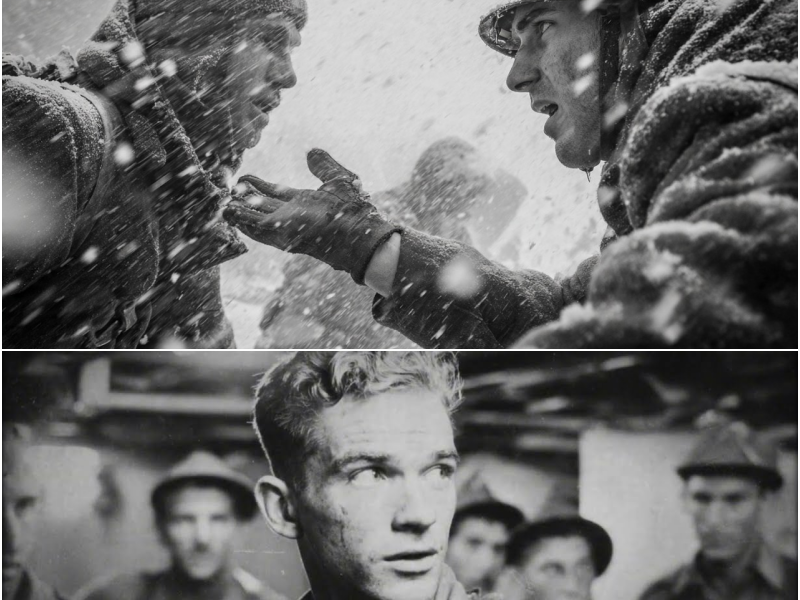
The Final Letter He Swore to Deliver — A Story of Brotherhood, Sacrifice, and War. VD

The Final Letter He Swore to Deliver — A Story of Brotherhood, Sacrifice, and War
The Final Letter He Swore to Deliver
Part 1
In the autumn of 1987, I sat in the little room behind my house with an old tape recorder on the table and a black-and-white photograph resting beside it.
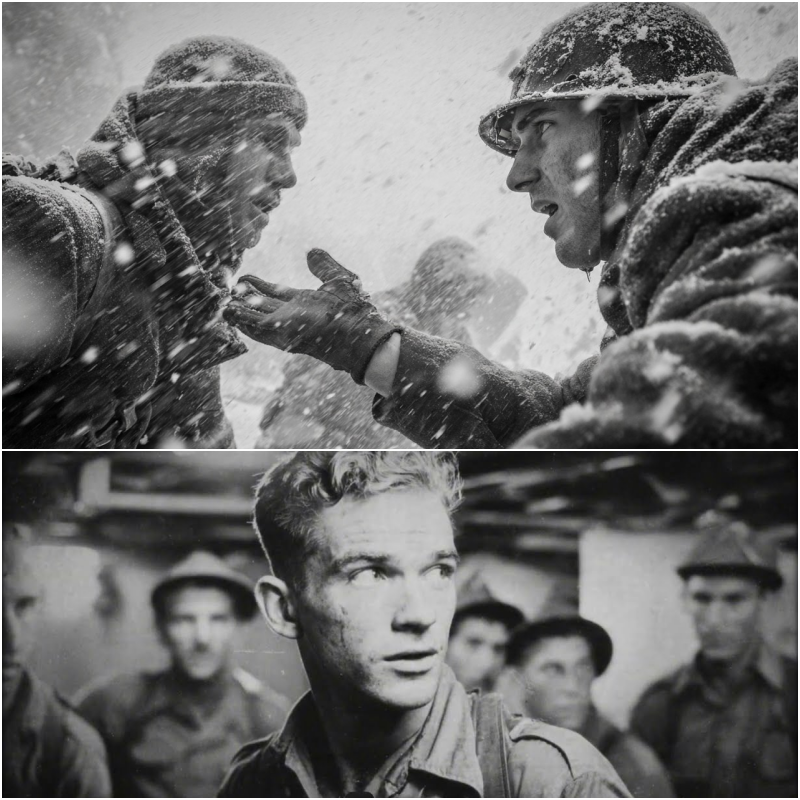
The machine hissed when I pressed play.
My hands trembled with age, but memory did not.
Some nights I still woke hearing iron chains scraping over wet pavement. Some mornings I opened the back door, saw sunlight on the grass, and felt my chest tighten at the sight of that innocent brightness, because it reminded me of another white entirely—the snow of the Ardennes, where too many good men stayed forever.
I leaned toward the microphone.
“My name is Daniel Hayes,” I said. “And if my grandson Caleb ever hears this tape, I want him to know I did not record it to talk about myself. I recorded it to talk about the men who wore the American uniform and walked into fire without turning away.”
I stopped for a moment and looked at the photograph.
There were four of us in that picture. Young. Straight-backed. Smiling as if war were something that happened in newspapers and not to flesh and bone. Thomas Reed stood with one arm crooked at my shoulder. Paul Bennett looked serious even then. Sergeant Donnelly looked like he had been born frowning. Lieutenant Carter stared at the camera with calm eyes that made him seem older than he was.
Outside, the American flag by my porch stirred in the wind.
I closed my eyes.
And I was twenty-three again.
I was back in Abilene, Kansas, in 1944, standing in my parents’ kitchen while the old radio crackled with news from Europe.
My father sat at the table, elbows on his knees, listening in silence.
My mother mended a shirt beneath the yellow light.
And my wife, Grace, stood by the window with one hand resting on the gentle curve of her belly.
She was five months pregnant.
The announcer’s voice came through low and grave, speaking of villages crushed, rail lines bombed, children missing, armies moving through mud and ruin. When the report ended, my father reached over and turned the radio off.
The kitchen became so quiet I could hear the clock on the wall.
He looked at me.
“You know you’re going,” he said.
It was not a question. It was something that had already entered the room before he spoke.
I looked at Grace.
She did not cry.
She just held herself very still, as if she were trying to stop her heart from breaking too loudly.
“I don’t want to go,” I said.
It was the first time in my life I had spoken fear plainly.
“I don’t want to leave her. I don’t want to leave the baby.”
My father rose from his chair and came to me slowly. He put his rough hand on my shoulder.
“No decent man wants war,” he said. “But sometimes decent men are the only thing standing between evil and the people it wants to swallow.”
My mother bowed her head and wiped her eyes with the back of her hand.
Grace stepped toward me and took my fingers in hers.
They were warm.
Mine felt cold as river stone.
“I don’t want you to go either,” she said softly. “But I want our child to grow up in a country that never has to kneel to fear.”
I looked at her then, really looked at her—the brave mouth, the tired eyes, the love she was forcing to stand upright.
And I understood something that has remained true all my life.
Courage is not always the man holding the rifle.
Sometimes it is the woman standing at the door, letting him leave because she believes some things are bigger than her grief.
I enlisted the next morning.
The wind was sharp. Leaves ran along the dirt road like little yellow animals trying to escape winter.
There were other young men lined up outside the recruitment office, each of us pretending not to see the worry in the others’ faces. My hand shook when I signed the paper.
Nobody laughed.
Every hand there shook.
The night before I left, Grace gave me a small pocket Bible and a photograph of us standing on the porch.
“So you remember home,” she said.
“I’m afraid one day I’ll forget what it feels like.”
She stepped closer and laid her palm over my chest.
“Then don’t let the war take your heart.”
Before I boarded the train, my father pressed his pocket watch into my hand.
“I carried this in the last war,” he said. “If you must fight, fight like a real American.”
I looked at him.
He held my gaze.
“Not the best at destruction,” he said. “The best at protection.”
That sentence stayed with me longer than many sermons.
When the train whistle blew, my mother cried openly.
Grace did not.
She stood on the platform, one hand on her belly, her pale green dress moving in the wind, looking at me as if she were trying to carve my face into memory.
As the train pulled away, she called out, “Daniel, come back.”
I nodded.
At the time, I did not know that some promises are kept with footsteps, and some are kept with a lifetime of carrying the dead inside you.
Training in Georgia felt like being thrown into a furnace and told to become iron.
The sun beat down without mercy. Red clay stuck to our boots and to the sweat on our skin. Every morning began with a bugle and ended with exhausted men trying to stand straight when every muscle begged them not to.
That was where I met Thomas Reed.
He was from Tennessee, tall and broad-shouldered, with dark blond hair and a crooked grin that made it seem as though trouble amused him. He hid fear the way some men hide liquor—carefully, and never for long enough.
One evening, while we were stuffing our packs, he glanced at the photograph of Grace that I kept tucked in my gear.
“Well,” he said, “there goes morale. Married man. Pretty wife. Baby coming. Some of us never had a chance.”
“Shut up, Reed.”
“That’s not very patriotic.”
“You die on the drill field tomorrow, they’ll write on your cross that you talked too much.”
He laughed so hard he nearly dropped his boots.
That was Thomas. He could turn a miserable day into something a man could survive.
Then there was Paul Bennett, a medic from Ohio, quiet and thoughtful, with careful hands and eyes that seemed to notice pain before anyone spoke it. Sergeant Frank Donnelly was hard as cured leather and twice as sharp. His voice always sounded like an order. Lieutenant Samuel Carter was young, but there was an old steadiness in him. He never shouted to prove he was in charge. He simply stood there, calm and straight, and men listened.
One afternoon after a brutal march, Donnelly gathered us in the yard behind the barracks.
He walked past us slowly, staring each man over.
“What do you think the Army is?” he asked.
No one answered.
He nodded, as though silence proved his point.
“It is not a place for lone heroes,” he said. “It is the place where the man on your right drags the man on your left back to his feet. It is where you break your last ration in half. It is where you remember that a uniform means nothing if you don’t know how to keep the man beside you alive.”
He jabbed a finger toward our chests.
“You can shoot straight, run fast, and bark like a big dog. I don’t care. If you won’t carry your brother when he falls, you don’t deserve what’s on your back.”
That evening the usual joking was quieter.
We sat behind the barracks sharing a cigarette and a can of bitter coffee.
Paul stared at his hands.
“I hate blood,” he said.
Thomas snorted. “Then you picked the wrong line of work.”
Paul did not smile.
“Maybe that’s exactly why I picked it. Somebody ought to hate it enough to stop it from flowing.”
The air seemed to still around us.
I looked at the three men beside me and understood that an army is not made only of men eager to win.
It is made of men unwilling to let evil win.
That is something very different.
A week later, I caught Thomas writing a letter and then shoving it unfinished into his pack.
“Who’s Margaret?” I asked.
He looked up too fast.
“You read names now?”
“You blush like a schoolboy. Hard to miss.”
He sighed and rubbed a hand over his face.
“She’s my fiancée.”
“Does she know you’re scared?”
He was quiet for a moment.
“Yes,” he said. “And she loves me anyway.”
That answer told me more about him than any joke he ever made.
At night I wrote to Grace.
I told her about the heat, the drills, the red clay, the blisters, and Thomas’s endless talking. I did not tell her that some nights I lay awake staring into darkness, wondering whether courage was something a man truly possessed or only something he borrowed one hour at a time.
Her letters came thin and precious.
One afternoon I opened one with dirty hands and read:
Dear Daniel, the baby kicks harder every week. I stand on the porch in the evenings and look toward the train tracks. Not because I am weak, but because waiting is also a way of loving.
I had to stop reading then.
Thomas saw my face and said nothing for once.
After a while, he only muttered, “Get home, Hayes. Even if you have to walk through hell.”
I folded Grace’s letter and slipped it into my breast pocket over my heart.
I left the United States on a gray morning beneath a sky the color of old tin.
The troop ship smelled of oil, metal, sweat, and seawater. Men were sick, quiet, prayerful, restless. Some wrote letters as though writing fast enough might shorten the ocean. Some lay in their bunks with their eyes open and their thoughts somewhere far across the Atlantic in kitchens, fields, porches, and little bedrooms where wives slept alone.
One night an alarm ran through the ship—word of an enemy submarine somewhere near our route.
Life jackets came on.
No one joked.
A boy from Missouri began praying out loud.
Another soldier took his wedding ring from his pocket, kissed it, and tucked it back against his skin.
I looked around at those faces and thought: this is the American Army. Not a machine. Not a parade. Not a flag fluttering cleanly in the sun.
It was thousands of human hearts pounding in fear, longing, and duty—and still moving forward.
The submarine never found us.
But after that night, the last boyish part of us seemed to stay behind on the water.
Before we made land, Lieutenant Carter walked through the hold and stopped with our group.
“When you step onto Europe,” he said, “you will carry the flag of the United States on your shoulders. But that flag means nothing if you forget your humanity.”
He looked at Paul.
“Bennett, you keep them alive.”
Then at Thomas.
“Reed, you keep their spirits.”
Then his eyes came to me, and he noticed the corner of Grace’s photograph peeking from my pocket.
“Hayes,” he said, “you keep your promise.”
I did not answer.
I only nodded.
France smelled like ash.
We came in after the great landings, but not so late that the land had healed. Villages stood broken open like cracked skulls. Walls were charred. Roads were cratered. Windows stared out empty as dead eyes. The silence frightened me more than shellfire at first. Not because it was peaceful, but because it was the silence left behind when normal life has been torn away.
Our first mission was to sweep a rural road and secure a crossroads.
Donnelly led.
Thomas, Paul, and I followed close behind.
The first time bullets snapped over my head, my whole body locked.
I dropped into a ditch so hard that mud filled my mouth. My hands shook. My chest felt too tight to breathe.
Donnelly roared from ahead, “Move, damn it!”
But terror is a heavy thing. It can pin a man harder than rubble.
Then Thomas crawled close enough to grab my sleeve.
“Daniel!”
I turned.
His face was streaked with mud, his eyes bright with strain.
“You still with me?”
I nodded.
“Then move.”
That was all.
No great speech. No miracle. Just my name spoken in the middle of hell by a man who would not let fear swallow me.
I moved.
We advanced yard by yard, firing, dropping, crawling, rising again.
Then from the shell of a half-collapsed house came a sound so small I almost thought I imagined it.
A child crying.
Paul heard it too.
“Civilians,” he shouted.
“Stay in formation!” Donnelly barked.
Then the cry came again, thin and desperate.
I do not know what made me break.
Maybe I was foolish.
Maybe I was too human.
But I knew that if we heard that sound and walked on, then everything we had been taught about protecting the weak would become a lie.
I ran.
Thomas cursed and followed.
Inside the ruined house lay a dead French woman and a little boy pinned beneath a beam. He was maybe six. He was not screaming anymore. He was gasping in little frightened bursts, eyes huge in his dust-covered face.
“Paul!”
The medic came in like bullets had no claim on him. His hands shook once, then steadied. He slid bandages into place, pressed cloth against blood, spoke softly to the boy in English the child could not understand but somehow seemed to trust.
Thomas braced himself under the beam.
“On three,” he grunted.
I crouched beside him.
We lifted.
The wood groaned.
The boy whimpered.
I pulled him free and gathered him against my chest. He was so light. His heart was beating wildly through his torn coat.
When we got back behind cover, I realized I was holding him the way a father holds a child after a bad dream.
That afternoon we held the crossroads.
Near dusk, an old French woman emerged from a cellar, trembling all over. She took my filthy hand and kissed the back of it. She said something in French through tears.
I did not understand the words.
I understood gratitude.
That night Carter sat with us beside a shattered fence.
“You broke formation,” he said to me.
“Yes, sir.”
“You could have died.”
“Yes, sir.”
He took a long drag from his cigarette and looked toward the dark village.
“Maybe,” he said, “but the American soldier is remembered not only for battles won. He is remembered for the lives he refused to abandon.”
Those words warmed me more than the cigarette ever could have.
Winter came hard.
By December the world had narrowed to snow, breath, frozen mud, and the strange quiet that comes before artillery. On Christmas Eve we were given a new mission. A reconnaissance platoon had vanished near a vital bridge. If the bridge fell, supply lines behind us would be cut and civilians in the area would be trapped.
Carter chose a small group.
Himself. Donnelly. Paul. Thomas. Me. Three others.
Snow lay deep enough to swallow a man to the knee. The trees stood black and bare against a gray sky. We moved through a white world so empty it felt as though God Himself had stepped back to watch.
After an hour we found blood in the snow.
Fresh.
Then an anti-tank ditch.
Two American soldiers were still alive inside it. One had a ruined leg. The other was barely conscious with cold and blood loss. When they saw our patches, the one with the leg wound began to cry—not from pain, but from relief.
Only a soldier understands that sound.
Sometimes in war, hope is not victory.
Sometimes it is simply seeing your own uniform coming toward you through the smoke.
Paul dropped to his knees and went to work.
Donnelly bent to the wounded man.
“Where’s the bridge?”
“Up ahead,” the man whispered. “Lieutenant Martin’s holding it. Barely.”
Carter did not hesitate.
“We move.”
“What about them?” I asked.
“None abandoned,” he said. “None delayed.”
It sounded impossible.
Then Thomas crouched beside the unconscious soldier.
“I’ll carry him.”
The man was full-grown and limp with weakness. The snow was deep. The distance ahead was still dangerous.
Thomas bent anyway, hauled him up across his back, and straightened with a grunt.
His lips had already turned pale from cold.
Still he moved.
I remember that sight more clearly than some faces from my own family. A young American soldier with a wounded man on his back, pushing forward through a freezing world one step at a time.
That is what glory often looks like in war.
Not banners.
Burden.
The bridge came into view through the trees at last—sandbags, smoke, a burning jeep, two bodies in the snow, and the sharp rattle of gunfire coming and going like torn breath.
Lieutenant Martin was still alive, wounded in the shoulder and directing what remained of his men.
We ran in.
I fired until my shoulder went numb.
Thomas lowered the man he had carried and seized another rifle.
Paul threw himself beside Martin and began treating him under fire.
Donnelly became iron. Calm, immovable, barking orders with the steadiness of a man who had no room left for fear.
Then, in the brief lull that came after the first exchange, Thomas dropped beside me behind a broken barrier. Snow clung to his coat. His face looked older than it had that morning.
From inside his jacket he pulled a folded envelope, worn soft at the edges.
“Daniel,” he said.
I glanced at it.
“Margaret?”
He nodded.
“It’s finished now.”
“Good,” I said, still watching the tree line.
He did not smile.
“If I don’t walk off this bridge, you swear you’ll get it to her.”
I looked at him then.
His eyes were steady. No joke in them. No crooked grin. Only trust.
A shell burst somewhere beyond the road, and snow fell from the beams above us like powdered plaster.
“Thomas—”
“Swear it.”
I took the letter.
The paper felt lighter than it should have.
“I swear.”
He let out one breath, as if that promise had lifted something heavy from his chest.
Then he gripped his rifle again, turned toward the dark edge of the woods, and the next wave came.
Note: Some content was generated using AI tools (ChatGPT) and edited by the author for creativity and suitability for historical illustration purposes.