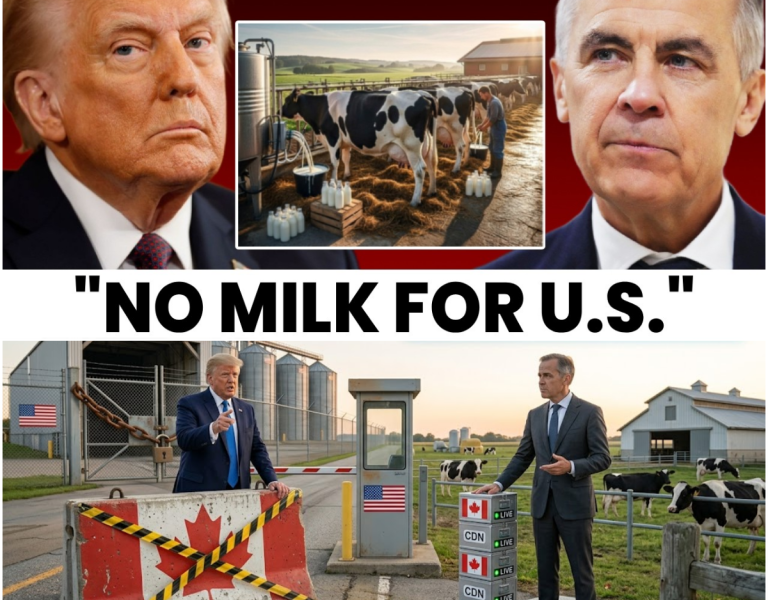
BREAKING: TRUMP DEMANDS ACCESS TO CANADA’S $20B DAIRY MARKET — CARNEY FIRES BACK LIVE. s1

BREAKING: TRUMP DEMANDS ACCESS TO CANADA’S $20B DAIRY MARKET — CARNEY FIRES BACK LIVE
A Dairy Dispute Tests the Limits of North American Trade
The long-simmering dispute over dairy access between the United States and Canada has reemerged as one of the most consequential fault lines in North American trade, just months before a mandated review of the United States–Mexico–Canada Agreement. What might appear, at first glance, to be a narrow disagreement over milk quotas has evolved into a broader test of political resolve, legal rigidity, and economic interdependence.
At the center of the conflict is a familiar American complaint: that Canada’s tightly controlled dairy market remains effectively closed despite concessions negotiated under the current trade pact. American producers argue that access granted on paper has not translated into meaningful exports, reinforcing a perception that the system is designed to exclude foreign competition.
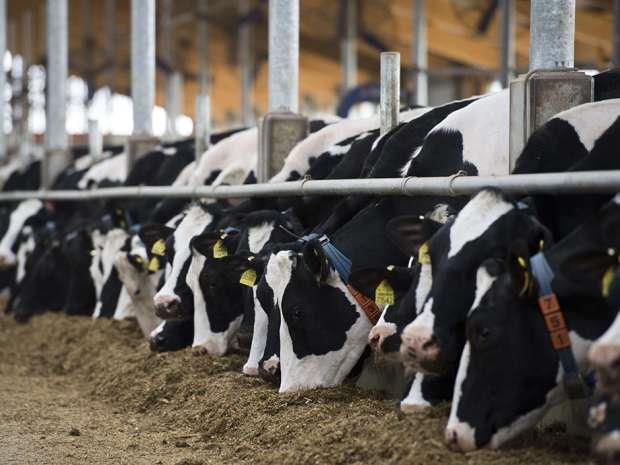
Canadian officials counter that their approach is not only deliberate but essential. Supply management, the framework governing dairy, poultry, and eggs, was built over decades to stabilize prices, ensure farmer income, and shield domestic production from volatile global markets. To many in Canada, it is less a policy than a cornerstone of rural economic life.
The scale of that system underscores its political weight. The dairy sector contributes tens of billions of dollars annually to Canada’s economy and supports hundreds of thousands of jobs. In provinces like Quebec and Ontario, where dairy farming is deeply embedded in both culture and electoral politics, any perceived threat to the system carries immediate political consequences.
What distinguishes the current moment from previous disputes is not merely the intensity of American pressure but the constraints facing Canada’s government. In 2025, Parliament passed legislation that effectively prohibits future trade negotiators from expanding dairy import quotas or reducing tariffs. The law transformed what might have been a bargaining position into a legal boundary.
This shift has fundamentally altered the dynamics of negotiation. American officials, backed by bipartisan support in Congress and powerful industry groups, are calling for reforms to how Canada allocates its limited import quotas. They argue that the current system channels access to domestic processors with little incentive to import foreign products, thereby undermining the spirit of the agreement.
From Washington’s perspective, such adjustments are technical rather than transformative. Redirecting quotas toward retailers or food service companies, proponents say, would allow existing access to function as intended without dismantling Canada’s broader system of protections.
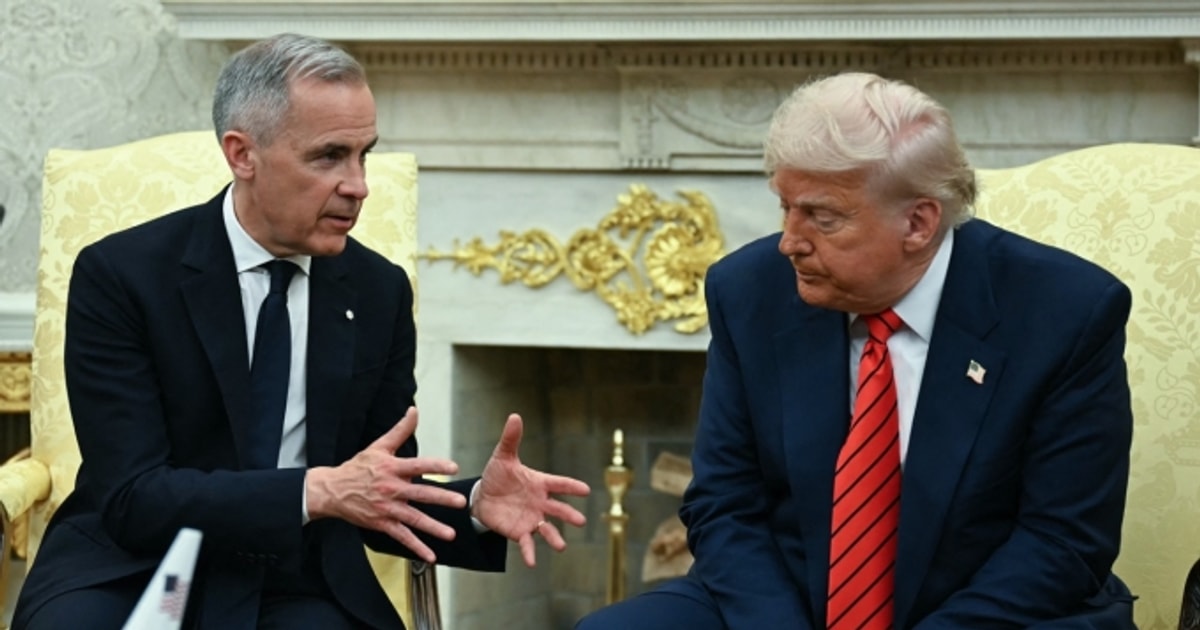
Yet in Ottawa, even modest changes are viewed through a different lens. Any concession risks being interpreted as the first breach in a carefully constructed framework. Dairy farmers, long accustomed to defending supply management against external pressure, have shown little appetite for compromise, and their political influence remains substantial.
Prime Minister Mark Carney has, for now, adopted a position of firm resistance. By pointing to the legal constraints imposed by Parliament, he has reframed the dispute as one in which Canada’s hands are tied. Whether that stance reflects strategic calculation or genuine limitation is, in some respects, beside the point. It has effectively closed off avenues for negotiation.
The timing of the dispute adds to its significance. The upcoming review of the trade agreement provides a formal mechanism for addressing grievances, but it also raises the stakes. The United States has signaled that failure to resolve the dairy issue could have broader implications for the agreement itself.
Such threats carry weight, particularly given President Donald Trump’s record of challenging existing trade frameworks. Yet the prospect of escalation is complicated by the interests of American industries that rely heavily on integrated North American supply chains. For sectors such as automotive manufacturing, the agreement is not merely beneficial but foundational.
This tension—between sector-specific demands and broader economic stability—illustrates the complexity of modern trade policy. A dispute rooted in agriculture now intersects with manufacturing, energy, and investment flows, making any potential breakdown far more consequential than its origins might suggest.
Canada, for its part, has sought to reduce its vulnerability by diversifying trade relationships and expanding exports beyond the United States. While such efforts remain gradual, they signal a recognition that dependence on a single partner carries inherent risks.
As the July deadline approaches, both countries face a narrowing set of options. The United States can escalate, risking disruption to industries that depend on cross-border integration, or accept incremental gains that fall short of its initial ambitions. Canada can maintain its position, but not without potential economic and diplomatic costs.
In the end, the dispute over dairy is less about milk than about the limits of compromise in a deeply interconnected economy. It raises a fundamental question: how far can two closely linked nations push their differences before the structures that bind them begin to strain?