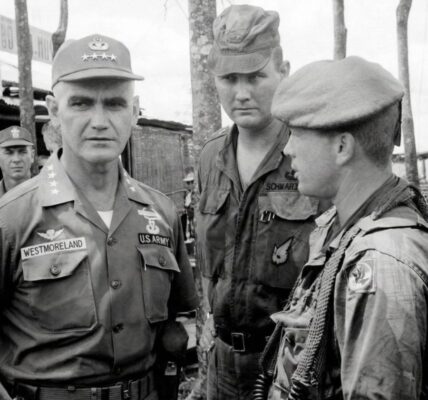

The Fastest Corps Commander in Europe. Almost Nobody Knows His Name.
The two-star general climbed out of a jeep on the side of a muddy jungle road 800 yards from a Japanese machine gun position. His aid grabbed his arm. The general shook him off. He wanted to see the battalion command post on Hill 52 for himself, and the only way to get there was to walk through a stretch of open ground that Japanese snipers had been picking at all morning.
Rifle fire cracked through the canopy. Mortar rounds thumped into the wet earth somewhere to his left. He kept walking. It was January 11th, 1943 on Guadal Canal and the man crossing that killing ground was Joseph Lton Collins. The youngest division commander in the United States Army. He was 46 years old. He had never commanded troops in combat before.
And within two years, he would become the most effective core commander the American army produced in the entire Second World War. Most of you have never heard his name. You know Patton, you know Bradley, you know Eisenhower and MacArthur. But the general who led the assault at Utah Beach, captured Cherburgg, broke the German line at Cobra, contained the Mortain counterattack, led the counteroffensive in the Bulge, took Cologne, and helped seal 317,000 Germans inside the Roar Pocket, the general who fought 337 consecutive days across 12,200 miles of
Europe. the general that Bradley called the ablest core commander in the American army that Montgomery demanded by name when things got desperate that German generals ranked as one of the two best American core commanders they ever faced. That general has been almost completely erased from popular memory. His name was Jay Lton Collins.
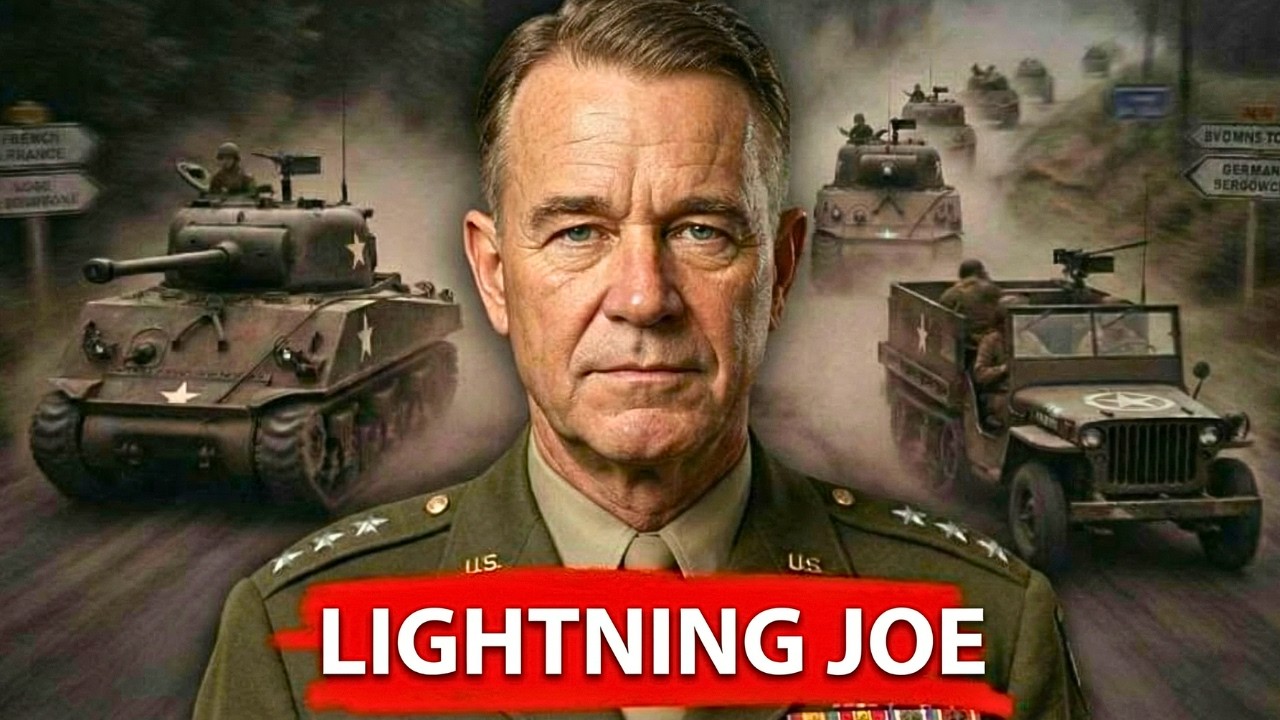
They called him Lightning Joe. And this is a story about what happens when a man does everything right, wins every battle that matters, fights from one end of Europe to the other, and history forgets him anyway. Not because the system punished him, not because someone stole his credit, but because he had the misfortune of being brilliant at a level of command that nobody makes movies about.
Collins came from a big Irish Catholic family in Alers, Louisiana, across the river from New Orleans, 10th of 11 children. His father was an Irish immigrant who had served as a Union drummer boy in the Civil War. If the Collins name sounds familiar in a different context, it should. His nephew was Michael Collins, the Apollo 11 command module pilot who orbited the moon while Armstrong and Aldron walked on it.
The family produced generals the way other families produce lawyers. Collins entered West Point in 1913 and graduated in April 1917. His class accelerated because of the war. The class of 1917 was one of the most remarkable in academy history. It produced Matthew Rididgeway, Mark Clark, Norman Cota, Ernest Harmon, and Charles Ghart among others.
Collins finished 35th out of 139 cadets. Solid, not spectacular. He spent the first world war stateside which frustrated him enormously. He served briefly with occupation forces in the Rhineland, but never saw combat. What he did in the inter war years, though, was build something more important than a combat record.
He built connections and competence. He instructed at West Point in Fort Benning. He attended the Command and General Staff College, the Army Industrial College, and the Army War College. And at Benning, he first crossed paths with George Marshall, who was reshaping the infantry school’s curriculum. Marshall remembered Collins. That memory would matter more than any bullet Collins ever dodged.
By 1941, Collins was chief of staff of the Seventh Corps based in Birmingham, Alabama. After Pearl Harbor, the core moved to California to defend the West Coast. Then, Collins caught what he later called his usual Irish luck. The general sent to replace Walter Short in Hawaii was killed in a plane crash on route.
Collins was appointed chief of staff of the Hawaiian Department instead. 5 months later, in May 1942, he took command of the 25th Infantry Division, Tropic Lightning. He was 46, the youngest division commander in the Army. The division had what one officer diplomatically called quite a poor reputation. He had six months to turn them into a fighting unit.
He drilled them relentlessly. He replaced officers who could not meet his standards. He ran field exercises in the Hawaiian jungle that simulated the conditions they would face in the South Pacific. The 25th Infantry Division that shipped out for Guadal Canal in November 1942 was a fundamentally different organization than the one Collins had inherited 6 months earlier. Then Guadal Canal.
If you are finding this valuable, subscribing genuinely helps. It tells the algorithm, “This kind of deep research is worth showing to more people.” Now, back to Collins. The 25th Division began landing on Guadal Canal in mid December 1942, relieving exhausted Marines around Henderson Field.
Collins issued his first field order on January 8th, 1943, targeting three objectives near the Madaniko River. The names sound almost absurd. The Galloping Horse, a 900 ft ridge, the Seahorse, and the Madanika River Pocket. The attack kicked off at 0635 on January 10th after an artillery preparation of 5,700 rounds in 30 minutes.
The fighting was ugly. Company K of the 35th Infantry walked into a massive ambush. Men on Hill 53 ran out of water and licked moisture off leaves, and Collins was there, not in a rear command post, but walking through sniper fire to visit forward battalions, earning the Silver Star for voluntarily exposing himself to rifle, machine gun, and mortar fire.
But it was the Cookona offensive starting January 22nd that made his reputation. Most units bogged down in the attack. But the 27th Infantry Regiment covered nearly two miles in less than three hours, and Collins noticed something from his observation post on Hill 49. The Japanese were offering far less resistance in that sector than anyone expected.
Admiral Hollyy later described what happened next. Collins was quick on his feet and even quicker in his brain. Collins jumped in a jeep, raced to the front, got authority from the core chief of staff to keep pushing, and changed the division boundary on the fly to exploit the gap. Even though the 27th had outrun its communications wire and its artillery support, by nightfall, the regiment had gained over three miles and held the high ground overlooking Cookona.
The next day, they pushed to the beach, trapping Japanese forces against the coast. Cocona, a critical enemy landing beach and assembly area, was in American hands. I want to pause here because this moment on Guadal Canal tells you everything about Collins as a commander. He was not sitting in a bunker reading reports. He was at the front.
He saw the opportunity before anyone else did. And he moved on it immediately. Even though it meant outrunning his own support, he accepted the risk because he understood that in combat, speed kills hesitation. That instinct, that willingness to commit before the textbook says you should would define his entire career. It would produce his greatest victories and it would contribute to his worst failure.
The division’s 31-day Guadal Canal campaign ended February 5th with 216 killed and 439 wounded, relatively light, reflecting the speed of Collins operations. The nickname Lightning Joe stuck, borrowed from the division’s Tropic Lightning moniker and its radio code name. After Guadal Canal, Collins led the 25th through the New Georgia campaign from July to October 1943, capturing Munda Airfield in some of the most difficult jungle fighting of the Pacific War.
By the time Collins returned to the States in December 1943, he had proven something that many American generals of that era could not demonstrate. He had actually commanded troops in sustained combat and won. Here is where the army’s personnel system actually worked the way it was supposed to.
Marshall wanted Collins for core command in Europe. He had been watching Collins career since Fort Benning, and Guadal Canal confirmed what Marshall suspected. This was a man who could lead large formations aggressively and decisively under the worst conditions. MacArthur characteristically had rejected giving Collins a core in the Pacific, calling him too young for three stars.
MacArthur wanted to keep his own favorites in place. So Marshall arranged the transfer to Europe instead. In a different story on this channel, this would be where the politics killed the competence. But in Collins case, the politics actually worked in his favor. Marshall’s intervention sent him to the theater where his talents would matter most.
Collins arrived in England in early February 1944 and reported to Eisenhower and Bradley. The existing Seventh Corps commander, Major General Rosco Woodruff, was Eisenhower’s West Point classmate, but had no combat or amphibious experience. When Collins described his tactical approach from the Pacific, always targeting the high ground and keeping pressure on the enemy before they could consolidate, Bradley turned to Eisenhower and said he talks our language.
On February 14th, 1944, Collins assumed command of the Seventh Corps. He was the youngest core commander in the United States Army, and the irony was rich. This was the same corps he had served as chief of staff three years earlier. The seventh corps drew the Utah beach assault on D-Day. Collins had the fourth infantry division for the beach assault, the 82nd and 1001st Airborne Divisions dropping inland starting at 0130 and the 90th Infantry Division coming ashore later in the afternoon.
Strong currents pushed the landing craft 2,000 yards south of the intended sector. Brigadier General Theodore Roosevelt Jr., the oldest man on the beach, 56, made his famous call. We will start the war from right here. Utah was the lightest casualty beach on June 6th. 197 killed among 589 total casualties for more than 21,000 troops landed.
By comparison, Omaha Beach suffered over 2,000. By the end of D-Day, roughly 1,700 vehicles were also ashore. The beach had been added to the invasion plan specifically to speed up the capture of Sherborg’s deep waterport. Everything about Utah was oriented toward one objective. Get ashore. Get inland. Get to Sherborg. Collins wanted to drive straight north immediately.
Bradley overruled him, insisting the Cotton Peninsula be cut off first to prevent German reinforcement. Collins adapted and then he showed what Lightning Joe meant. The 90th Infantry Division, tasked with cutting the peninsula westward, performed poorly. I want to stop on this point because it reveals something about Collins that most accounts miss.
He was not just aggressive. He was ruthless about leadership. Thomas Ricks writes in the generals about the Marshall system of rapid promotion and rapid relief. Collins embodied that system. When the 90th division stumbled, Collins did not give them a pep talk and another chance. He relieved the division’s commanders and replaced the 90th with the more experienced 82nd Airborne and 9th Infantry Division.
Max Hastings wrote that Collins sacked officers of any rank who failed to match his standards. This was not cruelty. This was the cold mathematics of combat command. The wrong leader in the wrong position costs lives. Collins understood this and he acted on it faster than almost any other American general in the theater.
By June 18th, the peninsula was sealed. Though roughly 1400 Germans managed to slip through the lines on the 19th. A catastrophic channel storm from June 19th through the 22nd, then damaged the Malbury artificial harbor at Omaha Beach, halting supply unloading and making Sherberg’s capture even more urgent than the original timeline anticipated. Collins did not slow down.
He sent the 4th, 9th, and 79th infantry divisions north in a three division assault formation. He drove them hard, sometimes launching attacks without the usual artillery preparation to maintain surprise and tempo. Monteborg was liberated June 19th. Bologn fell June 20th. On the night of June 21st, Collins broadcast a surrender demand via radio to the German commander.
General Litnant Carl Wilhelm Fon Schleden refused. The three division assault began June 22nd. The fighting at Fort Duru, the dominant fortification built into the cliffs above the city, was some of the most intense of the entire Normandy campaign. The 79th Division’s 314th Infantry Regiment had to fight up sheer rock faces against hardened concrete positions.
Two medals of honor were awarded for that single regimental assault. Fort Daru fell on June 25th. On June 26th, Von Schleban and Admiral Walter Henkah surrendered to Collins at the Chateau de Servini. Sherborg fell on D plus 20, roughly 6 days behind the original plan of D +15. The Seventh Corps lost 22,000 casualties taking the port. 39,000 Germans were captured.
Eisenhower wrote that Collins had conducted a relentless offensive and justified his nickname Lightning Joe. The Germans had wrecked the port so thoroughly that Hitler awarded Henkah the Knight’s Cross for the demolitions. But by September, Sherborg was handling 17,000 tons per day, second only to Marseilles as the main American supply point in Europe.
But Sherborg was the warm-up. What came next was the most important tactical decision any American core commander made in the entire European War. By mid July 1944, the Allies were stuck. The bridge head was roughly 50 mi wide and 20 m deep. Both sides had lost over a 100,000 men. The hedro country of Normandy had turned every field into a fortress.
Bradley conceived Operation Cobra, a concentrated attack on a 7,000yard front using massive aerial bombardment to blow a hole in the German line west of St. Low. On July 12th, Bradley told his core commanders, “If they get set again, we go right back to this hedge fighting and you cannot make any speed. This thing must be bold.
” Colin’s seventh core was the main effort. He had the 9th, 30th, and fourth infantry divisions for the breakthrough and the second armored, third armored, and first infantry divisions for the exploitation. The plan was simple. Infantry punches through. Armor pours in behind. It almost failed before it started. On July 24th, an aborted bombing run dropped loads on Colin’s own troops.
25 Americans killed, 131 wounded. Bradley was furious, charging that the Air Force had simply lied about the bombing approach. The next day, July 25th, the full bombardment launched. Roughly 3,000 aircraft dropped 4,000 tons of bombs. The Panzer Lair Division took the worst of it, but bombs fell short again. 111 American soldiers killed, 490 wounded.
Among the dead was Lieutenant General Leslie McNair, the highest ranking American killed in the European theater. A bomb reportedly landed directly in his foxhole. His body was hurled 80 feet and could only be identified by the three stars on one shoulder. Total friendly fire casualties across both days came to approximately 720 killed and wounded.
Eisenhower told Bradley he had given the green light this time, but it would be the last. Here is where the decision gets made that changes the war. On the evening of July 25th, the 7th Corps had advanced only about 2,000 m. Eisenhower went to bed thinking Cobra would be an abortive failure.
Most commanders would have agreed. The ground gained was minimal. The cost had been horrific. The safe play was to wait, regroup, send the infantry forward again the next morning, and hold the armor back until the penetration was clean. Collins did not make the safe play. He saw something that night that others missed. The German positions still held in places, but they no longer formed a continuous line.
The bombing had not obliterated German defenses, but it had shattered German command and control. Units could not communicate. Reserves could not move. The system was broken even if individual positions still fought. I believe this was the single most consequential tactical decision of the Normandy campaign. Collins committed his armored exploitation force into the breach a full day ahead of schedule with orders to push through at dawn on July 26th.
The original plan called for armor to wait until infantry had fully cleared the penetration zone. Collins gambled that momentum would overcome the remaining pockets of resistance. If he was wrong, he would have armor tangled up with infantry and terrain that had already cost 700 casualties to friendly fire alone. He was right. On July 26th, the first division with combat command B of the third armored attacked toward Marini.
The second armored division under Brigadier General Maurice Rose pushed towards Sanjil. Rose’s armor kept advancing even through the night. Some German vehicles joined the American column in the darkness, thinking it was their own retreating force and were captured without a shot. On July 27th, the German front disintegrated. Collins pushed everything through the gap.
He personally joined forward columns, criticizing the third armored for moving too cautiously. By nightfall, the 30th division reported, “This thing has busted wide open.” On July 28th, armored divisions covered over 12 miles in a single day. More than 100,000 combat troops poured south through a gap barely 5 miles wide.
Vonluga told Blummetrit it was a mad house. By July 30th, a ranch fell. 70,000 troops crossed the bridge at Pontto in less than 3 days. On August 1st, Patton’s third army activated. But here is the part that gets lost. The breakout that made Patton’s famous dash across France possible was Collins breakout.
Patton exploited what Collins created. Collins cracked the line. Patton ran through it. During this period, Patton told Collins something revealing. You know, Collins, you and I seem to be the only ones enjoying this damn war. Then his face clouded. After all, they put me in a straight jacket. That is right, a straight jacket. Even Patton recognized Collins as a kindred spirit, an aggressive, fast-moving commander who shared his instinct for the attack.
The difference was that Collins had the discipline Patton lacked and the political sense to stay out of trouble. What happened next should have made Collins a household name. On August 7th, Hitler ordered a massive counterattack between Mortine and of Ranches to cut off Patton’s third army. The idea was bold and potentially devastating.
If German armor could reach of branches and cut the narrow corridor through which all of patent supplies flowed, the entire breakout could be reversed. The full force of the attack fell on the Seventh Corps, particularly the 30th Infantry Division. The second Panzer Division, the first SS Panzer Division, and the second SS Panzer Division attacked with roughly 145 tanks.
It was the most concentrated armor assault the Germans had launched in Normandy since D-Day. The 30th division held the Critical Hill 314 despite being completely surrounded. The battalion on that hill had no resupply for days. Called in artillery on its own positions to break up German assaults and held on through sheer determination.
Collins contained the German advance within 24 hours. He then ordered immediate counterattacks with the third armored and fourth infantry divisions, refusing to give the Germans any time to consolidate. By August 13th, the Germans had lost 120 tanks, twothirds of their entire committed armor force.
The Morta counterattack was not just stopped, it was destroyed. I think what makes Morta revealing is the contrast with other commanders who might have pulled back, dug in, and waited for reinforcements. Collins did the opposite. He attacked into the teeth of a German armored offensive. He understood that a counterattacking enemy is also a vulnerable enemy, extended, committed with flanks exposed.
That instinct, attack even when you’re being attacked, is rare. It is what separated Collins from good core commanders who were merely competent. Then Collins pivoted the entire seventh core northeast to help close the fillet’s pocket. Roughly 10,000 Germans were killed and 50,000 captured when the pocket was sealed around August 20th.
Eisenhower wrote that it was literally possible to walk for hundreds of yards at a time, stepping on nothing but dead and decaying flesh. And then came one of Colin’s most brilliant victories, one that almost nobody talks about. During the pursuit across France, the Seventh Corps trapped roughly 70,000 German troops near Monz, Belgium, the remnants of about 10 divisions from the fifth Panzer Army.
The results were extraordinary. About 25,000 Germans taken prisoner. roughly 3,500 killed. The Seventh Corps’s own casualties were remarkably light. The Third Armored Division lost 57 killed. The First Infantry Division suffered 32 killed and 93 wounded. Equipment losses for the core amounted to two tanks, one tank destroyer, and 20 vehicles.
The Third Armored was actually immobilized at Mons for 24 hours because it ran out of gasoline, and it still took over 2500 prisoners while waiting. As one observer noted, hunting was excellent. This is the part the official histories gloss over when they talk about the race across France as though it was just Patton’s third army.
Collins’s seventh core crossed the Sen the M the A and was outside Leesge by September 11th more than 300 miles from Normandy in less than two months. Collins later recalled we ran out of gas, we ran out of ammunition and we ran out of weather. Before the Herkin though, Collins had another fight that deserves attention. The Battle of Aen.
The Seventh Corps began penetrating the Zigfrieded line on September 12th. The ninth division’s 47th infantry captured Shivven Huda on September 16th, pushing roughly 10 miles into Germany, deeper than any other Allied unit at that point. But momentum was dying. The third armored division’s tank strength had dwindled from 300 Shermans to just 70.
Supply lines were stretched to the breaking point. Aen was the first major German city to fall to the Allies, the first time since Napoleon that a foreign army captured a German city. The symbolic significance was enormous. Hen was the seat of Charlemagne, the coronation city of the Holy Roman Empire. Hitler ordered it held at all costs.
Collins first infantry division attacked from the south while the 19th Cors 30th division attacked from the north, planning to link up at Worsland northeast of the city. On October 10th, General Hner sent a surrender ultimatum. Colonel Ghart Vil refused. After the ultimatum expired, 300 fighter bombers attacked, followed by 12 battalions of artillery.
What followed was nine days of house-to-house fighting. some of the most savage urban combat the American army experienced in the entire war. On October 21st, Milk surrendered the last garrison at the Hotel Quelenhof. Aan cost both sides heavily. Over 7,000 American casualties, over 5,000 German casualties, plus 5600 prisoners.
85% of the city was destroyed. I think Aan is underrated in the Collins story. It was a different kind of battle. Not the fluid, fast-moving warfare he excelled at, but a grinding close quarters urban fight. And he won it. Not every commander can shift from the blitzkrieg of Cobra to the street fighting of Aen and excel at both. Collins could.
Now I need to talk about the Herkin forest because I believe an honest assessment on this channel. Collins record is extraordinary, but the Herkin is a stain on it and pretending otherwise would be dishonest. The Herkin Forest was a 50 square mile triangle of dense conifer forest between Aen and the Rower River. The battle lasted roughly 88 days from September 1944 into February 1945, making it the longest single battle the American army has ever fought.
The terrain nullified every American advantage. Armor could not maneuver. Air support was useless under the dense canopy. Artillery shells detonated in the treetops, showering troops with lethal wooden splinters that the men called tree bursts. Ernest Hemingway, who was there with the 22nd Infantry Regiment, called it Passanddale with tree bursts.
Under Collins’s seventh corps, the 9th Infantry Division launched the first sustained assault in September. The result was catastrophic. 4,500 casualties for 3,000 yards of ground. That is roughly one casualty for every two feet gained. Later, during Operation Queen in November, the Fourth Infantry Division suffered even worse. The 22nd Infantry Regiment under Colonel Charles Lam spent 18 days in the forest and lost 2773 men, 85% of its complement of 3257 to take one village and 6,000 yards of forest.
Rifle companies that started with about 160 soldiers averaged 87 after a week. The regiment absorbed nearly 2,000 replacements, meaning its losses exceeded 150% of original strength. Total American casualties in the Herkin Forest reached at least 33,000 with some estimates running as high as 55,000. German casualties were approximately 28,000.
The most damning criticism centers on the Rower River dams. Seven dams held up to 40 billion gallons of water that could flood the entire downstream plane. In early October, the 9inth Division’s intelligence officer warned of great destructive flood waves. First Army’s intelligence chief disagreed, claiming damage would cause at most local flooding for about 5 days.
No terrain analysis was ordered. The dams were not mentioned in tactical plans. If the dams had been the objective from the start, the forest fighting could have been bypassed entirely. Collins himself later admitted this. He told a Fort Levenworth seminar in 1983, “We had not studied that particular part of the zone.
That was an intelligence failure, a real combat intelligence failure.” His primary justification for fighting through the forest was flank protection. If we would have turned loose of the Herkin and let the Germans roam there, they could have hit my flank. Russell WGley, one of the best historians of the American army in Europe, demolished this argument.
The forest was so dense that a credible German counterattack through it was virtually impossible. WGley found it inexplicable that Collins and Hodgeges, both veterans of the Argon forest in the First World War, would willingly repeat a forest debacle. In my view, Collins bears real responsibility here, though it is shared with Hodgeges, Bradley, and Eisenhower.
The chain of command failed from top to bottom. Hodgees kept feeding divisions in one after another. Bradley never questioned the strategy. Eisenhower never intervened. And Collins, who had the instinct and the record to push back, deferred to his army commander. He later said he would not question Courtney, meaning Hajes. That difference cost thousands of lives.
The irony is devastating. The divisions shattered in the Herkin. The 4th and the 28th were the same divisions sitting in the path of the German offensive when the Bulge exploded in December. Collins forest battle weakened the very front the Germans would exploit. I think the honest assessment of the Herkin is that it was a systemic failure, not just one man’s mistake.
Carlo Deste called it the most ineptly fought series of battles of the war in the West. Rick Atkinson noted that no consideration was given to bypassing or screening the forest. Charles Macdonald, who was both an army historian and a combat veteran of the Herkin, called it a misconceived and basically fruitless battle that should have been avoided.
Even the German command could not understand why the Americans kept attacking there. General Rudolph Fonersf, chief of staff of the German 7th Army, said the fighting was worse than anything he had seen on the Eastern Front. But even after the Herkin, the system turned to Collins when it mattered most. On December 20th, 1944, 4 days into the Battle of the Bulge, Eisenhower placed first and ninth armies under Montgomery’s command.
Montgomery told Hodgeges he wanted the most aggressive American core commander who could be found to lead the counterattack. Montgomery made his wishes very clear. He wanted Collins, nor would he listen to any other names. Think about that for a moment. The British field marshal, who rarely had a kind word for American generals, specifically demanded Collins.
That tells you everything about how the professionals viewed him, regardless of what the public knew. Collins assembled a force approaching 100,000 men. The Second Armored Division, the Third Armored Division, the 84th Infantry Division, the 75th Infantry Division, the 83rd Infantry Division, and 12 Independent Artillery Battalions.
On Christmas Eve, before the planned counter offensive could even begin, Major General Ernest Harmon of the Second Armored telephoned requesting permission to attack elements of the German Second Panzer Division spotted near Kels, the German high water mark within 9 km of the Muse River. Collins was away visiting his divisions.
The core artillery commander took the call and hesitated. First army and Montgomery’s consent was needed. When Collins got word, he gave the immediate go-ahad. The second armored division destroyed the second panzer division at cells on December 25th and 26th. This was the furthest point of German westward penetration and Collins effectively violated the spirit of Montgomery’s defensive posture to launch what became a decisive counterattack.
Vintage Lightning Joe, aggressive, independent, seizing the moment. The second armored attack was devastating. German armored columns strung out and running low on fuel were hit from the flanks and shattered. Tanks, halftracks, and vehicles littered the roads around Cell in Foy Notredam. The German drive to the MO was finished.
The planned counterattack toward Hules launched January 3rd. The seventh corps led first army’s main effort advancing from the hot and north river area toward the plateau day thai roughly 12 mi away. The conditions were nightmarish. Snow up to 2 ft deep. Temperatures well below freezing. Dense forests and steep ridges.
Roads that were barely more than tracks through frozen mud. Persistent overcast that grounded Allied air support for days at a time. Collins force ground forward against the 560th Folks Grenadier Division and the 116th Panzer Division units that fought with the desperation of men defending German soil. This was not glamorous warfare. It was slogging, frozen, brutal combat.
The kind that produces no headlines and grinds men down one ridge line at a time. Collins pushed his divisions hard, accepting casualties to maintain pressure. I think this phase of Colin’s career is worth lingering on because it shows the other side of Lightning Joe. He could be fast when the situation demanded speed, but he could also be relentless when the situation demanded patience and grinding pressure.
Not every fastmoving commander can slow down and still win. Collins could. On January 16th at 0905 hours, elements of the second armored division linked up with the 11th armored division from Patton’s third army at Huffles, effectively ending the battle of the bulge. Montgomery returned first army to Bradley’s command the next day.
The final months of the war read like a highlights reel. Collins’s core crossed the rower in late February. The crossing delayed by flooding from the rower dams. The very dams that should have been the objective instead of the Herkin forest. The irony was not lost on anyone. The Germans had opened the dam slooes on February 9th.
flooding the rower valley and delaying the Allied crossing by two weeks. 33,000 American casualties in the Herkin and the dam still dictated the timetable. Once across, the Seventh Corps advanced rapidly. The third armored reached the Rine at Waringan by March 4th, cutting the Cologne Highway. The Battle of Cologne followed. Germany’s third largest city, a place of enormous cultural and symbolic weight fell on March 7th.
On March 6th, one of the most famous tank engagements of the war, took place near Cologne Cathedral when a Persing tank knocked out a Panther in a duel caught on film. Bon was captured March 8th. The first infantry division crossed the Rine through the Raagan bridge head on March 15th and 16th. On March 25th, First Army broke out eastward.
Collins’s seventh corps on the left flank had the hardest terrain, but still advanced 12 miles beyond the line of departure. On the first day on March 30th, Collins lost one of his finest officers and closest combat partners. Major General Maurice Rose, commander of the Third Armored Division and Collins spearhead throughout the entire European campaign, was killed near Patterborn.
Rose’s jeep had run into a German tank at close range. As Rose reached for his pistol, apparently intending to surrender it, a German tank commander misinterpreted the movement and shot him. Rose was the highest ranking American killed by enemy fire in the European theater. He was also one of the highest ranking Jewish American officers in combat command.
His loss hit Collins hard. On Easter Sunday, April 1st, 1945, elements of the third armored division met the second armored division from the 9inth Army at Lipstat. Collins had personally called Lieutenant General Simpson of the 9th Army to coordinate the linkup. The meeting sealed Field Marshall Models Army Group B inside the Rurer Pocket.
A ring roughly 30 m by 75 miles. The result was staggering. 317,000 German soldiers surrendered over the following weeks. More than Stalingrad, 14 divisions, two dozen generals, the remnants of two entire German armies. Model refused to surrender and shot himself on April 21st. The Seventh Corps drove east through the Harts Mountains, crossed the Vaser on April 7th.
And on April 11th, the 104th Infantry Division and Third Armored Division entered the Dora, Middle Bau, and Bila Kazerna concentration camps near Nordhousen. What they found there was beyond anything the soldiers had imagined. Thousands of emaciated prisoners, many dead or dying, crammed into underground tunnels where the Nazis had been manufacturing V2 rockets with slave labor.
The reality of what the war had been fought for was suddenly horribly visible. On April 24th, Collins informed Hodgees that enemy resistance in the Seventh Core zone was finished. Collins recalled VE day as anticlimactic for us because we had not been fighting since the fall of Desau. The core had been designated for redeployment to the Pacific and elements departed La Hav on June 30th but Japan surrendered before they arrived.
337 days of combat 1,200 miles. 377,000 prisoners including the ruer pocket 14 German divisions credited as destroyed. Five campaign stars every major turning point of the European war from Utah Beach to the Elbe. and Collins was at the center of everyone. Now, let me talk about what most of you are already thinking.
Why does nobody know this man’s name? The simplest answer is structural, and it is worth understanding because it explains a pattern that goes beyond Collins. In the American Army’s chain of command, a core was the largest tactical formation, typically controlling two to five divisions. Above the core set the army, and above that, the army group.
Patton commanded the third army. Hodgeges commanded the first army. Bradley commanded the 12th Army Group. Collins commanded the seventh corps. Each level up brought exponentially more visibility. Army commanders interacted with theater commanders and political leaders. They attended highle conferences. They dealt with the press.
They made decisions that shaped entire campaigns. Core commanders did the fighting. They translated strategy into tactics. They made the calls on the ground that determined whether attacks succeeded or failed. But they did it in the shadow of their army commander. Collins reported to Hajes, who reported to Bradley, who reported to Eisenhower.
The public never knew Colin’s name because the public’s view of the war was filtered through the men above him. As historian Harold Winton put it, “Core command is the largely neglected level of command. Too high for frontline drama, too low for strategic decision-making visibility.” And here’s the proof.
Name a single American core commander from the Second World War who is famous in popular culture. Troy Middleton, Leonard Gerro, Matt Netti, Wade Heslip, Alvin Gillum. None of them. Only Matthew Rididgeway achieved broader recognition and that came from his command in Korea, not from his extraordinary wartime service with the 18th Airborne Corps.
Then there’s the personality gap. Patton was a walking headline. Ivory handled pistols, polished boots, profane speeches, the slapping incidents, inflammatory public statements about the Russians, the remark about Nazis and political parties. He cultivated a theatrical persona that war correspondents could not resist.
Every week seemed to produce a new patent story. Collins was the opposite. He was described as never a celebrity general like Patton, Eisenhower or MacArthur. He was simply a consmate professional officer, quietly competent. Chester Hansen Bradley’s aid called Collins independent, vigorous, heady, capable, and full of vinegar. John Edward Wiltz, writing in the register of the Kentucky Historical Society, described him as a man of extraordinary good judgment who was at once modest and serenely confident of his skills. But these were assessments
written by professionals. For professionals, none of it reached the public. Colin’s own personality worked against fame. He pulled his punches in his autobiography about what he really thought of other generals. According to reviewers, he did not seek controversy. He did not cultivate journalists. He did not make inflammatory remarks.
In a media environment that rewarded drama, Collins offered competence. Competence does not sell newspapers. And then there is Hollywood. The 1970 film Patton starring George C. Scott won seven Academy Awards, including best picture. That opening monologue, Scott in front of a giant American flag, is one of the most iconic scenes in American cinema.
President Nixon watched it repeatedly. Some historians have argued it influenced his decision to escalate bombing in Cambodia. One critic noted that Scott’s performance became so identified with the character that even historians have trouble remembering what the real Patton looked or sounded like. No film, no documentary, no popular media of any kind exists about Collins.
Not one. Patton died dramatically in a car accident in December 1945. At the peak of his fame, cementing his legend with a tragic ending. He was 60 years old. The timing was almost mythological. The warrior cut down at the moment of triumph, never having to deal with peaceime irrelevance. Collins lived to 91, dying quietly of cardiac arrest in Washington on September 12th, 1987.
He is buried at Arlington National Cemetery. There was no dramatic death, no final act that the press could turn into a story. He simply lived a long, productive life and faded from view. The bibliography tells the story most clearly. Patton has had dozens of biographers. Lattis Los Verago, Carlo Deste, Martin Blumenson, Stanley Henson, and many others have written full-scale works about his life.
Collins has his own autobiography, Lightning Joe, published in 1979. Russell Wgley reviewed it and said Collins had met a standard comparable to that of his exercise of command, which is saying a great deal. But Wgley also noted that Collins characteristically pulled his punches in regard to what he thought about other generals.
There is one biography, Taking Command by H. Paul Jeffers, published in 2009. It received mixed reviews for scholarly rigor. Jeffers called Collins a virtually forgotten hero. That is it. Two books, one by Collins himself and one biography of middling reputation. That is the entire Collins library. For the man that the Fort Levvenworth panel of historians called the best core commander of the war, I think this pattern tells us something important about how military history gets written and remembered.
We remember the showman. We remember the controversies. We remember the dramatic deaths. We do not remember the man who simply showed up every single day for 337 days, made the right call more often than anyone else, fought from one end of the continent to the other, and went home quietly when it was over.
Collins was not punished by the system. He was not screwed by a rival. He was not fired or sidelined. He was rewarded, promoted, made army chief of staff during the Korean War. But none of that translated into fame because fame requires a story that the public finds dramatic and quiet. Relentless competence is apparently not dramatic enough.
After the war, Collins served as the 18th Chief of Staff of the United States Army from 1949 to 1953, the Army’s senior officer throughout the entire Korean War. He succeeded Bradley and was succeeded by Ridgeway. He made at least five trips to Korea to monitor operations firsthand. He was closely involved in the MacArthur relief crisis of April 1951, one of the most dramatic civil military confrontations in American history.
He brought the first special forces group into the Army’s order of battle. He oversaw the army’s contribution to the newly established NATO alliance. And almost none of this is remembered either. In November 1954, Eisenhower sent Collins to Saigon as special United States representative in Vietnam with a personal rank of ambassador.
His job was to stabilize the DM regime after the Geneva Accords. Collins was supposed to make DM work. Instead, he did something that took more courage than any battlefield decision. He told Washington the truth. Collins quickly realized that Deem could not govern effectively, that his regime was corrupt and unstable, and that the United States was backing the wrong man.
By March 1955, he was advocating that the United States find a replacement for DM. This put him directly at odds with CIA operative Edward Landdale and Secretary of State Dulles, who continued backing DM. Collins misgivings proved prophetic. DM’s regime collapsed in a coup in 1963 and the deepening American involvement that followed became the Vietnam War.
Had anyone listened to Collins in 1955, the entire trajectory of American involvement in Southeast Asia might have been different. The Eisenhower Library notes that Collins Vietnam papers contain some of the richest historical materials in his entire collection. Even in diplomacy, far from the battlefield, Collins saw what others could not.
Just as he had on the evening of July 25th when everyone else thought Cobra had failed, Collins retired from active duty in March 1956. After almost 39 years of service, he became vice chairman of the board of Fizer International and wrote two books, War in Peace Time about Korea, published in 1969, and Lightning Joe, his autobiography, published in 1979.
He died on September 12th, 1987 in Washington at 91 of cardiac arrest. He is buried at Arlington National Cemetery, section 30, grave 422. So here’s my final assessment. The Fort Levvenworth panel of historians named Collins, the best core commander of the Second World War, at his Hall of Fame induction, the first living soldier present at his own ceremony.
Bradley said, “If another army had been created in Europe, Collins would have commanded it despite his youth and lack of seniority.” Montgomery demanded him by name. German generals ranked him alongside Troy Middleton as the best American core commanders they faced. Harold Winton wrote that Collins had staked out a reputation as perhaps the most effective large unit commander in the European theater.
Charles Macdonald called him a dynamic driving personality whose opinions often exerted more than the normal influence at the army level. His Cobra decision, committing armor a day early into a breach that everyone else thought had failed, was arguably the single most important tactical call of the Normandy campaign.
But he also shares responsibility for the Herkin Forest, one of the worst American tactical disasters of the war. 33,000 casualties in a battle that even the enemy could not understand. He deferred when he should have pushed back. He accepted a flawed strategy when his own instincts should have told him it was wrong. Both of these things are true.
Collins was brilliant and flawed, aggressive and sometimes reckless, the best core commander of the war and a man complicit in one of its worst decisions. He was not a myth or a legend. He was a professional soldier who won more battles than any other American corps commander in Europe who did it with less fanfare than anyone around him and who went home to a quiet life and a forgotten grave in Arlington.
The recognition gap here is not about politics or stolen credit. It is about something deeper, something structural about how we remember wars and the men who fight them. We build our military heroes from spectacle, not from substance. Patton gets the movie because Patton was a movie, a walking drama of pistols and profanity and slapping incidents and a tragic death.
the moment of victory. Collins gets nothing because Collins was just good at his job every single day for 337 days straight. This is a pattern that goes beyond the Second World War. We celebrate the flashy over the effective. We remember the controversies, the firings, the rivalries, the dramatic endings. We forget the men who simply showed up every morning, made the right call more often than not, adapted when the situation changed, and never gave the press a reason to write a headline.
Collins won at Utah Beach, at Sherberg, at Cobra, at Mortaine, at the Mon’s Pocket, at Aen, at the Bulge, at Cologne, and at the Rar Pocket. He lost at the Herkin, and he owned that failure for the rest of his life. His record across 337 days of continuous combat is unmatched by any other American core commander of the war, and almost nobody knows.
Collins himself understood what mattered. He once said about his command philosophy, “The crux of the fighting was the place I headed for. for 337 days across Europe.