
Every Rank in British Army During WW2 Explained in 15 minutes
During the Second World War, the British Army swelled from roughly 900,000 men and women to nearly 3 million at its peak with hundreds of thousands more serving in auxiliary and territorial forces. It fought on every continent except Antarctica from the deserts of North Africa to the jungles of Burma. And the only way this colossal machine functioned was through a rank structure forged over centuries of tradition, battle, and hard one experience.
But if you’ve ever looked at old photographs of British soldiers, you’ve probably noticed something strange. The insignia looks nothing like the American system. Instead of chevrons pointing up, British stripes point downward. You’ll spot crowns, crossed swords, a coat of arms, and regimental badges that seem to follow their own mysterious rules.
Who was in charge? Who answered to whom? And why does one private call himself a guardsman while another insists he’s a fuselier? Today, we’re breaking down the entire rank structure of the British Army in World War II, from the lowest private soldier all the way up to the field marshal. Let’s get into it. The other ranks, the backbone of the army.
The British Army didn’t use the American term enlisted. Instead, ordinary soldiers fell under the category of other ranks. And the very bottom of that ladder was the private. Simple enough, right? Not quite. Because in the British Army, the title private changed depending on which regiment you belong to. In the infantry, yes, you were a private.
But in the Royal Artillery, you were a gunner. In the Royal Engineers, a sapper. In the Cavalry and Royal Armored Corps, a trooper. In the Royal Corps of Signals, a signalman. And if you had the honor of serving in one of the guards regiments, you were a guardsman, never a mere private.
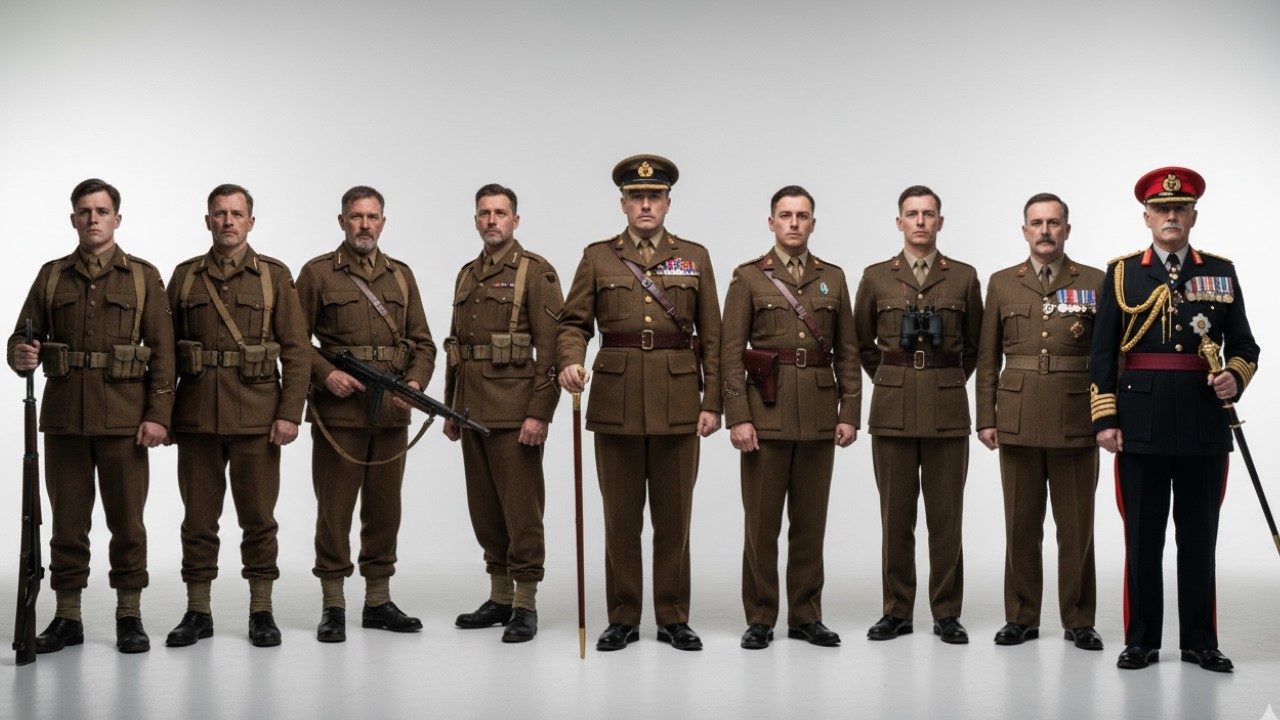
Regardless of the title, the job was the same. You were the newest, lowestranking soldier in the British army. You carried your Lee Enfield rifle. You followed orders without question, and you did whatever dirty, exhausting, or dangerous task your NCOs’s told you to do. Pay in 1939 started at three shillings a day, roughly equivalent to a couple of pounds in today’s money.
Not exactly a king’s ransom for the men who would storm the beaches of Normandy. Lance Corporal, the first rung. Above the private sat the Lance Corporal, identified by a single downward pointing chevron on the upper sleeve. This rank has a peculiar history. The word lance originally meant someone acting in a role without the full authority or pay.
By the second world war though, it was a fully recognized rank and the first real step up for a soldier. The lance corporal was typically a section second in command, assisting the corporal in leading a section of about 10 men. He had just enough authority to make the privates listen, but not enough to avoid still getting the worst jobs himself.
Veterans often described it as all the responsibility with none of the respect. Still, it was the moment a soldier proved he had something more. A bit of initiative, a steadier nerve under fire, or simply the ability to keep his kit in order when everyone else had fallen apart. Corporal, the section commander. Two downward chevrons mark the corporal.
In the British infantry, the corporal was the section commander. directly responsible for leading about 10 men in combat. This was the sharp end of leadership. When a section advanced under fire, it was the corporal out front making split-second decisions about where to move, when to fire, and how to keep his men alive.
Unlike the American system, the British army didn’t create a parallel technician track. Specialists existed, of course, signalers, mechanics, medics, but they generally held the same rank titles and were simply assigned to specialist roles within their units. This meant a corporal in the Royal Electrical and Mechanical Engineers might spend his days repairing tank engines, while a corporal in the king’s own Scottish borderers was leading bayonet charges.
Same rank, wildly different wars. Sergeant, the platoon’s anchor. three chevrons. The sergeant, this is where real authority began. In an infantry platoon, the sergeant was the platoon sergeant, the senior non-commissioned officer working directly alongside the platoon commander, usually a young lieutenant. And more often than not, it was the sergeant who actually ran the show.
Here’s why. Many of the officers commissioned during wartime were young men fresh out of officer cadet training units. They might have been bright and brave, but they were green. The platoon sergeant was often a regular army man with years of service. He knew how to read ground, how to keep men fed and supplied under impossible conditions, and how to maintain discipline without destroying morale.
The best platoon in the British Army were the ones where a young officer was wise enough to listen to his sergeant. The worst were the ones where he wasn’t. In the guards regiments, there was an additional distinction here. the Lance Sergeant who wore three chevrons but ranked between corporal and full sergeant. It was one of those uniquely British complications that drove everyone outside the guard’s regiments slightly mad.
Color sergeant and staff sergeant, the senior NCOs. Above the sergeant, the British system introduced two ranks at the same level depending on the arm of service. In infantry regiments, this was the color sergeant, wearing three chevrons topped by a crown. The title dates back to the Napoleonic Wars when the most trusted NCO was assigned to carry and protect the regimental colors in battle.
By 1939, nobody was carrying flags into machine gun fire, but the rank survived and the prestige remained. In other branches, the equivalent rank was the staff sergeant wearing a crown. above three chevrons as well. These men served as company quartermaster sergeants, managing the supplies, ammunition, and equipment that kept a company of over a 100 men functioning.
It was unglamorous, exhausting work, and absolutely critical. When a rifle company ran low on ammunition in the middle of a firefight, it was the quartermaster sergeant scrambling to get resupply forward under fire. An army, as the old saying goes, marches on its stomach, and the staff sergeant made sure that stomach was fed.
Warrant officers, a class apart. Now we enter genuinely special territory. The British army had two classes of warrant officer, and these men were treated with a reverence that bordered on fear. The warrant officer class 2 held the appointment of company sergeant major or CSM. His insignia was the royal coat of arms worn on the lower sleeve.
The CSM was the senior soldier in the company, responsible for discipline, drill, and administration. He was the bridge between the officers and the men, and he wielded enormous informal power. A quiet word from the CSM could end a career or save one. He ran the company from behind the scenes with an iron grip wrapped in regimental tradition.
Soldiers didn’t just respect the CSM. They feared him. And that fear kept order when nothing else could. Then at the very pinnacle of the non-commissioned world stood the warrant officer class one, the regimental sergeant major, the RSM. He wore the same royal arms as the CSM. But no one confused the two. The RSM carried a pace stick as his badge of office, and his reputation preceded any insignia.
The RSM stood above every other non-commissioned man in the entire battalion. He answered only to the commanding officer, the lieutenant colonel, and even colonels trod carefully around a good RSM. There is a famous story from the Desert War where a newly arrived officer tried to correct an RSM’s decision.
The RSM reportedly turned, stared the man down, and said nothing. The officer never tried again. The RSM was tradition, discipline, and the soul of the regiment made flesh. He had typically served 20 years or more. He knew every soldier’s name, every soldier’s weakness, and he held the battalion together through sheer force of personality.
The commissioned officers, company grade. Now we cross the great divide into the officer ranks, the men who held the king’s commission. Starting with the company grade officers, the ones closest to the fighting, the second lieutenant wore a single pip, formerly called a bath star on each shoulder. He was the platoon commander, responsible for roughly 30 men.
Like his American counterpart, the British second lieutenant had one of the most dangerous jobs in the war. Infantry platoon commanders suffered appalling casualty rates, particularly in Normandy and the Italian campaign. Many were killed or wounded within weeks of reaching the front. Yet, these officers, often barely 20 years old, were expected to lead hardened soldiers into battle and earn their trust overnight.
The left tenant wore two pips and served as a senior platoon commander or second in command of a company. With a few months of combat experience, the lieutenant was a harder, sharper version of the second lieutenant. He had seen what worked and what got men killed. surviving long enough to earn that second pip was itself an achievement.
The captain wore three pips and typically commanded a company of around 120 men. He was the lynchpin of the battalion’s fighting strength. The captain knew his men personally. He censored their letters, managed their welfare, led them in attacks, and wrote to their families when they fell. It was a deeply personal form of command and the best captains inspired a fierce loyalty that could hold a unit together through the worst fighting imaginable.
Fieldgrade officers. The commanders above the company grade officers sat the fieldgrade officers commanding a battalion and brigade level. The major wore a single crown on each shoulder. He served as a company commander in some cases or more commonly as the battalion second in command.
The major was the chief administrator, turning the commanding officer’s decisions into operational reality, juggling logistics, reinforcements, and the endless paperwork that kept a battalion functioning. The left tenant colonel wore a crown and a single pip. He was the commanding officer of a battalion, roughly 800 men.
This was the most coveted command in the British Army, the level where one man’s decisions directly shaped the fate of hundreds. Yet the command still felt intimate rather than abstract. The great battalion commanders of the war, men who held units together at Tobuk, Kohima, and Arnum were left tenant colonels who combined tactical brilliance with the personal touch that the British regimental system demanded.
The colonel wore a crown above two pips. In practice, wartime colonels often served in staff roles at brigade or divisional headquarters rather than commanding a single unit. The rank also carried an honorary dimension. Distinguished officers were often named colonel of the regiment, a ceremonial figurehead who might visit the battalion once a year, inspect the silver in the officer’s mess, and remind everyone that the regiment’s traditions stretched far beyond any single war. The Brigadier. A peculiarly
British rank. The Brigadier deserves special mention. Unlike the American Brigadier General, the British Brigadier was technically not a general officer. He wore a crown, three pips, and no crossed sword and baton insignia of a general. He commanded a brigade of between 3 and 5,000 men, usually three infantry battalions, plus supporting units.
The brigadier sat in an odd middle ground, too senior for regimental command, not yet part of the rarified world of the generals. Yet, brigade command was arguably the most intense level of leadership in the British army, close enough to the front to hear the guns, but responsible for coordinating multiple battalions in complex operations.
The general officers, the architects of victory. Finally, we reached the generals. Their insignia featured crossed swords and a baton behind a pip or crown arrangement, symbols of supreme command dating back centuries. The major general wore a pip over a crossed sword and baton, commanding a division of around 15,000 men across multiple brigades with artillery, engineers, and logistical support.
A division was the smallest formation capable of sustained independent operations. and commanding one required a mind that could balance dozens of competing demands simultaneously. The left tenant general wore a crown over the crossed sword and baton, commanding a core of two or more divisions.
Men like Brian Horox, who led XXX Corps during Operation Market Garden, operated at this level, orchestrating the movements of tens of thousands of soldiers across vast distances. The general, known informally as a full general, wore a crown, a pip, and the crossed insignia. He commanded an army. Harold Alexander held this rank while directing operations across the entire Mediterranean theater before earning his own field marshals baton in the war’s final months.
And then at the very summit, the field marshall. The insignia was a crown above crossed batons set within a wreath. This was the highest rank in the British Army, held during the war by men like Bernard Montgomery and Alan Brookke. The field marshal didn’t just command armies. He shaped the entire strategic direction of the war.
Montgomery, arguably the most famous British soldier of the conflict, rose to fame after his victory at Elamagne and went on to command all Allied ground forces during the Normandy landings, receiving his field marshals baton in September 1944. Unlike the American five-star rank, which was created specifically for the Second World War, the Field Marshall had existed in the British Army for over two centuries.
And by tradition, a field marshal never truly retired. He held the rank for life. The chain that held from the private cleaning his Lee Enfield in a muddy trench to the field marshal planning the invasion of Europe. Every rank in this structure served a purpose. It was a system rooted in the old regimental world, bent and stretched to meet the demands of the largest war in human history.
Some of it was elegant, some of it was baffling, but it worked. Which rank do you find most fascinating? The terrifying RSM, the overburdened second left tenant, or the specialist sapper keeping the army moving? Let me know in the comments. If you enjoyed this breakdown, hit that like button and subscribe. We’ve got plenty more military history coming your way. Thanks for watching.
Note: Some content was generated using AI tools (ChatGPT) and edited by the author for creativity and suitability for historical illustration purposes.