10 American Rifles and Infantry Weapons That Made the German Army Fear the U.S.. nu

10 American Rifles and Infantry Weapons That Made the German Army Fear the U.S.
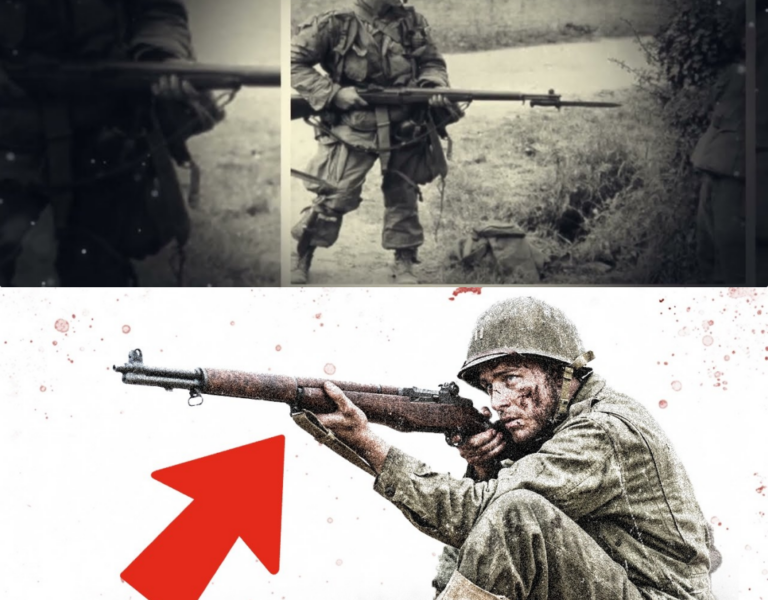
A German soldier who had been fighting British or French infantry knew what incoming rifle fire sounded like. It came in bursts, three rounds, maybe four, and then stopped while the rifleman worked his bolt. That pause was time. Time to move. Time to shift position. Time to get your head down and wait. American infantry sounded different. The M1 Garand was a semi-automatic rifle. Pull the trigger, fire around, pull again. No bolt stroke between shots. An American squad of 12 men could put sustained fire down range
at a rate no boltaction army could match, and they could do it while moving. German veterans who fought in Normandy and wrote about it later described the same experience repeatedly. The density of American fire was unlike anything they had encountered on the Eastern Front. It wasn’t just more fire. It arrived at the wrong moments. When they were moving between positions, when they thought the fire had shifted. When they expected the pause that never came. The Germans had the MG42. They had the CAR 98K. They had good
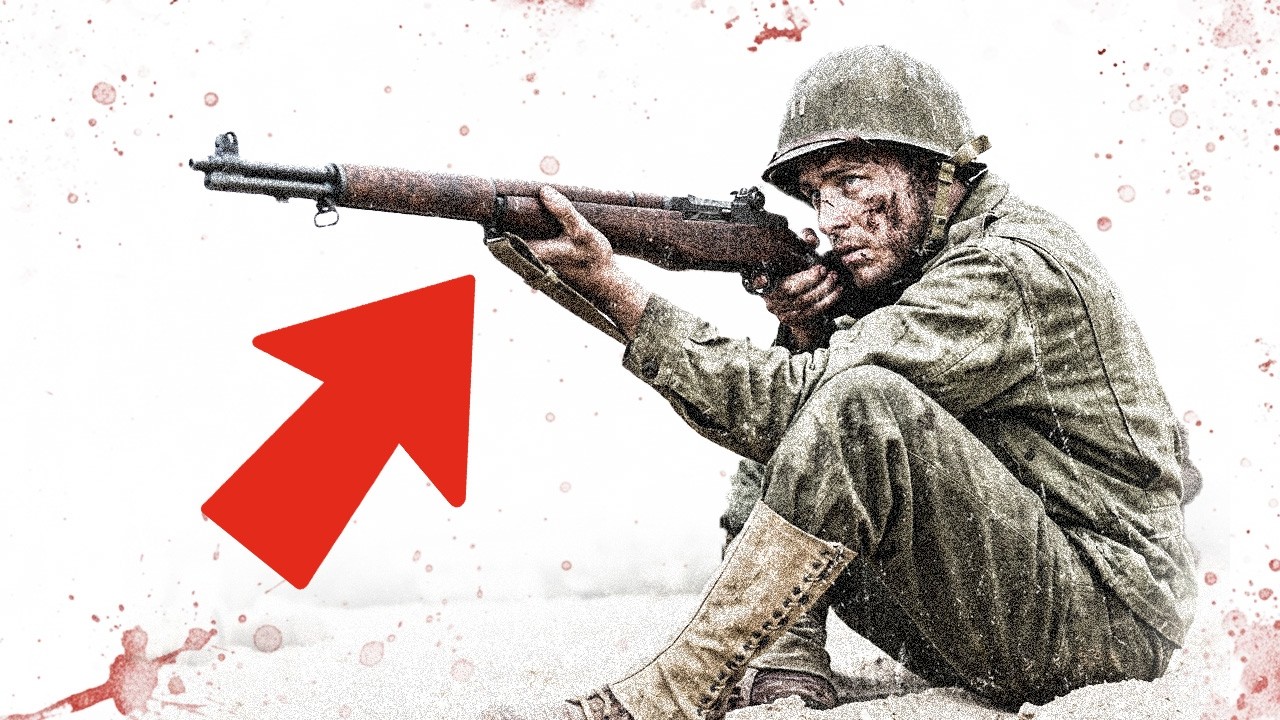
soldiers and good doctrine. What they didn’t have was an answer for what it felt like to be on the other end of a force where every rifleman fired like a machine gun. These are the 10 American rifles and infantry weapons that made that force what it was. Number 10, the M1 Garand. By America’s entry into the war, the army had committed itself to something no other major power had done. Making a semi-automatic rifle the standard weapon of its infantry. Not an automatic rifle, not a submachine gun. A
rifle accurate to 500 yardds, firing the full power 306 cartridge with eight rounds in the onblock clip and no bolt stroke required between shots. Germany’s standard infantry rifle was the Carabiner 98K, a bolt-action design derived from the Mouser action of the 1890s. Japan’s was the Aasaka. Britain’s was the Lee Enfield. Only the Americans went to war with semi-automatic fire as the standard. About 4 million M1 Garands were built during the war at Springfield Armory and Winchester, feeding every
branch of the military in every theater. John Garand, the Canadian-Born engineer who designed it, gave the patent to the government and received no royalties for the most consequential infantry weapon of the war. General Patton called it the greatest battle implement ever devised. Meaning not the rifle in isolation, but the math. 12 men in an American squad with M1s could produce the sustained fire that 12 men with boltaction rifles simply could not. The Germans encountered that math on every front
from North Africa to the Rine. The Carabiner 98K was a fine rifle. The man carrying it was at a structural disadvantage from the moment he fired his first round. Number nine, the M1903 Springfield. The Garand replaced it. That didn’t mean it left. The M1903 Springfield was a bolt-action rifle that had served the US Army since the First World War. Accurate, beautifully made, and chambered for the same 306 cartridge as the Garand. By the time the United States entered World War II, it had been
officially superseded. And yet, it remained in frontline service throughout the war, primarily in two roles that the Garand’s design complicated. as a grenade launcher platform and most importantly as the primary American sniper rifle. Fitted with the M73 B1 scope and issued to trained marksmen as the M1903 A4 sniper variant, the Springfield gave American infantry units a reach that went beyond the Garand’s practical effective range. American snipers in the hedge of Normandy, the forests of the
Herkin, and the mountains of Italy worked at distances where the shot itself was the message. Not just the man who fell, but every other man within earshot who understood what it meant. Marine raiders and early Ranger units also used the Springfield in contexts where its accuracy for deliberate long range work made it the preferred option. The Springfield the Army had officially moved past was still doing things the Garand couldn’t. Number eight, the M1918 A2 BAR. German squad leaders when planning an assault on an American
position had a standing priority. Find the BAR and kill the BAR gunner first. The Browning automatic rifle had been in American service since 1918, redesigned and updated for the Second World War as the M1918 A2. At about 20 lb with a 20 round magazine that emptied quickly enough that every man in the squad carried extra ammunition for the one man carrying the weapon, cycling at up to 650 rounds per minute at its fast setting, the BAR was neither elegant nor easy to lug across a field. Every American rifle squad went to war with at
least one. Some late war units informally increased bar density beyond the standard to E, giving American infantry more automatic fire at close range than German attackers typically expected at that level. It was not the most powerful automatic weapon on the battlefield. It was the one that showed up at squad level, the echelon, where automatic fire was least expected and most decisive. German doctrine concentrated automatic firepower in the MG34 and MG42. Excellent weapons, one per rifle squad,
with additional guns at platoon and company level. The Americans distributed it down to the smallest maneuver element. A German company assaulting an American platoon position ran into automatic weapons from angles they hadn’t located because there were more of them than the reconnaissance had found. The BAR was part of that distributed weight. Heavy, unglamorous, present, and reliable. German afteraction reports from Normandy through the Bulge named it consistently as the weapon that most disrupted their
attack planning. Number seven, the M1 Carbine. More Americans carried the M1 Carbine into combat than any other individual weapon. Over 6 million were produced by the time the war ended. Built by IBM, General Motors Inland Division, Rockola Manufacturing, and the Underwood Typewriter Company, among others. Lighter than the Garand by half with a detachable 15 round magazine, and a practical combat range of around 200 yd. It was designed for the men behind the rifle line. Truck drivers, artillery
men, radiomen, mechanics, engineers, and officers who needed something more capable than a pistol without the weight of a full combat rifle. What it changed was German assumptions about rear area resistance. A German force that punched through American lines expecting soft support troops found every time that American logistics personnel were armed and willing to use what they had. During the Battle of the Bulge, many rear echelon American troops found themselves in frontline fighting, and the carbine
gave them far more firepower than a pistol ever could. The M1 carbine didn’t match the grand at range, and it wasn’t meant to. But at 50 yards, in a doorway, in the dark, six million of them were enough. Number six, the M1928 A1 Thompson. The Army had been ambivalent about the Thompson for years. Heavy and famously expensive compared with the cheaper stamped metal substitutes that followed. The calculus shifted when the paratroopers arrived. For the men of the 82nd and 101st Airborne jumping into Normandy, the
Thompson’s limitations were secondary to its advantages. It was compact enough to manage during a jump and in a ditch, a farmhouse, or a crossroads at 0300 on the morning of June 6th. The 45 ACP it fired was decisive at the only ranges that mattered. Thompson armed paratroopers were also rangers, marine raiders, and OSS operatives. People who fought at distances where a rifle’s effective range was irrelevant, and the ability to put heavy rounds downrange fast was everything. The Thompson was
gradually displaced by the cheaper M3 grease gun as the war progressed. But the soldiers who carried it into the first hours of D-Day, clearing hedge rows and road junctions in the Norman dark never found the weight a meaningful objection. Number five, the Winchester trench gun. In September 1918, the German government sent a formal diplomatic protest to the United States Secretary of State. The protest cited article 23E of the HEG Convention, which prohibited weapons causing unnecessary suffering. Germany threatened to execute
any American prisoner captured in possession of the weapon in question. The weapon was not a tank, a flamethrower, or a chemical projectile. It was the Winchester Model 1897 pump-action shotgun. The US Army’s judge advocate general concluded that the German protest was without legal merit and the State Department noted pointedly that Germany had introduced chlorine gas and the flamethrower to the same war. The Winchester Model 1897 in trench configuration fired six rounds of double O buckshot, each shell carrying nine 8.4
mm pellets. A trained soldier using slam fire, holding the trigger while pumping, could empty the magazine in under 3 seconds. At the effective range of a trench or a bunker, the effect was what the German protest implied. Not a weapon, but an eraser. The Model 1897 went into World War II alongside its successor, the Winchester Model 12. Over 80,000 procured for Marine Corps, Army Air Forces, and Navy use. Pacific Island fighting and cave clearing gave it context the weapon had been built for 27
years after Germany’s diplomatic note. The shotgun was still in the inventory, still being issued, and still producing the same result. Number four, the M3 grease gun. The M3 submachine gun cost about $22 to manufacture. It was stamped from sheet metal, welded, and assembled with minimal machined parts. One of the ugliest firearms the American military ever issued. A tube with a trigger group and a folding wire stock that genuinely resembled the tool in any auto mechanic shop. Its designers at the Army’s
Aberdine proving ground built it specifically to replace the Thompson at a fraction of the cost. It worked. Chambered in 45 ACP with a 30 round magazine, the M3 fired at a deliberately unhurried 450 rounds per minute. controlled, ammunition conserving, and adequate for every range a tank crewman or paratrooper was likely to need. About 66,000 were built between 1943 and 1945. Tankers carried it as their personal weapon. Paratroopers used it as a lighter Thompson alternative, and OSS operatives valued a suppressed variant
for the same clandestine work the high standard HDM served in Europe. At 500 m, it had nothing to offer. At 10 ft, against the crew of a tank that had just been knocked out, it was sufficient. Number three, the M9A1 Bazooka. Before the Bazooka, killing a German tank required a tank, a tank destroyer, an artillery piece, or a very large bomb. After it, a twoman infantry team with a steel tube could threaten armor from a ditch, a hedro, or a second floor window. That changed the tactical calculation for every German armored
vehicle operating near American infantry. The M1 rocket launcher first reached American troops in 1942. By the Normandy landings, the army had over 35,000 in the European theater, reaching 93,000 by spring 1945. The Germans captured early versions in North Africa and were sufficiently impressed to build their own, the Panzer Shrek, with a larger, more powerful warhead. The American 2.36 in rocket was not reliable against Panther or Tiger frontal armor at combat distances. Side and rear shots were the practical
solution, and crews learned accordingly. What it did reliably was alter German armored behavior. A tank commander who knew every American ditch might contain a bazooka team moved more carefully, protected his flanks more closely, and kept infantry tighter than he might have otherwise. More than 450,000 2.36 in bazookas were produced in World War II. Each one made the Vermach armor slightly more cautious, and caution in a war of momentum had its own cost. Number two, the 3006 Springfield cartridge.
Germany managed at least three primary infantry cartridges in the field. The 7.92 x 57 mm mouser for rifles and generalpurpose machine guns. The 9mm Parabellum for pistols and submachine guns, and by late war, the 7.92x 33 mm Kurtz for the Sturm Gu 44. Each required a separate supply chain, a separate production allocation, a separate organizational footprint running through every logistics column. The United States ran nearly its entire rifle and machine gun arsenal on a single round. The M1 Garand fired 3006.
The M1903 Springfield fired 3006. The BAR fired 306. The M1919 Browning machine gun fired 3006. Four primary weapons, one cartridge, one supply chain, one thing for the ammunition sergeant to track. American infantry units at squad level carried two categories of rifle ammunition, 3006 and 30 carbine. And the logistical simplicity that created was an invisible compounding advantage that never showed up in any single weapon’s technical specifications. It showed up in the fact that American rifles kept firing when German supply
columns were sorting through incompatible loads. And from the enemy’s perspective, it meant every American rifle sounded the same. The weapons were different. The round told you nothing about which one was about to find you. Number one, the American rifleman. Every weapon on this list had a German counterpart. Some of the German versions were technically superior. What the Vermach could not replicate was the man behind the American rifle. The United States drew its infantry from a civilian population where firearm ownership was
widespread and marksmanship was a practice skill rather than one introduced entirely at induction. The expert infantryman badge program introduced in 1943 created a formal combat skills standard that pushed individual capability beyond weapons handling alone. An American training doctrine emphasized practical marksmanship at ranges that matched what the grand could actually do. None of this appeared in any production figure or technical manual. It appeared in the German afteraction reports. commanders
noting that American infantry identified positions quickly and delivered accurate fire at distances that should have required trained specialists. It appeared in what Patton meant when he called the Garand the greatest battle implement. Not that the rifle was exceptional in isolation, but that the rifle and the man behind it together produced something no specification could fully capture. Germany built an excellent military. America paired the best standard infantry rifle any major power fielded with a training system
built to use every yard of it. If you come here for the history underneath the history, the weapons, the decisions, and the real reasons the war went the way it did, subscribe and turn on notifications. We’ll be back.
Note: Some content was generated using AI tools (ChatGPT) and edited by the author for creativity and suitability for historical illustration purposes.